
The captivating spectacle of a formation drone light show, where hundreds of synchronized UAVs paint the night sky with intricate, luminous patterns, represents a pinnacle of technological coordination. As a researcher deeply involved in this field, I have witnessed firsthand how these performances are not merely artistic displays but also complex, real-time networked systems operating in a congested electromagnetic environment. This experience has solidified my conviction that the future of such large-scale cooperative aerial systems, whether for entertainment or tactical applications, hinges on intelligent and efficient spectrum resource management. The traditional static spectrum allocation paradigm is fundamentally inadequate, leading to significant underutilization of the radio spectrum—a finite and critical resource. Therefore, the transition to dynamic spectrum management (DSM) is not just an improvement; it is an imperative for the scalability, reliability, and safety of any advanced formation drone light show or unmanned aerial vehicle (UAV) fleet operation.
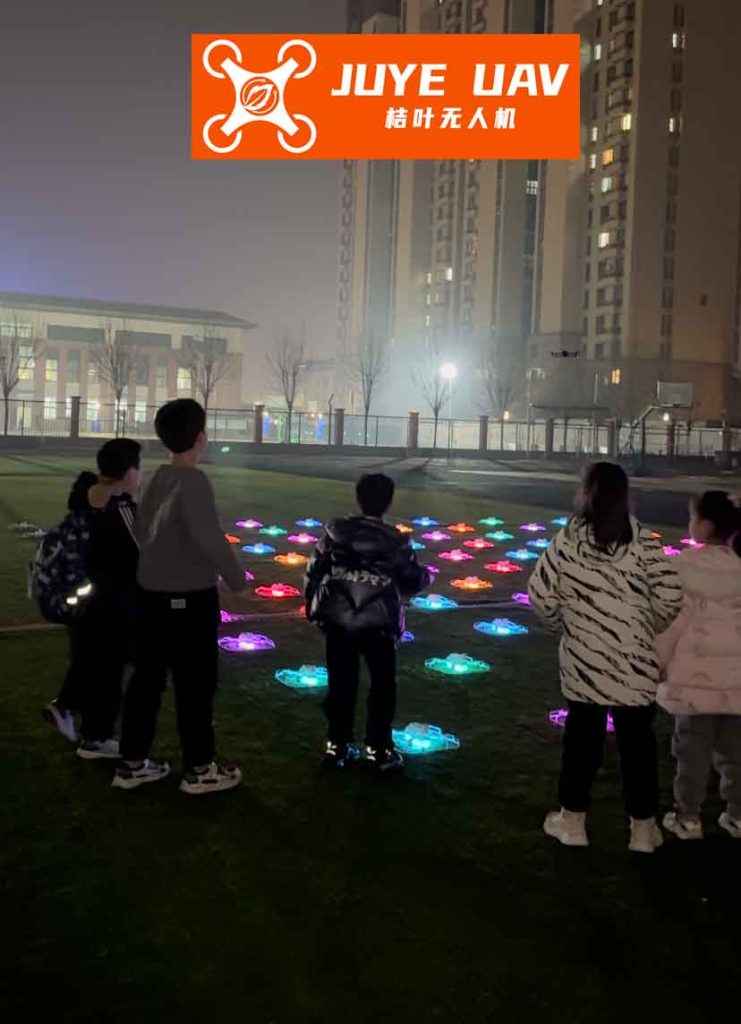
My analysis begins with the core premise: every drone in a formation drone light show is a node in a dense, mobile ad-hoc network. Its operation depends on multiple radio links, primarily for command and control (C2), high-rate telemetry/data downlink, and intra-swarm synchronization for precise positioning and lighting cues. These links compete not only internally but also with a plethora of other services sharing the same frequency bands, such as Wi-Fi, public safety radios, and other IoT devices. Static assignments cannot adapt to the rapid spatial and temporal variations in interference and demand, often causing latency spikes or link failures that disrupt the choreography. Thus, a dynamic system capable of perceiving the radio environment and intelligently accessing underutilized spectrum “holes” is essential. The goal of DSM in this context is to maximize spectrum utilization, ensure robust communication links, minimize mutual interference within the swarm and with primary users, and ultimately guarantee the flawless execution of the formation drone light show.
1. Spectrum Requirements and Challenges for Drone Formations
Managing spectrum for a formation drone light show requires a detailed understanding of its specific operational profile. The primary spectrum demands can be categorized as follows:
| System Category | Primary Function | Key Requirements | Typical Frequency Bands (Examples) |
|---|---|---|---|
| Command & Control (C2) | Uplink for flight commands, safety directives. | High reliability, low latency, moderate data rate. | 900 MHz, 2.4 GHz, 5.8 GHz (ISM), UHF bands. |
| Telemetry & Payload Data | Downlink for status, GPS data, and show choreography updates. | High data rate, moderate reliability. | 2.4 GHz, 5.8 GHz, potential use of white space TV bands. |
| Intra-Formation Sync | Precise timing, relative positioning, and light cue coordination. | Ultra-low latency, extremely high reliability, tight synchronization. | 2.4 GHz (e.g., TimeSlotted Channel Hopping), 5.8 GHz. |
| Supporting Sensors | Collision avoidance, redundant navigation (if equipped). | Low latency, high availability. | 77 GHz (radar), 5.8 GHz (vision-based). |
The central challenge is that these systems must operate reliably in license-free or shared bands (like the 2.4 and 5.8 GHz ISM bands), which are often saturated. A formation drone light show in an urban environment faces interference from countless Wi-Fi access points, Bluetooth devices, and other wireless networks. A static frequency plan is vulnerable to this unpredictable noise floor. Therefore, the system must be cognitive, capable of spectrum sensing to identify temporary “spectrum holes”—unused frequencies in time and space—and then dynamically access them. This cognitive cycle forms the bedrock of an effective DSM system for a reliable formation drone light show.
2. Architecture of a Dynamic Spectrum Management System
Based on my research and practical considerations, a viable DSM architecture for a formation drone light show must be distributed, intelligent, and cross-layer by design. The traditional OSI layered model introduces too much latency and siloed information for rapid adaptation. A cross-layer design, where the physical (PHY), medium access control (MAC), and network layers share critical parameters, is far more effective.
2.1 Cross-Layer Management Framework
In this framework, decisions are made based on fused information from multiple layers. For instance, the PHY layer’s spectrum sensing results are passed directly to a central Spectrum Resource Manager (SRM) agent, which also receives queue states from the MAC layer and routing metrics from the network layer. This SRM can then make holistic decisions, such as instructing a sub-group of drones in the formation drone light show to switch to a new channel and simultaneously informing the network layer to adjust routing paths. The cross-layer interaction can be modeled as an optimization problem, often aiming to maximize total throughput or minimize total interference:
$$ \text{Maximize } \sum_{i \in \mathcal{U}} R_i(\mathbf{P}, \mathbf{C}) $$
$$ \text{Subject to: } \sum_{j \in \mathcal{B}} I_{i,j}^{agg}(P_j) \leq I_{th}^{primary}, \quad \forall i \in \mathcal{P} $$
$$ \quad \quad \quad P_{min} \leq P_k \leq P_{max}, \quad \forall k \in \mathcal{U} $$
Where $\mathcal{U}$ is the set of UAVs in the formation drone light show, $\mathcal{P}$ is the set of protected primary users, $R_i$ is the data rate for UAV $i$, which is a function of the power allocation vector $\mathbf{P}$ and channel assignment matrix $\mathbf{C}$. The constraint ensures the aggregate interference $I_{i,j}^{agg}$ from all UAVs on primary user $j$ is below a threshold $I_{th}^{primary}$.
2.2 Multi-Agent System (MAS) Based Intelligence
A purely centralized SRM becomes a single point of failure and a bottleneck. Therefore, I advocate for a distributed Multi-Agent System (MAS) architecture. In this model, each drone or a logical cluster leader in the formation drone light show hosts an intelligent agent. These agents have autonomy to perform local spectrum sensing and make initial decisions, but they also collaborate through message passing to achieve a globally efficient spectrum allocation. This mirrors the self-organizing behavior of the formation drone light show itself. An agent’s utility function for choosing a channel might look like:
$$ U_i(c) = \alpha \cdot B_c – \beta \cdot \sum_{k \in \mathcal{N}_i} J_{i,k}(c) – \gamma \cdot \tau_{switch} $$
Here, $U_i(c)$ is the utility for agent (drone) $i$ on channel $c$. $B_c$ is the estimated available bandwidth, the summation term represents interference to neighboring drones $\mathcal{N}_i$ in the formation, $J_{i,k}$ is the interference function, and $\tau_{switch}$ is the predicted channel switching overhead. Agents negotiate to maximize their collective utility, leading to an emergent, robust spectrum allocation for the entire formation drone light show.
3. Core Enabling Technologies and Comparative Analysis
3.1 Spectrum Sensing Technology
Accurate and fast spectrum sensing is the eyes and ears of the DSM system. For a formation drone light show, sensing must be low-latency and cooperative to overcome the hidden node problem. The primary techniques are compared below:
| Technique | Principle | Advantages | Disadvantages for Drone Formations |
|---|---|---|---|
| Energy Detection | Compares received signal power to a noise threshold. | Simple, low complexity, no prior knowledge needed. | Poor performance in low SNR, cannot distinguish signal types. |
| Matched Filtering | Correlates received signal with a known pilot sequence. | Optimal detection SNR, fast. | Requires perfect knowledge of primary signal; impractical for diverse interferers. |
| Cyclostationary Feature Detection | Detects periodic statistics (like carrier frequency) in modulated signals. | Robust to noise, can classify signal types. | Computationally complex, longer sensing time. |
| Cooperative Sensing (Distributed) | Multiple drones share local sensing data via a fusion rule (AND, OR, Majority). | Mitigates fading/shadowing, greatly improves detection reliability. | Introduces communication overhead and fusion delay. |
For a dynamic formation drone light show, a hybrid approach is often best. Fast energy detection can be used for initial scanning, while cooperative sensing with a simplified “voting” mechanism among neighboring drones provides the necessary reliability. The probability of detection $P_d$ and probability of false alarm $P_{fa}$ for a cooperative cluster using an OR-rule are key metrics:
$$ P_d^{coop} = 1 – \prod_{i=1}^{N} (1 – P_{d,i}) $$
$$ P_{fa}^{coop} = 1 – \prod_{i=1}^{N} (1 – P_{fa,i}) $$
Where $N$ is the number of cooperating drones in a segment of the formation drone light show.
3.2 Spectrum Allocation and Access Strategies
Once spectrum holes are identified, they must be allocated efficiently among the competing drones in the formation drone light show. This is a combinatorial optimization problem. The following table summarizes the main algorithmic approaches:
| Algorithmic Approach | Key Mechanism | Suitability for Drone Formations |
|---|---|---|
| Graph Coloring | Models interference as a conflict graph; adjacent nodes get different “colors” (channels). | Good for static interference maps. Less adaptable to rapid topology changes in a moving show. |
| Game Theory (Non-cooperative) | Each drone selfishly selects channel/power to maximize its own utility, converging to a Nash Equilibrium. | Distributed, low overhead. Equilibrium may be inefficient; requires careful utility design. |
| Game Theory (Cooperative/Bargaining) | Drones form coalitions or bargain to achieve a fair and Pareto-optimal allocation. | Promotes fairness and global efficiency. Higher communication complexity for negotiation. |
| Heuristic Methods (Genetic Algorithm, Auction) | Evolutionary search or virtual currency auction to find near-optimal solutions. | Can handle complex, nonlinear constraints. Computation time may be high for real-time adaptation. |
The choice of access model is equally crucial. The Overlay (opportunistic) model, where drones only transmit in idle bands, is most appropriate and legally compliant for a formation drone light show operating in shared spectrum. It requires highly reliable spectrum sensing to avoid interfering with primary users.
3.3 Joint Power Control and Spectrum Allocation
Power control is not an isolated function; it must be jointly optimized with spectrum allocation. Transmitting at full power is wasteful and causes excessive interference. The classic Water-Filling principle provides a foundational insight for power allocation across channels:
$$ P_k = \left( \mu – \frac{N_0}{|h_k|^2} \right)^+ $$
where $P_k$ is the power allocated to sub-channel $k$, $\mu$ is a “water level” determined by total power budget, $N_0$ is noise power, and $h_k$ is the channel gain. The operator $(x)^+$ denotes $\max(0, x)$. This allocates more power to better channels. In a distributed formation drone light show context, this translates to iterative algorithms where each drone adjusts its power based on interference feedback from neighbors. A common distributed power update rule is:
$$ P_i^{(t+1)} = \min \left( P_{max}, \frac{\gamma_{target}}{G_{ii}} \left( \sum_{j \neq i} G_{ij} P_j^{(t)} + \sigma^2 \right) \right) $$
Here, $P_i$ is the power of drone $i$, $\gamma_{target}$ is the desired Signal-to-Interference-plus-Noise Ratio (SINR), $G_{ii}$ is its channel gain, $G_{ij}$ is the interference gain from drone $j$ to $i$’s receiver, and $\sigma^2$ is noise variance. This iterative process, when combined with channel selection, allows the formation drone light show to autonomously find a stable operating point.
4. Implementation Challenges and Future Directions
While the theoretical framework is promising, deploying a robust DSM system for a large-scale formation drone light show presents significant practical hurdles that define my current research focus.
Key Challenges:
- Real-time Constraint: The entire cognitive cycle—sensing, decision, handover—must occur within tens of milliseconds to avoid disrupting the choreography of the formation drone light show.
- Sensing Accuracy vs. Speed Trade-off: Improving detection reliability ($P_d$) typically requires longer sensing times, which directly conflicts with the real-time constraint.
- Hidden and Exposed Node Problems: In a dense, mobile 3D formation, these classic wireless network issues are exacerbated, complicating both sensing and allocation.
- Coordination Overhead: The messaging required for cooperative sensing and distributed allocation consumes the very spectrum resource it aims to optimize.
- Regulatory Compliance: Ensuring the system never violates interference limits for protected users in a provable manner is critical for licensing and safety.
Future Research Trajectories:
- Machine Learning (ML) Integration: I am particularly interested in replacing traditional sensing and allocation algorithms with ML models. Reinforcement Learning (RL) agents on each drone can learn optimal spectrum access policies through interaction with the environment, potentially outperforming pre-defined algorithms. A deep Q-network could learn a policy $\pi(s)$ mapping state $s$ (channel observations, neighbor info) to action $a$ (channel/power selection) to maximize the long-term reward for the formation drone light show.
- Predictive Spectrum Mobility: Instead of reactive handovers, using time-series prediction (e.g., LSTM networks) to forecast channel occupancy, allowing the formation drone light show to proactively switch to channels that will be free longer.
- Cross-Layer Optimization with Physical Layer Security: Integrating security as a first-class constraint into the DSM framework to prevent jamming or spoofing attacks on the formation drone light show.
- Standardization of Protocols: Developing lightweight, open protocols for information exchange between agents in a heterogeneous formation drone light show ecosystem is essential for widespread adoption.
Conclusion
The evolution from static to dynamic spectrum management is the critical enabler for the next generation of sophisticated aerial applications, most visibly in the complex coordination required for a flawless formation drone light show. My analysis underscores that success depends on a holistic system view, integrating fast and cooperative spectrum sensing, intelligent and distributed allocation algorithms, and joint power control within a cross-layer, agent-based architecture. The challenges in real-time operation, overhead, and robustness are substantial, but they are being addressed through advancements in machine learning and predictive analytics. As research continues to bridge the gap between theory and practice, dynamic spectrum management will cease to be a luxury and become the standard foundation for reliable, scalable, and interference-resilient formation drone light show operations, unlocking their full potential for entertainment, commercial, and beyond-visual-line-of-sight missions.