
As I reflect on the evolution of agriculture, it is clear that farming has always been a cornerstone of the global economy and a critical domain for ensuring food security and rural revitalization. With advancements in technology and societal development, agricultural production models are continuously transforming. The convergence of traditional and modern farming practices has become a driving force in advancing agricultural modernization. In this context, agricultural drone technology has emerged as a high-tech equipment solution, revolutionizing plant protection and crop management. Over recent years, agricultural drones have gained prominence due to their precision in chemical application, water and pesticide savings, and time- and labor-efficient operations. These devices have effectively addressed long-standing challenges in agricultural pest control, such as the difficulty of spraying in hard-to-reach areas, thereby promoting large-scale production and mechanized development. From my perspective, the adoption of agricultural drones represents a significant leap forward, but it also comes with hurdles that need to be overcome for sustainable implementation. In this article, I will explore the application advantages, existing shortcomings, optimization measures, and future directions of agricultural drones in farming, incorporating tables and formulas to summarize key points and enhance understanding.
To begin, let me define what an agricultural drone is. Also known as an unmanned aerial vehicle (UAV) for agriculture, an agricultural drone is a specialized flying device designed for tasks in farming, forestry, and plant protection. It can be operated remotely to perform missions such as spraying pesticides, applying fertilizers, and monitoring crop health, thereby effectively controlling pests and diseases that threaten plants. Currently, drones are utilized in various agricultural applications, including precision spraying, remote sensing, seeding, and yield prediction. Compared to traditional methods, agricultural drones offer characteristics like precision, efficiency, environmental friendliness, ease of operation, automation, and intelligence. These features significantly boost agricultural productivity, safeguard food supplies, and drive the modernization process. In my experience, the versatility of agricultural drones makes them indispensable tools in contemporary farming, as they can adapt to diverse terrains and cropping systems.
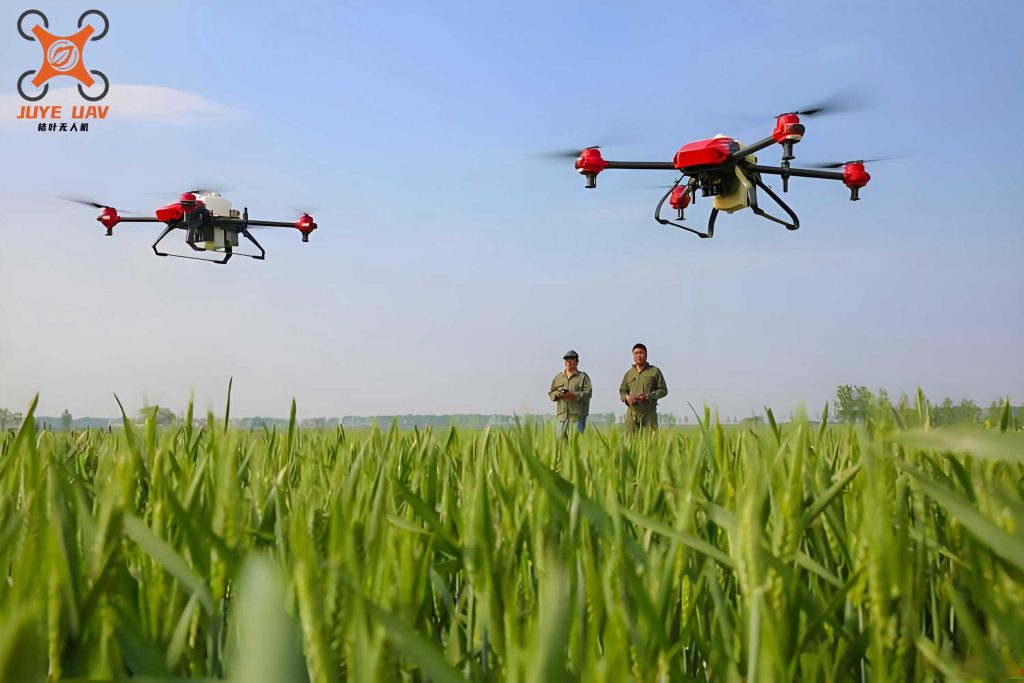
One of the most compelling aspects of agricultural drones is their array of application advantages. Firstly, they enable precise chemical application with superior effectiveness. Agricultural drones employ fine droplet spraying technology, where droplet diameters are on the micrometer scale. This high atomization of pesticides, herbicides, and other agrochemicals ensures that the mist penetrates crop canopies effectively. The downwash airflow generated by the drone’s rotors pushes the droplets downward, agitating and摇晃 crops so that the雾化药液 reaches the undersides of leaves and roots, maximizing contact and adhesion. This level of coverage is unattainable with traditional sprayers. Moreover, since drones operate above the crops, they minimize damage to plants and soil. For instance, in my observations, drone-sprayed fields often show more uniform pest control and reduced crop stress compared to manual methods.
Secondly, agricultural drones excel in water and pesticide conservation. They are equipped with high-speed centrifugal nozzles that can rotate up to 10,000 rpm, producing droplets as small as 100 μm. This reduces the amount of water required per unit area significantly. Research indicates that traditional spraying methods result in only about 20% of pesticides adhering to crop surfaces, leading to substantial waste. In contrast, agricultural drones can achieve the same or better control efficacy while saving approximately 30% of pesticides and 90% of water, thanks to their targeted application and avoidance of overlap or misses. To quantify this, consider the efficiency formula for pesticide utilization: $$E_u = \frac{A_d}{A_t} \times 100\%$$ where \(E_u\) is the utilization efficiency, \(A_d\) is the amount of pesticide deposited on crops, and \(A_t\) is the total amount applied. With drones, \(E_u\) can increase dramatically, reducing environmental runoff and contamination.
Thirdly, agricultural drones save time and labor while enhancing operational efficiency. They utilize autonomous navigation systems like GPS and RTK (Real-Time Kinematic) for automated takeoff, landing, and route planning. A single agricultural drone can cover up to 12 hectares per hour, which is about 30 times faster than conventional manual spraying. This efficiency is particularly beneficial for large-scale operations, such as weed control in seed fields or pest outbreaks over extensive areas. Additionally, drones are lightweight, mobile, and have low terrain requirements, allowing them to operate in plains, hills, mountains, and plateaus. Their ability to avoid obstacles and maintain altitude锁定 ensures safety and adaptability. In my work, I have seen drones complete spraying tasks in hilly regions within hours, whereas manual efforts would take days, enabling timely interventions that protect crop yields.
Lastly, agricultural drones offer enhanced safety and environmental benefits. Operators control them remotely via transmitters, eliminating direct exposure to hazardous chemicals and reducing poisoning risks. This is crucial when dealing with highly toxic pesticides. Furthermore, drone spraying minimizes pesticide residues and non-point source pollution, contributing to ecological conservation. Many agricultural drones also feature multifunctional systems, allowing them to switch between spraying, seeding, fertilizing, and even feed distribution, maximizing their utility across farming seasons. As I advocate for sustainable practices, I find that agricultural drones align well with green farming goals by promoting精准农业 principles.
To summarize these advantages, I have compiled a table comparing traditional plant protection methods with agricultural drone applications:
| Aspect | Traditional Methods | Agricultural Drone |
|---|---|---|
| Precision | Low; uneven coverage | High; uniform droplet distribution |
| Water Usage | High; up to 100 L/ha | Low; about 10 L/ha |
| Pesticide Savings | Minimal; high waste | Up to 30% reduction |
| Labor Efficiency | Slow; 0.4 ha/hour per person | Fast; 12 ha/hour per drone |
| Terrain Adaptability | Limited; difficult in slopes | High; works in diverse landscapes |
| Safety | Risky; operator exposure | Safe; remote operation |
| Environmental Impact | High pollution potential | Low; reduced runoff |
Despite these strengths, the adoption of agricultural drones faces several shortcomings. One major issue is the lack of operator proficiency among farmers in some regions. Operating an agricultural drone requires specialized training and certification, as well as knowledge of pest identification and pesticide selection. In areas where farmers have limited education or technical skills, this can lead to inefficient use, frequent malfunctions, and accidents. From my interactions, I have noticed that inadequate training often results in suboptimal spraying patterns or even drone crashes, undermining the technology’s potential.
Another challenge is the high maintenance cost and sparse after-sales service networks. Agricultural drones are sophisticated devices with expensive components. When repairs are needed, parts may be costly and hard to source locally, requiring shipments from manufacturers or返厂维修. This not only increases downtime but also adds to the overall cost of ownership. In remote farming communities, the absence of nearby service centers can delay critical operations, affecting crop timeliness. For example, a broken propeller or battery issue might halt spraying during a pest outbreak, causing yield losses.
Furthermore, the high upfront cost of agricultural drones and the proliferation of brands pose barriers. A typical agricultural drone can cost around $10,000, plus additional expenses for batteries and charging equipment. This is prohibitive for small-scale farmers with limited purchasing power. The market is flooded with hundreds of manufacturers and thousands of models, leading to variability in quality, reliability, and performance. Some drones may lack durability or advanced features, reducing their practical value. As I analyze this, I realize that without standardization, farmers may struggle to choose suitable models, risking investments in subpar technology.
Technical研发滞后 also limits the application value of agricultural drones. There is a scarcity of dedicated R&D units and researchers focused on drone technology, resulting in slower innovations. Issues like short battery life, long charging times, susceptibility to wind drift (which can cause off-target pesticide damage), and inadequate crash resistance persist. These factors elevate the risk of accidents and diminish efficiency. For instance, battery续航 is a common constraint; most drones operate for only 10-15 minutes per charge, requiring 20-30 minutes to recharge, which interrupts continuous fieldwork. A formula to illustrate this limitation is the operational efficiency ratio: $$R_{oe} = \frac{T_{flight}}{T_{flight} + T_{charge}}$$ where \(T_{flight}\) is flight time and \(T_{charge}\) is charging time. With current technology, \(R_{oe}\) often falls below 0.5, indicating room for improvement.
Lastly,配套服务体系 remains underdeveloped, slowing widespread推广. In many areas, there is a lack of organized support structures, standardized protocols, and comprehensive training programs. After purchasing an agricultural drone, farmers may receive minimal instruction, focusing on theory rather than hands-on practice. This gap hinders effective utilization and maintenance. From my perspective, without robust售后 systems, the benefits of agricultural drones cannot be fully realized, as users may abandon the technology due to frustration or lack of support.
To address these shortcomings, I propose several optimization measures. First,完善配套服务体系 is essential. Strengthening coordination between agrochemical suppliers and drone companies can leverage existing distribution channels to promote drone sales. Establishing after-sales service points in key agricultural zones will ensure timely repairs and support. Drone manufacturers should enhance service quality and brand推广, making agricultural drones more accessible and user-friendly. In my recommendations, I emphasize that a reliable network can build farmer trust and encourage adoption.
Second,加大政策扶持力度 through government interventions can lower barriers. Policymakers should introduce subsidies, tax incentives, and regulatory frameworks that support agricultural drone adoption. For example, integrating drones into农机购置补贴 programs can reduce purchase costs. A formula for subsidy impact could be: $$S_{eff} = \frac{C_{base} – C_{sub}}{C_{base}} \times 100\%$$ where \(S_{eff}\) is the subsidy effectiveness, \(C_{base}\) is the base cost, and \(C_{sub}\) is the subsidized cost. Higher \(S_{eff}\) values indicate greater affordability, potentially boosting uptake among farmers.
Third,强化人才技能培训 is crucial for building operator competence. Authorities and companies should organize regular training sessions on drone operation, maintenance, and agronomic knowledge. Manufacturers can provide detailed manuals and on-site technical support to foster复合型技术人才. By ensuring operators are well-versed in both飞行技巧 and crop management, we can minimize errors and extend drone lifespan. In my experience, practical, hands-on workshops yield better results than theoretical lessons alone.
Fourth,加强社会服务推广 can increase awareness and demand. Governments or dealers can form agricultural drone service teams to offer contracting services during peak seasons. Demonstrations and pilot projects in farming communities can showcase drone capabilities, helping farmers understand their benefits. This grassroots approach can stimulate market growth. As I advocate, seeing drones in action often convinces skeptics of their value, leading to increased adoption.
Fifth,提升无人机产品性能 through R&D is vital. Engineers should focus on improving battery technology for longer flight times, enhancing wind resistance to reduce drift, and developing smarter sensors for environment analysis. Innovations in materials can make drones more durable and lightweight. For example, optimizing the spraying system for variable rates can be modeled with: $$Q_{spray} = k \times \sqrt{P}$$ where \(Q_{spray}\) is the spray flow rate, \(k\) is a constant, and \(P\) is the pressure. Advances in nozzle design can fine-tune this for better precision.
Looking ahead, the future of agricultural drones lies in three directions: system化发展,智能化发展, and高性能发展. Systematically, we need to integrate drones into holistic agricultural management systems. This involves not only improving drone hardware but also developing supporting software, insurance products, and维修 markets. By creating an ecosystem, we can mitigate adoption risks and ensure稳定发展态势. From my vision, agricultural drones should be part of a larger智慧农业 framework, where data from drones feeds into farm management databases for informed decision-making.
Intelligently, agricultural drones must evolve towards greater autonomy and smart functionality. This includes AI-driven features for automatic terrain adaptation, real-time pest detection, and adaptive spraying based on crop conditions. Building intelligent production management systems will allow drones to operate seamlessly within automated farming cycles. For instance, machine learning algorithms can optimize flight paths using data from previous missions, maximizing efficiency. A predictive model for pest outbreaks could be: $$P_{risk} = f(C, W, H)$$ where \(P_{risk}\) is pest risk, and \(C, W, H\) are crop, weather, and historical data variables.
High-performance development will address current limitations in durability,续航, and accuracy. Research into better batteries, such as solid-state or hydrogen fuel cells, could extend flight times to hours. Enhanced stabilization systems can combat wind effects, while advanced materials can improve crash resilience. As I foresee, next-generation agricultural drones will be more robust and versatile, capable of handling diverse farming tasks with minimal human intervention.
In conclusion, agricultural drones represent a transformative force in modern farming, offering solutions to increase production, reduce costs, and promote sustainability. They have the potential to reshape agricultural practices by enabling precision, efficiency, and environmental stewardship. However, realizing this potential requires addressing challenges through collaborative efforts in policy, training, service, and innovation. As I reflect on the journey ahead, I am optimistic that with continued advancements and widespread adoption, agricultural drones will play a pivotal role in achieving food security and agricultural现代化, driving the industry towards a more productive and resilient future. The integration of technologies like agricultural drones is not just an option but a necessity for feeding our growing population while preserving our planet.