
From my perspective as someone deeply involved in the evolution of emergency response technology, the integration of advanced unmanned aerial systems into firefighting represents a paradigm shift. The fire drone, equipped with sophisticated wireless remote control systems, is no longer a futuristic concept but a critical tool on the front lines. The maturity of this technology, driven by advances in automatic control, communications, and computer science, has fundamentally expanded our operational capabilities. In the demanding realm of fire and rescue, the primary mission is always clear: enhance efficiency and maximize safety. The fire drone serves this mission by providing unparalleled situational awareness, conducting reconnaissance in hostile environments, and even delivering initial fire suppression. This article explores the multifaceted application of wireless remote-controlled drones—specifically fire drones—in fire suppression and rescue operations, analyzing their functionalities, inherent advantages, technical requirements, and concrete implementation strategies to empower fire departments in saving lives and property.
Core Functionalities and Characteristics of the Fire Drone
The operational essence of a modern fire drone lies in its integrated system: a flight control platform, real-time video transmission, and ground support systems. This integration solves the historical problem of delayed or absent aerial intelligence at emergency scenes. Remote control is typically achieved through code-division systems, where distinct pulse codes represent different command signals, allowing for precise maneuvering.
The defining characteristics of an effective fire drone are its agility and sensory reach:
- Compact and Agile: These systems are designed for portability and rapid deployment. Their small size and light weight allow responders to carry them directly into inaccessible areas. They possess exceptional maneuverability with a small turning radius, enabling flight in complex urban or natural environments largely independent of ground traffic. Their environmental tolerance is high, allowing operation in a range of temperatures and conditions where traditional aerial assets might be grounded.
- Expansive and Intelligent Field of View: Utilizing broadband and data-link technologies, the fire drone operates effectively beyond visual line of sight (BVLOS). Its onboard cameras, often equipped with thermal and night-vision capabilities, can capture high-resolution imagery and video from various altitudes and angles. This provides both a broad overview of an incident and the ability to zoom in on critical details. The intelligence layer allows for automated patrol path planning, intelligent data analysis, continuous定点 monitoring, and automatic emergency response triggering, transforming raw data into actionable intelligence.
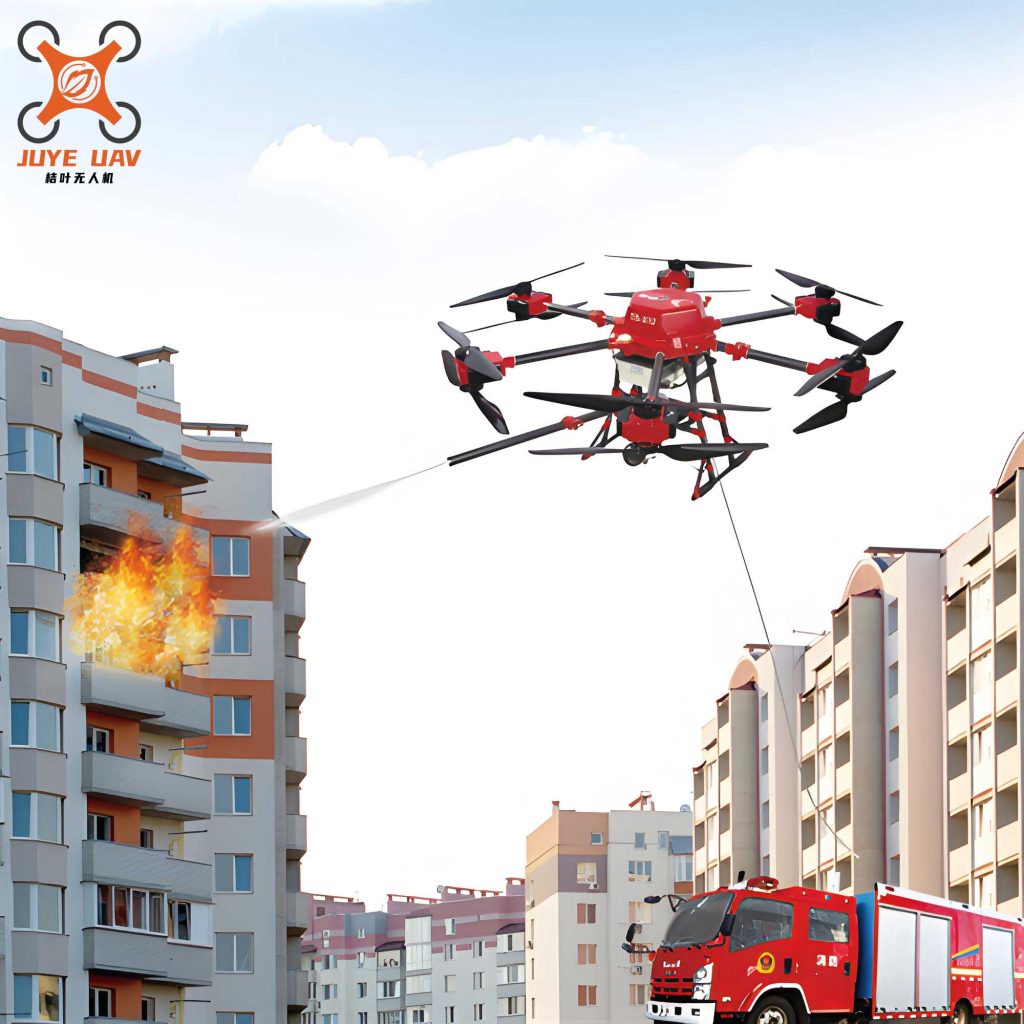
The operational advantages offered by a fire drone in critical scenarios are transformative. In incidents involving flammable, explosive, or chemical agents, the fire drone can safely ingress areas deemed too hazardous for personnel. Equipped with micro gas detectors, it can map concentrations of toxic or combustible gases, providing critical data for establishing safe approach routes and predicting fire behavior. Furthermore, the fire drone serves as a persistent aerial observation platform, monitoring the progression of a fire and the effectiveness of suppression efforts in real-time. This live feed can be integrated into command center systems for archiving, analysis, and remote access, enabling supervisors to make informed, dynamic decisions based on a comprehensive view of the evolving crisis.
| Operational Aspect | Traditional Methods | With Fire Drone |
|---|---|---|
| Initial Scene Assessment | Reliant on ground reports; slow, limited perspective. | Immediate aerial overview; rapid identification of fire seat, spread, and hazards. |
| Hazardous Environment Recon | Requires suited personnel; slow, high risk. | Remote sensing; no risk to personnel; can detect invisible gas threats. |
| Progress Monitoring | Ground-level views; often obstructed. | Unobstructed aerial view tracks fire spread and crew movements continuously. |
| Data Transmission & Coordination | Voice radio; potential for confusion. | Real-time video shared across command; enables precise, coordinated action. |
Technical Requirements for a Robust Fire Drone System
To perform reliably in the harsh and unpredictable theater of fireground operations, a fire drone must meet stringent technical specifications. These requirements ensure that the platform is not just an aircraft, but a dependable tool for first responders.
1. Enhanced Reliability and Durability: The operational envelope for a fire drone includes extreme conditions. Key durability factors include:
- Wind Resistance: The fire drone must maintain stable flight and positional accuracy in strong, turbulent winds common at emergency sites. Its design must account for aerodynamic stability. The lift force ($L$) required to counteract wind shear and maintain hover is critical and can be related to air density ($\rho$), velocity ($v$), and the platform’s reference area ($A$) through the lift coefficient $C_L$:
$$L = \frac{1}{2} \rho v^2 A C_L$$
A high $C_L$ through intelligent design allows the fire drone to operate in adverse conditions. - High-Temperature Tolerance: Components must be shielded or constructed from materials that withstand radiant heat. The propulsion system must be spark-proof and reliable to prevent failure or becoming an ignition source itself.
2. Operational Performance: Practical deployment dictates specific performance metrics. Cruising speed and range determine the area of operation, while battery life dictates on-station time. For a fire drone with an average cruise speed $v_{cruise}$ and a total available energy $E_{total}$ from its power system, the maximum effective operational radius $R_{max}$ for a hover-inspect mission is constrained by the power draw for hover $P_{hover}$ and cruise $P_{cruise}$:
$$ t_{hover} + \frac{2 R_{max}}{v_{cruise}} \leq \frac{E_{total}}{P_{avg}} $$
where $P_{avg}$ is the average power consumption. Furthermore, operational altitude must accommodate modern high-rise structures, often requiring a service ceiling above 200m.
3. Signal Stability and Anti-Interference: The core value of the fire drone is its real-time data link. The system must employ robust wireless protocols with strong anti-jamming capabilities. Signal strength $I$ at the receiver, considering free-space path loss, is inversely proportional to the square of the distance $d$ from the transmitter:
$$I \propto \frac{1}{d^2}$$
To maintain a stable link in cluttered, signal-hostile environments, the fire drone system must utilize high-gain antennas, frequency agility, and adaptive modulation to overcome this attenuation and ensure continuous video and telemetry transmission.
4. System Integration and Compatibility: A fire drone is a platform. Its utility is multiplied by its ability to carry different payloads—thermal cameras, gas sensors, loudspeakers, or delivery mechanisms. This requires a modular design with standard mechanical and electrical interfaces. Furthermore, the data it collects must be compatible with existing incident command software (e.g., GIS systems, CAD platforms), requiring adherence to common data standards and protocols for seamless workflow integration.
| Parameter Category | Typical Requirement / Specification | Importance for Fire & Rescue |
|---|---|---|
| Flight Endurance | 30 – 45 minutes (electric); 1-2+ hours (hybrid/fuel) | Determines time available for continuous reconnaissance or monitoring. |
| Wind Resistance | Beaufort Scale 5-6 (30-50 km/h winds) | Ensures stable operation during storms or in windy urban canyons. |
| Ingress Protection (IP) Rating | IP54 or higher (Dust and water resistant) | Protects electronics from water spray (from hoses, rain) and particulate matter. |
| Payload Capacity | 2 – 10 kg | Defines the range of sensors or emergency payloads (e.g., rescue buoys, fire suppressants) that can be carried. |
| Data Link Range | 5 – 10 km (BVLOS capable with authorization) | Allows operation over large incident sites like wildfires or industrial complexes. |
| Sensor Suite | Visible Light (4K), Radiometric Thermal, Gas Detector | Enables finding victims through smoke, identifying hot spots, and detecting hazardous leaks. |
Concrete Applications of the Fire Drone in Operations
The theoretical capabilities of the fire drone are realized in practical, life-saving applications. A structured approach to deployment and specific use cases defines its role on the fireground.
1. Establishing a Tiered Deployment Model: To optimize resources and response, fire departments can adopt a tiered model for fire drone assets:
- Company/Battalion Level: Deployable, man-portable electric fire drones. Their role is immediate scene assessment upon first arrival, providing the incident commander with initial intelligence.
- District/Division Level: More advanced platforms with greater endurance, higher-quality sensors, and BVLOS potential. They support larger, more complex incidents and provide sustained aerial monitoring.
- Regional/State Level: Heavy-lift, long-endurance systems (often gas/hybrid-powered). These fire drones are assets for major disasters like wildfires, capable of wide-area mapping, long-duration monitoring, and potentially deploying larger payloads.
2. Scientific Application for Disaster Reconnaissance: The fire drone revolutionizes the reconnaissance phase:
- It provides immediate access to hard-to-reach or hazardous areas, eliminating delays and risk to scouts.
- It delivers comprehensive data on fire origin, type, intensity, and spread dynamics, enabling data-driven strategy formulation.
- It acts as a force multiplier for scene safety, identifying structural weaknesses, gas leaks, or chemical hazards before crews commit.
- Equipped with integrated environmental sensors, the fire drone can create a real-time map of hazard zones, measuring parameters like temperature ($T$), gas concentration ($C_{gas}$), and wind speed ($v_{wind}$) at various waypoints ($x_i, y_i, z_i$).
3. Active Assistance in Rescue Operations: Beyond observation, the fire drone actively assists:
- Communication Relay: With integrated loudspeakers and microphones, the fire drone can broadcast instructions to trapped victims or guiding commands to crews on the ground, especially effective in high-rise scenarios.
- Emergency Communication Node: In terrain where radio signals fail (e.g., mountains, deep urban canyons), the fire drone can act as a temporary airborne repeater, restoring vital communication links.
- Rapid Emergency Mapping: Using photogrammetry, the fire drone can quickly generate 2D orthomosaics or 3D models of the disaster area. This provides command with accurate maps for planning ingress/egress routes, identifying potential collapse zones, and allocating resources efficiently.
4. Direct and Indirect Fire Suppression: This represents the cutting edge of fire drone application, where the platform transitions from an eye in the sky to an active firefighter:
- Payload Delivery: Drones can be fitted to carry and discharge fire suppression agents. For compartment fires in high-rises, a fire drone can approach a window and discharge a payload of water, foam, or dry chemical. The delivered volume, while limited, can knock down a fire to enable entry or protect an egress path.
- Integrated Suppression Systems: More advanced concepts involve drones carrying compact fire suppression grenades or specialized projectiles. The fire drone positions itself at a safe stand-off distance, and using a precision launching system, fires a projectile that penetrates a window and disperses suppressant inside the room. This addresses the “first five minutes” problem in high-rise fires before ground forces can reach the seat of the fire.
- Advanced Technology Integration: Experimental applications include acoustic fire suppression. Here, the fire drone is equipped with a directed acoustic emitter. The sound waves at specific frequencies can disrupt the combustion zone’s air pressure, effectively separating the flame from its fuel source. The sound intensity $I_s$ required decays with distance, presenting an engineering challenge: $$I_s(r) = \frac{P_{acoustic}}{4 \pi r^2}$$ where $P_{acoustic}$ is the acoustic power and $r$ is the distance to the flame. While currently limited in scale, this illustrates the innovative potential of the fire drone as a platform for novel firefighting technologies.
In conclusion, the maturation of wireless remote-controlled drone technology has bestowed the fire service with a tool of immense strategic value—the fire drone. Its advantages in reconnaissance, monitoring, assistance, and incipient attack are clear and growing. As departments continue to adopt and innovate with these systems, integrating them into standard operating procedures and training regimens, their potential to reduce risk to firefighters, improve operational outcomes, and save lives will be fully realized. The future of firefighting is intelligent, data-driven, and increasingly aerial, with the fire drone playing a central role in this transformative era.