
The integration of military UAVs into contemporary warfare represents more than a tactical evolution; it signifies a profound transformation in the very phenomenology of war—in how action is executed, memory is formed, and reality is mediated. Warfare is no longer merely represented by communication; it is increasingly enacted through communicative, operational circuits. Traditional media studies, however, have often approached the military UAV through a lens of ocularcentrism, framing its essence within the paradigm of the cinematic screen and the disembodied, controlling “gaze.” This perspective, while insightful, creates a critical blind spot: it obscures the apparatus’s primary function as a tool for action and the vital, embodied role of the human operator within its feedback loops. To move beyond the gaze is to engage with the gesture—the purposeful, embodied motion that unifies perception and action. This analysis, from a first-person perspective, delves into the phenomenology of the military UAV interface, arguing that the core relationship is not one of passive surveillance but of active, distributed operation. Through this operational gesture, the body is reconfigured, vision is resituated within a sensorimotor whole, and a new type of subject—a distributed subject—emerges across multiple spaces.
The dominant discourse, inherited from visual culture studies, has metaphorically cast the military UAV as a modern Gorgon, whose power emanates from a panoptic, disembodied stare. This framework reduces the complex human-machine assemblage to a simplistic “seeing/being-seen” dyad, where power flows unidirectionally from an invisible observer to a terrorized subject. Analyses focus on the visual rhetoric of drone footage, the societal anesthesia induced by monotonous aerial views, and the imperialistic dynamics of remote observation. The cinematic apparatus, with its fixed spectator and linear narrative, serves as the implicit model. This is a legacy of what can be called the “Great Separation” of the senses, a historical process where vision was artificially isolated and elevated by media technologies like print and film that could easily inscribe and replicate two-dimensional surfaces. Touch and kinesthesia, more resistant to such inscription, were relegated to the background. Consequently, “vision” in theory became synonymous with a detached, interpretive, and often ideological mode of apprehending the world as image or text. Applying this model to the military UAV is to mistake one component of its being for its totality. It prioritizes the product (the image-as-text) over the process (the image-as-interface), and the symbolic power of seeing over the physical efficacy of doing.
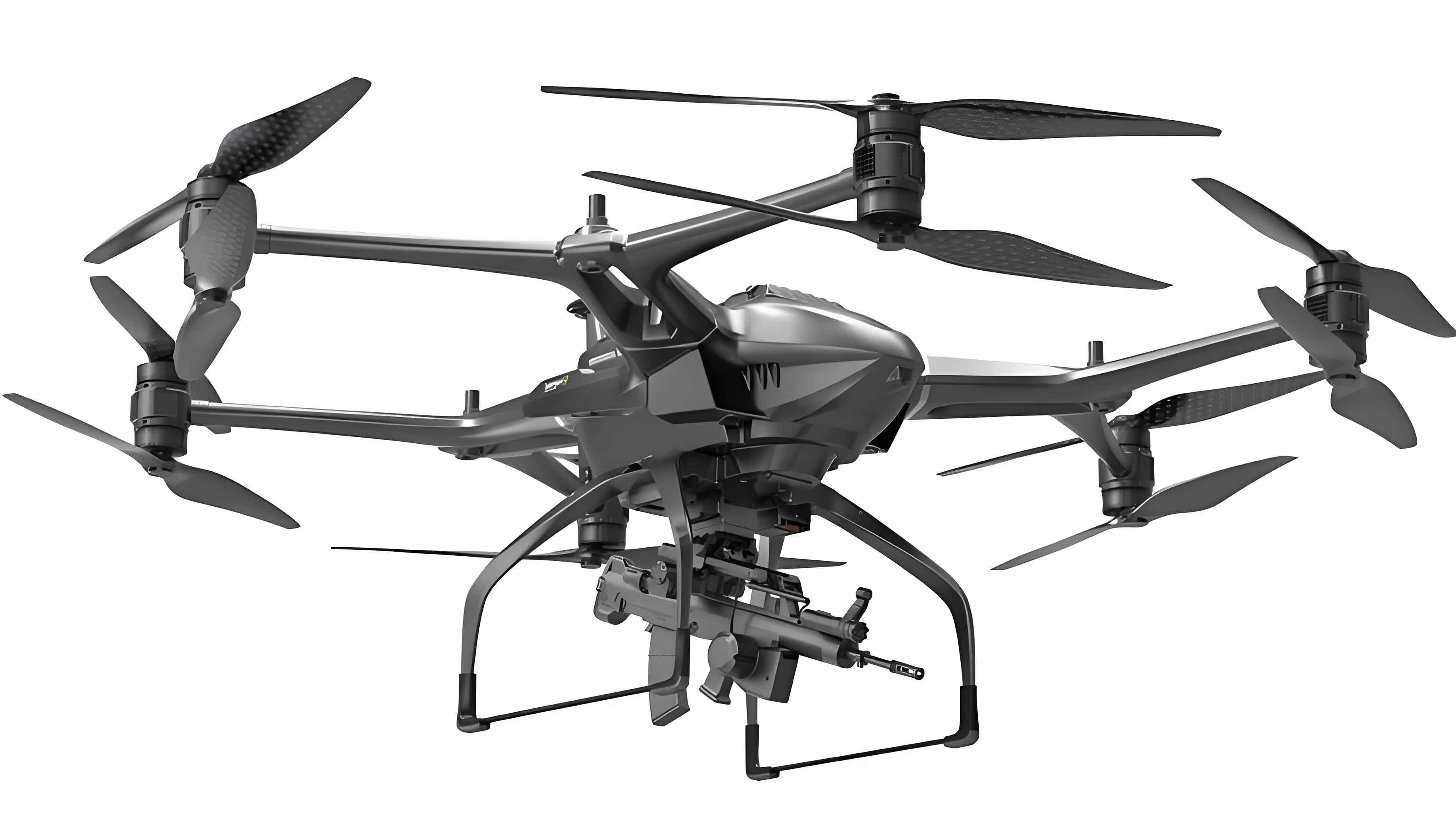
To understand the military UAV as an operational apparatus, we must first retrace its technical genealogy not as a camera, but as a *gestural tool*. Its development reveals a synthesis of distinct bodily prostheses:
| Era | Primary Function | Bodily Prosthesis | Image Role | Temporal Mode |
|---|---|---|---|---|
| Early 20th Century (e.g., Aerial Torpedo) | Strike | Arm (ballistic extension) | None | Action without real-time feedback. |
| Mid-20th Century (e.g., Firebee in Vietnam) | Reconnaissance | Eye (photographic) | Inscriptive Text (film to be developed and interpreted). | Delayed, hermeneutic. Action and perception are separate phases. |
| Late 20th Century – Present (e.g., MQ-1 Predator & beyond) | ISR (Intelligence, Surveillance, Reconnaissance) & Strike | Synergistic Sensorimotor System (eye-hand fusion). | Operational Surface (real-time video for targeting). | Real-time, cybernetic. Perception and action are fused in a feedback loop. |
The pivotal shift occurred with the advent of real-time video transmission. This transformed the image from an archival, hermeneutic *text* that required decoding (e.g., analyzing film strips to deduce coordinates) into a fluid, transparent *surface* for direct action. The “kill chain” conceptualized in military theory is, phenomenologically, a cybernetic feedback loop centered on the operator’s gestural intent. This loop can be modeled as a closed system where the operator’s body is an integral component:
$$
\begin{aligned}
\text{Intent} & \rightarrow \text{Operator’s Gesture (at GCS)} \\
& \rightarrow \text{Control Signal} \\
& \rightarrow \text{UAV Actuation} \\
& \rightarrow \text{Environmental Change/Sensor Data} \\
& \rightarrow \text{Visual/Aural Feedback (on Interface)} \\
& \rightarrow \text{Perceptual Adjustment} \\
& \rightarrow \text{Revised Intent} \quad (\text{loop closes})
\end{aligned}
$$
In this model, the operator does not sit *outside* the loop, gazing in. The operator’s embodied consciousness is the loop’s guiding node, constantly processing feedback and issuing micro-corrections through gesture. The Ground Control Station (GCS) is the critical portal where this cybernetic circuit becomes lived, embodied experience. Its design evolution—from complex arrays of physical switches mimicking fighter jet cockpits to streamlined, game-inspired portable stations with touchscreens and handheld controllers—reveals a relentless drive to optimize the *transparency* of the interface. The ideal is not to present the operator with a complex instrument to read, but to create a tool that vanishes into the body schema, much like a blind person’s cane becomes an extension of their tactile perception.
The quintessential gesture of the military UAV interface is **aiming**. This is fundamentally different from the cinematic “framing” or the surveillant “staring.” Aiming is a goal-directed, tactile-kinaesthetic gesture projected through a visual medium. The Head-Up Display (HUD) symbology—the crosshair, altitude, distance—is not data to be interpreted so much as a direct affordance for action. The operator’s task is to make the crosshair and the target coincide. This gestural synchronization is key. The mapping between the operator’s hand movements on the controller and the resulting movement in the video feed is designed for intuitive, embodied correspondence:
| Controller Input (e.g., Right Stick) | UAV/ Camera Response | Embodied Kinesthesia (Projected) |
|---|---|---|
| Push Forward | Vehicle moves forward / Camera tilts down | Sensation of leaning or moving forward. |
| Pull Back | Vehicle moves backward / Camera tilts up | Sensation of leaning or stepping back. |
| Move Left/Right | Vehicle/camera pans left/right | Sensation of turning one’s head or torso. |
Through sustained practice, this mapping ceases to be a conscious calculation. The controller disappears from thematic awareness, and the operator experiences a form of **telepresence**: a feeling of “being there” and acting directly in the remote environment. This is an embodiment relation of the form (I-Technology) -> World. The UAV’s camera becomes my eye; its propulsion system becomes my capacity for movement. My consciousness and agency are distributed across the networked system. I am *here* in the seat, and *there* in the airspace, simultaneously. This distributed subjectivity is the hallmark of operating the military UAV.
This operational paradigm enacts a radical **reunification and re-hierarchization of the senses**. Within the gestural loop, vision is subordinated to, and integrated with, touch and kinaesthesia. I do not “see” the target in the detached, contemplative sense. I see it *as* the object of my imminent operational gesture—to track, to mark, to strike. The image on the screen is not a representation to be decoded; it is a field of tactile affordances. This is what differentiates the phenomenology of the operational image from the cinematic one. In the cinema, my body may react (flinching, crying), but it is essentially passive, its kinaesthetic system tricked by editorial montage into feeling movement. In the military UAV interface, my body is the source of movement. The image moves *because* and *as* I move. Vision is no longer a sovereign, distant sense but has become “haptic,” a modality of touch-at-a-distance.
This has profound implications for the human-image-world relationship. The operational image is non-hermeneutic and non-inscriptive. It exists primarily in the present tense of the feedback loop. Its “meaning” is not in what it signifies, but in what it enables one to *do* in the very next moment. The complex, hermeneutic work—the translation of visual data into targeting solutions, the calculation of ballistics—is not absent. Rather, it is pushed into the “background,” automated by the apparatus’s software black box. The interface presents a simplified, gesturally transparent world-surface. The operator interacts with this surface, not with the lines of code that generate it. This creates a powerful, and potentially dangerous, illusion of immediacy and simplicity. The world is rendered as a series of actionable icons, and the other human within it is reduced to a “bare life” target, stripped of symbolic complexity and open to the ultimate tactile gesture: annihilation.
The shift from gazing at images to operating through them, as exemplified by the military UAV, marks a significant reconfiguration of human perception within technological systems. It demonstrates that the history of media is not a linear progression towards greater visual immersion, but a series of renegotiations between the senses. The operational gesture de-thrones the abstract, interpretive eye and re-centers the synesthetic, acting body—even as that body is stretched, distributed, and disciplined by the apparatus it operates. The ethical and philosophical challenges posed by the military UAV, therefore, lie not merely in the violence it delivers, but in the specific form of embodiment it cultivates: one where the world and the other appear primarily as objects for transparent, seamless operation, while the mediating complexities of technology and interpretation recede into an invisible, and thus uninterrogatable, background. The future of human-technology relations may well be written in the logic of this operative gesture.