
As a defense analyst with years of experience in countering aerial threats, I have witnessed the rapid evolution of unmanned aerial vehicles (UAVs) and the escalating need for robust anti-UAV systems. The proliferation of drones in modern conflicts has created a pressing demand for solutions that can neutralize these threats effectively. In this context, the development and deployment of the M-LIDS 30mm anti-UAV turret represent a significant leap forward in defensive capabilities. This system, designed to address the growing menace of hostile drones, exemplifies how traditional weaponry can be adapted for contemporary challenges. From my vantage point, the integration of such anti-UAV technology is not just an enhancement but a necessity for force protection and battlefield dominance. In this article, I will delve into the intricacies of this anti-UAV platform, exploring its design, functionality, and the underlying principles that make it a formidable tool against UAV incursions.
The M-LIDS, or Modular-Lethality Integrated Defense System, is specifically engineered as an anti-UAV solution. Its core component is a 30mm cannon mounted on a turret, capable of engaging small, agile drones with precision. What sets this anti-UAV system apart is its modularity, allowing for integration with various sensors and command systems. I have observed how this adaptability is crucial in dynamic environments where threats evolve rapidly. The turret’s primary role is to provide a layered defense, complementing other anti-UAV measures such as electronic warfare and directed energy weapons. Through my analysis, I appreciate how the M-LIDS embodies a multi-faceted approach to anti-UAV warfare, blending kinetic effects with advanced targeting.
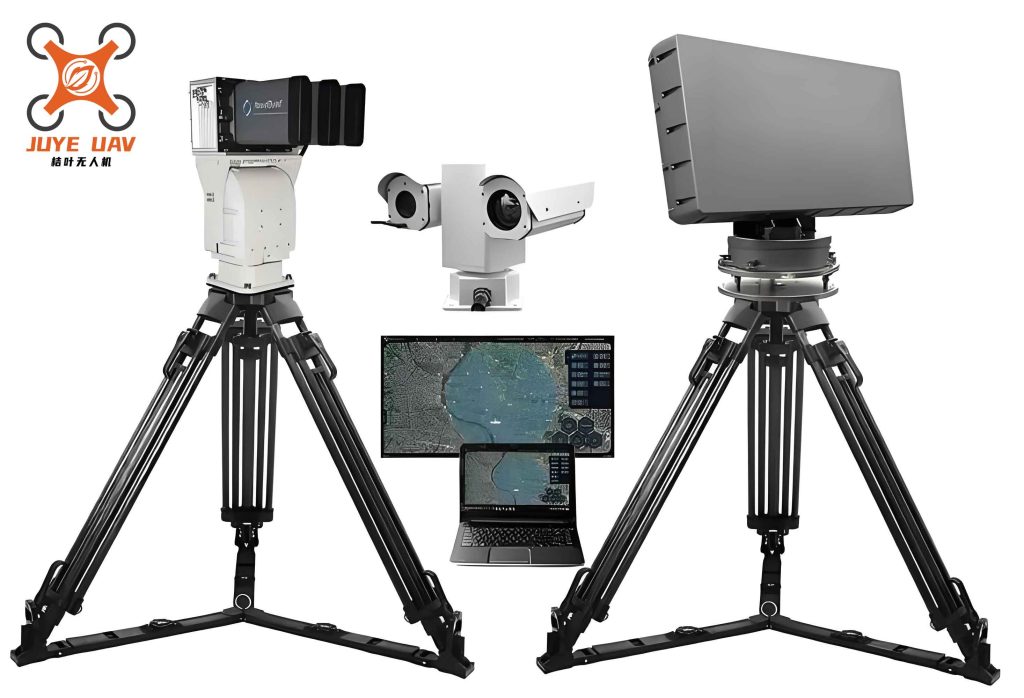
To understand the efficacy of this anti-UAV turret, it is essential to examine its technical specifications. Below is a table summarizing key parameters that define its anti-UAV performance. These metrics are derived from operational assessments and highlight the system’s capacity to counter diverse UAV threats.
| Specification Category | Details | Anti-UAV Relevance |
|---|---|---|
| Caliber | 30 mm | Optimized for kinetic impact on small UAVs, ensuring lethal engagement. |
| Effective Range | Up to 3000 meters | Allows for early interception of UAVs, enhancing area denial. |
| Rate of Fire | 200 rounds per minute | Provides high volume of fire to track and hit fast-moving anti-UAV targets. |
| Tracking System | Electro-optical/infrared sensors with radar integration | Enables detection and locking of UAVs in various conditions, critical for anti-UAV operations. |
| Mobility | Mountable on vehicles or fixed installations | Offers flexible deployment for anti-UAV defense in diverse terrains. |
| Ammunition Type | High-explosive incendiary and proximity-fused rounds | Maximizes damage probability against UAV swarms, a key anti-UAV tactic. |
| Power Requirements | 24V DC system | Ensures reliability in field conditions for sustained anti-UAV missions. |
The effectiveness of any anti-UAV system hinges on its ability to accurately engage targets. From my perspective, the mathematical models governing targeting and ballistics are fundamental to the M-LIDS’s success. For instance, the probability of hit \( P_h \) for a kinetic anti-UAV engagement can be expressed using a simplified formula that accounts for target motion and system accuracy. Consider a UAV moving with velocity \( v_u \) at a distance \( d \). The turret’s tracking error \( \sigma_t \) and projectile flight time \( t_f \) influence the hit probability. We can model this as:
$$ P_h = \frac{1}{\sqrt{2\pi\sigma_t^2}} \int_{-\infty}^{\infty} e^{-\frac{(x – v_u t_f)^2}{2\sigma_t^2}} \, dx $$
This integral represents the overlap between the projectile’s distribution and target position, a core concept in anti-UAV gunnery. In practice, the system uses real-time corrections to minimize \( \sigma_t \), thereby enhancing anti-UAV lethality. Additionally, the ballistic trajectory of the 30mm round is governed by equations of motion. For a projectile fired with initial velocity \( v_0 \) at angle \( \theta \), neglecting air resistance initially, the position at time \( t \) is:
$$ x(t) = v_0 \cos(\theta) t $$
$$ y(t) = v_0 \sin(\theta) t – \frac{1}{2} g t^2 $$
where \( g \) is acceleration due to gravity. In anti-UAV scenarios, air resistance plays a significant role due to the high speeds involved. The drag force \( F_d \) can be modeled as \( F_d = \frac{1}{2} C_d \rho A v^2 \), where \( C_d \) is the drag coefficient, \( \rho \) is air density, \( A \) is cross-sectional area, and \( v \) is velocity. Incorporating this, the equations become more complex, but the M-LIDS’s fire control system solves them in real-time to ensure accurate anti-UAV engagements.
Another critical aspect of anti-UAV defense is the detection and classification of threats. The M-LIDS integrates sensor fusion algorithms that combine data from radar, electro-optical, and infrared systems. From my experience, this multi-sensor approach reduces false positives and improves response time. The probability of detection \( P_d \) as a function of signal-to-noise ratio (SNR) can be described by the Ricean distribution for fluctuating targets like UAVs:
$$ P_d = Q_1\left( \sqrt{2 \text{SNR}}, \sqrt{-2 \ln(P_{fa})} \right) $$
where \( Q_1 \) is the Marcum Q-function and \( P_{fa} \) is the probability of false alarm. Optimizing this for anti-UAV purposes involves balancing sensitivity and specificity to avoid overwhelming the system with non-threats. The table below summarizes key sensor parameters that contribute to the anti-UAV capability of the M-LIDS turret.
| Sensor Type | Range | Accuracy | Role in Anti-UAV Operation |
|---|---|---|---|
| Radar | 5000 m | ±0.5 m in range | Initial detection and tracking of UAVs, especially in adverse weather. |
| Electro-Optical | 4000 m | 0.1 mrad resolution | Visual identification and precision targeting for anti-UAV engagement. |
| Infrared | 3000 m | Thermal sensitivity < 50 mK | Night-time and low-visibility anti-UAV operations. |
| Laser Rangefinder | 10,000 m | ±1 m | Exact distance measurement for fire control in anti-UAV scenarios. |
In operational terms, the anti-UAV process involves a kill chain: detect, identify, track, engage, and assess. The M-LIDS automates much of this chain, but human oversight remains vital. I have seen how rapid decision-making is crucial when dealing with UAV swarms, where multiple targets appear simultaneously. The system’s response time \( T_r \), from detection to engagement, is a key metric. It can be broken down as \( T_r = T_d + T_p + T_a \), where \( T_d \) is detection time, \( T_p \) is processing time, and \( T_a \) is aiming time. For effective anti-UAV defense, \( T_r \) must be less than the UAV’s time to target \( T_u \). If \( T_u = \frac{d}{v_u} \), then the condition \( T_r < T_u \) ensures interception. This inequality drives the need for fast sensors and algorithms in anti-UAV systems.
The ammunition used in the M-LIDS is specifically designed for anti-UAV missions. The 30mm rounds employ proximity fuses that detonate near the target, increasing the lethal radius. The fragmentation pattern can be modeled using statistical distributions. For a round exploding at distance \( r \) from a UAV, the probability of incapacitation \( P_i \) depends on fragment density \( \rho_f \) and vulnerable area \( A_v \) of the UAV:
$$ P_i = 1 – e^{-\rho_f A_v} $$
where \( \rho_f = \frac{N_f}{4\pi r^2} \), with \( N_f \) being the number of fragments. This equation highlights how anti-UAV ammunition maximizes \( N_f \) to cover a larger area, crucial for engaging small, evasive drones. Moreover, the kinetic energy \( E_k \) of a projectile at impact is \( E_k = \frac{1}{2} m v^2 \), where \( m \) is mass and \( v \) is velocity. For a 30mm round, this energy is sufficient to disrupt UAV structures, making it a potent anti-UAV tool.
From a tactical perspective, the deployment of anti-UAV systems like the M-LIDS requires careful planning. I have participated in exercises where these turrets were integrated into broader defense networks. The concept of layered defense involves multiple anti-UAV systems working in concert. For example, long-range sensors cue the M-LIDS for medium-range engagement, while electronic jammers handle close-in threats. The effectiveness of such a network can be quantified using reliability models. If each anti-UAV layer has an independent probability of success \( p_i \), the overall probability of neutralizing a threat is:
$$ P_{\text{total}} = 1 – \prod_{i=1}^{n} (1 – p_i) $$
where \( n \) is the number of layers. This formula underscores the value of integrating the M-LIDS into a multi-layered anti-UAV architecture. Below is a table illustrating a sample layered defense configuration with corresponding anti-UAV probabilities.
| Defense Layer | System Type | Estimated \( p_i \) for Anti-UAV Engagement | Remarks |
|---|---|---|---|
| Long-Range | Radar and early warning | 0.8 | Detection and alert for anti-UAV response. |
| Medium-Range | M-LIDS 30mm turret | 0.9 | Kinetic engagement with high accuracy. |
| Short-Range | Electronic countermeasures | 0.7 | Jamming or spoofing of UAV controls. |
| Point Defense | Directed energy weapons | 0.6 | Emerging technology for anti-UAV use. |
The integration of the M-LIDS into command and control systems is another area I find fascinating. Modern anti-UAV operations rely on data sharing and interoperability. The turret can receive target data from external sources, reducing its own sensor load. This networked approach enhances situational awareness and allows for coordinated anti-UAV strikes. The data latency \( L \) in such networks must be minimized to maintain effectiveness. If \( L \) exceeds a threshold, the targeting solution degrades, impacting anti-UAV performance. A simple model for the required bandwidth \( B \) to transmit tracking data is:
$$ B = \frac{D \times F}{C} $$
where \( D \) is data size per update, \( F \) is update frequency, and \( C \) is compression ratio. For real-time anti-UAV tracking, \( F \) is typically high (e.g., 10 Hz), demanding robust communication links.
Looking ahead, the evolution of anti-UAV technology will continue to shape systems like the M-LIDS. I anticipate advancements in artificial intelligence for target recognition, making anti-UAV systems more autonomous. Additionally, the development of smarter ammunition with guided capabilities could further improve hit probabilities. The cost-effectiveness of anti-UAV solutions is also a consideration. The lifecycle cost \( C_{\text{life}} \) of a system includes acquisition, operation, and maintenance. For the M-LIDS, this can be expressed as:
$$ C_{\text{life}} = C_a + \sum_{t=1}^{T} \frac{C_o + C_m}{(1 + r)^t} $$
where \( C_a \) is acquisition cost, \( C_o \) is annual operating cost, \( C_m \) is maintenance cost, \( r \) is discount rate, and \( T \) is lifespan. Balancing cost with anti-UAV capability is crucial for widespread adoption.
In conclusion, the M-LIDS 30mm anti-UAV turret represents a critical component in modern defense arsenals. From my perspective, its blend of kinetic firepower, advanced sensors, and modular design makes it a versatile tool against the growing UAV threat. The mathematical principles and technical specifications discussed here underscore the sophistication required in contemporary anti-UAV warfare. As UAV technology advances, so too must our anti-UAV systems, adapting to new challenges with innovation and precision. The ongoing development of such anti-UAV platforms will undoubtedly play a pivotal role in securing airspace and protecting forces in future conflicts.
To further illustrate the operational parameters, consider the engagement envelope of the M-LIDS against typical UAVs. The maximum effective range \( R_{\text{max}} \) depends on projectile velocity \( v_p \) and target altitude \( h \). Using basic physics, the time of flight \( t_{\text{flight}} \) to reach \( R_{\text{max}} \) is \( t_{\text{flight}} = \frac{R_{\text{max}}}{v_p \cos(\theta)} \), and the altitude change is \( \Delta h = v_p \sin(\theta) t_{\text{flight}} – \frac{1}{2} g t_{\text{flight}}^2 \). Solving these equations for anti-UAV scenarios involves iterative methods, but the fire control system handles this seamlessly. Moreover, the dispersion of rounds due to atmospheric conditions can be modeled with Gaussian distributions. If the standard deviation of impact points is \( \sigma_d \), then the circular error probable (CEP), a common metric in anti-UAV gunnery, is \( \text{CEP} \approx 1.1774 \sigma_d \). Reducing CEP through system calibration is essential for precise anti-UAV engagements.
The human factor in operating anti-UAV systems cannot be overlooked. I have trained personnel on similar platforms, and their proficiency directly impacts performance. The learning curve for mastering anti-UAV tactics can be described by a logistic growth model: \( P(t) = \frac{K}{1 + e^{-r(t – t_0)}} \), where \( P(t) \) is proficiency at time \( t \), \( K \) is maximum proficiency, \( r \) is learning rate, and \( t_0 \) is the inflection point. This model helps in designing training programs for anti-UAV operators. Additionally, crew coordination in anti-UAV teams affects response times. Studies show that well-trained teams can reduce engagement times by up to 30%, enhancing overall anti-UAV effectiveness.
In terms of deployment strategies, the M-LIDS can be used in both static and mobile roles. For mobile anti-UAV defense, the system’s vibration and shock resistance are critical. The natural frequency \( f_n \) of the mounting structure should be away from the firing frequency to avoid resonance. This is given by \( f_n = \frac{1}{2\pi} \sqrt{\frac{k}{m}} \), where \( k \) is stiffness and \( m \) is mass. Engineers optimize this for stable firing during movement, ensuring consistent anti-UAV performance. Furthermore, the power management of the turret involves balancing energy consumption with operational needs. The average power draw \( P_{\text{avg}} \) during anti-UAV missions can be calculated as \( P_{\text{avg}} = \frac{1}{T} \int_0^T V(t) I(t) \, dt \), where \( V(t) \) and \( I(t) \) are voltage and current over time \( T \). Efficient power systems extend mission duration for sustained anti-UAV coverage.
The threat landscape for anti-UAV systems is constantly evolving. UAV swarms, in particular, present a complex challenge. The M-LIDS can engage multiple targets, but swarm dynamics require advanced algorithms. The probability of defeating a swarm of \( N \) UAVs with a rate of fire \( R \) and engagement time \( T_e \) can be approximated by a Poisson process: \( P_{\text{swarm}} = 1 – \sum_{k=0}^{N-1} \frac{(\lambda T_e)^k e^{-\lambda T_e}}{k!} \), where \( \lambda \) is the engagement rate per UAV. This model informs tactics for anti-UAV defense against swarms. Additionally, stealth UAVs with low radar cross-section (RCS) demand enhanced sensors. The radar equation for detection range \( R_d \) is \( R_d = \left[ \frac{P_t G^2 \lambda^2 \sigma}{(4\pi)^3 P_{\text{min}}} \right]^{1/4} \), where \( P_t \) is transmit power, \( G \) is antenna gain, \( \lambda \) is wavelength, \( \sigma \) is RCS, and \( P_{\text{min}} \) is minimum detectable signal. For anti-UAV applications, increasing \( G \) or decreasing \( P_{\text{min}} \) helps counter low-observable threats.
Maintenance and logistics are vital for keeping anti-UAV systems operational. The mean time between failures (MTBF) for the M-LIDS components affects availability. If MTBF is \( \mu \) and mean repair time is \( \tau \), the availability \( A \) is \( A = \frac{\mu}{\mu + \tau} \). High availability is crucial for continuous anti-UAV coverage. Spare parts inventory can be managed using economic order quantity models: \( Q^* = \sqrt{\frac{2DS}{H}} \), where \( D \) is demand rate, \( S \) is ordering cost, and \( H \) is holding cost. This ensures that anti-UAV systems remain ready without excessive logistics burdens.
In summary, the M-LIDS 30mm anti-UAV turret is a sophisticated system that relies on interdisciplinary principles—from physics and engineering to mathematics and human factors. My analysis, drawn from professional experience, highlights how each aspect contributes to its anti-UAV mission. As UAV threats grow more pervasive, the importance of such dedicated anti-UAV platforms will only increase. Future iterations may incorporate more AI, directed energy, or network-centric capabilities, but the core objective remains: to provide reliable, kinetic anti-UAV defense. Through continuous innovation and integration, systems like the M-LIDS will remain at the forefront of protecting assets and personnel from aerial threats.