
As a professional deeply involved in rescue and emergency response, I have witnessed firsthand the transformative impact of unmanned aerial vehicles, particularly fire UAV, on modern firefighting and disaster management. In this article, I will explore the comprehensive applications, technical specifications, and operational frameworks of fire UAV, drawing from practical experiences and technological advancements. The goal is to provide a detailed analysis that underscores the critical importance of these systems in improving safety, efficiency, and reliability in rescue scenarios.
The advent of fire UAV has revolutionized traditional rescue methods by offering aerial perspectives, remote capabilities, and real-time data acquisition. Initially, fire UAV were primarily used for reconnaissance and monitoring, but their roles have expanded to include active intervention, communication relay, and logistical support. This evolution is driven by advancements in hardware materials, software integration, and energy systems, which have made fire UAV more accessible and versatile across various sectors, including public safety. In rescue operations, the ability to deploy fire UAV quickly can mean the difference between life and death, especially in complex environments like urban fires, chemical leaks, or natural disasters.
To understand the full potential of fire UAV, it is essential to delve into their fundamental characteristics. UAV, or unmanned aerial vehicles, are aircraft operated without a human pilot onboard, controlled remotely or autonomously via pre-programmed plans. In the context of firefighting, fire UAV refer specifically to systems designed for rescue applications, often equipped with specialized modules for tasks such as thermal imaging, payload delivery, and environmental sensing. These systems can be categorized based on multiple criteria, as summarized in the table below, which highlights common classifications relevant to rescue operations.
| Classification Criteria | Types | Typical Characteristics in Rescue |
|---|---|---|
| Flight Platform | Multi-rotor, Fixed-wing, Hybrid | Multi-rotor fire UAV offer vertical take-off and landing, ideal for confined spaces; fixed-wing provide longer endurance for large-area surveys. |
| Intended Use | Reconnaissance, Payload Delivery, Communication Relay | Fire UAV can be tailored for specific roles, such as carrying sensors or emergency supplies. |
| Size and Weight | Micro, Light, Medium, Heavy | Light fire UAV (e.g., under 7 kg) are common for portability, while heavy ones handle larger payloads like rescue equipment. |
| Flight Altitude and Radius | Low-altitude (under 500 m), Medium-altitude, High-altitude | Most rescue fire UAV operate at low altitudes for detailed observation and control within visual line of sight. |
| Endurance and Range | Short-range (under 10 km), Medium-range, Long-range | Endurance limits mission duration; battery-powered fire UAV typically last 15-60 minutes, affecting operational planning. |
Key parameters of fire UAV directly influence their effectiveness in rescue missions. Understanding these factors allows for better deployment strategies. For instance, the take-off and landing systems vary: hand-launched fire UAV are suitable for quick deployment, while vertical take-off systems enable operations in rugged terrain. Payload capacity is crucial, as it determines what equipment can be carried. In rescue scenarios, fire UAV often need to transport items like life jackets, medical kits, or sensors, with capacities ranging from 5 kg to 30 kg. The control radius defines the operational area, with many fire UAV offering ranges up to several kilometers, sufficient for most local rescue incidents. Endurance, or flight time, is a critical limitation; it can be modeled using a simplified formula for battery-powered fire UAV: $$ T = \frac{C \times V}{P} $$ where \( T \) is the flight time in hours, \( C \) is the battery capacity in ampere-hours (Ah), \( V \) is the voltage, and \( P \) is the power consumption in watts. For example, a fire UAV with a 10 Ah battery at 12 V and consuming 120 W would have: $$ T = \frac{10 \times 12}{120} = 1 \text{ hour} $$ However, factors like wind resistance and payload reduce actual endurance, necessitating spare batteries for extended missions.
Environmental resilience is another vital aspect. Fire UAV must operate in adverse conditions common to rescue sites, such as high winds, rain, or extreme temperatures. Most commercial fire UAV can withstand winds up to 10-15 m/s (approximately 6-8 on the Beaufort scale), but heavy rain may ground them due to electronic vulnerabilities. In my experience, selecting fire UAV with robust designs and waterproof ratings enhances reliability. Regulatory compliance also plays a role; in many regions, fire UAV over 7 kg require pilot certifications and flight approvals, which can delay responses. Thus, training and pre-authorization are essential for seamless integration into rescue workflows.
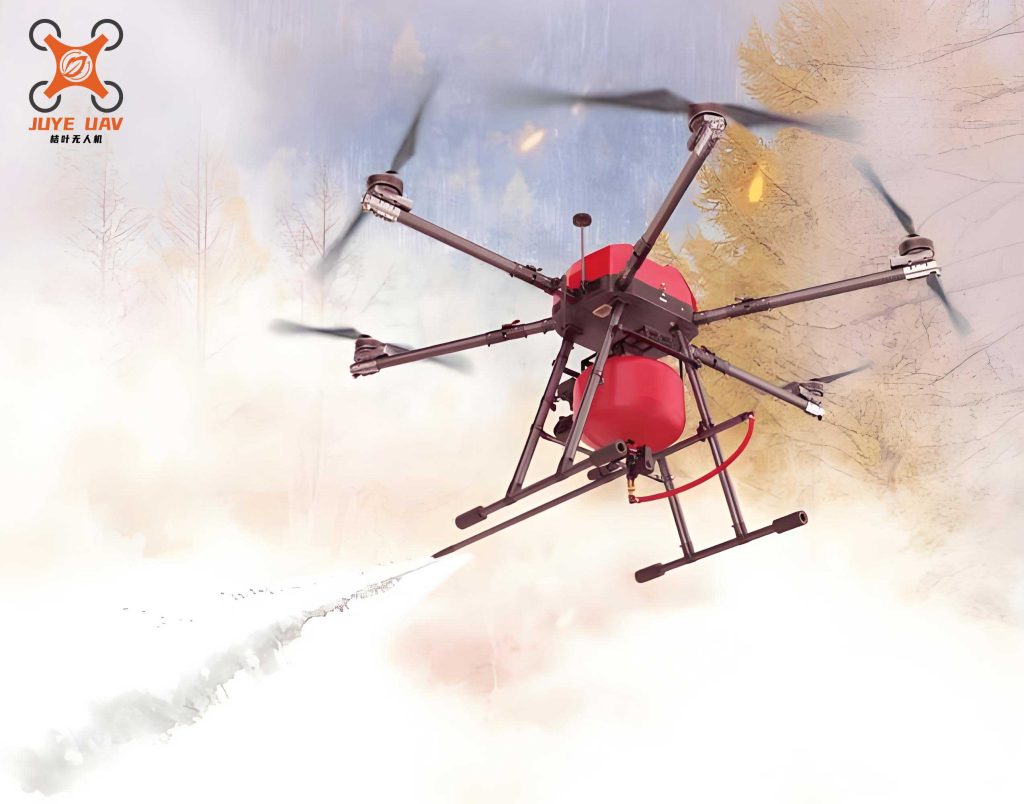
The applications of fire UAV in rescue operations are diverse and continually expanding. Based on my observations, these systems excel in five core areas:辅助决策 (assisted decision-making), command dissemination, task execution, communication relay, and route familiarization. Each area leverages the unique capabilities of fire UAV to address specific challenges in firefighting and emergency response.
First, fire UAV provide invaluable support for assisted decision-making through real-time reconnaissance and monitoring. In fire incidents, they can be dispatched ahead of ground teams to assess the scene, identify hazards, and locate victims. For instance, during a structural collapse, fire UAV equipped with high-resolution cameras and thermal sensors can detect heat signatures and structural weaknesses, feeding data to command centers. This enables faster, informed decisions on resource allocation and entry points. The data acquisition process can be represented as: $$ D(t) = \int_{0}^{t} S(\tau) \, d\tau + N $$ where \( D(t) \) is the data collected over time \( t \), \( S(\tau) \) is the sensor output at time \( \tau \), and \( N \) represents noise factors. By minimizing \( N \) through advanced filtering, fire UAV enhance data accuracy. In large-scale disasters like earthquakes, fire UAV have been used to map affected areas, reducing risks to human responders and speeding up rescue timelines.
Second, fire UAV facilitate emergency command dissemination. Integrated with loudspeaker modules, they can broadcast warnings or instructions to populations in peril. For example, in wildfire evacuations, fire UAV can fly over inaccessible zones, directing people to safety routes. This capability is crucial when ground communication is disrupted. The effectiveness of such systems depends on audio clarity and range, which can be optimized using acoustic formulas: $$ L = 10 \log_{10}\left(\frac{P}{P_0}\right) $$ where \( L \) is the sound level in decibels, \( P \) is the acoustic power, and \( P_0 \) is the reference power. By boosting \( P \), fire UAV ensure messages are heard over ambient noise, enhancing public safety.
Third, fire UAV execute direct rescue tasks, expanding their role beyond observation. They can deliver essential supplies to trapped individuals, such as in water rescues where fire UAV drop life rings or ropes. Payload capacity formulas come into play here: $$ W_{\text{max}} = T_{\text{total}} – W_{\text{UAV}} $$ where \( W_{\text{max}} \) is the maximum payload weight, \( T_{\text{total}} \) is the total thrust generated, and \( W_{\text{UAV}} \) is the weight of the fire UAV itself. For a fire UAV with 50 kg thrust and weighing 20 kg, the payload capacity is: $$ W_{\text{max}} = 50 – 20 = 30 \text{ kg} $$ This allows for carrying multiple items, like first-aid kits or sensors. In chemical incidents, fire UAV equipped with gas detectors can sample air quality, transmitting data to calculate concentrations: $$ C = \frac{M}{V} $$ where \( C \) is the concentration, \( M \) is the mass of detected substance, and \( V \) is the air volume. This helps delineate danger zones without exposing personnel.
Fourth, fire UAV serve as communication relays in areas with compromised infrastructure. By hovering above disaster sites, they amplify signals for radios and mobile devices, maintaining connectivity among rescue teams. The relay efficiency can be modeled using signal strength equations: $$ P_r = P_t G_t G_r \left( \frac{\lambda}{4 \pi d} \right)^2 $$ where \( P_r \) is received power, \( P_t \) is transmitted power, \( G_t \) and \( G_r \) are antenna gains, \( \lambda \) is wavelength, and \( d \) is distance. Fire UAV positioned optimally reduce \( d \), boosting \( P_r \) and ensuring seamless coordination. In mountainous or urban canyon environments, this function is particularly vital for organizing complex rescues.
Fifth, fire UAV aid in route and resource familiarization for fire stations. They can survey local hydrant locations, road networks, and hazard points, creating detailed maps for pre-incident planning. This proactive use of fire UAV enhances preparedness, reducing response times during emergencies. Data from such surveys can be integrated into geographic information systems (GIS) for analysis, with algorithms optimizing routes: $$ \text{Minimize } \sum_{i,j} c_{ij} x_{ij} $$ where \( c_{ij} \) is the cost (e.g., time) between points \( i \) and \( j \), and \( x_{ij} \) is a binary variable indicating path selection. Fire UAV collect the \( c_{ij} \) data, enabling efficient planning.
To maximize the benefits of fire UAV, their deployment should follow a structured配备模式 (equipment model) across different organizational levels. Based on my assessment, fire stations, regional commands, and national agencies require tailored approaches to integrate fire UAV effectively. The table below outlines recommended configurations, emphasizing the roles of fire UAV at each tier.
| Organization Level | Primary Functions of Fire UAV | Suggested Specifications | Deployment Strategy |
|---|---|---|---|
| Local Fire Stations (Ground-level operators) | Assisted decision-making, command dissemination, task execution, route familiarization | Lightweight, multi-rotor fire UAV with modular payloads; battery-powered; endurance 20-30 minutes | One fire UAV in active use with few backups; focus on rapid deployment and basic救援 tasks |
| Regional Commands (Coordination and reinforcement) | Assisted decision-making (including hazardous material detection), task execution, communication relay, public outreach | Medium to heavy fire UAV with advanced sensors (e.g., gas detectors, thermal cameras); hybrid power options (battery/fuel); endurance 1-2 hours | Multiple fire UAV in use with limited backups; support跨区域增援 (cross-regional support) and technical operations |
| National Agencies (Coordination,保障, and technical support) | Assisted decision-making, communication relay, large-scale surveillance, research and development | High-performance fire UAV with long endurance (fuel-powered), multi-sensor arrays, and swarm capabilities; endurance over 5 hours | Multiple fire UAV with ample backups; employ multi-drone协作模式 (collaborative models) for complex missions; support international aid |
This tiered approach ensures that fire UAV resources match operational needs, from routine inspections to catastrophic events. At the local level, fire UAV should be simple and affordable, enabling widespread adoption. For instance, a station might use a fire UAV for daily checks of high-risk buildings, storing data on cloud platforms. Regional commands require more robust fire UAV for incidents like industrial fires, where aerial surveillance guides resource allocation. National agencies can invest in cutting-edge fire UAV for disaster response across borders, leveraging technologies like autonomous swarms that cooperate based on algorithms: $$ \text{Swarm Behavior} = \sum_{i=1}^{n} f(\text{position}_i, \text{velocity}_i) $$ where \( f \) is a function dictating movement based on neighboring fire UAV, optimizing coverage and redundancy.
Despite their advantages, several制约因素 (constraining factors) limit the optimal use of fire UAV in rescue operations. From my perspective, these challenges stem from technological, human, regulatory, and experiential domains, requiring addressed to fully harness fire UAV potential.
Technologically, fire UAV are susceptible to environmental conditions. Heavy rain, strong winds, or electromagnetic interference can degrade performance or cause crashes. For example, in a fire scenario, high temperatures may affect battery life, modeled by Arrhenius’ equation: $$ k = A e^{-E_a/(RT)} $$ where \( k \) is the degradation rate, \( A \) is a constant, \( E_a \) is activation energy, \( R \) is the gas constant, and \( T \) is temperature. As \( T \) increases, \( k \) rises, reducing reliability. Manufacturers are developing hardened fire UAV with better materials, but costs remain high. Additionally, payload and endurance trade-offs persist; increasing payload often shortens flight time, as shown in the formula: $$ T_{\text{actual}} = T_{\text{base}} – \alpha W_{\text{payload}} $$ where \( T_{\text{base}} \) is the base endurance, \( \alpha \) is a coefficient, and \( W_{\text{payload}} \) is payload weight. For a fire UAV with \( T_{\text{base}} = 60 \) minutes and \( \alpha = 2 \) min/kg, carrying 10 kg reduces endurance to: $$ T_{\text{actual}} = 60 – 2 \times 10 = 40 \text{ minutes} $$ This necessitates careful mission planning.
Human factors also pose significant hurdles. Operating fire UAV demands specialized skills in piloting, data interpretation, and maintenance. Many rescue personnel lack formal training in aviation, leading to errors in stressful situations. Competency can be quantified through proficiency scores: $$ S = \sum_{i=1}^{m} w_i s_i $$ where \( S \) is the overall score, \( w_i \) are weights for skills like spatial awareness, and \( s_i \) are sub-scores. Regular simulations and certifications are essential to improve \( S \) for fire UAV operators. Moreover, teamwork between ground crews and fire UAV pilots must be seamless, requiring standardized protocols.
Regulatory and airspace management issues further complicate fire UAV deployment. In many countries,飞行手续 (flight procedures) mandate licenses for fire UAV above certain weights or for operations beyond visual line of sight. Obtaining these certifications involves time and expense, potentially delaying urgent responses. Air traffic control restrictions in urban areas can ground fire UAV during critical moments. Advocacy for streamlined regulations for emergency fire UAV is needed, possibly with pre-approved corridors or waivers during disasters.
Finally, a lack of standardized经验 and规范 (experience and norms) hinders widespread adoption. Since fire UAV are relatively new in rescue, best practices are still evolving. Lessons from past missions—such as optimal altitudes for imaging or effective payload release mechanisms—are not always documented. Establishing guidelines based on data analytics can help; for instance, using machine learning to analyze fire UAV performance: $$ \text{Efficiency} = \frac{\text{Successful Tasks}}{\text{Total Missions}} \times 100\% $$ By collecting data across multiple agencies, this efficiency metric can guide improvements in fire UAV usage.
In conclusion, fire UAV represent a pivotal advancement in rescue technology, offering unmatched capabilities in surveillance, intervention, and communication. As I reflect on their growing role, it is clear that fire UAV are not just tools but force multipliers that enhance safety and operational reach. The future of fire UAV lies in overcoming current limitations through innovation—such as developing fire-resistant materials, enhancing autonomous functions, and fostering inter-agency collaboration. With continued investment and training, fire UAV will become standardized assets in rescue units worldwide, ultimately saving more lives and protecting communities. The journey toward fully integrated fire UAV systems is ongoing, but each mission underscores their indispensable value in the ever-evolving landscape of emergency response.