
In my extensive experience as an industrial designer specializing in agricultural technology, I have focused on the造型设计 of intelligent agricultural UAVs, which are revolutionizing modern farming practices. This article delves into my design philosophy, process, and outcomes, emphasizing the integration of aesthetics, ergonomics, and functionality. The agricultural UAV is not merely a tool but a sophisticated system that enhances precision agriculture, reduces labor costs, and minimizes environmental impact. Through this first-person narrative, I will explore the key aspects of designing such UAVs, supported by tables, formulas, and practical insights.
The design of an agricultural UAV begins with understanding the operational requirements in diverse farming environments. My approach prioritizes user-centric design, ensuring that the agricultural UAV is intuitive for farmers with varying technical expertise. The造型设计 must balance aerodynamic efficiency with durability, as these UAVs often operate in harsh conditions. For instance, the fuselage shape impacts stability during flight, which is critical for precise pesticide spraying or crop monitoring. I employ computational fluid dynamics (CFD) simulations to optimize the design, reducing drag and improving battery life. The goal is to create an agricultural UAV that is both visually appealing and highly functional, fostering trust and adoption among users.
One fundamental aspect is the ergonomic design of the control interface. As a designer, I consider the human factors involved in operating an agricultural UAV. The controller should be lightweight, with clearly labeled buttons and a responsive display. I conducted user studies to gather feedback on prototype designs, refining them based on comfort and ease of use. This iterative process ensures that the agricultural UAV integrates seamlessly into daily farming routines. Moreover, safety features, such as automatic obstacle avoidance and emergency landing protocols, are incorporated to prevent accidents. The agricultural UAV must be reliable, as downtime during critical farming seasons can lead to significant losses.
To quantify design parameters, I use mathematical models that describe the performance of the agricultural UAV. For example, the lift force generated by the rotors can be expressed using the following formula, where \( L \) is lift, \( \rho \) is air density, \( v \) is velocity, \( A \) is rotor area, and \( C_L \) is the lift coefficient:
$$ L = \frac{1}{2} \rho v^2 A C_L $$
This equation helps in sizing the rotors for optimal payload capacity, which is essential for carrying liquid pesticides or sensors. Another critical metric is the endurance of the agricultural UAV, which depends on battery energy and power consumption. The flight time \( T \) can be estimated as:
$$ T = \frac{E}{P} $$
where \( E \) is the battery energy in watt-hours, and \( P \) is the power required in watts. By minimizing \( P \) through efficient造型设计, I can extend the operational range of the agricultural UAV, allowing it to cover larger fields in a single mission.
In my design process, I also focus on the structural integrity of the agricultural UAV. Using materials like carbon fiber composites, I achieve a high strength-to-weight ratio. The stress-strain relationship is crucial, as it determines the durability under load. For a beam element in the frame, the bending stress \( \sigma \) is given by:
$$ \sigma = \frac{M y}{I} $$
where \( M \) is the bending moment, \( y \) is the distance from the neutral axis, and \( I \) is the moment of inertia. Through finite element analysis (FEA), I simulate various loading scenarios to ensure the agricultural UAV can withstand impacts and vibrations. This analytical approach reduces the need for physical prototypes, speeding up the development cycle.
The following table summarizes key design parameters for a typical agricultural UAV, based on my project specifications. This table highlights the trade-offs involved in造型设计, such as between weight and battery life:
| Parameter | Value | Unit | Description |
|---|---|---|---|
| Weight | 5.2 | kg | Total takeoff weight including payload |
| Wingspan | 1.8 | m | Span of fixed wings for hybrid models |
| Rotor Diameter | 0.4 | m | For multirotor configurations |
| Battery Capacity | 20000 | mAh | Lithium-polymer battery at 22.2V |
| Flight Time | 45 | minutes | At optimal cruising speed |
| Payload Capacity | 10 | L | For liquid spraying systems |
| Maximum Speed | 60 | km/h | In calm weather conditions |
| Control Range | 2000 | m | Line-of-sight operation with radio link |
This table illustrates how each parameter influences the overall performance of the agricultural UAV. For instance, increasing the payload capacity may reduce flight time, necessitating a balance through efficient power management. In my designs, I optimize these parameters using multi-objective optimization algorithms, where the goal is to maximize endurance and payload while minimizing weight and cost. The objective function can be formulated as:
$$ \text{Minimize } f(x) = w_1 \cdot \text{Weight} + w_2 \cdot \frac{1}{\text{Flight Time}} + w_3 \cdot \text{Cost} $$
subject to constraints such as structural strength and regulatory limits. Here, \( w_1, w_2, w_3 \) are weighting factors that reflect the priorities of the agricultural UAV design. This mathematical framework allows me to explore the design space systematically, leading to robust solutions.
Another vital consideration is the spraying system of the agricultural UAV. Precision agriculture requires uniform distribution of pesticides or fertilizers. The droplet size and flow rate are critical parameters. I model the spraying process using fluid dynamics equations. The volume flow rate \( Q \) is given by:
$$ Q = A v $$
where \( A \) is the nozzle cross-sectional area, and \( v \) is the fluid velocity. To achieve optimal coverage, I adjust the nozzle design based on the Bernoulli equation:
$$ P + \frac{1}{2} \rho v^2 + \rho g h = \text{constant} $$
where \( P \) is pressure, \( \rho \) is fluid density, \( g \) is gravity, and \( h \) is height. By controlling these variables, the agricultural UAV can adapt to different crop heights and densities, ensuring efficient resource use. This is particularly important for sustainable farming, as it reduces chemical runoff and environmental harm.
In terms of造型设计, the aesthetic appeal of the agricultural UAV plays a significant role in user acceptance. I draw inspiration from nature, using biomimicry to create forms that are both functional and visually pleasing. For example, the sleek curves of the fuselage reduce air resistance, while the color scheme—often green or white—helps the agricultural UAV blend into agricultural settings or remain visible for safety. The following image illustrates a conceptual design of an agricultural UAV, highlighting its streamlined shape and compact structure:
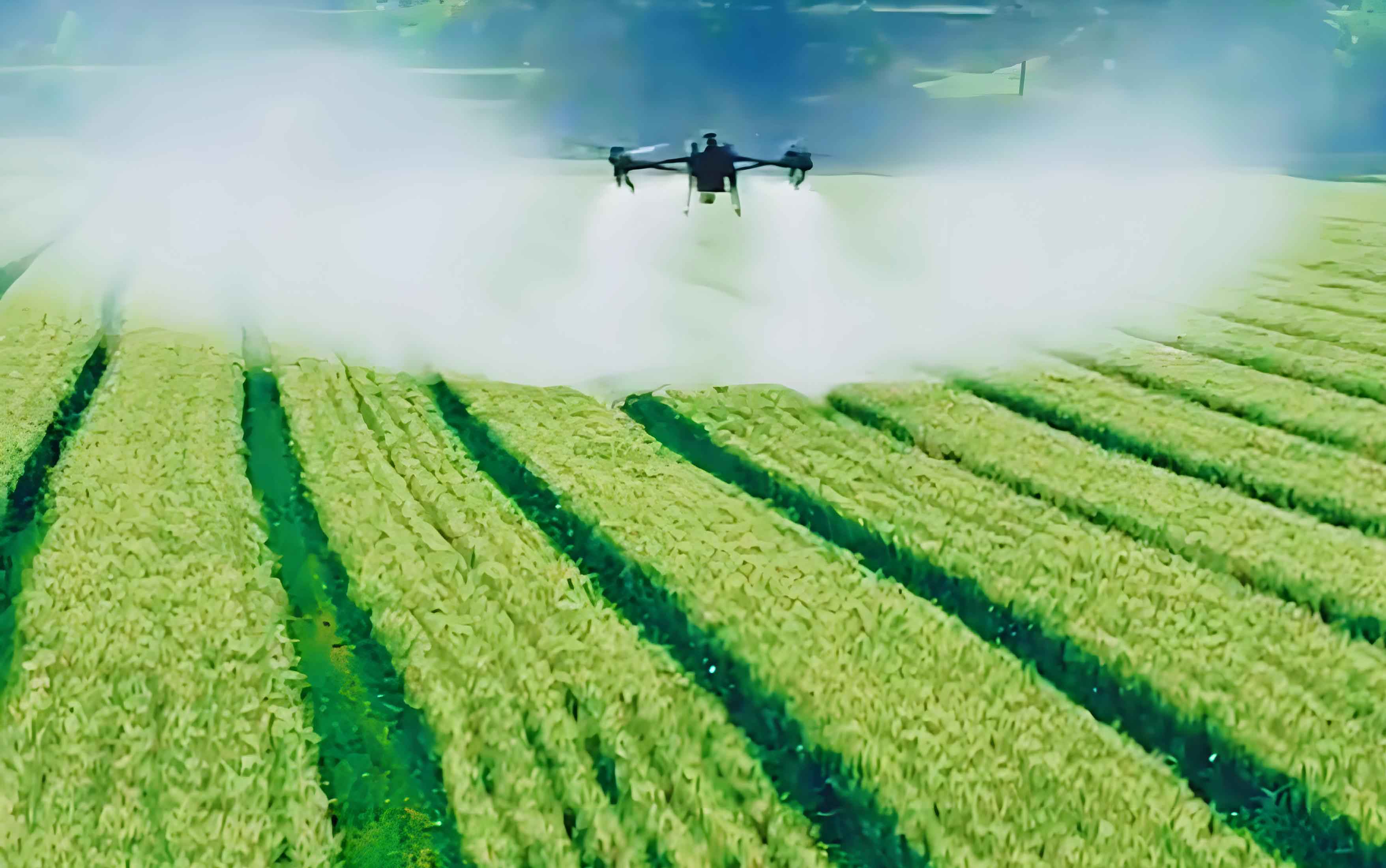
This design embodies the principles discussed, with a focus on aerodynamics and modularity. The agricultural UAV features foldable arms for easy transport, a key requirement for farmers who move between fields. The image demonstrates how造型设计 can enhance practicality without compromising on style. In my work, I iterate on such designs using 3D modeling software, validating them through virtual testing before physical fabrication.
The integration of smart technologies is another cornerstone of my agricultural UAV designs. I incorporate sensors such as GPS, IMUs (Inertial Measurement Units), and multispectral cameras to enable autonomous operations. The data collected by the agricultural UAV is processed using machine learning algorithms for crop health assessment. For instance, the Normalized Difference Vegetation Index (NDVI) is calculated from sensor data to detect plant stress:
$$ \text{NDVI} = \frac{NIR – Red}{NIR + Red} $$
where \( NIR \) is near-infrared reflectance, and \( Red \) is red light reflectance. This index helps farmers make informed decisions, and the agricultural UAV serves as a data collection platform. The onboard computer uses path planning algorithms to optimize flight routes, minimizing energy consumption. The total distance \( D \) covered in a field of area \( A_f \) can be approximated by:
$$ D = \frac{A_f}{w_s} $$
where \( w_s \) is the swath width of the spraying system. By optimizing \( w_s \) through nozzle placement, the agricultural UAV can complete missions faster, saving time and resources.
To further elaborate on the design trade-offs, I present a table comparing different agricultural UAV configurations based on their applications. This table helps in selecting the right design for specific farming needs:
| Configuration | Advantages | Disadvantages | Best For |
|---|---|---|---|
| Fixed-Wing UAV | Long endurance, high speed | Requires runway for takeoff/landing | Large-scale crop monitoring |
| Multirotor UAV | VTOL capability, precise hovering | Limited flight time, higher energy use | Spot spraying, small fields |
| Hybrid UAV | Combines endurance and VTOL | Complex design, higher cost | Versatile applications in varied terrain |
In my projects, I often favor hybrid designs for agricultural UAVs, as they offer flexibility for diverse farming scenarios. The造型设计 of such UAVs involves integrating wings for forward flight and rotors for vertical lift. The transition between modes is modeled using dynamics equations. For example, the total thrust \( T \) during hover is:
$$ T = n \cdot k \cdot \omega^2 $$
where \( n \) is the number of rotors, \( k \) is a constant, and \( \omega \) is the rotor angular velocity. During forward flight, lift is generated by the wings, reducing the load on rotors and conserving battery. This hybrid approach enhances the efficiency of the agricultural UAV, making it suitable for tasks like aerial mapping and targeted spraying.
Human factors engineering is integral to my design process for agricultural UAVs. I consider the entire user journey, from unboxing to maintenance. The control software interface is designed with simplicity in mind, using intuitive icons and real-time feedback. For instance, battery status and flight path are displayed prominently to prevent operational errors. I also conduct usability tests with farmers to refine the interface, ensuring that the agricultural UAV is accessible to users with minimal training. This focus on ergonomics reduces cognitive load, allowing operators to focus on the farming task rather than the technology.
Material selection is another critical aspect. I choose materials that are lightweight, corrosion-resistant, and recyclable. The use of aluminum alloys and composites ensures that the agricultural UAV can withstand exposure to chemicals and weather. The thermal properties of materials affect performance in extreme temperatures. The heat transfer equation is considered in design:
$$ Q = h A \Delta T $$
where \( Q \) is heat flow, \( h \) is heat transfer coefficient, \( A \) is surface area, and \( \Delta T \) is temperature difference. By optimizing the thermal management system, I prevent overheating of electronic components in the agricultural UAV, enhancing reliability during prolonged missions.
In terms of sustainability, the agricultural UAV contributes to precision agriculture, which reduces waste and environmental impact. My designs incorporate eco-friendly features, such as solar panels for auxiliary power. The energy harvested from solar cells can extend flight time, calculated as:
$$ E_{\text{solar}} = \eta \cdot I \cdot A_{\text{panel}} \cdot t $$
where \( \eta \) is efficiency, \( I \) is solar irradiance, \( A_{\text{panel}} \) is panel area, and \( t \) is time. This renewable energy integration makes the agricultural UAV more self-sufficient, aligning with green farming initiatives.
To summarize the design optimization process, I use statistical methods to analyze performance data. For example, regression analysis helps correlate design variables with outcomes like flight time or spray uniformity. The coefficient of determination \( R^2 \) indicates how well the model fits the data:
$$ R^2 = 1 – \frac{SS_{\text{res}}}{SS_{\text{tot}}} $$
where \( SS_{\text{res}} \) is the residual sum of squares, and \( SS_{\text{tot}} \) is the total sum of squares. By iterating based on such analyses, I refine the agricultural UAV design to meet stringent requirements. This data-driven approach ensures that every aspect of the造型设计 is justified and effective.
Looking ahead, the future of agricultural UAVs lies in increased autonomy and AI integration. In my ongoing work, I explore swarm robotics, where multiple agricultural UAVs collaborate to cover vast fields efficiently. The coordination algorithm minimizes collisions and optimizes task allocation. The total work done by a swarm of \( n \) UAVs can be modeled as:
$$ W = \sum_{i=1}^{n} \int F_i \cdot dx_i $$
where \( F_i \) is the force applied by UAV \( i \), and \( dx_i \) is its displacement. This collaborative approach scales up the benefits of agricultural UAVs, making them indispensable for modern agriculture.
In conclusion, my design philosophy for intelligent agricultural UAVs revolves around harmonizing form and function. Through rigorous analysis, user-centered design, and innovative technologies, I create UAVs that are efficient, reliable, and user-friendly. The agricultural UAV is a testament to how industrial design can transform farming, promoting sustainability and productivity. As I continue to refine these designs, I remain committed to advancing the field, ensuring that agricultural UAVs meet the evolving needs of farmers worldwide.