
The rapid advancement of science and technology since the dawn of the new century has triggered a profound transformation within the global military domain. In the context of future high-tech warfare, military equipment is increasingly evolving towards greater intelligence and autonomy. At the forefront of this revolution is a category of intelligent weaponry defined by its core reliance on smart information processing and communication technologies, designed to execute predetermined tactical or strategic missions—the military drone. These Unmanned Aerial Vehicles (UAVs), colloquially known as drones, are pilotless aircraft controlled either by remote radio signals or pre-programmed autonomous systems. Their successful development and battlefield deployment have heralded a new era of “non-contact warfare,” dominated by long-range, intelligent, and informational weapons.
It has been posited that “if the tank was the central weapon of land warfare in the 20th century, the military robot is likely to be it in the 21st century.” As the premier representative of aerial robotics, the military drone constitutes the fastest-growing family within the spectrum of military robots. The advantages of unmanned systems are compelling: significantly lower cost, zero risk of pilot loss or injury, high maneuverability, diverse take-off and landing capabilities, and reusability. Consequently, numerous nations worldwide have integrated military drones into diverse roles, including reconnaissance, surveillance, communications relay, electronic warfare, fire guidance, battle damage assessment, air-to-surface (or air-to-sea) strike, target simulation, and early warning. Current statistics indicate that over 50 different models of military drones have been developed across 32 countries, with manufacturing capabilities present in more than 50 nations.
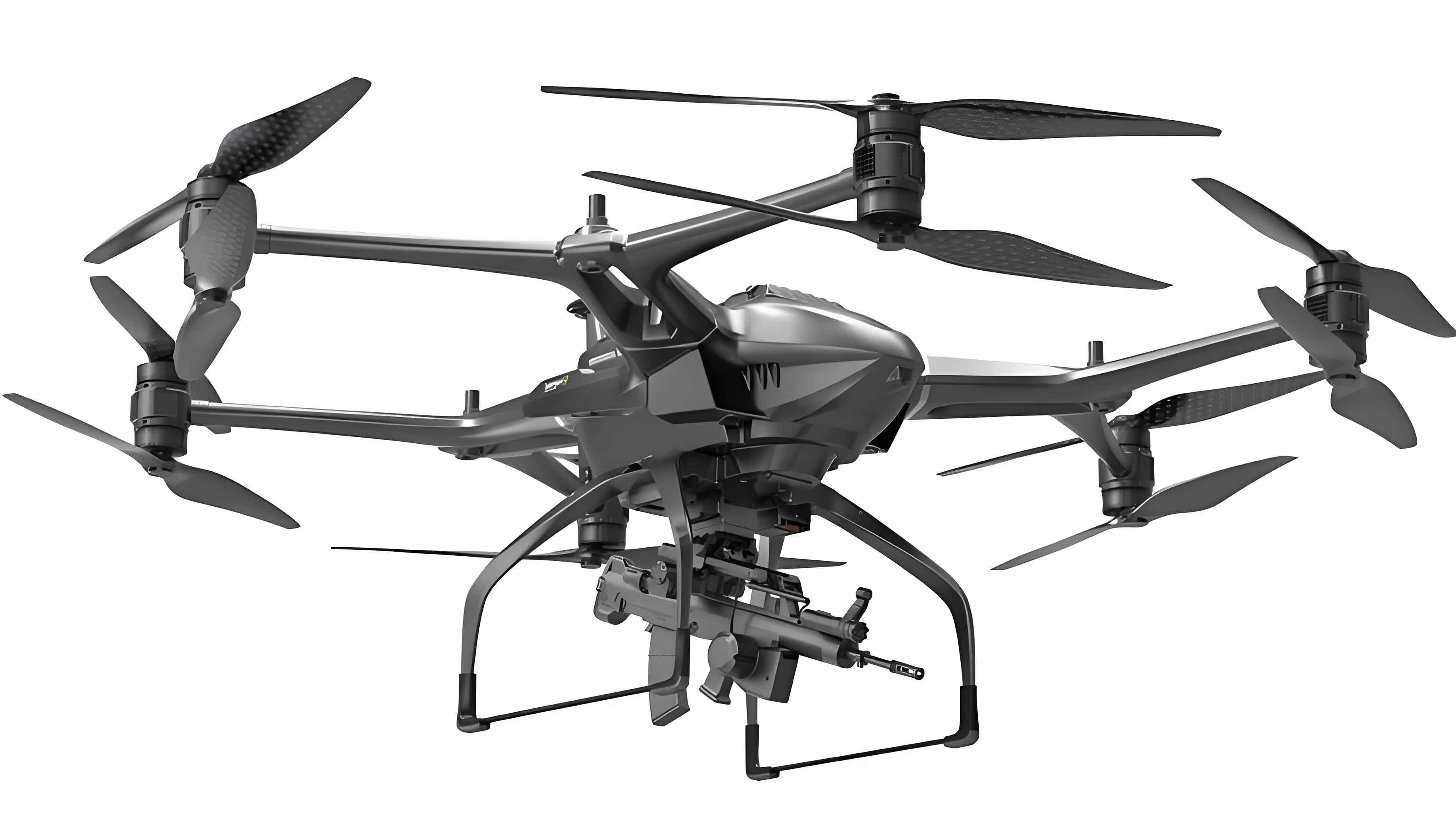
This article provides a detailed examination of the current state of development for military drones in key nations and regions, including the United States, the European Union, and Israel, followed by a comprehensive outlook on emerging trends that will shape the future of this critical technology.
Current State of Global Military Drone Development
United States
As the world’s preeminent military power, the United States places the highest priority on unmanned combat systems. Strategic planning documents, such as the Unmanned Systems Integrated Roadmap, outline a clear vision for the future fleet composition. The U.S. inventory encompasses nearly 60 different military drone models, with the MQ-1 “Predator” and the RQ-4 “Global Hawk” being among the most iconic.
| Model | Category | Key Parameters | Primary Roles & Notes |
|---|---|---|---|
| MQ-1 Predator / MQ-9 Reaper | MALE (Medium Altitude Long Endurance) | Wingspan: ~14.8m (Predator), ~20m (Reaper); Endurance: 24-40 hrs; Payload: ~340 kg; Cruise Speed: ~70-90 knots. | The archetype of the armed, multi-role military drone. The MQ-1’s first missile strike in 2001 marked the operational debut of armed drones. The larger MQ-9 Reaper is dedicated to persistent hunter-killer missions. |
| RQ-4 Global Hawk | HALE (High Altitude Long Endurance) | Wingspan: 35.4m; Endurance: >30 hrs; Max Altitude: 60,000 ft; Range: ~22,800 km. | A strategic ISR platform with near-global reach. Its high-operating altitude provides sanctuary from most ground-based air defenses, enabling wide-area surveillance with sensors like SAR and EO/IR. |
| X-47B UCAS | UCAS (Unmanned Combat Air System) | Tailless, swept-wing design; Stealth configuration; Capable of autonomous aerial refueling (AAR). | A technology demonstrator that proved the feasibility of carrier-based unmanned operations. It represents the future of stealthy, penetrating military drones for high-threat environments, paving the way for programs like the MQ-25 Stingray and Next Generation Air Dominance (NGAD) family of systems. |
The performance of a reconnaissance-focused military drone like the Global Hawk can be partially modeled by its area coverage rate, a function of sensor swath width and platform velocity:
$$ A_{cov} = W_{swath} \cdot V_{ground} $$
where \( A_{cov} \) is the area coverage rate (e.g., km²/hour), \( W_{swath} \) is the sensor’s imaging swath width, and \( V_{ground} \) is the ground speed of the military drone.
European Union
European nations, often through consortiums, have developed advanced military drone technologies to maintain a leading edge in aerospace. Key programs emphasize stealth, autonomy, and coalition interoperability.
| Model / Program | Lead Nation/Consortium | Key Characteristics | Technological Focus |
|---|---|---|---|
| Taranis | United Kingdom | Low-observable (stealth) design; Fully autonomous flight & threat response systems; Internal weapons bays. | A demonstrator for a future stealthy Unmanned Combat Air Vehicle (UCAV). It integrates artificial intelligence for autonomous mission execution and self-protection. |
| nEUROn | France (with Italy, Sweden, Spain, etc.) | Flying-wing stealth configuration; Fully autonomous from take-off to landing; Designed for “deep strike” and SEAD missions. | A joint European UCAV technology demonstrator focusing on stealth, integration of advanced armaments, and testing of autonomous behaviors within a networked environment. |
| EuroMALE | European Defense Agency (EDA) / Airbus | Next-generation MALE UAV; Designed from the outset for European airworthiness certification (STANAG 4671). | Aims to provide a sovereign European ISR and precision strike capability, reducing dependency on foreign military drone systems and ensuring interoperability among EU member states. |
The stealth characteristic of advanced military drones like the Taranis and nEUROn is quantified by their Radar Cross-Section (RCS). A simplified model for the maximum detection range of a radar against a stealth target is given by the radar range equation, rearranged to solve for range \(R_{max}\):
$$ R_{max} = \left[ \frac{P_t G_t G_r \lambda^2 \sigma}{(4\pi)^3 P_{rmin}} \right]^{1/4} $$
where \(P_t\) is transmit power, \(G_t\) and \(G_r\) are antenna gains, \(\lambda\) is wavelength, \(P_{rmin}\) is the minimum detectable signal, and \(\sigma\) is the target’s RCS. For a stealthy military drone, \(\sigma\) is drastically reduced, collapsing the enemy’s detection and engagement bubble.
Israel
Israel is a world leader in military drone technology and operational doctrine, having pioneered tactical UAV support for ground forces. Its industry excels in both high-end strategic systems and innovative, cost-effective tactical solutions.
| Model | Category | Key Features | Operational Concept |
|---|---|---|---|
| Heron TP (Eitan) | HALE | Wingspan: 26m; Endurance: >30 hrs; Multi-sensor payload (SAR, ELINT, COMINT); Heavy fuel engine. | A strategic asset for persistent, wide-area surveillance and signals intelligence over denied territory. Its large payload capacity makes it a key node for network-centric warfare. |
| Harop / Harpy | Loitering Munition (Suicide Drone) | Anti-Radiation Seeker (Harpy) or Electro-Optical seeker (Harop); “Fire-and-forget” or man-in-the-loop operation; Kamikaze attack profile. | Represents a disruptive concept: a military drone that is the munition. It loiters in a target area, identifies high-value targets (like radars or armor), and then plunges to destroy them, blending surveillance and strike into a single, low-cost platform. |
The lethality of a loitering munition, a specialized type of attack military drone, can be related to its warhead effectiveness and targeting accuracy. The probability of kill \(P_k\) against a point target can be modeled as:
$$ P_k = 1 – (1 – P_{hit})^{n} $$
where \(P_{hit}\) is the single-shot probability of hitting the target (a function of seeker and guidance accuracy) and \(n\) is the number of munitions assigned. For a loitering munition with a man-in-the-loop final confirmation, \(P_{hit}\) can be very high, making even a single platform (\(n=1\)) highly effective.
Future Trends and Technological Trajectories for Military Drones
The evolution of the military drone is accelerating, moving beyond remotely piloted vehicles towards increasingly autonomous, networked, and intelligent systems. The following trends are shaping the next generation of unmanned aerial warfare.
1. Collaborative Swarming and Manned-Unmanned Teaming (MUM-T)
The future of the military drone lies not in individual platforms, but in collaborative systems. Two dominant paradigms are emerging:
Autonomous Swarms: Large numbers of small, inexpensive drones operating collaboratively with decentralized coordination. Swarms can saturate defenses, conduct distributed sensing, and execute complex attack patterns. The control logic for such a swarm of \(N\) drones can be inspired by bio-inspired algorithms like Boid’s rules (separation, alignment, cohesion), formulated as control inputs for drone \(i\):
$$
\begin{aligned}
u_{sep,i} &= -\sum_{j \in \mathcal{N}_i} \frac{x_i – x_j}{||x_i – x_j||^2} \\
u_{align,i} &= \frac{1}{|\mathcal{N}_i|} \sum_{j \in \mathcal{N}_i} v_j – v_i \\
u_{coh,i} &= \frac{1}{|\mathcal{N}_i|} \sum_{j \in \mathcal{N}_i} (x_j – x_i)
\end{aligned}
$$
where \(x_i\) and \(v_i\) are the position and velocity of drone \(i\), and \(\mathcal{N}_i\) is its set of neighbors. The total control input is a weighted sum: \(u_i = w_s u_{sep,i} + w_a u_{align,i} + w_c u_{coh,i} + u_{goal,i}\).
Manned-Unmanned Teaming (MUM-T): Advanced crewed aircraft (e.g., fighter jets, command helicopters) will act as “quarterbacks” for teams of loyal wingman drones. These military drones will perform tasks such as forward sensing, electronic attack, weapons delivery, and expendable defense, significantly extending the reach, survivability, and combat power of the manned platform. The tactical advantage can be expressed as a force multiplier effect.
2. Advanced Autonomy and Artificial Intelligence (AI)
The next leap for the military drone is in cognitive autonomy. This involves moving from pre-programmed scripts to drones that can perceive, reason, and make decisions in complex, dynamic battlespaces. Key AI/ML applications include:
- Autonomous Target Recognition (ATR) and Tracking: Using convolutional neural networks (CNNs) to classify objects from EO/IR/SAR data in real-time, reducing the sensor-to-shooter timeline.
- Adaptive Mission Planning: Dynamic re-planning of routes and tasks in response to threats, pop-up targets, or loss of team members.
- Air-to-Air Combat Algorithms: Developing AI pilots for dogfighting and beyond-visual-range (BVR) engagements, potentially encapsulated in models that evaluate maneuver decisions based on energy-state and geometry: $$ J = \int (w_1 \Delta E + w_2 \Delta \theta_{aspect} + w_3 \Delta R) dt $$ where \(J\) is a cost function to minimize, balancing energy (\(E\)), aspect angle to target (\(\theta\)), and range (\(R\)).
3. Modularity, Open Architectures, and Network Integration
Future military drones will be designed as “flying trucks” with open, standardized interfaces. Payloads (sensors, jammers, weapons pods) will be swappable “plug-and-fight” modules, allowing a single airframe to be reconfigured for different missions in hours. This approach maximizes flexibility and reduces lifecycle costs.
Moreover, every military drone will function as a node in a larger combat network—the Joint All-Domain Command and Control (JADC2) system. They will not only collect data but also fuse it with inputs from other drones, satellites, ground units, and ships, creating a common, real-time operational picture. The data throughput requirement for such a networked military drone can be substantial:
$$ Data\ Rate_{total} = \sum_{sensors} (Resolution \times Frame\ Rate \times Compression\ Ratio)^{-1} + Data_{C2} + Data_{Health} $$
This necessitates advanced, resilient data links, including stealthy LPI/LPD (Low Probability of Intercept/Detection) waveforms and mesh networking protocols.
4. Enhanced Survivability and Counter-Drone Technologies
As military drones become ubiquitous, counter-UAV (C-UAV) systems proliferate. This drives the development of drones with enhanced survivability features:
| Survivability Feature | Technology Examples | Effect on Vulnerability (V) |
|---|---|---|
| Signature Reduction | Stealth shaping, RAM coatings, IR suppressors. | Dramatically reduces \(P_{detect}\) in the radar/IR threat equation: \(V \propto P_{detect} \times P_{track} \times P_{engage} \times P_{kill}\). |
| Electronic Warfare (EW) Self-Protection | Onboard jammers, DRFM-based deception. | Reduces \(P_{track}\) and \(P_{engage}\) by degrading enemy radar/guidance lock. |
| Autonomous Threat Reaction | AI-driven maneuver libraries, expendable decoys. | Reduces \(P_{kill}\) by executing optimal evasion upon missile launch detection. |
5. Energy and Propulsion Innovation
Endurance remains a critical metric. Beyond efficient turboprop and jet engines, research is focused on:
- Hylectric and Solar-Electric Propulsion: For extreme endurance HALE platforms, potentially enabling flights lasting weeks or months. A simplified power balance for a solar-electric military drone in steady, level flight is: $$ P_{required} = P_{prop} + P_{payload} = \eta_{solar} \cdot A_{wing} \cdot I_{solar} $$ where \(P_{prop}\) is power for propulsion, \(P_{payload}\) for systems, \(\eta_{solar}\) is cell efficiency, \(A_{wing}\) is solar panel area, and \(I_{solar}\) is solar irradiance.
- Alternative Fuels & Efficient Design: Exploring biofuels and hydrogen fuel cells to reduce logistics footprint and increase sortie generation rates.
In conclusion, the military drone has transitioned from a niche surveillance tool to a central pillar of modern and future warfare. Its evolution is characterized by increasing autonomy, seamless network integration, collaborative behaviors, and sophisticated counter-survivability features. The ongoing convergence of artificial intelligence, modular design, and advanced propulsion will further solidify the military drone‘s role as a decisive, ubiquitous, and transformative asset on the 21st-century battlefield. The trajectory points towards a future where unmanned systems operate in intelligent clusters alongside human warfighters, fundamentally altering the concepts of air power, reconnaissance, and strike operations.