
In my experience as a professional in the field of emergency response, the integration of technology into fire fighting and rescue operations has been transformative. Among these technologies, multi-rotor unmanned aerial vehicles (UAVs), which I often refer to as fire UAVs, have emerged as a critical tool. This article explores the role expansion of fire UAVs in fire fighting and rescue, delving into their fundamentals, limitations, functionalities, and the systemic requirements for their effective deployment. I will share insights from a first-person perspective, emphasizing practical applications and future directions.
The concept of UAVs, or drones, has evolved significantly over the years. A fire UAV, specifically a multi-rotor type, is an aircraft that operates without a human pilot onboard, relying on electronic control systems. In fire fighting and rescue, these fire UAVs offer unique advantages due to their ability to perform vertical take-offs, hover stably, and maneuver in tight spaces—capabilities that are unmatched by other UAV types like fixed-wing or single-rotor helicopters. This makes fire UAVs indispensable for tasks such as aerial surveillance, equipment delivery, and direct intervention in hazardous environments.
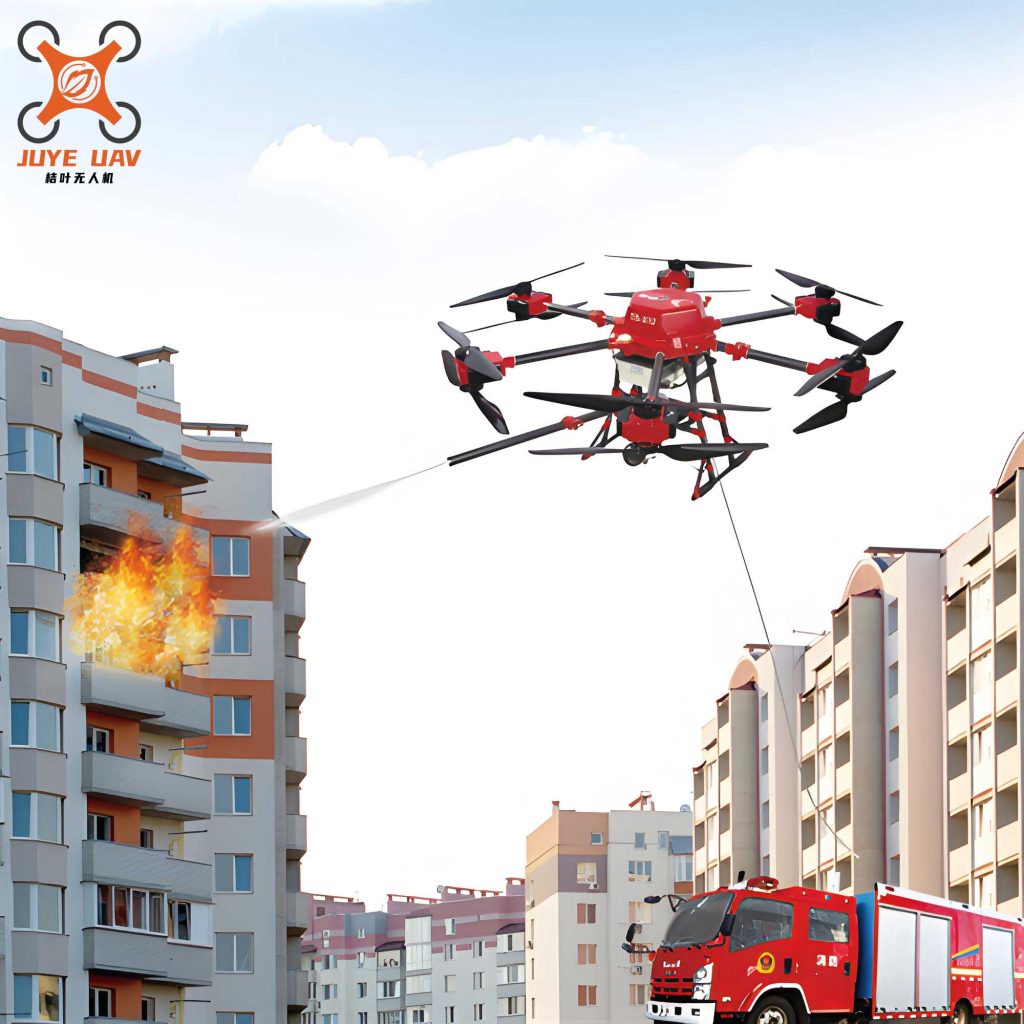
From a structural standpoint, a typical fire UAV consists of several key components: motors (electric or fuel-based), electronic speed controllers (ESCs), a power distribution board, propellers, a battery or fuel tank, a frame, and a flight control system. Additionally, fire UAVs can be equipped with various payloads tailored to fire fighting needs, such as cameras, sensors, or delivery mechanisms. The design principles for fire UAVs prioritize stability, durability, and modularity to adapt to diverse rescue scenarios. Below is a table summarizing the core components and their functions in a fire UAV:
| Component | Function | Importance in Fire UAV |
|---|---|---|
| Motor | Provides thrust for lift and movement | Determines payload capacity and flight efficiency; electric motors are common for quiet operation. |
| Electronic Speed Controller (ESC) | Regulates motor speed based on flight control signals | Ensures precise control, crucial for stable hovering in windy conditions during fire incidents. |
| Propeller | Generates aerodynamic lift | Design affects noise and efficiency; larger propellers may enhance lift for heavier fire-fighting payloads. |
| Battery/Fuel Tank | Powers the fire UAV | Limits flight duration; advancements like hydrogen fuel cells are being explored for extended missions. |
| Flight Control System | Processes sensor data and pilot commands | Enables autonomous functions like waypoint navigation, essential for complex fire rescue operations. |
| Payload Module | Carries fire-specific equipment (e.g., cameras, extinguishers) | Customizable for tasks such as thermal imaging or water delivery, defining the fire UAV’s role. |
Despite their potential, fire UAVs face several efficacy defects that must be addressed. First, the payload limitation is a significant constraint. Due to their rotor configuration and power dynamics, most fire UAVs have a rated load capacity between 2 kg and 20 kg, with smaller models limited to 500–800 g. This restricts their ability to transport heavy fire-fighting gear. Mathematically, the payload capacity \( P_{max} \) can be expressed as a function of thrust \( T \) and weight \( W \): $$ P_{max} = \frac{T – W}{g} $$ where \( g \) is gravitational acceleration. For a fire UAV, increasing \( T \) through motor power is often balanced against battery drain, highlighting the trade-off.
Second, endurance is a critical issue. Fire UAVs typically rely on batteries that provide flight times of 20–25 minutes, with hover times under load reduced to 15 minutes or less. This is inadequate for prolonged fire monitoring or rescue missions. The endurance \( E \) in minutes can be modeled as: $$ E = \frac{C \times V}{P_{avg}} $$ where \( C \) is battery capacity in ampere-hours, \( V \) is voltage, and \( P_{avg} \) is average power consumption in watts. For instance, a fire UAV with a 10,000 mAh battery at 22.2V and consuming 200W might achieve: $$ E = \frac{10 \times 22.2}{200} \times 60 \approx 66.6 \text{ minutes} $$ but in practice, factors like wind resistance reduce this. Advanced power sources like hydrogen fuel cells, as seen in models like the HYDrone-1800, promise longer endurance but are not yet widespread due to cost.
Third, weather susceptibility poses risks. Fire UAVs are unsuitable in winds above Level 3 (approximately 12–19 km/h), rain, or intense midday sun, as these conditions can cause control loss, electrical shorts, or signal interference. The wind resistance threshold for a fire UAV can be approximated using the drag force equation: $$ F_d = \frac{1}{2} \rho v^2 C_d A $$ where \( \rho \) is air density, \( v \) is wind speed, \( C_d \) is drag coefficient, and \( A \) is cross-sectional area. Exceeding this force compromises stability, leading to potential crashes.
Fourth, safety concerns remain prevalent. Although comprehensive data on crash rates for fire UAVs is lacking, incidents due to signal loss, battery failure, or operator error are common. While many fire UAVs feature automatic return-to-home functions, these can fail under adverse conditions. Ensuring reliability requires rigorous testing and redundancy systems.
Moving to functionalities, fire UAVs offer diverse applications in fire fighting and rescue. The visual function is the most basic, involving reconnaissance, monitoring, and decision support. For example, a fire UAV equipped with high-resolution cameras can stream real-time video via 4G networks, providing commanders with situational awareness of fire spread, trapped victims, or structural integrity. This visual data enhances tactical planning without risking personnel.
The single-type payload function involves transporting fire-fighting equipment within the fire UAV’s weight limit. This can be achieved through simple modifications like hooks, baskets, or custom carriers. Applications include delivering rescue ropes in mountain or river rescues, where precision surpasses traditional throw lines, or supplying personal protective equipment to firefighters in inaccessible areas. A table below outlines common payloads for single-type functions:
| Payload Type | Example Items | Use Case in Fire Rescue |
|---|---|---|
| Rescue Gear | Ropes, harnesses, small tools | Enables rapid deployment in vertical or aquatic environments, reducing responder exposure. |
| Escape Kits | Smoke masks, descent devices, water | Dropped to trapped individuals in high-rise fires, providing interim survival aid. |
| Communication Relays | Wireless repeaters, antennas | Establishes temporary networks in signal-dead zones, crucial for coordination. |
| Medical Supplies | First-aid kits, defibrillators | Delivers urgent care to isolated victims before ground teams arrive. |
For heavier loads, such as evacuating people, large fire UAVs like the EHang 184—an 8-rotor model capable of carrying one person—have been developed. However, these manned fire UAVs face regulatory and safety hurdles, limiting their current deployment. The payload capacity for such models must satisfy strict stability criteria, often involving complex control algorithms.
The composite-type payload function represents a more advanced use, where fire UAVs are integrated with active systems to directly or indirectly participate in fire suppression. This requires specialized modifications and operating systems. Direct actions include deploying fire extinguishing agents, such as dry chemical pellets or water pulses, onto incipient blazes in high-rise buildings. The effectiveness can be quantified using discharge rate formulas: $$ Q = A \times v $$ where \( Q \) is flow rate, \( A \) is nozzle area, and \( v \) is exit velocity. For a fire UAV carrying a water tank, the extinguishing time \( t_{ext} \) depends on \( Q \) and fire size \( S \): $$ t_{ext} = \frac{S}{Q \times \eta} $$ with \( \eta \) as efficiency factor.
Indirect assistance involves fire UAVs equipped with sensors for environmental monitoring. For instance, thermal cameras can detect hotspots in structural fires, aiding in stability assessment, while gas detectors can identify hazardous leaks in chemical incidents, keeping firefighters safe. The data from these sensors can be processed in real-time, enhancing decision-making. Below is a formula for thermal detection range \( R \) based on sensor sensitivity: $$ R = \sqrt{\frac{P_t G_t \sigma A_r}{(4\pi)^2 S_{min}}} $$ where \( P_t \) is transmitted power, \( G_t \) is gain, \( \sigma \) is target cross-section, \( A_r \) is receiver area, and \( S_{min} \) is minimum detectable signal. This illustrates the technical depth required for advanced fire UAV applications.
To fully leverage fire UAVs in fire fighting, several derivative needs must be addressed. System construction is paramount—a holistic approach encompassing a smart closed-loop control system, ground stations with command interfaces, data links, and maintenance facilities like hangars. Personnel structuring is equally vital; a dedicated team should include pilots, observers, and technicians, all trained in both UAV operation and fire rescue protocols. The organizational framework can be summarized in this table:
| System Component | Description | Role in Fire UAV Operations |
|---|---|---|
| Control System | Hardware and software for flight management | Enables autonomous missions and real-time adjustments during fire emergencies. |
| Ground Station | Base unit for data reception and transmission | Serves as command hub, integrating video feeds and sensor data for coordinated response. |
| Maintenance Depot | Facility for storage, repair, and charging | Ensures fire UAV readiness and longevity, reducing downtime in critical situations. |
| Personnel Roles | Pilot, spotter, mechanic, commander | Defines clear responsibilities, enhancing efficiency and safety in fire rescue teams. |
Operating systems for fire UAVs require customization. While commercial drones come with generic software, fire-specific models need dedicated platforms that integrate payload controls, mission planning, and data analytics. For example, an operating system for a fire UAV might include modules for thermal imaging analysis, extinguisher deployment sequencing, and emergency override protocols. Development should follow modular principles to allow scalability across different fire UAV types.
Talent cultivation is another critical area. Operators of fire UAVs must hold certifications like the AOPA (Aircraft Owners and Pilots Association) license for UAV pilots, combined with fire fighting training through vocational programs. This dual expertise ensures that fire UAV deployments are both legally compliant and tactically sound. Regular drills and simulations can bridge the gap between theory and practice.
Regulatory and legal frameworks cannot be overlooked. In many regions, laws such as the “Regulations on the Management of Civil Unmanned Aircraft” mandate registration, no-fly zones, and operational permits for fire UAVs. Compliance is essential to prevent “black flights” that could jeopardize safety. Fire departments must work with aviation authorities to establish protocols for emergency deployments, balancing agility with legal adherence. For instance, geofencing systems like DJI’s GEO can be adapted to dynamically adjust flight boundaries during fire incidents.
Institutionalization within fire services is also necessary. Currently, few agencies have formalized fire UAV units or standardized procedures. Creating dedicated positions, such as a Fire UAV Operator role, and integrating them into incident command systems will professionalize usage. This involves drafting guidelines for pre-flight checks, mission profiles, and post-action reviews, ensuring that fire UAVs become a reliable asset rather than an ad-hoc tool.
Looking ahead, the expansion of fire UAVs in fire fighting and rescue is inevitable, driven by technological advances and increasing demand for safer, more efficient responses. However, this journey requires confronting the inherent limitations of current fire UAV designs—such as payload and endurance—while investing in research for improvements like hybrid power systems or AI-enhanced autonomy. The potential for fire UAVs to revolutionize areas like urban search-and-rescue or wildfire management is immense, but it hinges on a collaborative effort among manufacturers, regulators, and fire professionals.
In conclusion, as someone deeply involved in this field, I believe that fire UAVs represent a paradigm shift in emergency response. By understanding their principles, addressing their shortcomings, and systematically building around them, we can unlock new capabilities that save lives and property. The future of fire fighting will increasingly rely on these aerial workhorses, making it imperative to foster innovation while ensuring robust standards. Through continuous learning and adaptation, fire UAVs will not only expand their roles but become indispensable partners in the relentless battle against fire disasters.
To further illustrate the technical aspects, consider the aerodynamic efficiency of a fire UAV in hover mode, which can be expressed using the figure of merit \( FM \): $$ FM = \frac{T^{3/2}}{\sqrt{2 \rho A} \times P} $$ where \( T \) is thrust, \( \rho \) is air density, \( A \) is rotor disk area, and \( P \) is power input. Optimizing \( FM \) through design tweaks can extend the operational window for fire UAVs. Similarly, cost-benefit analyses for deploying fire UAVs versus traditional methods can be modeled with equations weighing factors like response time and risk reduction.
Ultimately, the journey of fire UAVs in fire fighting is one of constant evolution. As we integrate more sensors, improve battery tech, and refine regulations, these machines will become smarter and more capable. I envision a future where fire UAV fleets operate in swarms, collaboratively extinguishing blazes or conducting large-scale rescues, all guided by human expertise. The key is to start now—by testing, training, and iterating—so that fire UAVs can rise to meet the challenges of tomorrow’s fire grounds.