
As we witness the rapid evolution of the aerospace information sector, the release of numerous digital scenarios marks a pivotal step in bridging innovation with practical application. This movement is not merely about technological advancement but about creating a robust ecosystem where concepts like drone training become integral to economic growth and societal development. In this narrative, we explore the multifaceted dimensions of this industry, emphasizing how drone training and related endeavors are shaping the future.
The aerospace information industry, encompassing satellite and rocket manufacturing, aerospace information applications, aviation support, and the low-altitude economy, is a cornerstone for nurturing new quality productive forces. We have recently unveiled 50 digital scenarios, which are categorized into capability lists, government opportunity lists, and enterprise opportunity lists. These scenarios serve as a catalyst for transforming laboratory breakthroughs into real-world solutions, with drone training playing a critical role in operationalizing these innovations.
Let us delve into the 38 capability scenarios that highlight our technological prowess. These scenarios focus on pioneering technologies that require deployment and scaling. For instance, the development of AI-driven edge computing platforms for drones enables autonomous decision-making, such as in surveillance and emergency response. Drone training is essential here to ensure operators can leverage these advanced systems effectively. The integration of AI algorithms allows drones to “see” and “interpret” their surroundings, akin to human cognition, which necessitates specialized drone training programs for mastery.
To summarize the capability scenarios, we present a table that outlines key areas and their emphasis on drone training:
| Scenario Category | Number of Scenarios | Primary Focus | Relevance to Drone Training |
|---|---|---|---|
| Satellite and Rocket Manufacturing | 12 | Production of satellites, rockets, and associated components | Indirect support through infrastructure for drone navigation and communication |
| Aerospace Information Applications | 15 | Utilization of satellite data for earth observation, navigation, and communication | Drone training for data interpretation and application in fields like agriculture and disaster management |
| Aviation Support | 6 | Maintenance, logistics, and support services for aviation operations | Direct involvement in drone training for maintenance and operational safety |
| Low-Altitude Economy | 5 | Development of low-altitude airspace for commercial and civil uses | Core focus on drone training for pilots, operators, and service providers |
This table underscores how drone training permeates various aspects, from enabling precise satellite-aided navigation to ensuring safe low-altitude flights. The low-altitude economy, in particular, thrives on proficient drone training, as it involves applications like logistics, tourism, and urban management.
In addition to capabilities, we have released opportunity lists that invite collaboration. The government opportunity list includes four key scenarios aimed at fostering regional growth. For example, one scenario involves establishing drone test flight bases, which inherently require comprehensive drone training programs for pilots and technicians. Another focuses on introducing flight training enterprises to cultivate a skilled workforce. Here, we present a summary of these opportunities:
| Government Opportunity Scenario | Region | Key Objectives | Drone Training Components |
|---|---|---|---|
| Low-Altitude Economic Innovation Hub | Lixia District | Develop key technologies and operational services for low-altitude applications | Training programs for AI-based drone operations and management |
| Low-Altitude Economic Demonstration Base | Zhangqiu District | Build drone test flight facilities and attract industrial drone companies | Hands-on drone training for test pilots and maintenance crews |
| Low-Altitude Industry Demonstration Base | Pingyin County | Promote aviation equipment manufacturing and general aviation operations | Drone training for short-haul transport, tourism, and emergency response |
| Low-Altitude Economic Industry Cultivation Base | Shanghe County | Attract drone and general aircraft manufacturing enterprises | Training initiatives for manufacturing processes and flight operations |
These opportunities highlight a concerted effort to embed drone training into regional development strategies. For instance, Zhangqiu District’s plan to construct a drone test flight base will necessitate advanced drone training modules to ensure safety and efficiency. Similarly, Pingyin County’s emphasis on general aviation operations includes flight training as a core component, directly boosting drone training capacities.
On the enterprise front, eight opportunity scenarios have been opened, focusing on needs such as system development and talent acquisition. A prime example is the demand for drone cabin cluster协同作业调度系统, which requires operators with specialized drone training to manage fleets effectively. Another scenario involves “探驱防”一体化净空系统平台, where drone training is crucial for deploying defensive measures in sensitive airspace. To illustrate, we can model the efficiency of such systems using a formula that incorporates drone training levels:
$$ E_{system} = \alpha \cdot \sum_{i=1}^{n} (S_i \cdot T_i) $$
Here, \( E_{system} \) represents the overall system efficiency, \( \alpha \) is a coefficient influenced by drone training quality, \( S_i \) denotes the skill level of operator \( i \), and \( T_i \) is the technology adoption rate. This formula emphasizes that enhanced drone training directly boosts \( \alpha \), leading to higher efficiency. Moreover, the cost-effectiveness of drone operations can be expressed as:
$$ C_{op} = C_{fixed} + C_{variable} \cdot N_{flights} + \frac{C_{training}}{N_{trainees}} $$
In this equation, \( C_{op} \) is the total operational cost, \( C_{fixed} \) includes infrastructure expenses, \( C_{variable} \) covers per-flight costs, \( C_{training} \) is the investment in drone training, and \( N_{trainees} \) is the number of trained personnel. As \( N_{trainees} \) increases, the per-person training cost decreases, underscoring the economies of scale in drone training initiatives.
Regional developments further amplify the importance of drone training. In Lixia District, the focus on rocket and satellite manufacturing complements low-altitude economic activities, where drone training ensures seamless integration. The district aims to become a national hub for aerospace information, with drone training programs supporting innovation in净空防御 systems. Zhangqiu District’s无人机试飞基地 is a testament to this commitment, as it will serve as a center for practical drone training, enabling pilots to hone their skills in controlled environments.
Pingyin County’s approach involves leveraging general airports for diverse applications, from aerial tourism to agricultural monitoring. Each application relies on rigorous drone training to guarantee safety and precision. For example, in农林植保, drones equipped with sensors require operators trained in both flight mechanics and data analysis. The county plans to complete airport enhancements by mid-2025, which will include facilities dedicated to drone training.
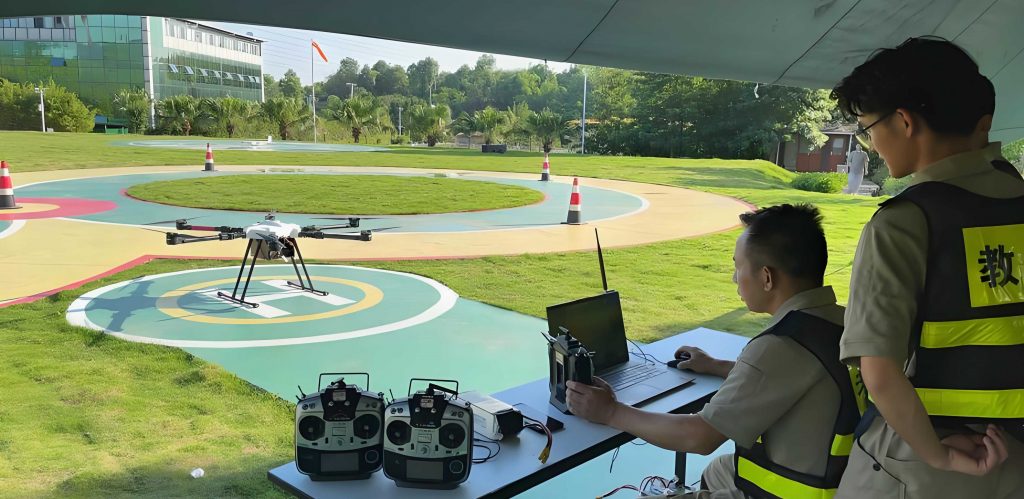
Shanghe County’s strategy centers on attracting manufacturing enterprises for drones and general aircraft. This not only boosts production but also creates demand for associated drone training services, such as maintenance workshops and pilot certification courses. By 2025, the county aims to host multiple companies involved in drone training, fostering a holistic industry chain.
The technological underpinnings of these initiatives are equally noteworthy. AI-driven platforms, like the edge computing systems mentioned earlier, transform drones into intelligent agents. However, their effectiveness hinges on continuous drone training to update algorithms and adapt to new scenarios. Consider the performance metric for AI-enhanced drones:
$$ P_{drone} = \frac{A_{accuracy} \cdot R_{response}}{D_{delay}} $$
where \( P_{drone} \) is the performance score, \( A_{accuracy} \) is the AI model’s accuracy, \( R_{response} \) is the operator’s response rate influenced by drone training, and \( D_{delay} \) is the system delay. Improving drone training elevates \( R_{response} \), thereby boosting overall performance. Furthermore, the scalability of drone fleets can be modeled using a growth function:
$$ N_{drones}(t) = N_0 \cdot e^{rt} $$
Here, \( N_{drones}(t) \) is the number of drones at time \( t \), \( N_0 \) is the initial fleet size, and \( r \) is the growth rate dependent on factors like investment and drone training capacity. As drone training programs expand, \( r \) increases, accelerating adoption.
To encapsulate the broader impact, we examine the low-altitude economy’s contribution to regional GDP. A simplified model might be:
$$ GDP_{contribution} = \sum_{s=1}^{m} (V_s \cdot E_s) $$
with \( V_s \) representing the value added by sector \( s \) (e.g., logistics, tourism) and \( E_s \) denoting the employment multiplier enhanced by drone training. Sectors with intensive drone training, such as emergency medical services, show higher \( E_s \) due to skilled labor requirements.
Our efforts extend beyond immediate applications to building an “industrial scenario ecosystem.” This involves linking technological innovation with market demands through mechanisms like “scenario + innovation” and “scenario + investment.” Drone training serves as a linchpin in this ecosystem, enabling the transition from prototypes to widespread deployment. For instance, the integration of satellite navigation with drone operations requires cross-disciplinary drone training that covers both space-based data and aerial maneuvering.
Looking ahead, we anticipate a surge in demand for drone training across various domains. The proliferation of星座计划, such as micro-scale low-orbit satellite constellations, will enhance positioning accuracy for drones, necessitating updated training curricula. Similarly, the rise of “low-altitude +” scenarios—from物流运输 to城市治理—will call for specialized drone training modules tailored to each use case.
In conclusion, the aerospace information industry is poised for exponential growth, driven by digital scenarios and a relentless focus on practical implementation. Drone training emerges as a critical enabler, ensuring that technological advancements translate into tangible benefits. Through collaborative opportunities, regional initiatives, and continuous innovation, we are committed to fostering a thriving ecosystem where drone training becomes synonymous with progress and resilience. The journey from laboratory to application is paved with education and skill development, making drone training an indispensable pillar of our future landscape.