
As an engineer and researcher deeply fascinated by the confluence of aesthetics and technology, I have always been captivated by the spectacle of a formation drone light show. What appears as a seamless, magical dance in the night sky is, in reality, a triumph of precision engineering, robust communication, and advanced control theory. Moving beyond the visual wonder, I view each formation drone light show as a compelling real-world application of multi-agent systems, demanding solutions to complex problems in cooperative guidance, navigation, and control. In this article, I will delve into the core technical challenges and present a structured, model-based approach to designing control systems that can orchestrate hundreds, even thousands, of drones into stunning, reliable aerial displays.
The primary objective of any formation drone light show is to maneuver a fleet of UAVs from an initial configuration to trace a pre-defined, possibly time-varying, three-dimensional path. Each drone becomes a luminous pixel in a grand, kinetic canvas. The fundamental challenges are manifold: ensuring collision-free operation amidst dense packing, maintaining precise relative positioning for shape integrity, compensating for environmental disturbances like wind, and managing the inherent dynamics and limitations of each vehicle. Unlike simple waypoint navigation, a formation drone light show requires synchronized motion where the state of every agent is coupled to the others.
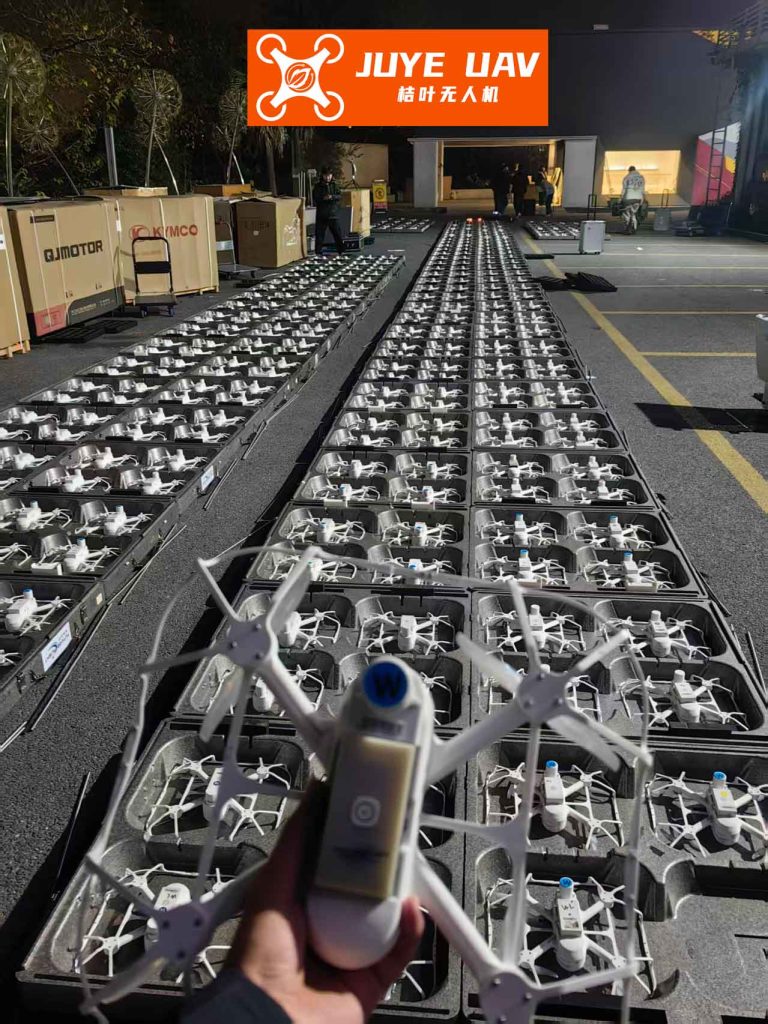
The visual impact of a formation drone light show is undeniably its most famous attribute. However, the engineering rigor behind the scenes is what guarantees a flawless performance. A failure in coordination is not merely a software bug; it is a very public and potentially hazardous system failure. Therefore, the control paradigm must be inherently safe, predictable, and capable of handling the “what-if” scenarios before they occur. This is where model-based predictive strategies shine, as they allow us to embed safety and performance constraints directly into the control law’s computation.
1. System Modeling for a Formation Drone Light Show
Any rigorous control design begins with a mathematical representation of the system. For a formation drone light show, we must model two interconnected layers: the individual drone dynamics and the collective formation geometry.
1.1 Single-Agent Dynamics
We typically consider quadrotor drones due to their agility and hovering capability. The dynamics are nonlinear and underactuated (six degrees of freedom controlled by four motor inputs). The state vector for drone \( i \) is often defined as:
$$\mathbf{x}_i = [p_n, p_e, h, \phi, \theta, \psi, u, v, w, p, q, r]^T$$
where \( (p_n, p_e, h) \) are North-East-Down (NED) positions, \( (\phi, \theta, \psi) \) are roll, pitch, yaw Euler angles, \( (u,v,w) \) are body-frame velocities, and \( (p,q,r) \) are body-frame angular rates.
The nonlinear dynamics can be derived from Newton-Euler equations:
$$ m \dot{\mathbf{v}} = \mathbf{F}_g + \mathbf{R}(\phi,\theta,\psi) \mathbf{F}_t – \mathbf{F}_a $$
$$ \mathbf{J} \dot{\boldsymbol{\omega}} = -\boldsymbol{\omega} \times \mathbf{J} \boldsymbol{\omega} + \boldsymbol{\tau}_a + \boldsymbol{\tau}_t $$
where \( m \) is mass, \( \mathbf{J} \) is the inertia matrix, \( \mathbf{F}_g \) is gravity, \( \mathbf{F}_t \) and \( \boldsymbol{\tau}_t \) are thrust and torque from motors, and \( \mathbf{F}_a, \boldsymbol{\tau}_a \) are aerodynamic forces/torques. For control design, we often linearize these dynamics around a hovering or cruising equilibrium point \( (\mathbf{x}^*, \mathbf{u}^*) \), yielding a discrete-time linear time-invariant (LTI) model for prediction:
$$ \mathbf{x}_i(k+1) = \mathbf{A}_i \mathbf{x}_i(k) + \mathbf{B}_i \mathbf{u}_i(k) $$
1.2 Formation Kinematics and Communication Topology
The essence of a formation drone light show is defined by relative geometry. We describe the desired formation using a set of relative position vectors \( \mathbf{r}_{ij}^d = \mathbf{p}_j^d – \mathbf{p}_i^d \) between drones \( i \) and \( j \) in a common reference frame. The drones must maintain these vectors while the entire formation translates, rotates, or scales.
The flow of information is critical. The communication or sensing topology can be represented as a graph \( \mathcal{G} = (\mathcal{V}, \mathcal{E}) \), where vertices \( \mathcal{V} \) are drones and edges \( \mathcal{E} \) represent available communication links. A common topology for a formation drone light show is a leader-follower or a spanning tree structure, where a subset of drones (leaders) track a global trajectory, and others (followers) maintain position relative to their neighbors.
The combined system model for \( N \) drones is a large-scale, interconnected system. The overall state is \( \mathbf{X} = [\mathbf{x}_1^T, …, \mathbf{x}_N^T]^T \), and the coupled dynamics and formation constraints make the control problem high-dimensional.
2. A Hierarchical Control Architecture
To manage complexity, a hierarchical control structure is most effective for a formation drone light show.
| Layer | Function | Timescale | Key Inputs/Outputs |
|---|---|---|---|
| Mission & Path Planning | Defines the overall show sequence, 3D shapes, and smooth global paths for the formation centroid. | Minutes | Artistic intent → Time-parameterized centroid trajectory \( \mathbf{p}_c(t), \psi_c(t) \). |
| Formation Management | Generates reference trajectories \( \mathbf{x}_i^{ref}(t) \) for each drone from the global path and desired shape. Handles shape transitions (morphing). | Seconds | Centroid path + Formation shape → \( N \) individual reference trajectories. |
| Coordinated Control | Computes control inputs \( \mathbf{u}_i \) for each drone to track its reference while respecting inter-agent constraints (collision avoidance, connectivity). This is the core algorithmic layer. | Milliseconds to Seconds | Current states \( \mathbf{X} \) + Reference trajectories → Actuator commands \( \mathbf{U} \). |
| Low-Level Flight Control | Stabilizes the drone’s attitude and executes velocity/thrust commands. Typically a fast, onboard PID or similar controller. | Milliseconds | Desired attitude/rates → Motor PWM signals. |
The “Coordinated Control” layer is where the most significant challenge for a reliable formation drone light show lies. It must reconcile precise tracking with safety.
3. Model Predictive Control (MPC) for Formation Flight
Model Predictive Control is exceptionally well-suited for the coordinated control layer of a formation drone light show. Its predictive nature and explicit constraint-handling capability are ideal for this application.
3.1 Centralized vs. Distributed MPC
In a Centralized MPC scheme, a single ground control station solves one large optimization problem encompassing all \( N \) drones:
$$ \min_{\mathbf{U}(k:k+H-1)} \sum_{j=0}^{H-1} \left( \| \mathbf{X}(k+j|k) – \mathbf{X}^{ref}(k+j) \|_{\mathbf{Q}}^2 + \| \mathbf{U}(k+j|k) \|_{\mathbf{R}}^2 \right) $$
subject to:
$$ \mathbf{X}(k+j+1|k) = \mathbf{f}(\mathbf{X}(k+j|k), \mathbf{U}(k+j|k)) $$
$$ \mathbf{U}_{min} \leq \mathbf{U} \leq \mathbf{U}_{max} $$
$$ \| \mathbf{p}_i – \mathbf{p}_j \| \geq d_{safe}, \quad \forall i \neq j \quad \text{(Collision Avoidance)} $$
$$ \| \mathbf{p}_i – \mathbf{p}_j \| \leq d_{com}, \quad \forall (i,j) \in \mathcal{E} \quad \text{(Connectivity)} $$
where \( H \) is the prediction horizon, and \( \mathbf{Q}, \mathbf{R} \) are weighting matrices. While powerful, this approach scales poorly with \( N \), becoming computationally intractable for a large formation drone light show.
Distributed MPC (DMPC) is the practical choice. Each drone \( i \) solves its own local optimization problem, using estimates or communicated plans of its neighbors’ future states. The local cost for drone \( i \) becomes:
$$ J_i = \sum_{j=0}^{H-1} \left( \| \mathbf{x}_i – \mathbf{x}_i^{ref} \|_{\mathbf{Q}_i}^2 + \| \mathbf{u}_i \|_{\mathbf{R}_i}^2 + \sum_{l \in \mathcal{N}_i} \| \mathbf{p}_i – \mathbf{p}_l^{pred} – \mathbf{r}_{il}^d \|_{\mathbf{S}}^2 \right) $$
where \( \mathcal{N}_i \) are its neighbors in the communication graph, and \( \mathbf{p}_l^{pred} \) is the predicted position of neighbor \( l \). The third term enforces formation-keeping relative to neighbors. Constraints are localized (e.g., \( \| \mathbf{p}_i – \mathbf{p}_l^{pred} \| \geq d_{safe} \)). Drones iteratively communicate and update their plans to achieve consistency, making the system scalable and fault-tolerant—a crucial feature for a professional formation drone light show.
3.2 Handling Uncertainty and Disturbances
A formation drone light show operates outdoors, subject to wind gusts and model inaccuracies. Robust MPC or Tube-Based MPC can be employed. Here, the nominal model is used for prediction, but the controller is designed to keep the actual state within a “tube” around the nominal trajectory despite bounded disturbances. The dynamics are often modeled as a polytopic uncertainty set:
$$ [\mathbf{A}(k), \mathbf{B}(k)] \in \text{Co}\{ [\mathbf{A}_1, \mathbf{B}_1], …, [\mathbf{A}_L, \mathbf{B}_L] \} $$
where Co denotes the convex hull. The online optimization then finds a control policy that minimizes the worst-case cost over this set of possible models, guaranteeing robust constraint satisfaction—an essential property for safe operation of a massive formation drone light show.
4. Advanced Methods: Integrating Learning and Adaptation
While linearized models and robust MPC provide a solid foundation, the ultimate formation drone light show system can benefit from advanced integration. We can augment the MPC framework with learning-based components to improve performance.
Consider an architecture where a neural network learns a residual dynamics model \( \Delta \mathbf{f}(\mathbf{x}, \mathbf{u}) \) that captures the nonlinearities and unmodeled effects (e.g., complex aerodynamics, battery sag effects) not captured by the simple linear model:
$$ \mathbf{x}(k+1) = \mathbf{A} \mathbf{x}(k) + \mathbf{B} \mathbf{u}(k) + \Delta \mathbf{f}(\mathbf{x}(k), \mathbf{u}(k); \boldsymbol{\Theta}) $$
The parameters \( \boldsymbol{\Theta} \) are learned from flight data. This learned model can then be used within the MPC predictor, leading to more accurate predictions and better tracking, especially during aggressive maneuvers in a dynamic formation drone light show.
Furthermore, the weighting matrices \( \mathbf{Q}_i \) and \( \mathbf{R}_i \) in the local cost function can be adapted online via meta-learning or reinforcement learning principles to optimize for overall formation smoothness or energy efficiency based on the current maneuver type in the formation drone light show script.
| Aspect | Traditional Geometric Control | Proposed MPC-Based Approach |
|---|---|---|
| Constraint Handling | Difficult; often handled reactively or through careful trajectory design. | Explicit and proactive. Safety (collision, connectivity) is encoded as hard/soft constraints in the optimization. |
| Optimality | Local optimality, usually for a specific task (e.g., consensus). | Limited-horizon optimality. Directly optimizes a performance metric (tracking error, control effort) over a future window. |
| Disturbance Rejection | Relies on robustness of feedback law; can degrade performance. | Predictive compensation. Can anticipate and counteract the effect of persistent disturbances. Robust MPC variants guarantee bounded error. |
| Formation Transitions | Can be jerky; requires separate planning and control phases. | Seamless. Shape morphing is naturally handled by smoothly updating the reference trajectories \( \mathbf{x}_i^{ref}(t) \) fed to the MPC. |
| Computational Load | Low (suitable for onboard). | Higher, but manageable with efficient solvers (QP, ADMM) and distributed computation. Scales well for a formation drone light show. |
5. Future Directions and Conclusion
The engineering of a formation drone light show is a rapidly evolving field. Future research and development will push towards even greater autonomy, resilience, and creative expression.
First, learning and adaptation will move from augmentation to core components. End-to-end learning of robust control policies that implicitly understand swarm dynamics and constraints is a promising frontier. This could allow a formation drone light show system to automatically compensate for the loss of a drone or adapt its pattern to unforeseen obstacles.
Second, fault-tolerant and safe-reaction protocols are critical for certification and public safety. Formal methods, inspired by aerospace practices, need to be integrated to verify that the distributed control algorithms will never produce a catastrophic failure, even under multiple faults.
Third, exploring physical interactions opens new artistic dimensions. Imagine drones carrying lightweight physical elements or projection screens, creating hybrid physical-digital displays. This adds another layer of complexity to the dynamics and control of the formation drone light show.
In conclusion, orchestrating a breathtaking formation drone light show is far more than programming lights to follow paths. It is a sophisticated exercise in systems engineering, requiring careful modeling, hierarchical decomposition, and the application of advanced predictive control strategies like MPC. By framing each drone as an intelligent agent within a tightly coupled network and employing distributed optimization to manage their collective behavior, we can achieve the remarkable synergy of precision, safety, and artistry that defines a world-class formation drone light show. The continuous integration of machine learning and robust control theory promises to unlock even more spectacular and intelligent aerial performances in the years to come.