
The spectacle of a formation drone light show, with hundreds of luminescent drones moving in perfect, intricate harmony against the night sky, represents far more than just a technological marvel for entertainment. It is the most visible and public-facing manifestation of a profound shift in robotics and autonomous systems: the move from centralized command to distributed, cooperative intelligence. While the choreography of a formation drone light show is often pre-programmed, the underlying requirement—precise, reliable, and scalable spatial coordination—is directly applicable to critical military, industrial, and scientific missions. This article explores the theoretical foundations, state-of-the-art methodologies, and future trajectories of multi-drone formation control, with a specific focus on consensus-based algorithms, which form the backbone of robust and scalable distributed systems, including the very systems that enable a breathtaking formation drone light show.
1. The Imperative for Cooperative Drone Formations
The limitations of a single unmanned aerial vehicle (UAV) are stark when faced with complex, large-scale, or high-risk tasks. A solo drone tasked with wide-area surveillance, search-and-rescue, or precision delivery faces constraints in endurance, sensor coverage, and operational redundancy. In contrast, a cooperative formation of drones can distribute the workload, increase system resilience through redundancy, and accomplish missions with greater efficiency and success rates. For instance, a swarm can fan out to cover a vast search area simultaneously, relay communications over extended distances in a mesh network, or collaboratively lift and transport payloads impossible for a single agent. The formation drone light show exemplifies this principle on a aesthetic level, where the collective creates dynamic, complex patterns no single drone could achieve.
At the heart of this cooperation lies the formation control problem. The objective is to enable a group of drones to achieve and maintain a desired spatial configuration—a geometric pattern—while navigating through an environment, avoiding obstacles, and preventing inter-agent collisions. This is not merely about individual path tracking; it is about orchestrating relative dynamics based on shared or local objectives.
2. The Evolution of Formation Control Paradigms
Early approaches to formation control often relied on centralized architectures or simplistic following behaviors. Over time, more sophisticated and distributed paradigms emerged, each with distinct advantages and drawbacks.
| Control Paradigm | Core Principle | Advantages | Disadvantages |
|---|---|---|---|
| Leader-Follower | One designated leader drone dictates the group’s motion; followers maintain a predefined offset relative to the leader. | Conceptually simple, easy to implement, intuitive. | Single point of failure (leader), no feedback from followers to leader, tracking errors can accumulate downstream. |
| Behavior-Based | Each drone executes a weighted blend of basic behaviors (e.g., collision avoidance, goal seeking, formation keeping). | Highly adaptive and flexible in dynamic environments. | Difficult to formally analyze for stability, guarantee precise formation geometry, or scale to large numbers. |
| Virtual Structure | The entire formation is treated as a single rigid body or virtual structure; drones act as moving nodes attached to this structure. | Enables high-precision formation keeping and well-defined group maneuvers. | Requires a shared, synchronized model of the virtual structure, which can be challenging in distributed networks with communication delays. |
| Consensus-Based (Distributed) | Each drone adjusts its state based on agreements (consensus) with its immediate neighbors in a communication network. | Highly scalable, robust to individual failures, inherently distributed, strong theoretical foundation. | Controller design complexity depends on network topology; requires careful handling of communication constraints. |
The shift towards distributed control is critical for real-world applications. Centralized systems, where a single computer calculates commands for all drones, suffer from a critical vulnerability: the central node is a single point of failure and requires immense, unscalable communication bandwidth. The mesmerizing precision of a commercial formation drone light show often uses a centralized, motion-capture-aided system for ultimate precision in a controlled environment. However, for field operations—whether in GPS-denied environments, over large distances, or in adversarial settings—a distributed approach is essential. Here, each drone is an autonomous agent, making decisions based on information exchanged with nearby teammates, leading to systems that are fault-tolerant, scalable, and adaptable.
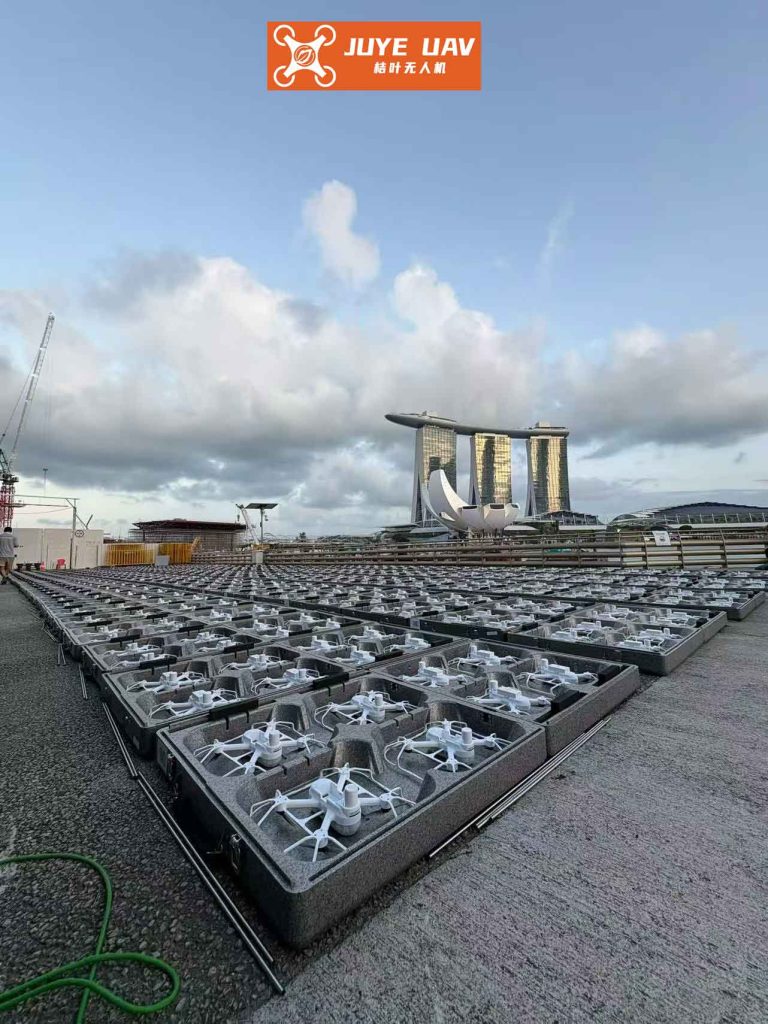
This image captures the essence of coordinated aerial robotics—a fleet of drones maintaining tight spatial relationships, a prerequisite for both advanced mission capabilities and the visual artistry of a formation drone light show. The transition from this static formation to dynamic, intelligent control requires the mathematical framework of multi-agent consensus.
3. The Mathematical Backbone: Graph Theory and Consensus
To analyze and design distributed systems, we model the communication network as a graph. Let a formation consist of \(N\) drones. The communication topology is represented by a graph \(\mathcal{G} = (\mathcal{V}, \mathcal{E})\), where:
– \(\mathcal{V} = \{1, 2, …, N\}\) is the set of vertices (drones).
– \(\mathcal{E} \subseteq \mathcal{V} \times \mathcal{V}\) is the set of edges (communication links). An edge \((j, i)\) exists if drone \(i\) can receive information from drone \(j\).
The topology is described by matrices:
– Adjacency Matrix \(A = [a_{ij}] \in \mathbb{R}^{N \times N}\), where \(a_{ij} > 0\) if \((j, i) \in \mathcal{E}\), else \(a_{ij} = 0\).
– Laplacian Matrix \(L = [l_{ij}] \in \mathbb{R}^{N \times N}\), where \(l_{ii} = \sum_{j \neq i} a_{ij}\) and \(l_{ij} = -a_{ij}\) for \(i \neq j\). This matrix is fundamental to consensus analysis.
The core consensus problem is defined as follows: For a group of agents with dynamics, design a distributed control law using only local neighbor information such that the states of all agents converge to a common value. For first-order integrator dynamics (where control input directly affects velocity), a fundamental consensus protocol is:
$$\dot{x}_i(t) = u_i(t) = -\sum_{j \in \mathcal{N}_i} a_{ij}(x_i(t) – x_j(t))$$
where \(x_i\) is the state (e.g., position) of agent \(i\), and \(\mathcal{N}_i\) is its set of neighbors. In matrix form, this is:
$$\dot{\mathbf{x}}(t) = -L \mathbf{x}(t)$$
Under a connected communication graph, this protocol guarantees \(\lim_{t \to \infty} x_i(t) = \frac{1}{N}\sum_{j=1}^N x_j(0)\), achieving average consensus.
For drone formation control, which typically involves controlling both position and velocity (second-order dynamics), the consensus objective extends. A typical second-order agent model is:
$$
\begin{align}
\dot{p}_i(t) &= v_i(t) \\
\dot{v}_i(t) &= u_i(t)
\end{align}
$$
where \(p_i\) and \(v_i\) are position and velocity, respectively. A basic consensus-based formation control law might be:
$$
u_i(t) = -\sum_{j \in \mathcal{N}_i} a_{ij}[(p_i(t)-p_j(t)) + \gamma (v_i(t)-v_j(t))] + f_i(p_i, v_i, t)
$$
Here, the consensus terms drive positions and velocities to alignment, while the term \(f_i(\cdot)\) encodes the specific desired formation geometry as offsets from a common reference. This elegantly separates the problems of agreement (consensus) and formation shape.
4. Consensus-Based Formation Control: Architectures and Advancements
The basic consensus principle can be extended and adapted to solve the complex, real-world formation control problem. The literature has evolved significantly from simple linear models to address practical challenges.
4.1 Handling Complex Dynamics and Communication
Real drones are not simple integrators; they have higher-order, nonlinear dynamics (attitude dynamics, motor dynamics). Consensus protocols must be designed for these general linear time-invariant (LTI) systems:
$$
\begin{align}
\dot{x}_i(t) &= A x_i(t) + B u_i(t) \\
y_i(t) &= C x_i(t)
\end{align}
$$
where \(x_i\) is the full state vector. The goal becomes achieving output consensus (e.g., position and velocity) using either state or output feedback. The control law takes the form:
$$
u_i(t) = K_1 \sum_{j \in \mathcal{N}_i} a_{ij}(y_i(t) – y_j(t)) + K_2 y_i(t)
$$
Finding the gain matrices \(K_1\) and \(K_2\) to ensure stability and consensus across the network often involves solving Linear Matrix Inequalities (LMIs) that incorporate both the agent dynamics \((A, B, C)\) and the network’s graph Laplacian \(L\).
A critical distinction in network topology is between undirected and directed graphs. An undirected graph implies two-way communication, making \(L\) symmetric and simplifying analysis. A directed graph (digraph) is more general and realistic (e.g., communication links may be one-way due to antenna patterns or interference). Consensus under directed topologies requires the graph to have a directed spanning tree. Recent research has focused on designing protocols robust to switching topologies, where communication links appear or disappear dynamically due to distance, obstacles, or intended network reorganization, as might happen in a large-scale formation drone light show transitioning between patterns.
4.2 Time-Varying Formations and Trajectory Tracking
A static formation is of limited use. The real challenge is a time-varying formation that can morph, rotate, and follow a designated trajectory. This is the essence of a dynamic formation drone light show. The control objective is redefined: instead of converging to constant offsets, drones must track time-varying offset vectors \(h_i(t)\) relative to a global trajectory \(p_0(t)\). The consensus error is redefined accordingly. The controller must now account for the derivatives of these desired offsets, effectively making the formation’s shape a dynamic command signal. Advanced protocols ensure that the formation center accurately tracks a virtual leader’s trajectory while the drones maintain the relative shape, even under switching communication networks.
4.3 Robustness and Performance: Disturbances and Constraints
Practical deployment introduces disturbances (wind gusts, modeling errors) and physical constraints. H∞ consensus control designs protocols to minimize the effect of bounded energy disturbances on the formation error. The goal is to find a controller that satisfies an H∞ norm condition, guaranteeing performance robustness.
Another major constraint is input saturation. The thrust and torque a drone can generate are physically limited. A high-gain consensus controller can demand unrealistic control efforts, especially during aggressive formation maneuvers or initial convergence. Designing protocols that explicitly respect actuator limits while achieving consensus is an active area of research, crucial for the aggressive but safe maneuvers seen in a high-performance formation drone light show.
The problem of collision avoidance is paramount. While consensus drives agreement, an additional repulsive potential field term is often added to the control input:
$$
u_{i, avoid}(t) = -\nabla_{p_i} \sum_{j \neq i} \Psi(\|p_i – p_j\|)
$$
where \(\Psi(\cdot)\) is a repulsive potential function that becomes large when drones are too close. The challenge is to integrate this seamlessly with the consensus protocol to ensure both formation keeping and safety without inducing oscillations or deadlock.
5. Current Frontiers and Future Trajectories
The field of consensus-based formation control continues to evolve, pushing towards greater autonomy, resilience, and applicability. The demands of a sophisticated formation drone light show—extreme precision, reliability, and complex choreography—often presage the requirements for mission-critical applications.
| Research Frontier | Technical Challenge | Potential Impact |
|---|---|---|
| Event-Triggered & Self-Triggered Control | Reducing constant communication by updating control only when necessary (e.g., when error exceeds a threshold). | Drastically saves communication bandwidth and onboard computational energy, enabling larger swarms and longer endurance. |
| Formation under Communication Delays | Explicitly modeling and compensating for time-varying, heterogeneous delays in the communication network. | Enables stable formation in real-world networks (e.g., ad-hoc wireless) and over longer distances, essential for scalable outdoor formation drone light show systems. |
| Learning-Based and Adaptive Consensus | Using machine learning (RL, neural networks) to adaptively tune controller gains or learn interaction dynamics online. | Allows formations to adapt to unknown agent dynamics, changing environments, or component failures autonomously. |
| Integrated Perception-Action Cycles | Using onboard vision (e.g., visual relative localization) instead of/exclusive of radio communication for neighbor state estimation. | Enables formation flight in GPS/communication-denied environments and provides a higher-fidelity, lower-latency state feedback for ultra-tight formations. |
| Secure and Resilient Consensus | Defending against cyber-attacks (e.g., false data injection, spoofing) that aim to disrupt the consensus process. | Critical for military and infrastructure applications where the swarm must be robust to adversarial interference. |
The ultimate vision is a fully autonomous, scalable, and resilient swarm where the lines between a functional mission formation and an artistic formation drone light show blur. The same core algorithms that allow drones to collaboratively map a disaster zone, deliver emergency supplies in a coordinated fleet, or establish a secure communication mesh network, also empower them to become dynamic pixels in the sky, painting complex, evolving images. The consensus protocol is the invisible conductor, ensuring that each individual agent’s local actions harmonize into a stable, intelligent, and purposeful collective behavior.
6. Conclusion
The journey from centralized, pre-programmed paths to distributed, consensus-based intelligence represents a fundamental leap in multi-robot systems. The theory of consensus, grounded in graph theory and linear systems, provides a powerful and flexible framework for designing formation controllers that are scalable, robust to failures, and adaptable to complex scenarios. While significant challenges remain—particularly in handling real-world communication constraints, actuator limits, and the need for integrated safe navigation—the progress has been remarkable. As research pushes forward on adaptive, learning-based, and secure consensus protocols, the capabilities of drone formations will expand far beyond today’s applications. The captivating spectacle of a formation drone light show serves as both a public demonstration and a demanding testbed for these technologies, foreshadowing a future where cooperative aerial robots seamlessly integrate into the fabric of our world, performing tasks and creating experiences that are fundamentally collective endeavors.