
In my research, I have observed that drone light shows, which emerged from early 20th-century prototypes and underwent prolonged technical preparation, have entered a rapid development phase since the early 21st century. These shows have gradually permeated the realm of visual culture, serving as technological media for performances and evolving into a novel art form that shines in large-scale events, festivals, and commercial promotions. A drone light show refers to the dynamic aerial display where multiple drones are coordinated into various shapes and patterns through computer control, programming, wireless communication, and swarm technology, offering audiovisual震撼. As the technology behind drone light shows becomes widely adopted and rapidly普及, the inherent conflict between technological rationality and humanistic values has become increasingly apparent. The cultural内涵 risks being diluted or marginalized amidst rapid technological迭代. This矛盾 not only hinders the artistic quality of drone light shows but also impacts their sustainable development, posing an urgent issue to address. In this study, I aim to analyze the conflict between technological rationality and humanistic values in drone light shows, thereby expanding the breadth and depth of research on the relationship between technology and humanities and promoting the良性 development of this field.
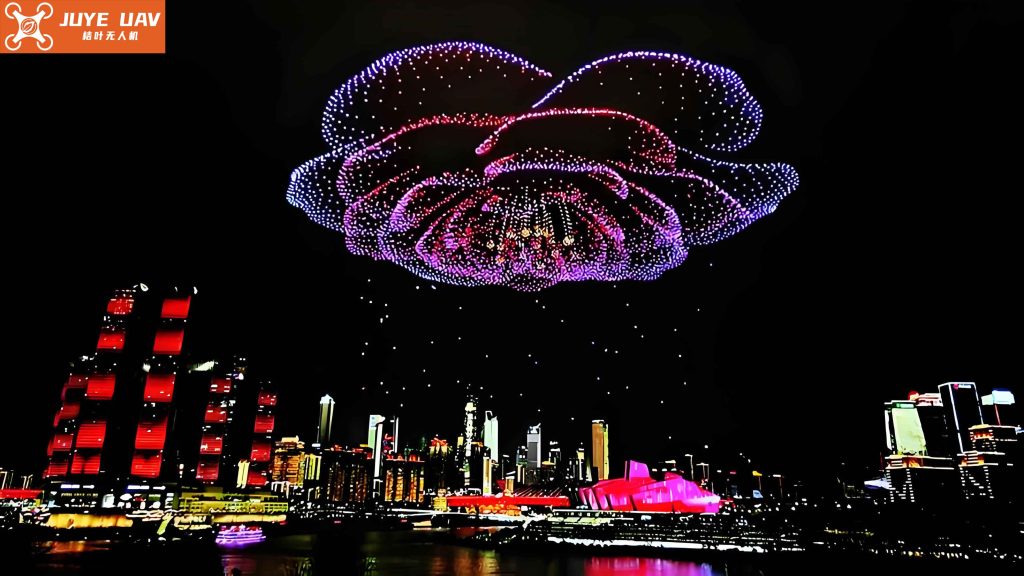
From my perspective, technological rationality in drone light shows encompasses the material foundation and methodological systems that enable their realization, including flight control, swarm coordination algorithms, lighting control systems, and communication technologies. The core of a drone light show lies in the precise adjustment and control of drone formations, lighting effects, and flight trajectories through code, optimizing efficiency, accuracy, and visual impact to deliver震撼 experiences for audiences. Based on the “transcodability” of technological tools, drone light shows facilitate flexible conversion between data and symbols, transforming physical space into a programmable virtual image backdrop—a unique “sky coding.” This媒介 practice allows drone formations to convey cultural内涵 and artistic value through symbols, graphics, and dynamic imagery in the air. Technological rationality and humanistic values exhibit a辩证统一关系 in drone light shows: technology enables the presentation of cultural elements and creative expressions, while humanistic values provide meaning and direction, driving technological innovation and application. Their良性互动 enhances artistic quality and imbues technological development with humanistic关怀, meeting society’s deeper spiritual and cultural needs.
However, in my analysis, I have identified several manifestations of conflict between technological rationality and humanistic values in drone light shows. These can be summarized in the following table:
| Conflict Manifestation | Description | Example from Drone Light Shows |
|---|---|---|
| Technology Dominance vs. Humanistic Experience Misalignment | Technical failures or overemphasis on visual spectacle undermine观众体验 and cultural interpretation. | Instances like the 2018 Xi’an show with 1374 drones experiencing “pattern乱码” due to technical glitches, or a 2024 show in Quanzhou where drones坠海, leading to audience disappointment. |
| Technical Standardization vs. Cultural Diversity Disharmony | Standardized technical approaches lead to homogenized content, eroding local cultural特色 and diversity. | Similar “Great Sage” patterns repeated across cities during 2025 Spring Festival shows, reducing cultural uniqueness and audience interest. |
| Visual Impact vs. Cultural内涵 Imbalance | Focus on technological innovation and visual震撼 overshadows deep cultural exploration and emotional resonance. | Shows like the 2023 “Dunhuang Feitian” performance that combined drones with cultural elements but lacked depth, or the 2024 Shenzhen National Day show that prioritized科幻 visuals over cultural reflection. |
To quantify the视觉冲击 in a drone light show, I consider factors like brightness, color variation, and motion dynamics. For example, the overall visual impact $V$ can be modeled as:
$$V = \alpha \cdot \sum_{i=1}^{N} L_i \cdot C_i + \beta \cdot \int_{0}^{T} |\vec{v}(t)| \, dt + \gamma \cdot \Delta S$$
where $N$ is the number of drones, $L_i$ is the luminosity of drone $i$, $C_i$ represents color intensity, $\vec{v}(t)$ is the velocity vector over time $T$, $\Delta S$ denotes shape complexity, and $\alpha, \beta, \gamma$ are weighting coefficients. This formula highlights how technological parameters dominate the experience, often at the expense of cultural depth.
In my investigation, I attribute these conflicts to several root causes, as outlined below:
| Causative Factor | Explanation | Impact on Drone Light Shows |
|---|---|---|
| Technology-Driven Development Model | Early stages prioritize technical expertise, with engineers focusing on performance and control, while humanists and artists have limited input. | Leads to high technical proficiency but insufficient人文价值, as seen in shows that emphasize编队 precision over cultural storytelling. |
| Imbalance Between Economic Interests and Cultural Value | Commercialization drives drone light shows toward marketing goals, with cost-cutting and profit motives reducing investment in cultural creativity. | Results in repetitive, spectacle-heavy performances that serve商业宣传 but neglect artistic and cultural expression, exacerbating the技术理性 bias. |
| Differences in Social认知 and Cultural认同 | Divergent expectations from technologists, general audiences, and diverse cultural groups create challenges in balancing technical and humanistic needs. | Makes it difficult to satisfy all stakeholders, leading to conflicts where drone light shows fail to resonate跨 culturally or evoke deeper情感共鸣. |
From a technical standpoint, the swarm control in a drone light show can be described using algorithms. For instance, the position of each drone $i$ in a formation at time $t$ might follow:
$$ \vec{p}_i(t) = \vec{p}_0(t) + R(\theta(t)) \cdot \vec{d}_i $$
where $\vec{p}_0(t)$ is the center position, $R(\theta(t))$ is a rotation matrix for orientation, and $\vec{d}_i$ is the relative offset. This precision enables complex patterns but, if not infused with cultural context, risks becoming mere technical display.
To address these conflicts, I propose a multi-layered adaptation mechanism that harmonizes technological rationality and humanistic values in drone light shows. This mechanism involves technical, creative, and institutional layers, as detailed in the following table:
| Adaptation Layer | Strategies and Actions | Expected Outcomes for Drone Light Shows |
|---|---|---|
| Technical Layer: Cultural Embedding | Integrate cultural content into algorithms via 3D scanning, motion capture, and AR交互. For example, encode Dunhuang dance movements into drone trajectories, allowing real-time cultural overlay for audiences. | Enhances artistic expression and cultural传承, making technology a tool for价值传播. AR interactions increase观众参与度, deepening cultural understanding during the drone light show. |
| Creative Layer: Cross-Subject Collaboration | Form interdisciplinary teams of engineers, humanists, and artists to co-create表演. Use crowd-sourcing and data analytics to diversify content and align with audience expectations. | Fosters innovation that balances technical prowess with cultural内涵, avoiding homogenization and enriching the人文价值 of each drone light show. |
| Institutional Layer: Value Anchoring | Establish regulations for technical safety and cultural表达界限. Implement tripartite评审机制 (government, enterprise, culture) and dual-track awards for innovation and cultural传承. | Ensures动态平衡 between technology and humanities, guiding drone light shows from “spectacle display” to “cultural媒介” while safeguarding public interest. |
In the technical layer, the cultural embedding can be formalized. Suppose a cultural element, such as a traditional symbol, is represented by a function $f(x,y,t)$ defining its shape and motion. The drone formation aims to approximate this function over time $t$, minimizing an error metric $E$:
$$ E = \int_{0}^{T} \sum_{i=1}^{N} || \vec{p}_i(t) – f(x_i, y_i, t) ||^2 \, dt $$
where $\vec{p}_i(t)$ is the actual drone position. By optimizing this, the drone light show can faithfully render cultural motifs, bridging technology and art.
Furthermore, from a creative perspective, the collaboration process can be modeled as a feedback loop. Let $T_c$ represent technical inputs, $H_c$ humanistic inputs, and $O$ the output performance quality. A simple relationship might be:
$$ O = k_1 \cdot \log(1 + T_c) + k_2 \cdot \arctan(H_c) $$
with $k_1$ and $k_2$ as synergy coefficients. This emphasizes that both elements are essential for a high-quality drone light show, and neglecting either reduces overall impact.
Institutional frameworks can be quantified through policy effectiveness. If $P_t$ denotes technical regulations and $P_h$ cultural policies, the overall制度 impact $I$ on a drone light show might be:
$$ I = \frac{P_t \cdot P_h}{P_t + P_h} \cdot \delta $$
where $\delta$ is a compliance factor. This shows that balanced policies yield better outcomes, preventing dominance by either rationality or values.
In conclusion, my research underscores that technological rationality in drone light shows provides the technical foundation and innovative impetus for visual spectacles and creative conceptions. Humanistic values, on the other hand, manifest in the deep interpretation of cultural symbols, creative artistic expression, and cultural construction of social values. The有机平衡 between technological rationality and humanistic values is crucial for the sustainable development of drone light shows. Only through such balance can audiences enjoy the visual novelty they seek while satisfying their needs for cultural内涵 and emotional resonance. By analyzing the conflicts, their causes, and proposing adaptation mechanisms, this study contributes to fostering a协同发展 path for drone light shows, ensuring they evolve as both technological marvels and cultural treasures. As drone light shows continue to proliferate, ongoing attention to this balance will be vital for their artistic and societal relevance.