
From my perspective as someone deeply engaged in the study of naval aviation, the evolution of the aircraft carrier is inextricably linked to the capabilities of its air wing. The modern carrier battle group projects power through a symphony of specialized aircraft—fighters, electronic warfare platforms, early warning sentries, and sub-hunters. Historically, these have been manned platforms, but a profound shift is underway. The relentless push for greater reach, persistence, and survivability, while managing risk to human life, is steering development decisively toward an integrated force where the military drone transitions from a supporting asset to a central pillar of carrier air power.
The journey of carrier-based aircraft began over a century ago, with bold experiments launching biplanes from modified cruisers. World War II cemented their role, transforming naval warfare from gunnery duels to strikes launched from the sea. The post-war introduction of jet propulsion, aided by innovations like the angled flight deck and steam catapult, ushered in the supersonic age. Throughout this history, increasing specialization led to a diverse but complex and costly air wing. Today, the imperative is consolidation, networking, and autonomy. The trajectory points toward a future where multi-role manned aircraft work in seamless concert with advanced, carrier-capable military drone systems, a combination often referred to as “manned-unmanned teaming” (MUM-T).
| Classification Basis | Category | Key Characteristics & Examples |
|---|---|---|
| By Lift Principle | Fixed-Wing | Conventional wings; higher speed, payload, and range (e.g., F-35C, future military drone). |
| Rotary-Wing | Rotors for lift; VTOL capability for ASW, transport, SAR (e.g., MH-60R/S). | |
| By Take-off & Landing (Fixed-Wing) | Catapult Launch / Arrested Recovery (CATOBAR) | Requires catapult and arresting gear; enables operation of heaviest aircraft (E-2D, F/A-18). |
| Short Take-Off / Vertical Landing (STOVL) | Uses vectored thrust or lift fans (F-35B). | |
| Short Take-Off But Arrested Recovery (STOBAR) | Uses ski-jump ramp for launch, arrestor wires for recovery (Su-33). | |
| Vertical Take-Off and Landing (VTOL) | Critical for future unmanned deck operations; simplifies launch/recovery cycles for military drone platforms. | |
| By Mission Role | Fighter/Attack | Core striking arm; gaining multi-role dominance (F/A-18, F-35C). |
| Airborne Early Warning & Control (AEW&C) | Force multiplier; provides long-range radar and battle management (E-2D). | |
| Electronic Warfare (EW) | Provides radar jamming and electronic attack (EA-18G). | |
| Unmanned Carrier-Based Systems | Encompasses reconnaissance, strike, tanking, and loyal wingman military drone concepts (X-47B, MQ-25). | |
| Other (ASW, Transport, etc.) | Specialized support functions, increasingly areas for military drone integration. |
The operating environment for any carrier-based aircraft is uniquely demanding, and these constraints directly shape design priorities for next-generation systems, especially unmanned ones. The carrier is a small, moving, and corrosive airfield at sea, far from friendly bases.
| Environmental Challenge | Impact on Operations | Design & Technology Response |
|---|---|---|
| Limited & Dynamic Deck Space | Extremely confined area for launch, recovery, parking, and maintenance. Deck moves in 6 degrees of freedom (pitch, roll, heave, etc.). | Folding wings; reinforced landing gear; compact design; advanced automated landing systems tolerant of deck motion. |
| Short “Runway” Length | Take-off run <100m; landing run ~200m. Insufficient for conventional jet take-off/landing rolls. | Catapult/ramp-assisted launch; arrested recovery with tailhook; STOVL/VTOL capability crucial for future military drone integration. |
| Complex Air Wake & Turbulence | Severe and unpredictable “burble” and turbulence behind the carrier superstructure (“island”). | High-integrity flight control systems; robust air data sensors; predictive modeling for autonomous recovery of military drone assets. |
| Corrosive Maritime Atmosphere | Constant exposure to salt spray, high humidity, and fungi accelerates airframe and engine corrosion. | Extensive use of corrosion-resistant materials (composites, treated alloys); advanced sealants and coatings; rigorous maintenance protocols. |
| Isolated Logistics Chain | Limited ability to receive spare parts and major support while on deployment. | Emphasis on high reliability, maintainability, and supportability (RMS); commonality of parts across air wing; condition-based maintenance. |
These harsh conditions necessitate aircraft that are more robust, more reliable, and easier to maintain than their land-based counterparts. The push for reduced logistical footprint and enhanced sortie generation rates makes the case for autonomous systems even stronger. A military drone designed for carrier operations must not only survive these conditions but excel within them, requiring extraordinary resilience in its structure, propulsion, and avionics.
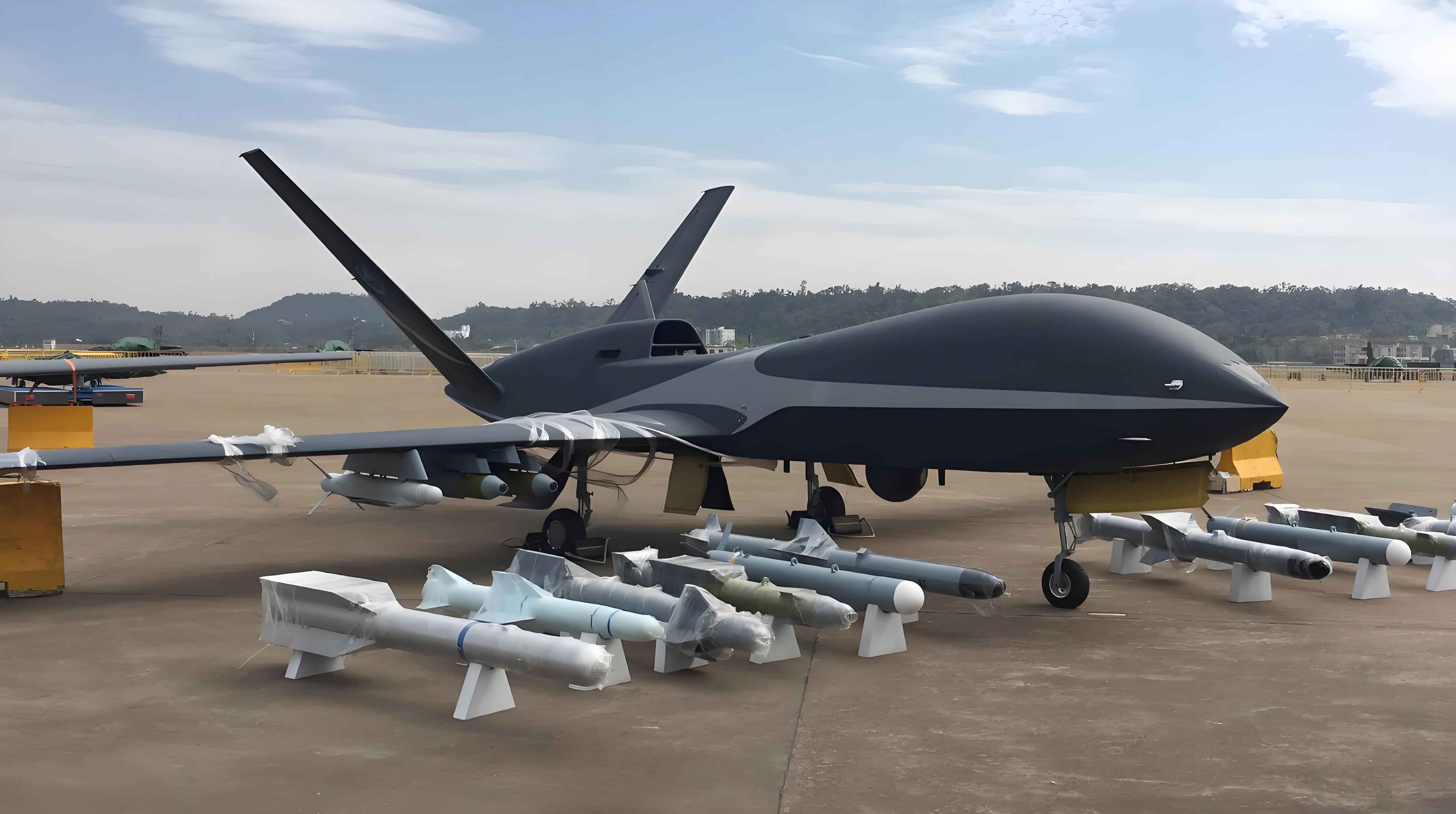
The technical evolution of the carrier air wing follows several interconnected vectors: platform consolidation, information dominance, and the integration of autonomy. The goal is to achieve greater capability with a leaner, more flexible, and more survivable force mix.
Vector 1: Multi-Role Consolidation & Commonality. The economic and logistical burden of maintaining numerous specialized aircraft types is unsustainable. The trend is toward “one airframe, many missions.” This is evident in the F-35 Lightning II family, designed from the outset in three variants (Conventional, STOVL, Carrier) for the Air Force, Marines, and Navy, sharing immense commonality in systems and logistics. This philosophy extends to the unmanned realm. A single type of carrier-based military drone airframe could be configured as a tanker (like the MQ-25 Stingray), an intelligence, surveillance, and reconnaissance (ISR) platform, or a strike asset, depending on mission needs and payload modules. The benefit is captured in a simplified model for fleet support cost (FSC):
$$ FSC \\propto \\sum_{i=1}^{n} (N_i \\cdot C_{maint,i} \\cdot S_{parts,i}) $$
Where \( n \) is the number of distinct aircraft types, \( N_i \) is the quantity of type \( i \), \( C_{maint,i} \) is its maintenance complexity, and \( S_{parts,i} \) is the uniqueness of its spare parts. Reducing \( n \) through common multi-role platforms (manned or unmanned) directly reduces \( FSC \).
Vector 2: Information as a Core Weapon. Modern combat is a contest of information. The side that better perceives, decides, and acts holds a decisive edge. Carrier aircraft are no longer just weapon platforms; they are critical nodes in a combat network. The E-2D Advanced Hawkeye epitomizes this, fusing data from multiple sensors (its own radar, other aircraft, ships) via data links to create a single, coherent, and resilient tactical picture. This picture is disseminated across the force, enabling long-range, over-the-horizon engagements. Future military drone systems will be fundamental to this network. They can act as forward sensor nodes, penetrating contested airspace too risky for manned platforms, feeding targeting data back to the carrier strike group. Their effectiveness in this role can be conceptualized through their contribution to the overall network’s information gain and decision speed.
Vector 3: Unmanned Systems as Force Multipliers. This is the most transformative trend. Unmanned carrier aviation moves from concept to reality, offering paradigm-shifting advantages. The operational benefits are not merely additive; they are multiplicative, fundamentally changing risk calculus and mission profiles.
| Aspect | Manned Aircraft | Advanced Military Drone / Unmanned System |
|---|---|---|
| Endurance | Limited by human physiological factors (8-10 hours typical). | Dramatically extended (24+ hours), enabling persistent ISR or combat air patrol. |
| Risk & Survivability | High-risk in contested environments; loss includes pilot. | No risk to aircrew; enables missions in anti-access/area-denial (A2/AD) zones; can be designed with lower observability. |
| Design Constraints | Must accommodate life support, cockpit, and human interface systems. | Airframe optimized purely for mission (larger fuel fraction, different G-limits, smaller cross-section). |
| Sortie Generation | Limited by pilot readiness and crew rest requirements. | Potentially higher sortie rate, limited mainly by maintenance and fueling. |
| Cost (Acquisition & Operation) | Extremely high for 5th-gen fighters. | Potentially lower lifecycle cost, though development costs are high. Enables “attritable” or “expendable” concepts. |
The technological pathway for carrier-based military drone integration is being paved through incremental steps. The MQ-25 Stingray addresses the critical and unglamorous need for aerial refueling, extending the range of the manned air wing. More profoundly, it validates the core technologies for unmanned carrier operations: robust deck handling, integration with catapults and arresting gear, and autonomous launch and recovery sequences. The next leap will be to combat-capable unmanned platforms, often envisioned as “Loyal Wingmen.” These attritable or reusable drones would fly alongside manned fighters like the F-35 or NGAD (Next Generation Air Dominance), controlled by the pilot, to perform tasks such as sensing, jamming, or weapons delivery. This distributes capability and confuses enemy targeting.
The operational concept for a future carrier air wing might involve a single sortie comprising two F-35s, each controlling two or three loyal wingman military drone units. This “combat cloud” would be supported by a persistent orbiting MQ-25 tanker and linked to an E-2D for battle management. The tactical advantage of such a distributed, networked force can be suggested by an adaptation of Lanchester’s laws for modern combat, where the combat power of a side is proportional to the square of its number of effective combat nodes \(N\) (platforms with networking and engagement capability), diminished by a factor representing network resilience \(R_{net}\):
$$ \\text{Combat Power} \\propto R_{net} \\cdot \\sum_{j=1}^{N} (E_{sensor,j} \\cdot E_{weapon,j}) $$
Here, \(E_{sensor}\) and \(E_{weapon}\) represent the sensor and weapon effectiveness of the j-th node (manned or unmanned). A swarm of networked military drone wingmen significantly increases \(N\) and enhances overall system resilience \(R_{net}\), creating a non-linear increase in combat power.
Key technological hurdles remain. Beyond the immense challenge of fully autonomous carrier landings in all weather and sea states, challenges include:
Secure and resilient communications: Drones must maintain robust, jam-resistant data links with controllers and the network.
Artificial Intelligence & Autonomy: Moving beyond remote control to advanced autonomy for navigation, threat response, and mission execution in communications-denied environments.
Integration into Air Wing Operations: Seamlessly managing mixed manned/unmanned flight decks, air traffic, and maintenance cycles.
Power and Propulsion: Enabling the long endurance and high-performance demands, potentially through advanced hybrid-electric or adaptive cycle engines.
Looking further ahead, the distinction between a dedicated military drone and a optionally-manned platform may blur. The ultimate expression of this trend could be a fully unmanned carrier air wing, where large “mothership” drones deploy smaller “daughter” drones for specific tasks, all orchestrated by AI battle managers. The fundamental physics of launch and recovery will always apply. The required take-off velocity \(V_{to}\) for a given aircraft weight \(W\), wing area \(S\), and lift coefficient \(C_{L,max}\) under deck wind over speed \(V_w\) and catapult stroke length \(d\) is governed by energy relations. For a drone with potentially different design parameters, the equation highlights trade-offs:
$$ \\frac{1}{2} m V_{to}^2 + \\frac{1}{2} m V_w^2 = F_{cat} \\cdot d $$
where \( V_{to} \\ge \\sqrt{\\frac{2W}{\\rho S C_{L,max}}} \)
This shows how a drone, potentially designed with a higher \(C_{L,max}\) through new control effectors, could reduce its catapult requirement or increase its payload fraction.
In conclusion, the future of carrier aviation is one of fusion—fusion of roles onto fewer airframes, fusion of platforms into a cohesive information network, and most critically, the fusion of manned and unmanned capabilities. The military drone is not merely an adjunct; it is becoming the indispensable wingman, the persistent sensor, and the penetrating striker that will define the next generation of naval air power. As the technology matures, the carrier air wing will evolve into a more capable, resilient, and adaptable system, ensuring that the aircraft carrier remains the preeminent symbol of global power projection well into the 21st century. The age of the autonomous wingman has begun.