
We stand at the cusp of a technological revolution in public security, driven by the seamless integration of fifth-generation (5G) wireless technology with unmanned aerial vehicles (UAVs). The traditional police drone, while transformative, has been constrained by the limitations of previous communication networks. As societal complexity grows and criminal methodologies become more sophisticated and technology-driven, law enforcement agencies globally require tools that are not merely incremental improvements but represent a fundamental leap in capability. This article explores how 5G technology addresses the critical bottlenecks of current police drone systems and unlocks a new era of intelligent, real-time, and highly effective aerial support for law enforcement missions.
The Inherent Limitations of Legacy Police Drone Systems
The operational effectiveness of a police drone is fundamentally tied to the quality of its communication link. Systems relying on point-to-point microwave or 4G LTE networks face several debilitating constraints that hinder their full potential in dynamic law enforcement scenarios.
Firstly, data transmission rates are a primary bottleneck. The signal rate $$S$$, defined as the number of bits transmitted per second (bps), and the modulation rate $$B$$, measured in Baud, are often insufficient for high-fidelity data transfer. For a police drone, this translates to grainy, low-resolution imagery and video feeds. A blurry photograph or a pixelated live stream can mean the difference between positive suspect identification and a lost lead. Furthermore, high network latency introduces a dangerous lag between the pilot’s command and the drone’s response. This delay not only impedes precise maneuvering in complex environments but can also cause mission failure during time-critical operations like tracking a fleeing vehicle or monitoring a rapidly evolving public disturbance.
Secondly, the coverage and capacity of 4G-based networks are not optimized for low-altitude, mobile applications. The effective operational radius and altitude ceiling of a police drone are often artificially limited by network availability, not by the drone’s own flight endurance. In large-scale event security or search operations over expansive terrain, this results in coverage gaps. Moreover, the limited bandwidth struggles with multiple simultaneous high-definition streams, making coordinated operations with a fleet of police drone units challenging. The technical parameters highlight these constraints:
| Parameter | 4G-Based Police Drone | Impact on Operations |
|---|---|---|
| Peak Data Rate | ~100 Mbps (shared/user) | Limits video to 1080p, causes lag in HD/4K streaming. |
| Latency | 20-50 ms | Noticeable control lag; hinders real-time response. |
| Connection Density | ~100,000 devices/km² | Sufficient for general use, but struggles in dense drone swarm scenarios. |
| Mobility Support | Optimized for ground speeds (<350 km/h) | May cause handover issues for high-speed drone flights. |
| Frequency Bands | Sub-6 GHz (e.g., 2.6 GHz) | Wider coverage but lower data capacity per channel. |
These limitations collectively undermine officer confidence, restrict tactical options, and ultimately reduce the return on investment in police drone technology.
The 5G Foundation: Technical Advantages for Aerial Platforms
The advent of 5G is not merely an upgrade; it is a re-architecting of mobile networks designed to support a hyper-connected world. Its core features directly counter the weaknesses of legacy systems and are uniquely beneficial for police drone applications.
The most significant leap is in bandwidth and speed, enabled by the use of new frequency spectra. 5G operates in two primary ranges: FR1 (Sub-6 GHz, like 3.5 GHz) for wide-area coverage and FR2 (millimeter-wave or mmWave, 24-100 GHz) for extreme capacity. The fundamental relationship $$c = \lambda \nu$$, where $$c$$ is the speed of light, $$\lambda$$ is wavelength, and $$\nu$$ is frequency, dictates that higher frequencies offer larger available bandwidths, thus enabling vastly higher data rates. A 5G-connected police drone can reliably stream multiple channels of 4K or even 8K video, along with telemetry and sensor data, with peak rates reaching multi-Gbps levels.
Ultra-Reliable Low-Latency Communication (URLLC) is another pillar of 5G. By reducing end-to-end latency to as low as 1 millisecond, it effectively eliminates the control lag experienced with 4G. This allows for precise, real-time piloting and enables advanced applications like real-time digital twin modeling of a crime scene or instantaneous automated obstacle avoidance.
To overcome the shorter propagation range of high-frequency mmWave signals, 5G employs a dense network of small cells and Massive MIMO (Multiple Input, Multiple Output) technology. Massive MIMO uses dozens of antennas at a base station to create multiple parallel data streams, significantly boosting capacity and spectral efficiency. Combined with beamforming—which focuses radio energy into a directed beam towards the police drone rather than broadcasting in all directions—this ensures a stable, high-strength connection even for mobile aerial nodes. This creates a “follow-me” connectivity model perfect for UAVs.
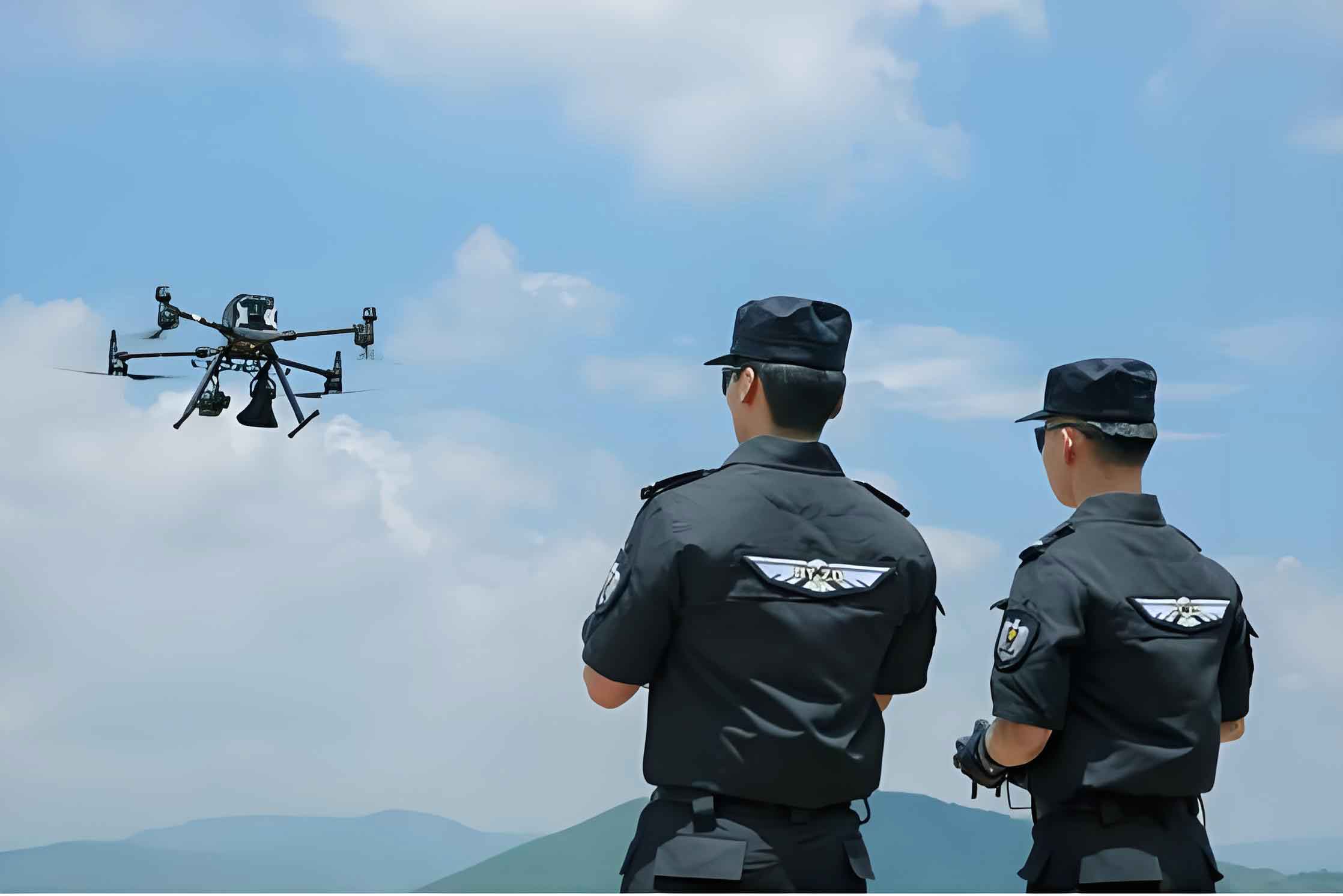
Finally, 5G’s network slicing capability allows a single physical network to be partitioned into multiple virtual networks. A dedicated, high-priority slice can be allocated for police drone operations, guaranteeing bandwidth, security, and low latency even when the public network is congested, ensuring mission-critical communications are never compromised.
Transformative Applications of the 5G Police Drone
The synergy between 5G’s network capabilities and advanced UAV payloads creates a versatile tool that transcends simple aerial observation. The enhanced data pipeline transforms the police drone into an intelligent node in a broader security ecosystem.
| Functional Module | 5G-Enabled Capability | Specific Law Enforcement Application |
|---|---|---|
| Intelligent Surveillance & Reconnaissance | Real-time 4K/8K streaming; Onboard AI processing with cloud offload; Ultra-low latency. | • Real-time crowd analysis & anomaly detection at major events. • Immediate face/vehicle recognition against watchlists. • “Point-of-interest” tracking: click on a suspect in the video feed to auto-track. |
| Tactical Communications & Interdiction | High-bandwidth, reliable aerial link; Network slicing for guaranteed service. | • Aerial communication relay in rugged terrain or during infrastructure damage. • Deploying a temporary, localized communication blackout for tactical operations. • Broadcasting directives via loudspeaker with crystal-clear audio. |
| Forensic Mapping & Scene Reconstruction | High-speed upload of massive sensor datasets (LiDAR, photogrammetry). | • Near-instantaneous generation of 3D crime/accident scene models. • Accurate measurement and evidence mapping from the air. |
| Swarm Operations & Coordinated Response | Massive connection density; Precise synchronization via low latency. | • Deploying a coordinated swarm for searching large areas (e.g., missing persons). • Forming a persistent surveillance net over a wide perimeter. |
| Payload Delivery & Immediate Action | Real-time control and sensor feedback for delicate operations. | • Delivering emergency supplies (life vests, defibrillators) to inaccessible locations. • Tactical delivery of non-lethal deterrents in barricade situations. |
The mathematical advantage in surveillance, for instance, can be conceptualized through information theory. The channel capacity $$C$$, representing the maximum error-free data rate, is given by Shannon’s formula: $$C = B \log_2(1 + \text{SNR})$$, where $$B$$ is bandwidth and SNR is the signal-to-noise ratio. 5G’s massive increase in usable bandwidth $$B$$ directly and exponentially increases the capacity $$C$$, allowing a police drone to transmit vastly more detailed information—essentially providing “sensor-grade” intelligence to the command center in real time.
In tactical scenarios, the low latency $$\Delta t$$ is critical. The positional error $$E$$ introduced during tracking of a moving target with speed $$v$$ is proportional to $$E \propto v \cdot \Delta t$$. Reducing $$\Delta t$$ from 50ms (4G) to 1-5ms (5G) minimizes this error, allowing for accurate, sustained tracking and enabling automated systems to maintain a secure observation distance reliably.
The Path Forward: Integration and Future Evolution
The full potential of the 5G police drone is realized only when it is deeply integrated into the broader police technology infrastructure. This involves seamless data fusion with Computer-Aided Dispatch (CAD) systems, real-time analytics platforms, and officer-worn devices. The drone becomes a flying sensor node feeding a common operational picture.
Future evolution points towards even greater autonomy and specialization. We envision the development of purpose-built police drone platforms: micro-drones for indoor tactical clearance, long-endurance VTOL (Vertical Take-Off and Landing) models for persistent patrol, and heavy-lift drones capable of carrying more sophisticated payloads. These platforms will leverage 5G not just for command and video, but for collaborative swarm intelligence, where decisions are made through distributed processing across the network.
Of course, this technological leap must be accompanied by robust frameworks addressing spectrum allocation for public safety, stringent cybersecurity protocols to protect data links and feeds, comprehensive pilot training programs, and clear operational guidelines that respect privacy and proportionality.
In conclusion, the convergence of 5G and UAV technology marks a definitive breakthrough for aerial law enforcement. By solving the fundamental issues of bandwidth, latency, and connectivity, 5G transforms the police drone from a useful observational tool into a intelligent, responsive, and integral force multiplier. It enables a shift from reactive monitoring to proactive, intelligence-led policing and enhances officer safety, operational efficiency, and public security outcomes. The future of the police drone is not just in the air—it is deeply connected, intelligently networked, and fundamentally empowered by the fifth generation of wireless technology.