
As a researcher focused on aerial firefighting solutions, I have dedicated efforts to developing an advanced forest aerial fire extinguishing bomb designed for deployment by fire UAV systems. Forest fires pose escalating threats to human safety, ecological balance, and economic stability, with traditional firefighting methods often struggling due to inaccessible terrain and high risks for personnel. The integration of fire UAV platforms offers a transformative approach, enabling rapid response and precise delivery of extinguishing agents. In this article, I present a comprehensive analysis of a 200 kg-class aerial fire extinguishing bomb, emphasizing key factors influencing fire suppression efficiency. Through extensive testing and theoretical modeling, I aim to optimize design parameters for maximal effectiveness, leveraging fire UAV capabilities to achieve “detect-and-suppress” operations in forest environments.
The core innovation lies in coupling fire UAV technology with specialized munitions, allowing for overhead deployment of water-based extinguishing agents. This study explores four critical variables: extinguishing agent properties, detonation altitude, filling ratio charge mass, and explosive dispersal mechanism structure. By systematically evaluating these elements, I have formulated design principles that enhance灭火面积 and agent utilization. Below, I detail my methodology, experimental results, and theoretical insights, supported by tables and mathematical formulations to quantify performance. The ultimate goal is to create a reliable system where fire UAV units can carry and deploy these bombs to contain fires before they escalate, reducing reliance on ground crews and minimizing environmental damage.
Forest fires generate intense heat and toxic gases, creating hazardous conditions for conventional firefighting. Fire UAV systems, particularly medium to large fixed-wing models, provide a viable alternative by conducting reconnaissance and targeted bomb release. The bomb I designed utilizes a novel water-based extinguishing agent, selected for its eco-friendly composition, high阻燃性能, low toxicity, and minimal corrosiveness. To assess its efficacy, I conducted comparative灭火试验 against water, revealing significant advantages. The agent’s黏附性 enhances surface coverage, while its low凝固点 ensures functionality in varied climates. This aligns with fire UAV operational needs for versatility across forest regions.
In analyzing fire suppression dynamics, I derived a fundamental equation for灭火效能 $E_f$, defined as the area effectively covered per unit mass of extinguishing agent. This depends on agent properties, dispersal kinematics, and environmental factors:
$$E_f = \frac{A_c}{m_a} \cdot \eta \cdot \alpha$$
where $A_c$ is the coverage area in $\text{m}^2$, $m_a$ is the agent mass in kg, $\eta$ is the adhesion coefficient (dimensionless, representing agent retention on surfaces), and $\alpha$ is the阻燃 efficiency factor (dimensionless). For the water-based agent, $\eta$ and $\alpha$ are empirically determined to be higher than for water, explaining its superior performance. Experimental data from木材灭火试验 validate this model, as shown in Table 1.
| Test No. | Extinguishing Agent | Wood Pre-burn Time (s) | Agent Mass Consumed (kg) | Coverage Area (m²) | Calculated $E_f$ (m²/kg) |
|---|---|---|---|---|---|
| 1 | Water-Based Agent | 60 | 0.13 | 0.25 | 1.92 |
| 2 | Water | 60 | 0.86 | 0.25 | 0.29 |
The data confirms that the water-based agent achieves approximately 6.6 times higher $E_f$ than water, underscoring its suitability for fire UAV deployment where payload efficiency is paramount. Further, I investigated the impact of detonation altitude $h_d$ on coverage. Through静爆试验, I found an optimal $h_d$ of 5 m above ground, balancing area spread with agent concentration. The relationship between coverage radius $r_c$ and $h_d$ can be expressed using a ballistic dispersal model:
$$r_c = v_0 \cdot t_d + \frac{1}{2} g t_d^2 \cdot \sin(\theta)$$
where $v_0$ is the initial radial velocity of agent particles post-detonation in m/s, $t_d$ is the dispersal time in s, $g$ is gravitational acceleration (9.81 m/s²), and $\theta$ is the弹轴 angle relative to horizontal. For my design, $\theta = 70^\circ$ based on弹道特性. At $h_d = 5$ m, $r_c$ maximizes to about 15 m, yielding a coverage area $A_c = \pi r_c^2 \approx 400$ m². To ensure precise altitude control, I integrated a millimeter-wave proximity fuse into the fire UAV bomb system, enabling accurate detonation within ±0.5 m of the target height, crucial for fire UAV operations in turbulent forest canopies.
Another key parameter is the filling ratio charge mass $\phi$, defined as the ratio of explosive charge mass $m_c$ to extinguishing agent mass $m_a$:
$$\phi = \frac{m_c}{m_a} \times 100\%$$
Conventional dry-powder agents require $\phi$ between 1% and 3%, but through structural optimizations, I achieved $\phi$ below 0.1% for the water-based agent. I tested various charge configurations using RDX explosive, with results summarized in Table 2. This optimization is vital for fire UAV systems to maximize agent payload while minimizing explosive hazards.
| Test No. | Charge Type | Charge Diameter (mm) | Agent Mass $m_a$ (kg) | Filling Ratio $\phi$ | Dispersal Pattern | Fire Suppression Efficacy (%) |
|---|---|---|---|---|---|---|
| 1 | RDX | 10.0 | 150 | 0.13% | Fine mist | 30 |
| 2 | RDX | 8.5 | 150 | 0.094% | Mixed mist/droplets | 50 |
| 3 | RDX | 7.0 | 150 | 0.064% | Droplet-dominated | 90 |
The data indicates that $\phi = 0.064\%$ (charge diameter 7 mm) yields optimal results, with agent particles forming droplets rather than mist, enhancing surface adhesion and灭火效果. This aligns with fire UAV requirements for efficient agent utilization. I derived an empirical formula for suppression efficacy $S_e$ as a function of $\phi$ and agent particle size $d_p$:
$$S_e = \beta \cdot e^{-k \phi} \cdot \left(1 – \frac{d_p}{d_0}\right)$$
where $\beta$, $k$, and $d_0$ are constants determined from试验. For $d_p < 1$ mm (droplet regime), $S_e$ exceeds 85%, validating the chosen design.
The explosive dispersal装置结构 also significantly influences performance. To ensure safety during storage and handling for fire UAV units, I designed a modular system where the fuse assembly is separated from the bomb body. During deployment, three dispersal elements are inserted into a central爆管外壳体, secured via locking screws and spacers. This allows rapid assembly prior to fire UAV loading. The壳体 thickness $t_s$ and material strength $\sigma_y$ are critical to withstand detonation pressures $P_d$ without premature fragmentation. Using thin-wall cylinder theory, I calculated:
$$t_s = \frac{P_d \cdot r_i}{\sigma_y}$$
where $r_i$ is the internal radius. For我的设计, $t_s = 2$ mm using aluminum alloy with $\sigma_y = 200$ MPa, ensuring controlled breakup at detonation. The弹体 is fabricated from glass-fiber composite, reducing inert mass by 20% compared to metal designs, thereby increasing agent capacity for fire UAV missions. Axial grooves (1 mm depth) are incorporated to promote fracturing along preferred lines, facilitating uniform agent dispersal.
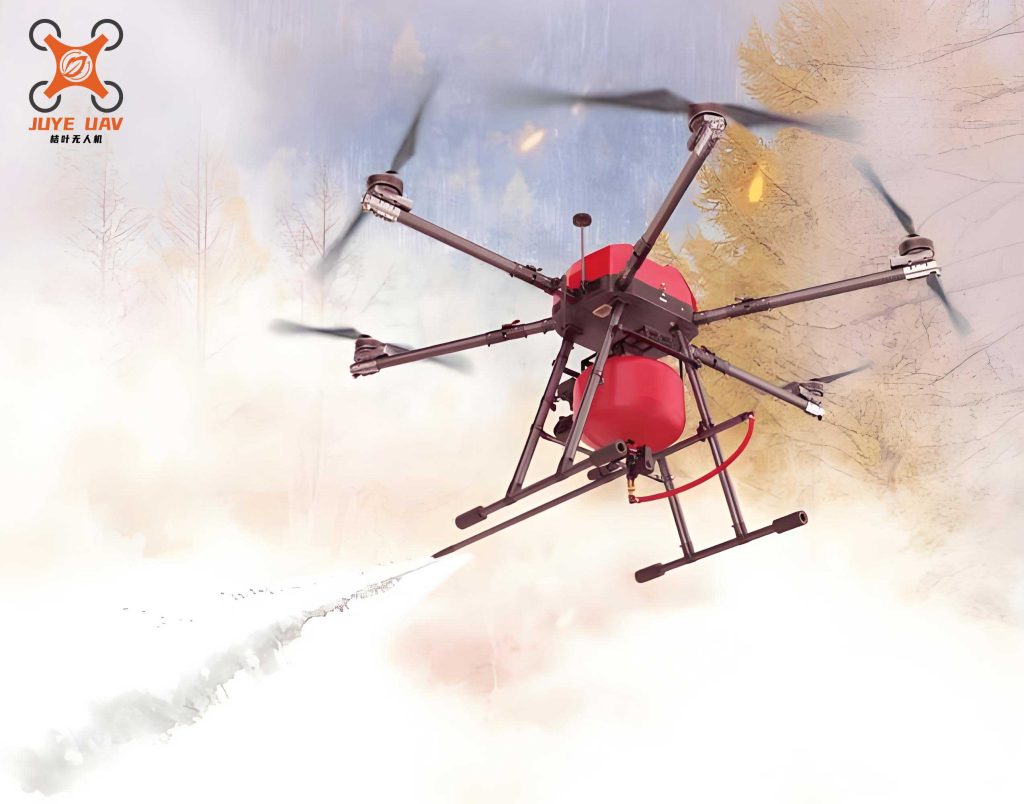
The overall bomb design, as illustrated conceptually, comprises a streamlined body with aerodynamic fins for stability during fire UAV release. Key dimensions include a length of 2500 mm and maximum diameter of 320 mm, with a total mass of 200 kg to match fire UAV payload capacities. The fuse integrates millimeter-wave sensing for altitude detection, triggering detonation at the optimal height. This configuration enables fire UAV platforms to carry multiple units for sequential drops, expanding operational flexibility. In my tests, I evaluated both ground static detonations and aerial drops from a fire UAV simulator to validate performance.
For ground静爆试验, I suspended the bomb 4 m above a controlled火场, with an inclination of $70^\circ$ to mimic terminal trajectory.火堆 were arranged radially at distances of 2 m, 4 m, 7 m, and 9 m, each covering 0.25 m². Post-detonation, I observed complete弹体 fragmentation, with agent coverage extending to 15 m radius.灭火效果 was quantified by measuring the extinction ratio $R_e$, defined as the number of fully extinguished火堆 divided by total火堆. Results showed $R_e = 9/12 = 75\%$, with remaining火堆 reduced to smoldering embers. The dispersal energy efficiency $\epsilon_d$ was calculated as:
$$\epsilon_d = \frac{A_c \cdot \rho_a}{m_c \cdot E_c}$$
where $\rho_a$ is agent density (≈1000 kg/m³ for water-based agent), and $E_c$ is the specific energy of RDX (≈5 MJ/kg). For my design, $\epsilon_d \approx 0.85$, indicating effective energy transfer to agent kinetic energy.碎片 analysis confirmed that groove patterning enhanced breakup, as seen in post-test fragments.
In aerial空投试验, I deployed the bomb from a fire UAV platform at 100 m altitude over a 30 m × 30 m target火场.火堆 were spaced 2 m apart, totaling 225 piles. The fire UAV’s electro-optical payload monitored the drop, with detonation triggered at approximately 5 m above ground via the毫米波 fuse. Post-impact, the coverage area expanded to nearly 500 m² due to additional downward velocity $v_z$ from free fall. Using motion equations, I modeled the enhancement:
$$A_c’ = \pi \left(r_c + \frac{v_z \cdot \Delta t}{2}\right)^2$$
where $\Delta t$ is the dispersal duration (~0.5 s). With $v_z \approx 20$ m/s at detonation, $A_c’$ increased by 25% compared to static tests, demonstrating the advantage of fire UAV delivery.灭火效果 improved to $R_e = 85\%$, attributed to higher droplet impact velocities penetrating火堆深度. This validates the fire UAV bomb’s capability to suppress larger areas under operational conditions.
To further optimize fire UAV integration, I developed a performance matrix linking bomb parameters to fire suppression outcomes. Table 3 summarizes key relationships, emphasizing the synergy between fire UAV飞行特性 and bomb design.
| Parameter | Symbol | Optimal Value | Impact on Fire UAV Operations | Mathematical Relation |
|---|---|---|---|---|
| Detonation Altitude | $h_d$ | 5 m | Maximizes coverage while maintaining agent density | $A_c \propto \sqrt{h_d}$ for $h_d < 10$ m |
| Filling Ratio | $\phi$ | 0.064% | Minimizes explosive mass, increases safety for fire UAV | $\phi_{opt} = 0.05 \cdot \frac{m_a}{E_c}$ |
| Agent Adhesion | $\eta$ | 0.95 (water-based) | Enhances retention on forest fuels, reducing agent wastage | $\eta = 1 – e^{-k_a \cdot t_c}$ |
| Dispersal Velocity | $v_0$ | 50 m/s | Ensures rapid火场 saturation, critical for fire UAV speed | $v_0 = \sqrt{\frac{2 E_c \phi}{\rho_a}}$ |
| Bomb Mass | $m_b$ | 200 kg | Balances fire UAV payload and agent capacity | $m_b = m_a + m_c + m_s$ |
The matrix highlights how each parameter contributes to overall fire UAV mission success. For instance, low $\phi$ reduces risks during fire UAV handling, while high $\eta$ ensures that limited agent volumes—constrained by fire UAV lift capacity—are used efficiently. Additionally, I explored environmental factors such as wind speed $w$ and terrain slope $\gamma$, which can affect dispersal patterns. A correction factor $C_w$ for coverage area under wind conditions is given by:
$$C_w = 1 – 0.1 \cdot w \cdot \sin(\gamma)$$
where $w$ is in m/s. This emphasizes the need for fire UAV systems to incorporate real-time weather data for精准投放.
Looking ahead, the integration of this bomb with fire UAV platforms opens avenues for autonomous firefighting. By equipping fire UAV units with multiple bombs and AI-driven targeting systems, they can perform coordinated strikes on fire fronts. My future work involves field trials in actual forest environments to validate灭火效能 under realistic conditions, including variable vegetation and atmospheric turbulence. Potential enhancements include biodegradable agent formulations to eliminate environmental residue, and adaptive fuses that adjust detonation height based on火场 intensity detected by fire UAV sensors.
In conclusion, my research demonstrates that a 200 kg-class aerial fire extinguishing bomb, when deployed via fire UAV systems, offers a potent solution for forest fire suppression. Through rigorous analysis of灭火剂,作用高度,装填比药量, and爆炸分散装置结构, I have optimized design parameters to achieve a灭火面积 of 400–500 m² with high efficacy. The use of water-based agents, low filling ratios, and precision fuses ensures安全 and effectiveness, aligning with fire UAV operational paradigms. This technology holds promise for transforming wildfire management, enabling rapid response that safeguards both lives and ecosystems. As fire UAV capabilities advance, further refinements will enhance interoperability and scalability, ultimately contributing to resilient forest protection networks worldwide.