
As an experienced operator in precision agriculture, I have come to appreciate the critical role that regular maintenance plays in ensuring the reliability and efficiency of agricultural drones. After a long winter storage, these sophisticated machines require meticulous care to prepare them for the upcoming season. In this comprehensive guide, I will share detailed steps, backed by practical insights, to help you rejuvenate your agricultural drone and its peripherals. The focus will be on systematic checks, preventive measures, and optimization techniques, all aimed at maximizing the performance and lifespan of your agricultural drone. Throughout this article, I will emphasize the importance of each step, integrating tables and formulas to summarize key points, and repeatedly highlight the term “agricultural drone” to reinforce best practices.
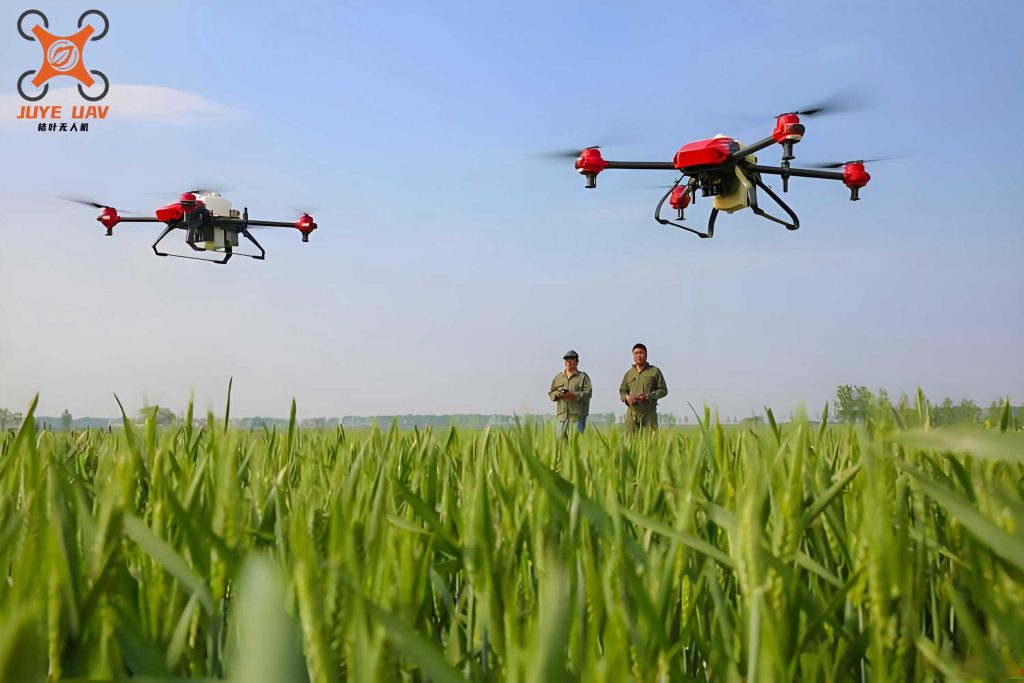
Spring maintenance for an agricultural drone is not merely a routine task; it is a fundamental process that can prevent costly downtime and ensure accurate operations during critical planting and spraying periods. From my perspective, neglecting this can lead to reduced efficiency, safety hazards, and shortened equipment life. Therefore, I advocate for a thorough approach, covering every component from the ground control station to the propulsion system. Let’s delve into the specifics, starting with the handheld ground station and moving through each subsystem. By following this guide, you can confidently prepare your agricultural drone for a productive season.
Handheld Ground Station and Controller Inspection
The handheld ground station, often referred to as the A2 unit in some models, is the command center for your agricultural drone. After prolonged storage, I always begin by checking its functionality. If the device does not respond upon power-up, it may be in a low-power protection state. To recover it, connect the charger and simultaneously press the power button and volume-down key. Once operational, I proceed to verify the software version through the system upgrade app, ensuring it is updated to the latest release. This is crucial for compatibility and feature access. For controllers like the ACS1 or ACS2, I recommend fully charging them first, then establishing a wireless connection with a smartphone to check for updates in the dedicated agriculture app. Keeping all software current enhances the stability and performance of your agricultural drone.
To systematize this process, I have developed a checklist that summarizes the key inspection points. This table can serve as a quick reference during your maintenance routine:
| Component | Inspection Step | Expected Outcome | Action if Failed |
|---|---|---|---|
| A2 Handheld Unit | Power on and check responsiveness | Device boots normally | Charge and use key combination to reset |
| Software Version | Access upgrade app | Latest version installed | Download and install updates |
| ACS1/ACS2 Controller | Charge fully and connect to app | Wireless link established, no upgrade alerts | Update controller firmware via app |
| Mobile App | Check for updates in app store | App is current | Install latest version |
In addition, I often consider the mathematical relationship between software updates and system reliability. For instance, the probability of a successful operation for an agricultural drone can be modeled as a function of software currency. Let’s denote \( P_s \) as the success probability, \( U \) as the update status (where \( U = 1 \) for updated and \( U = 0 \) for outdated), and \( \alpha \) as a baseline reliability factor. A simple formula might be:
$$ P_s = \alpha + \beta U $$
where \( \beta \) represents the improvement due to updates. This highlights why regular software checks are vital for your agricultural drone.
RTK Differential System Examination
The RTK differential system, commonly known as the “mushroom head,” is essential for achieving centimeter-level positioning accuracy in an agricultural drone. I always start by connecting the RTK differential unit and powering it on. Next, I pair it with the control system and inspect the firmware version through the app interface, upgrading it to the latest version if necessary. After upgrades, I conduct tests in an open area using mobile base stations and handheld mappers to verify functionality. This step ensures that your agricultural drone can maintain precise navigation during field operations.
To quantify the importance of RTK accuracy, consider the error reduction provided by differential corrections. The overall positioning error \( E \) of an agricultural drone can be expressed as:
$$ E = \sqrt{E_{GPS}^2 + E_{RTK}^2} $$
where \( E_{GPS} \) is the standard GPS error (e.g., several meters) and \( E_{RTK} \) is the residual error after RTK correction (e.g., a few centimeters). By minimizing \( E_{RTK} \) through proper maintenance, you enhance the operational precision of your agricultural drone. Below is a table summarizing the RTK inspection protocol:
| Step | Procedure | Success Criteria |
|---|---|---|
| 1 | Connect and power RTK unit | LED indicators show normal operation |
| 2 | Pair with control system and check firmware | Firmware version matches latest release |
| 3 | Perform field test in空旷地带 | Positioning data稳定 and accurate within specifications |
I emphasize that regular RTK checks are non-negotiable for any agricultural drone intended for precision tasks, as even minor deviations can lead to application errors.
Battery Health Assessment
Batteries are the lifeblood of an agricultural drone, and their care after winter storage is paramount. In my practice, I adhere to the guideline of charging batteries every three months during long-term storage, ensuring they maintain at least three bars of charge to avoid deep discharge. If a battery has been unused all winter, issues like “low cell voltage” warnings or intermittent charging may arise. This is typically due to accumulated self-discharge and increased cell voltage imbalance over time. The battery management system (BMS) in modern agricultural drone batteries can often rectify this by自动平衡 cells when the charge is above four bars; simply letting the battery rest for a few days usually resolves the problem.
To deepen understanding, I often refer to electrochemical principles. The voltage imbalance among cells can be modeled using the following formula, where \( V_i \) represents the voltage of cell \( i \), and \( n \) is the number of cells:
$$ \Delta V = \max(V_i) – \min(V_i) $$
A well-maintained battery for an agricultural drone should have \( \Delta V < 0.1 \, \text{V} \). The BMS works to minimize this differential through passive or active balancing. Additionally, battery lifespan \( L \) can be estimated based on storage conditions. A common empirical formula is:
$$ L = L_0 \cdot e^{-k T} $$
where \( L_0 \) is the initial lifespan, \( k \) is a degradation constant, and \( T \) is the storage temperature in Kelvin. This underscores why proper storage and periodic charging are critical for your agricultural drone’s batteries. Below is a table outlining battery maintenance steps:
| Aspect | Recommendation | Rationale |
|---|---|---|
| Storage Charge Level | Keep above 3 bars (approx. 60% SOC) | Prevents sulfation and capacity loss |
| Charging Frequency | Every 3 months during storage | Counters self-discharge, maintains cell health |
| Issue Resolution | If voltage low, charge to 4+ bars and rest | Allows BMS to balance cells automatically |
| Temperature Monitoring | Store in cool, dry place (15-25°C) | Reduces degradation rate \( k \) in the formula above |
By following these practices, you ensure that the power source for your agricultural drone remains robust throughout the season.
Spray Tank and Liquid System Inspection
The spray system is a core component of an agricultural drone, directly affecting application accuracy. I begin by disassembling the inlet nozzle to inspect the rubber seal for corrosion or deformation. If damaged, replace it promptly. Next, I open the top tank lid to check if the vent tube has detached, reattaching it if necessary. Then, I unscrew the bottom knob to remove and clean the mesh filter. These steps prevent leaks and ensure consistent fluid flow. For the灌药机 (liquid filling machine), I open the蠕动泵 cover to examine the tubing for folds, bends, or breaks, replacing it if needed. After powering on, I test functions like filling and draining, followed by calibration. Calibration involves placing an empty tank and then a full tank of known capacity, with the system adjusting its measurements accordingly. This process guarantees that your agricultural drone delivers precise amounts of agrochemicals.
To formalize the calibration, consider the linear relationship between sensor readings and actual volume. Let \( R \) be the sensor reading, \( V \) be the true volume, and \( m \) and \( b \) be calibration coefficients:
$$ V = mR + b $$
During calibration, using empty and full points allows solving for \( m \) and \( b \), ensuring accuracy for your agricultural drone. The table below summarizes these checks:
| Component | Inspection Action | Acceptance Standard |
|---|---|---|
| Inlet Nozzle Seal | Visual check for corrosion/deformation | Seal intact and flexible |
| Vent Tube | Verify attachment inside tank lid | Tube securely connected |
| Mesh Filter | Remove, clean, and inspect for damage | Filter clean and without holes |
| 蠕动泵 Tubing | Inspect for physical defects | Tubing smooth and无破损 |
| Filling Machine Functions | Test fill, drain, and calibration | Operations smooth, readings accurate |
Regular maintenance of the spray system not only optimizes the performance of your agricultural drone but also reduces chemical waste and environmental impact.
Comprehensive Agricultural Drone Airframe Check
The airframe of an agricultural drone requires meticulous inspection to ensure structural integrity and safety. I divide this into外观检查 (exterior check) and航前测试 (pre-flight test). For the外观检查, I first examine the frame for sturdiness, ensuring arms and landing gear are intact and propellers free of cracks or damage. The RTK unit on the arm must be vertically oriented and secure. Then, I check the propulsion system by rotating motors to detect unusual noises or bearing play. The spraying system inspection involves cleaning connection ports and NFC modules,拆卸流量计 to check impeller condition, and inspecting pipes for corrosion. Each of these steps is vital for the reliable operation of your agricultural drone.
In the航前测试, after installing a tank with water and a smart battery, I perform a series of system checks. For first-time use, pairing the agricultural drone with the controller is necessary. Then, I navigate through device information to verify firmware versions,定位信息 to ensure satellite count exceeds 16 and heading accuracy is within 2°,电池信息 to confirm cycle count under 300 and temperatures below 80°C,动力信息 for idle tests, and喷撒信息 for self-diagnostics. After any喷撒 system firmware update, recalibration is required. These protocols are designed to preempt failures during field operations of your agricultural drone.
To illustrate the importance of pre-flight checks, consider the reliability model of an agricultural drone. Let \( R_{total} \) be the overall reliability, and \( R_i \) be the reliability of each subsystem (e.g., propulsion, navigation, spraying). Assuming independence, we have:
$$ R_{total} = \prod_{i=1}^{n} R_i $$
where \( n \) is the number of subsystems. Regular maintenance improves each \( R_i \), thereby boosting \( R_{total} \) for your agricultural drone. The table below encapsulates the airframe inspection process:
| Check Category | Specific Items | Tools/Methods |
|---|---|---|
| Structural Integrity | Frame, arms, landing gear, propellers | Visual and manual inspection for cracks or looseness |
| Propulsion System | Motor rotation, bearing play,异响 | Hand-spin motors, listen for noises, check for wobble |
| Spraying System | Ports, NFC, flow meter, pipes | Clean, dismantle impeller, visual corrosion check |
| Pre-flight Tests | Firmware, GPS, battery, motor, spray self-test | Use controller app to run diagnostics and monitor readings |
By adhering to this comprehensive check, you significantly reduce the risk of in-flight failures for your agricultural drone.
Trial Flight and Post-Operation Maintenance
After completing all inspections and保养, I always conduct a trial flight in a safe, open area to validate the agricultural drone’s performance. This involves basic maneuvers, hover tests, and simulated spraying with water to ensure all systems function harmoniously. Post-flight, I immediately clean the agricultural drone, especially the spraying components, using soapy water or detergent solution to remove residues. This prevents corrosion and clogging, extending the lifespan of your agricultural drone.
From a mathematical perspective, the effectiveness of maintenance can be gauged through operational metrics. For instance, the availability \( A \) of an agricultural drone can be defined as:
$$ A = \frac{MTBF}{MTBF + MTTR} $$
where \( MTBF \) is mean time between failures and \( MTTR \) is mean time to repair. Proactive spring maintenance increases \( MTBF \) and reduces \( MTTR \), thus enhancing \( A \) for your agricultural drone. To summarize the entire spring maintenance cycle, I have compiled a master table that integrates all key actions:
| Maintenance Phase | Key Activities | Frequency | Impact on Agricultural Drone |
|---|---|---|---|
| Pre-Storage Preparation | Charge batteries, clean components, store in dry place | Before winter | Prevents degradation during idle period |
| Spring Reactivation | Inspect ground station, RTK, batteries, tanks, airframe | Annually before season | Ensures readiness and safety for operations |
| Pre-Flight Verification | Run diagnostics, calibrate, test with water | Before each作业 session | Minimizes in-field issues |
| Post-Operation Care | Clean spray system, check for wear, recharge batteries | After each use | Maintains longevity and accuracy |
In conclusion, spring maintenance for an agricultural drone is a multifaceted process that demands attention to detail. By embracing these practices—from software updates to battery care and structural checks—you can ensure that your agricultural drone operates at peak efficiency. Remember, the reliability of your agricultural drone directly influences agricultural productivity, so investing time in thorough maintenance pays dividends throughout the growing season. As I reflect on years of experience, I can affirm that a well-maintained agricultural drone is not just a tool but a partner in achieving sustainable farming outcomes.