
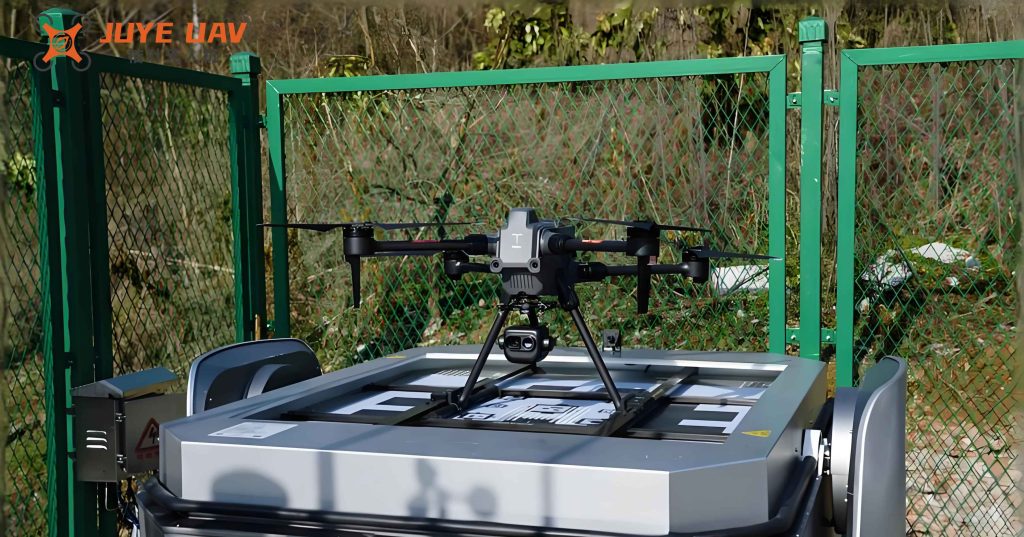
With the rapid development of the low‑altitude economy, drone hangars integrated with wireless charging capabilities have become a critical infrastructure for enabling persistent urban operations. In this work, we address the spatiotemporal path planning problem for a wireless charging drone hangar system. We propose a comprehensive framework that includes a layered urban environment model, a hierarchical path planning algorithm, and a dynamic charging management scheme. Our approach ensures that drones can safely navigate through dense urban canyons, efficiently utilize intermediate drone hangar nodes for energy replenishment, and avoid airspace conflicts via altitude layering. By combining global coarse planning with local fine obstacle avoidance, and by dynamically adjusting the state of charge target based on actual flight demands, we significantly reduce total mission time while maintaining compliance with regulatory altitude limits. The effectiveness of our proposed methods is validated through extensive simulations.
Urban Environment Modeling with Altitude Layering
We consider the urban low‑altitude airspace below 120 m, as mandated by the Chinese regulations for small unmanned aerial vehicles. To capture the vertical distribution of buildings and to provide a structured basis for path planning, we discretize the 100 km × 100 km area into a regular grid of 50 × 50 cells. Each cell is a square of side length \(d = 2\) km. Buildings occupy 90% of the cell interior, leaving the four grid vertices accessible for drone navigation. The modeling follows a four‑layer altitude strategy: 30 m, 60 m, 90 m, and 120 m. When a drone is assigned to fly at a certain altitude layer \(h_{\mathrm{mode}}\), it must avoid all buildings whose height is greater than or equal to \(h_{\mathrm{mode}}\). The set of obstacle heights to be avoided is defined as:
$$
K(h_{\mathrm{mode}}) =
\begin{cases}
\{30,60,90,120\} & h_{\mathrm{mode}} = 30\\
\{60,90,120\} & h_{\mathrm{mode}} = 60\\
\{90,120\} & h_{\mathrm{mode}} = 90\\
\{120\} & h_{\mathrm{mode}} = 120
\end{cases}
$$
Let \(\Omega\) be the set of all grid cells. The blocked cells at mode \(h_{\mathrm{mode}}\) are:
$$
B(h_{\mathrm{mode}}) = \{\,(i,j) \in \Omega \mid H(i,j) \in K(h_{\mathrm{mode}})\}
$$
where \(H(i,j)\) is the height of the building in cell \((i,j)\). Table 1 summarizes the distribution of buildings across the four altitude layers used in our scenario.
| Altitude layer (m) | Number of buildings | Percentage |
|---|---|---|
| 30 | 275 | 55% |
| 60 | 150 | 30% |
| 90 | 50 | 10% |
| 120 | 25 | 5% |
Drone hangars are placed at selected grid center points, with a maximum straight‑line distance between two consecutive drone hangars limited by the drone’s endurance. We set the maximum flight time \(t_{\max}=40\) min and the optimal cruising speed \(v_{\mathrm{opt}}=10\) m/s, yielding a maximum range \(d_{\max}=24\) km. To account for non‑straight paths due to obstacles, we enforce a conservative charging distance \(d_{\mathrm{charge}}=0.8\,d_{\max}=20.4\) km. This serves as the search radius for the global planner.
Hierarchical Path Planning Algorithm
Our path planning is divided into two layers: a global coarse planner based on the A* algorithm to determine the sequence of drone hangar nodes, and a local fine planner based on an improved rapidly‑exploring random tree (IRRT) algorithm to generate obstacle‑free paths between consecutive drone hangar nodes.
Global Coarse Planning with A*
We treat the drone hangar nodes as vertices in a graph. Starting from the initial drone hangar, we use the A* algorithm to search for the next drone hangar within the distance \(d_{\mathrm{charge}}\) that minimizes the total cost:
$$
f(n) = g(n) + h(n)
$$
where \(g(n)\) is the actual path length from the start to node \(n\), and \(h(n)\) is the Euclidean distance from \(n\) to the goal. The search continues until the goal drone hangar is reached, producing a sequence of intermediate drone hangar nodes that ensures feasible energy constraints.
Local Fine Planning with Improved RRT (IRRT)
For each pair of consecutive drone hangar nodes identified by the global planner, we perform fine obstacle avoidance using our IRRT algorithm. The improvements over standard RRT are designed specifically for the grid‑based urban environment.
Adaptive sampling rate. To balance exploration and goal‑directedness, we set the probability of sampling the goal point based on the obstacle density in the corridor between the start and goal drone hangars:
$$
p_{\mathrm{goal}} =
\begin{cases}
0.3 & \rho \ge 0.3\\
0.2 & 0.2 \le \rho < 0.3\\
0.1 & \rho < 0.2
\end{cases}
$$
where \(\rho\) is the ratio of blocked cells to total cells in the bounding rectangle. The sampling point is then chosen as:
$$
q_{\mathrm{rand}} =
\begin{cases}
q_{\mathrm{goal}} & \text{if } r < p_{\mathrm{goal}}\\
\mathrm{rsample}(q_{\mathrm{start}}, q_{\mathrm{goal}}) & \text{otherwise}
\end{cases}
$$
with \(\mathrm{rsample}\) uniformly picking a grid point within the rectangle spanned by \(q_{\mathrm{start}}\) and \(q_{\mathrm{goal}}\).
Eight‑direction node expansion. From the nearest node \(q_{\mathrm{near}}\) in the tree, we compute the direction vector \(\mathbf{d} = q_{\mathrm{rand}} – q_{\mathrm{near}}\). Instead of stepping along \(\mathbf{d}\), we evaluate all eight neighboring grid points \(q_{\mathrm{neighbor}}^{(i)}\) and select the one that maximizes the dot product with \(\mathbf{d}\):
$$
\mathrm{score}_i = \mathbf{d} \cdot \mathbf{v}_i, \quad \mathbf{v}_i = q_{\mathrm{neighbor}}^{(i)} – q_{\mathrm{near}}
$$
$$
q_{\mathrm{new}} = \arg\max_i \mathrm{score}_i
$$
This ensures that the expansion stays on the grid and naturally avoids diagonal collisions.
Collision detection. A path segment between two cells is considered valid if it does not cross the interior of a blocked cell. Collisions occur when the segment intersects an obstacle cell interior (not merely a vertex or an edge), as illustrated in the typical geometric relationships:
- Red segment: crosses interior – invalid.
- Green segment: touches only a vertex – valid.
- Coincident edge: valid.
Neighborhood search and parent optimization. After creating \(q_{\mathrm{new}}\), we examine all tree nodes within a Manhattan radius of 2 (24 candidate cells). For each candidate \(q_i\) that is collision‑free, we compute the alternative cost:
$$
f_{\mathrm{alt}}(q_{\mathrm{new}}) = f(q_i) + \mathrm{dist}(q_i, q_{\mathrm{new}})
$$
We select the candidate that yields the smallest \(f_{\mathrm{alt}}\) as the best parent \(q_{\mathrm{best-parent}}\).
Node addition and rewiring. If \(q_{\mathrm{new}}\) does not already exist in the tree, we add it with the best parent and cost. Then we perform a reverse rewiring step: for every neighbor \(q_i\) of \(q_{\mathrm{new}}\), if going through \(q_{\mathrm{new}}\) yields a lower cost and the connection is collision‑free, we update \(q_i\)’s parent to \(q_{\mathrm{new}}\). This improves the overall tree quality.
Goal checking. When \(q_{\mathrm{new}}\) is within a threshold distance \(d_{\mathrm{threshold}}=2\) km from the goal drone hangar, we attempt a direct connection. On success, we backtrack the path, compute its length, and store it in a candidate set. The tree is then reset for further iterations to search for a shorter path. The final output for each pair of drone hangar nodes is the path with the minimum length among all stored candidates.
Spatiotemporal Optimization
After obtaining the complete path through the drone hangar nodes, we address two remaining issues: altitude allocation to avoid conflicts between different missions, and charging time optimization at the drone hangars.
Altitude Layer Assignment Based on Path Characteristics
For each mission (represented by its start‑goal pair and its sequence of drone hangar nodes), we compute a comprehensive priority \(P_i\) that combines geometric complexity and building complexity:
$$
G_i = \alpha L_i + (1-\alpha) C_i, \quad \alpha \in [0,1]
$$
$$
L_i = \frac{\sum_{k=1}^{m-1} \|q_{k+1} – q_k\|}{\max_j L_j}, \quad C_i = \frac{\sum_{k=2}^{m-1} |\theta_k – \theta_{k-1}|}{\max_j C_j}
$$
where \(\theta_k\) is the direction angle of segment \(k\). The building complexity is:
$$
T_i = \frac{\gamma N_{\mathrm{b},i}}{S_i}, \quad N_{\mathrm{b},i} = \text{number of blocked cells in bounding box}, \quad S_i = (x_{\max}-x_{\min})(y_{\max}-y_{\min})
$$
Finally, the integrated priority is:
$$
P_i = \omega G_i + (1-\omega) T_i, \quad \omega=0.6
$$
Missions are ranked in descending order of \(P_i\). The mission with the highest priority is assigned the highest altitude layer (120 m), the next gets 90 m, and so on. This ensures that complex paths (longer, more turns, dense obstacles) obtain altitudes with fewer building penetrations.
Dynamic Wireless Charging Management
At each intermediate drone hangar, the drone’s battery state of charge (SOC) is replenished. We adopt a multi‑stage constant current (MCC) charging protocol (Table 2) and dynamically set the target SOC based on the actual flight distance to the next drone hangar node.
| SOC region (%) | Current rate |
|---|---|
| 0–15 | 2C |
| 15–40 | 1C |
| 40–80 | C/2 |
| 80–95 | C/5 |
| 95–100 | CV (trickle) |
The dynamic target SOC is computed as:
$$
\mathrm{SOC}_{\mathrm{target}} =
\begin{cases}
0.80 & \text{if } d_{\mathrm{next}} / d_{\max} < 0.70\\
0.95 & \text{if } 0.70 \le d_{\mathrm{next}} / d_{\max} < 0.90\\
1.00 & \text{if } d_{\mathrm{next}} / d_{\max} \ge 0.90
\end{cases}
$$
where \(d_{\mathrm{next}}\) is the length of the fine‑planned path from the current drone hangar to the next one. This “charging on demand” strategy avoids unnecessarily long CV phases and significantly reduces total charging time.
Simulation and Results
We conducted three sets of simulations to validate our framework. The environment is a 100 km × 100 km grid with the building distribution shown in Table 1. Four test missions (Table 3) were defined, each with a start and goal drone hangar node. All simulations were performed in MATLAB 2024b on an Intel i5‑8300H CPU.
| Mission | Start (row, col) | Goal (row, col) |
|---|---|---|
| 1 | (2, 40) | (47, 1) |
| 2 | (1, 5) | (49, 49) |
| 3 | (1, 21) | (49, 36) |
| 4 | (25, 50) | (26, 1) |
Simulation 1: Global Coarse Planning
The A* algorithm successfully computed the drone hangar node sequences for all four missions within the \(d_{\mathrm{charge}}\) constraint. The resulting sequences satisfy the energy limitation and provide the required intermediary drone hangar stops. The coarse paths serve as input to the fine planning module.
Simulation 2: Altitude Allocation and Fine Planning
Using the path characteristics (Table 4), we computed the priority scores and assigned altitudes: Mission 2 (highest priority) → 120 m, Mission 1 → 90 m, Mission 4 → 60 m, Mission 3 → 30 m. Then, for each consecutive drone hangar pair, the IRRT algorithm generated obstacle‑avoiding paths. We compared IRRT with standard RRT and RRT* over 100 independent runs for Mission 3 (the lowest altitude, hence most obstacles). The results are summarized in Table 5.
| Mission | Total length (km) | Length ratio \(L\) | Direction change \(C\) | Building complexity \(T\) | Priority \(P\) | Altitude (m) |
|---|---|---|---|---|---|---|
| 1 | 150.25 | 0.2799 | 0.1117 | 0.1974 | 0.2108 | 90 |
| 2 | 156.16 | 0.2910 | 0.0825 | 0.1844 | 0.2166 | 120 |
| 3 | 116.51 | 0.2171 | 0.0819 | 0.1638 | 0.1714 | 30 |
| 4 | 113.79 | 0.2120 | 0.1203 | 0.1760 | 0.1811 | 60 |
| Algorithm | Average time (s) | Mean path length (km) | Length variance | Max inter‑hangar distance (km) | Count exceeding \(d_{\max}\) |
|---|---|---|---|---|---|
| IRRT (ours) | 21.3 | 123.40 | 0.0505 | 20.60 | 0 |
| RRT | 3.5 | 154.75 | 79.59 | 38.56 | 91 |
| RRT* | 20.5 | 155.88 | 44.87 | 32.99 | 66 |
The IRRT algorithm produces the shortest and most consistent paths, always respecting the maximum distance limit, while RRT and RRT* frequently exceed the drone’s allowed range. Although IRRT is slower than plain RRT, its computational time is on par with RRT* and fully acceptable for offline planning.
Simulation 3: Dynamic Charging Time Optimization
We applied the dynamic MCC (DMCC) strategy to Mission 2 and compared it with three baselines: full‑charge CC (CC100), dynamic CC (DCC), and full‑charge MCC (MCC100). Table 6 lists the inter‑drone‑hangar distances and the charging times for each method. The DMCC strategy uses the target SOC determined by Equation (30).
| Segment distance (km) | CC100 (min) | DCC (min) | MCC100 (min) | DMCC (min) | Target SOC (%) |
|---|---|---|---|---|---|
| 9.10 | – | – | – | – | – |
| 18.91 | 20.3 | 8.6 | 20.3 | 8.6 | 95 |
| 18.11 | 26.6 | 15.8 | 25.2 | 13.9 | 95 |
| 18.91 | 26.1 | 15.3 | 24.9 | 13.6 | 95 |
| 20.02 | 26.7 | 15.7 | 25.2 | 13.9 | 95 |
| 10.90 | 27.4 | 10.7 | 25.6 | 8.3 | 80 |
| 17.23 | 21.5 | 12.9 | 21.5 | 12.5 | 95 |
| 18.11 | 25.6 | 14.7 | 24.7 | 13.4 | 95 |
| 14.14 | 26.2 | 9.4 | 24.9 | 7.8 | 80 |
| 12.82 | 23.1 | 9.2 | 23.6 | 7.7 | 80 |
| Total | 223.5 | 112.3 | 215.9 | 99.7 |
The DMCC strategy reduces the total charging time by 50% compared to full‑charge CC and by 10% compared to dynamic CC, while also outperforming full‑charge MCC. This demonstrates the effectiveness of combining dynamic target SOC with multi‑stage current profiles.
Conclusion
In this paper, we presented a complete spatiotemporal path planning framework for a wireless charging drone hangar system operating in urban environments. We first established a layered grid model that respects the 120 m altitude regulation and reflects realistic building distributions. Then, we proposed a hierarchical planning algorithm: a global A* planner that produces a feasible drone hangar node sequence, and a local IRRT planner that generates obstacle‑free paths between consecutive drone hangars. The IRRT algorithm incorporates adaptive sampling, eight‑direction expansion, neighborhood optimization, and rewiring to achieve high‑quality paths. Furthermore, we developed a spatial altitude allocation scheme based on path complexity and a temporal dynamic charging strategy that reduces unnecessary full‑charge cycles. Simulation results confirm that our approach yields safe, efficient, and regulatory‑compliant paths, and the dynamic charging management cuts total charging time by half. Future work will extend this framework to multi‑drone coordination, dynamic obstacle environments, and integration with real‑time weather conditions to further enhance the robustness of drone hangar operations.