
In modern agriculture, the control of wheat Fusarium head blight (FHB) is a critical challenge due to its impact on yield and food safety. As a climate-dependent epidemic disease, FHB can cause significant wheat losses worldwide and produce toxins harmful to humans and livestock. Traditional control methods, such as manual spraying or conventional boom sprayers, are often inefficient and time-consuming, especially during critical weather windows. In recent years, agricultural UAVs (unmanned aerial vehicles) have emerged as a transformative technology for crop protection, offering high efficiency, precision, and reduced labor costs. My research focuses on evaluating the application effects of various agricultural UAVs in controlling wheat Fusarium head blight, aiming to identify optimal models for large-scale推广. This study was conducted over the 2021–2022 growing season, comparing five types of agricultural UAVs and a conventional boom sprayer. Through comprehensive assessments of operational efficiency, safety, control efficacy, and grain quality, I seek to provide evidence-based recommendations for FHB management using agricultural UAVs.
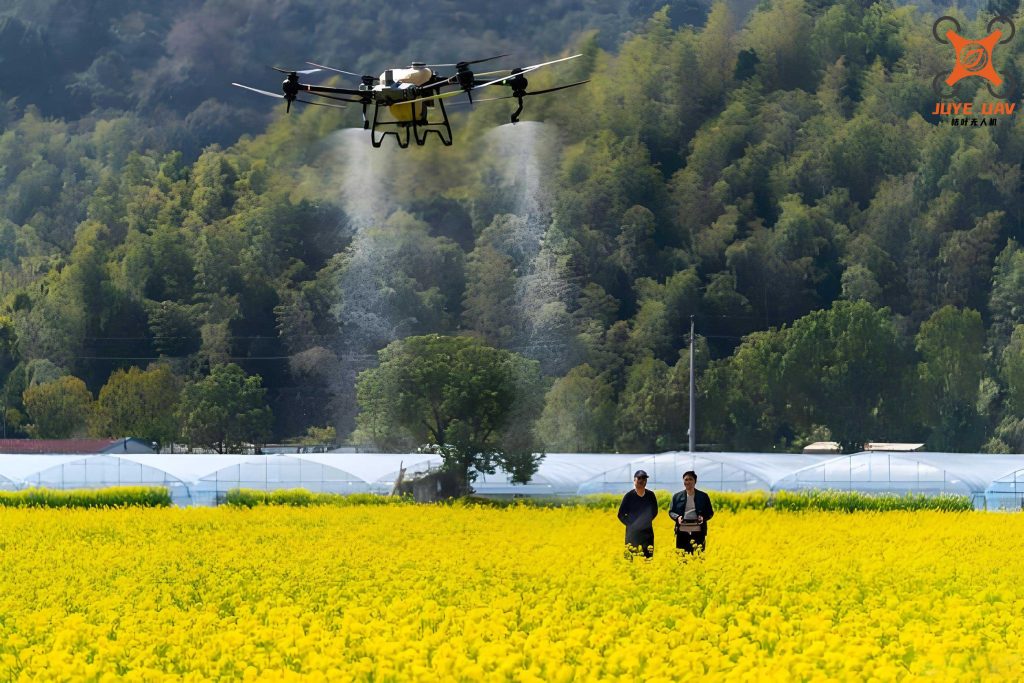
The adoption of agricultural UAVs has revolutionized pest and disease control in crops like wheat. These aerial systems enable rapid and uniform chemical application, minimizing crop damage and environmental impact. For wheat Fusarium head blight, timely intervention during flowering stages is essential to prevent spore germination and infection. Agricultural UAVs excel in this regard by allowing quick deployment over large areas, even under unfavorable conditions. In my study area, a major wheat-producing region, FHB incidence has increased in recent years due to climatic shifts and cropping patterns, necessitating advanced control strategies. This research evaluates specific agricultural UAV models—DJI T30, XAG P100, XAG V80, Quanfeng Free Eagle 1S, and DJI MG-1P—alongside a conventional boom sprayer as a control. By analyzing multiple performance metrics, I aim to determine which agricultural UAVs are most effective for FHB control, considering factors like speed, height, spray width, time, and safety. The findings will support local farmers and policymakers in optimizing agricultural UAV use for sustainable wheat production.
My experimental site was located in a cooperative farmland, characterized by a warm temperate semi-humid monsoon climate with an average annual temperature of approximately 15°C. The soil type was yellow-black soil, and the preceding crop was corn. This environment is typical for wheat cultivation in the region, with adequate rainfall and light resources. The wheat variety used was Huaimai 22 (National Approval No. 2007005), sourced from government procurement, with a sowing rate of 360 kg/ha in mid-October 2021. Fertilizer management followed standard practices: base fertilization with urea (225–240 kg/ha) and diammonium phosphate (210–225 kg/ha) at sowing, followed by topdressing with urea during regrowth (225 kg/ha), jointing (225 kg/ha), and the second-to-last leaf stages (60–75 kg/ha). These agronomic measures ensured uniform crop growth across all treatments, minimizing external variables. For disease control, I selected two fungicides commonly used in local unified prevention programs: 400 g/L tebuconazole·prochloraz emulsion in oil and 27% tebuconazole·thiabendazole emulsion in oil. These were applied at rates of 375 g/ha and 525 g/ha, respectively, diluted in 450 L/ha of water using a secondary dilution method. The first application occurred at the initial flowering stage, and the second at full flowering, integrated with insecticides and potassium dihydrogen phosphate for comprehensive “spray three protections” management. This approach aimed to control not only FHB but also pests like wheat aphids and spider mites, ensuring consistent conditions for evaluating agricultural UAV performance.
The agricultural UAVs tested included DJI T30 (from DJI Innovation Technology Co., Ltd.), XAG P100 and XAG V80 (from XAG Technology Co., Ltd.), Quanfeng Free Eagle 1S (from Quanfeng Aviation Plant Protection Technology Co., Ltd.), and DJI MG-1P (from DJI Innovation Technology Co., Ltd.). The control treatment used a conventional boom sprayer (from Hongchao Mechanical Equipment Co., Ltd.). Each treatment covered an area of approximately 1.5 hectares, with three replicates arranged in a randomized design to account for field variability. Operational parameters for each agricultural UAV were recorded, including flight speed, flight height, spray width, and operational time for the 1.5-hectare area. Safety assessments involved visual inspections of wheat plants at 3, 5, and 7 days after the second application to detect any phytotoxicity symptoms. Control efficacy was evaluated during the stable phase of FHB development by randomly selecting three points per replicate, each with at least 120 wheat spikes. Disease incidence (percentage of infected spikes) and disease index were calculated using standard methods. The disease index was derived from a severity scale (0–4) based on visual symptoms, and control efficacy was computed as follows:
For disease spike control efficacy:
$$ \text{Disease Spike Control Efficacy (\%)} = \frac{\text{Disease Spike Rate in CK} – \text{Disease Spike Rate in Treatment}}{\text{Disease Spike Rate in CK}} \times 100\% $$
For disease index control efficacy:
$$ \text{Disease Index Control Efficacy (\%)} = \frac{\text{Disease Index in CK} – \text{Disease Index in Treatment}}{\text{Disease Index in CK}} \times 100\% $$
These formulas allowed for a quantitative comparison of how well each agricultural UAV delivered fungicides to reduce FHB. Additionally, thousand-grain weight (TGW) was measured at 12.5% moisture content to assess grain quality and yield potential. All data were processed using Excel for averages and comparative analysis, ensuring statistical reliability through replication.
The operational efficiency of the agricultural UAVs was a key focus, as it directly impacts the timeliness and cost of FHB control. I collected data on flight speed, flight height, spray width, and operational time for the 1.5-hectare area. The results are summarized in Table 1, highlighting the advantages of agricultural UAVs over the conventional boom sprayer. Notably, agricultural UAVs generally operated at higher speeds and heights, with narrower spray widths for precision, but required less time due to their aerial mobility. This efficiency is crucial for FHB management, where rapid application during short weather windows is essential. The data underscore the potential of agricultural UAVs to enhance spray operations in wheat fields.
| Spray Equipment | Flight Speed (m/s) | Flight Height (m) | Spray Width (m) | Operational Time (min) |
|---|---|---|---|---|
| DJI T30 | 7.2 | 2.9 | 6.5 | 5.3 |
| XAG P100 | 8.8 | 3.0 | 6.5 | 4.4 |
| XAG V80 | 8.5 | 3.0 | 6.5 | 4.5 |
| Quanfeng Free Eagle 1S | 4.6 | 2.5 | 3.5 | 15.5 |
| DJI MG-1P | 5.5 | 2.2 | 3.0 | 15.2 |
| Conventional Boom Sprayer (CK) | 1.5 | 0.5 | 18.0 | 9.3 |
From Table 1, the agricultural UAVs exhibited significantly higher flight speeds than the conventional boom sprayer. XAG P100 had the fastest speed at 8.8 m/s, which is 4.87 times that of CK, followed by XAG V80 at 8.5 m/s (4.67 times CK) and DJI T30 at 7.2 m/s (3.80 times CK). This speed advantage translates to quicker coverage of large areas, a critical factor for FHB control during rainy periods. In terms of flight height, all agricultural UAVs operated above 2.2 m, with XAG P100 and XAG V80 reaching 3.0 m, compared to only 0.5 m for CK. Higher flight heights reduce the risk of crop damage from downdrafts and improve spray distribution. However, spray widths were narrower for agricultural UAVs, ranging from 3.0 m to 6.5 m, versus 18.0 m for CK. This narrower width may enhance precision by minimizing drift and ensuring targeted application, but it requires more flight passes; nonetheless, the overall time savings are substantial. For operational time, XAG P100 was the fastest at 4.4 minutes for 1.5 hectares, 52.7% shorter than CK, while XAG V80 and DJI T30 took 4.5 and 5.3 minutes, respectively. In contrast, Quanfeng Free Eagle 1S and DJI MG-1P required longer times (15.5 and 15.2 minutes), exceeding CK, which suggests lower efficiency for these models. These findings highlight that certain agricultural UAVs, like DJI T30, XAG P100, and XAG V80, can dramatically reduce the time needed for FHB spraying, making them ideal for large-scale operations where speed is paramount.
Safety is a crucial consideration when using agricultural UAVs for chemical application. After the second spray, I monitored wheat plants for any adverse effects. All treatments, including those with agricultural UAVs and the conventional boom sprayer, showed no visible phytotoxicity symptoms at 3, 5, and 7 days post-application. The wheat plants grew normally, with healthy foliage and no signs of burn or distortion. This indicates that the fungicides, when applied via agricultural UAVs, are safe for wheat crops at the tested rates. The aerial spraying technology of agricultural UAVs likely contributes to this safety by ensuring even droplet distribution and reducing chemical concentration hotspots. Thus, agricultural UAVs can be confidently deployed in wheat fields without harming crop development, which is essential for maintaining yield potential while controlling diseases like FHB.
The control efficacy against wheat Fusarium head blight varied among the agricultural UAVs, as shown in Table 2. Disease incidence (percentage of infected spikes) and disease index were lower for all agricultural UAV treatments compared to the conventional boom sprayer. This demonstrates the superior performance of agricultural UAVs in delivering fungicides effectively. Among the agricultural UAVs, DJI T30 had the lowest disease incidence at 5.6%, followed by XAG P100 at 6.2%, Quanfeng Free Eagle 1S at 7.5%, XAG V80 at 8.1%, and DJI MG-1P at 13.6%, while CK had 37.8%. For disease index, XAG P100 recorded the lowest value at 0.18, with others ranging from 0.20 to 0.37, compared to 1.58 for CK. These reductions translate to high control efficacy percentages, calculated using the formulas above. The results emphasize the role of agricultural UAVs in enhancing FHB management through precise and timely application.
| Spray Equipment | Disease Incidence (%) | Disease Index | Disease Spike Control Efficacy (%) | Disease Index Control Efficacy (%) |
|---|---|---|---|---|
| DJI T30 | 5.6 | 0.26 | 85.19 | 83.54 |
| XAG P100 | 6.2 | 0.18 | 83.60 | 88.61 |
| XAG V80 | 8.1 | 0.20 | 78.57 | 87.34 |
| Quanfeng Free Eagle 1S | 7.5 | 0.37 | 80.16 | 76.58 |
| DJI MG-1P | 13.6 | 0.21 | 64.02 | 86.71 |
| Conventional Boom Sprayer (CK) | 37.8 | 1.58 | — | — |
From Table 2, agricultural UAVs like DJI T30, XAG P100, and XAG V80 achieved disease spike control efficacies above 78.5% and disease index control efficacies above 83.5%. XAG P100 had the highest disease index control efficacy at 88.61%, indicating excellent fungicide deposition. In contrast, DJI MG-1P showed lower disease spike control efficacy (64.02%) but still had high disease index control efficacy (86.71%), suggesting variability in performance metrics. The superior control efficacy of agricultural UAVs can be attributed to their ability to apply chemicals uniformly across the canopy, even in dense wheat fields, whereas conventional sprayers may miss spots due to ground obstacles. This underscores the value of agricultural UAVs in achieving consistent disease reduction, which is vital for preventing yield losses and toxin contamination in wheat grains.
Grain quality, as measured by thousand-grain weight (TGW), was also influenced by the choice of spray equipment. Table 3 presents the TGW values for each treatment, showing that all agricultural UAV treatments yielded heavier grains compared to the conventional boom sprayer. This improvement likely results from better FHB control, which reduces infection and promotes fuller grain development. Among agricultural UAVs, XAG V80 had the highest TGW at 49.35 g, followed by DJI T30 at 49.21 g, Quanfeng Free Eagle 1S at 49.15 g, XAG P100 at 48.86 g, and DJI MG-1P at 48.20 g, while CK was 45.32 g. The percentage increases relative to CK ranged from 6.35% to 8.89%, highlighting the yield benefits of using agricultural UAVs. These gains are economically significant for farmers, as heavier grains often correlate with higher market value and overall productivity. Thus, agricultural UAVs not only control disease but also contribute to enhanced crop quality, reinforcing their role in sustainable wheat production.
| Spray Equipment | Thousand-Grain Weight (g) | Percentage Change Relative to CK (%) |
|---|---|---|
| DJI T30 | 49.21 | +8.58 |
| XAG P100 | 48.86 | +7.81 |
| XAG V80 | 49.35 | +8.89 |
| Quanfeng Free Eagle 1S | 49.15 | +8.45 |
| DJI MG-1P | 48.20 | +6.35 |
| Conventional Boom Sprayer (CK) | 45.32 | — |
The integration of agricultural UAVs into FHB control programs offers multifaceted advantages. From my findings, DJI T30, XAG P100, and XAG V80 emerged as top performers due to their high operational efficiency, excellent control efficacy, and positive impact on grain weight. These agricultural UAVs completed spraying tasks faster than the conventional boom sprayer, with XAG P100 taking only 4.4 minutes for 1.5 hectares—a 52.7% time reduction. This speed is critical for FHB management, as the disease requires prompt intervention during flowering stages, often under unpredictable weather. Moreover, their control efficacies exceeded 83% for disease index, significantly lowering infection risks. In contrast, agricultural UAVs like Quanfeng Free Eagle 1S and DJI MG-1P had longer operational times and variable efficacy, making them less suitable for large-scale use. The safety profiles of all agricultural UAVs were excellent, with no observed phytotoxicity, ensuring crop health. These results align with broader trends in precision agriculture, where agricultural UAVs are increasingly adopted for their ability to optimize resource use and improve outcomes. By leveraging agricultural UAV technology, farmers can achieve more sustainable FHB control, reducing chemical waste and environmental impact while boosting yields.
In discussion, the superiority of certain agricultural UAV models can be explained by their design features. For instance, DJI T30, XAG P100, and XAG V80 likely incorporate advanced navigation systems and spray mechanisms that enhance coverage and droplet penetration. Their wider spray widths (6.5 m) compared to other agricultural UAVs (3.0–3.5 m) may contribute to better canopy penetration, as reflected in higher control efficacies. Additionally, the faster flight speeds of these agricultural UAVs reduce the time window for pathogen exposure, a key factor in FHB dynamics. The relationship between operational parameters and control efficacy can be modeled using efficiency indices. For example, an overall performance score (OPS) for each agricultural UAV could be derived as a weighted sum of normalized metrics:
$$ \text{OPS} = w_1 \cdot \frac{S}{S_{\text{max}}} + w_2 \cdot \frac{H}{H_{\text{max}}} + w_3 \cdot \frac{W}{W_{\text{max}}} + w_4 \cdot \frac{T_{\text{min}}}{T} + w_5 \cdot \frac{E}{E_{\text{max}}} $$
where \( S \) is flight speed, \( H \) is flight height, \( W \) is spray width, \( T \) is operational time, \( E \) is control efficacy, and \( w_i \) are weights based on importance. Applying this to my data, agricultural UAVs like XAG P100 would score high due to balanced performance. Such quantitative approaches can guide selection processes for agricultural UAVs in different agricultural contexts.
Furthermore, the economic implications of using agricultural UAVs for FHB control are substantial. By reducing operational time, agricultural UAVs lower labor and fuel costs. For instance, if a conventional sprayer takes 9.3 minutes per 1.5 hectares, and an agricultural UAV like XAG P100 takes 4.4 minutes, the time savings per hectare is approximately:
$$ \text{Time Savings per Hectare} = \left( \frac{9.3 – 4.4}{1.5} \right) \text{ minutes} \approx 3.27 \text{ minutes/ha} $$
Over large areas, this accumulates to significant reductions, enabling more timely applications during critical periods. Additionally, the improved control efficacy from agricultural UAVs translates to higher yields, as seen in the TGW increases. Assuming a base yield of 3.5 t/ha, an 8.89% increase from using XAG V80 could yield an extra 0.31 t/ha, which at market prices can offset the investment in agricultural UAV technology. Thus, agricultural UAVs represent a cost-effective solution for modern wheat farming, especially in regions prone to FHB outbreaks.
My research also highlights the importance of tailored recommendations for agricultural UAV adoption. Based on the results, I recommend DJI T30, XAG P100, and XAG V80 for large-scale FHB control in wheat. These agricultural UAVs not only perform well but are often eligible for government subsidies in some regions, reducing upfront costs for farmers. In contrast, agricultural UAVs like Quanfeng Free Eagle 1S and DJI MG-1P, while effective in certain aspects, may be less efficient due to longer operational times and lack of subsidy support. Therefore, policymakers should consider promoting specific agricultural UAV models through incentive programs to accelerate their adoption. Future studies could explore the integration of agricultural UAVs with other technologies, such as remote sensing for real-time disease monitoring, to further optimize FHB management. By continuously refining agricultural UAV applications, we can enhance food security and agricultural sustainability in the face of climate change and disease pressures.
In conclusion, this study demonstrates the significant benefits of using agricultural UAVs for controlling wheat Fusarium head blight. Through comparative trials, I found that agricultural UAVs like DJI T30, XAG P100, and XAG V80 offer high operational efficiency, excellent safety profiles, superior control efficacy, and improved grain quality compared to conventional sprayers. Their ability to apply fungicides rapidly and precisely makes them ideal for FHB management, especially under time-sensitive conditions. The data presented in tables and formulas provide a robust framework for evaluating agricultural UAV performance. As agriculture evolves towards greater automation and precision, agricultural UAVs will play an increasingly vital role in crop protection. I encourage further research and adoption of these technologies to safeguard wheat production and ensure sustainable farming practices. By leveraging the power of agricultural UAVs, we can address the challenges of diseases like FHB and move towards a more resilient agricultural future.