
Urbanization and frequent natural disasters expose limitations in traditional firefighting, including slow response, chaotic environments, high-risk interventions, and operational inefficiencies. Police drones, enhanced by AI, IoT, big data, and cloud computing, revolutionize these operations. They minimize first-responder casualties while boosting efficiency. This research examines application scenarios and technical implementations of smart-enabled police UAVs.
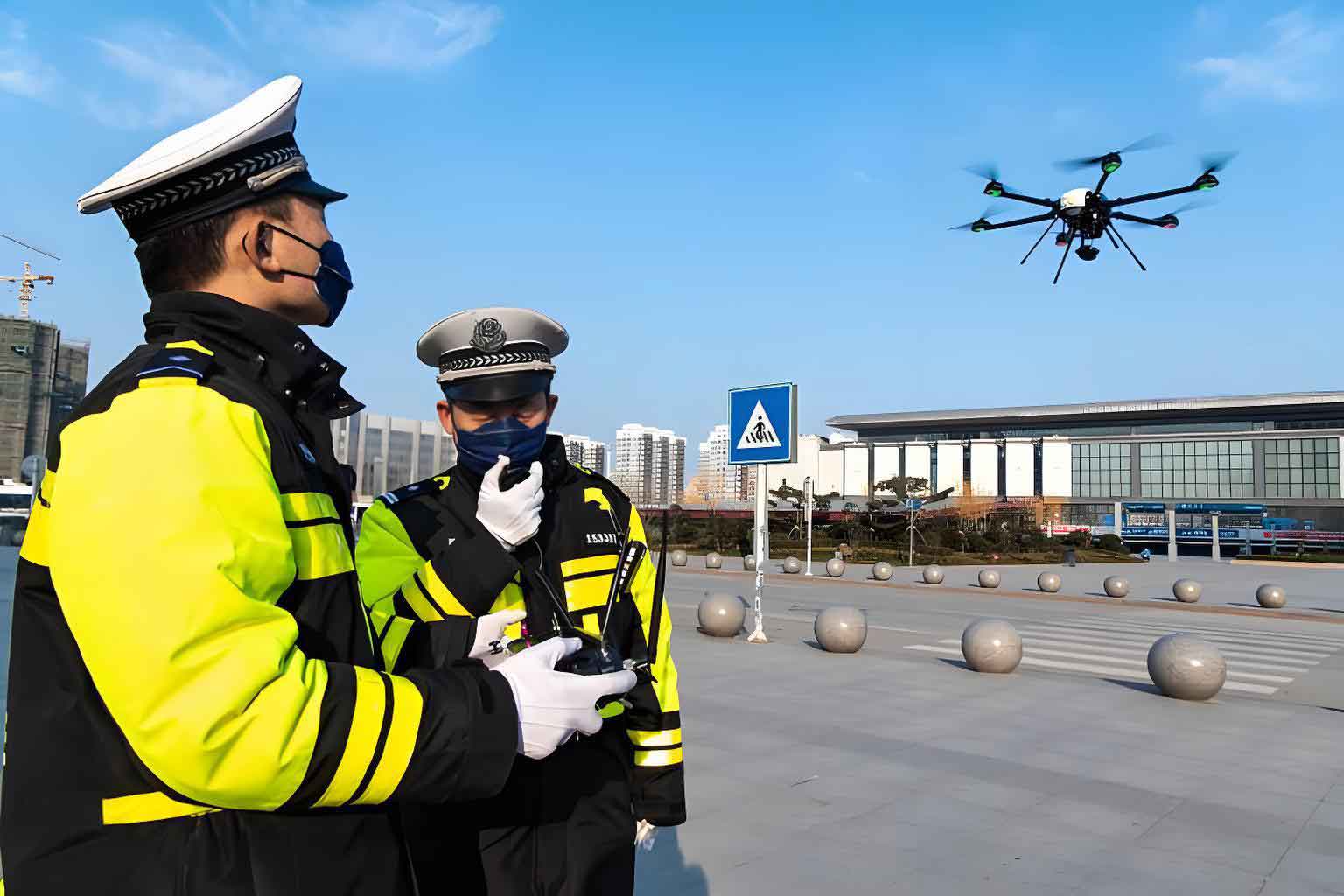
I. Application Scenarios of Smart-Empowered Police Drones
1. Fire Scene Reconnaissance & Monitoring
Police drones integrate multispectral sensors for real-time environmental mapping. Unlike ground teams, UAVs rapidly deploy to capture thermal, gas, and visual data. AI processes this to generate 3D building models and fire-spread predictions. Key metrics include:
$$ \text{Coverage Efficiency} = \frac{\text{Area Surveilled (m}^2\text{)}}{\text{Time (min)} \times \text{Energy Cost (kWh)}} $$
| Sensor Type | Data Captured | AI Application |
|---|---|---|
| Thermal Camera | Heat Signatures | Fire Core Localization |
| Gas Analyzer | CO₂, CH₄ Levels | Toxicity Risk Assessment |
| HD Camera | Structural Integrity | Collapse Prediction |
2. Hazard Detection & Early Warning
Police UAVs penetrate high-risk zones (e.g., chemical leaks or radiation fields), transmitting real-time alerts. IoT integration enables centralized hazard mapping, with drones acting as mobile safety monitors to prevent backdrafts or explosions.
$$ \text{Risk Index} = \sum_{i=1}^{n} \left( \frac{\text{Sensor Reading}_i}{\text{Safety Threshold}_i} \right) \times \text{Environmental Factor} $$
3. Material Delivery & Rescue
Mid-sized police drones (25–150kg payload) deliver extinguishing agents or medical supplies. Robotic arms enable complex interventions, reducing human exposure. Efficiency gains are quantified as:
$$ \text{Rescue Efficiency Gain} = 1 – \frac{\text{UAV Intervention Time}}{\text{Manual Intervention Time}} $$
| Payload (kg) | Mission Type | Time Saved (%) |
|---|---|---|
| 25–50 | Medical Kit Delivery | 65% |
| 50–100 | Fire Suppressant Deployment | 80% |
| 100–150 | Robotic Rescue Operations | 72% |
4. Collaborative Operations
Police drone swarms synchronize via IoT and AI-driven task allocation. In large-scale incidents, roles include surveillance, delivery, and structural scanning. Coordination follows:
$$ \text{Swarm Effectiveness} = \alpha \log(\text{Number of UAVs}) + \beta \left(\frac{\text{Data Shared}}{\text{Total Data}}\right) $$
where \(\alpha\) and \(\beta\) are swarm-coefficients calibrated to incident severity.
II. Technical Implementations of Police UAV Systems
1. Intelligent Path Planning
Police drones fuse LiDAR, GPS, and inertial navigation for obstacle avoidance and route optimization. AI algorithms like Q-learning adapt to dynamic fire environments:
$$ Q(s,a) \leftarrow (1 – \alpha) Q(s,a) + \alpha \left[ r + \gamma \max_{a’} Q(s’,a’) \right] $$
| Technology | Function | Impact on Response Time |
|---|---|---|
| 3D SLAM | Real-time Mapping | -40% |
| Reinforcement Learning | Dynamic Re-routing | -35% |
| Sensor Fusion | Environmental Awareness | -50% |
2. Real-Time Data Analytics
Edge-cloud computing architectures process UAV data. Edge nodes preprocess thermal/gas metrics, while cloud AI generates predictive models. Data throughput is critical:
$$ \text{Analysis Latency} = \frac{\text{Data Volume (GB)}}{\text{Edge Processing Rate (GB/s)}} + \frac{\text{Data Volume}}{\text{Cloud Processing Rate}} $$
3. Multi-Drone Collaboration
Police drone fleets use ad-hoc mesh networks for decentralized control. Task allocation follows auction-based algorithms:
$$ \text{Bid}_{ij} = \frac{\text{UAV Capability}_j}{\text{Distance to Task}_i} \times \text{Priority}_i $$
This enables autonomous area partitioning in forest fires or urban searches.
4. Remote Control & Automation
5G/6G ultra-reliable low-latency communication (URLLC) enables teleoperation. Autonomous charging stations support sustained operations. Automation reliability is measured as:
$$ R_{\text{auto}} = \prod_{k=1}^{m} R_{\text{component}_k} \times e^{-\lambda t} $$
| Automation Level | Human Intervention Needed | Error Rate Reduction |
|---|---|---|
| Remote Piloting | High | 30% |
| Semi-Autonomous | Medium | 65% |
| Fully Autonomous | Low | 92% |
Conclusion
Smart-enabled police drones transform firefighting through enhanced safety, efficiency, and data-driven decision-making. Key advancements—intelligent path planning, real-time analytics, swarm collaboration, and automation—demonstrate the police UAV’s indispensable role. As AI and IoT evolve, police drones will expand into predictive disaster management, solidifying their position in public safety infrastructure. Widespread adoption by global fire agencies underscores this technological imperative.