
As a member of a radio frequency security team, I have witnessed the breathtaking evolution of drone light shows from niche demonstrations to large-scale public spectacles. The convergence of technology and art in these displays is nothing short of miraculous, yet it hinges on an invisible foundation: pristine electromagnetic秩序. Every drone light show is a delicate ballet of hundreds, even thousands, of unmanned aerial vehicles (UAVs), each relying on precise radio commands, navigation signals, and timing. In this narrative, I will delve into the intricate radio安全保障 work that ensures these aerial symphonies proceed without a hitch, drawing from direct operational experience. The core of our mission is to protect the dedicated spectrum that gives life to a drone light show, and this account will detail the methodologies, challenges, and technical frameworks involved.
The planning for a major drone light show begins weeks, sometimes months, in advance. Our team’s first engagement is a deep technical dialogue with the drone light show operator. We analyze the flight plan, the communication protocols, and the specific frequency bands earmarked for the event. A critical risk assessment is conducted to identify potential sources of radio frequency interference (RFI). These can range from illegal transmitters and industrial equipment to harmonics from legitimate services. For a large-scale drone light show, the risk matrix is complex. We model the electromagnetic environment using propagation formulas. A fundamental equation we often reference is the free-space path loss model, which estimates signal attenuation over distance:
$$ P_r = P_t + G_t + G_r – 20 \log_{10}(d) – 20 \log_{10}(f) – 147.55 $$
Here, \(P_r\) is the received power in dBm, \(P_t\) is the transmitted power in dBm, \(G_t\) and \(G_r\) are the antenna gains in dBi, \(d\) is the distance in meters, and \(f\) is the frequency in Hz. This model helps us predict the coverage of both our drones’ signals and potential interferers.
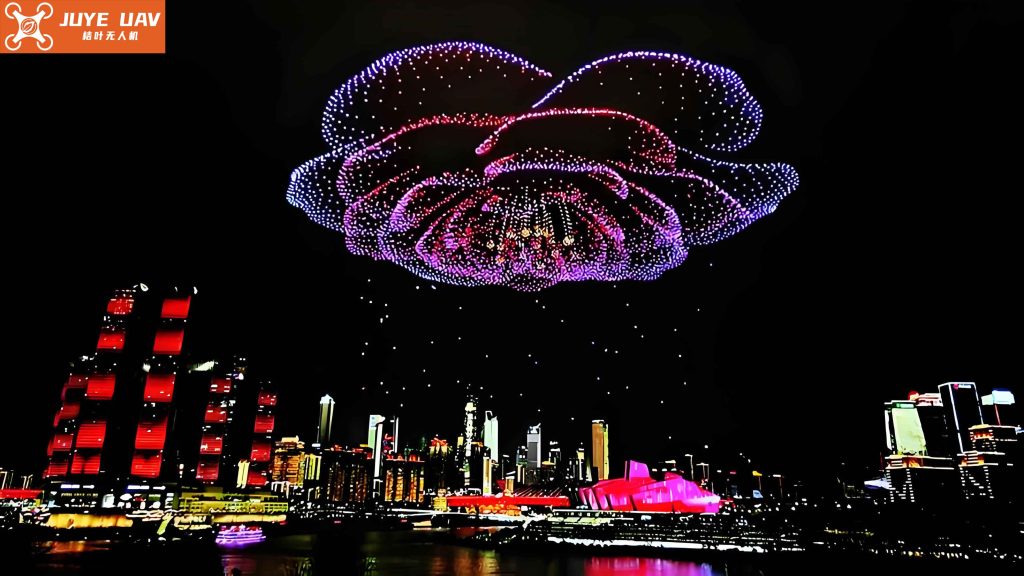
Prior to the show, we deploy a comprehensive monitoring network. This typically includes fixed monitoring stations around the venue and mobile monitoring vehicles that can be positioned strategically. The primary frequency bands we protect are categorized in the table below. For any drone light show, these are the lifelines.
| Band Designation | Frequency Range | Purpose in Drone Light Show | Potential Interference Sources |
|---|---|---|---|
| Global Navigation Satellite System (GNSS) | L1: 1575.42 MHz, L2: 1227.60 MHz | High-precision positioning and navigation for each drone. | GPS jammers, out-of-band emissions from nearby transmitters. |
| Command & Control (C2) | Commonly 2.4 GHz & 5.8 GHz ISM bands | Real-time flight control, maneuver commands, and emergency signals. | Wi-Fi networks, Bluetooth devices, consumer drones, video transmitters. |
| Telemetry & Data Link | 900 MHz, 1.2 GHz, or proprietary bands | Transmission of drone status (battery, health, position feedback). | Long-range radio systems, some industrial controls. |
| Synchronization Beacon | Often a dedicated UHF frequency | Precise timing synchronization for the entire drone swarm. | Broadcast equipment, two-way radios. |
Our pre-show activities involve protective monitoring of these bands. We establish a baseline spectral profile. Any deviation from this baseline is logged and investigated. We often use statistical detection methods. For instance, we monitor the power spectral density (PSD) and flag anomalies using a threshold model. If \(X(f)\) represents the baseline PSD and \(Y(f)\) is the real-time measurement, an alarm is triggered if the integrated difference exceeds a threshold \(\Theta\) over a critical bandwidth \(B_c\):
$$ \int_{B_c} |Y(f) – X(f)|^2 \, df > \Theta $$
This mathematical approach allows us to objectively identify potential threats to the drone light show.
The scale of a modern drone light show is staggering. To put it into perspective, consider the operational parameters for a show involving approximately 10,000 units. The coordination problem is immense, and the radio frequency management must be flawless. The following table summarizes key logistical and spectral parameters for such a mega drone light show.
| Parameter | Value / Description | Implication for RF Management |
|---|---|---|
| Number of Drones | ~10,000 units | Extremely dense C2 signal environment; high risk of self-interference or congestion. |
| Show Duration | 15-20 minutes | Requires sustained, uninterrupted spectrum clearance. |
| Total Data Links | 10,000+ concurrent links | Demands robust spectrum sharing protocols and efficient modulation. |
| Positioning Accuracy Required | < 0.1 meters | GNSS band must be absolutely clean; multipath and interference are unacceptable. |
| Key Frequency Bands in Use | GNSS L1/L5, 2.4 GHz, 5.8 GHz, 915 MHz | Multiple bands need simultaneous, real-time monitoring. |
| Typical C2 Data Rate per Drone | 50-100 kbps | Aggregate data rate approaches 1 Gbps, stressing spectrum efficiency. |
On the day of the drone light show, our team is on high alert. The mobile monitoring vehicle is stationed close to the launch site, equipped with direction-finding antennas and real-time spectrum analyzers. During one memorable event, which set records for its scale, our objective was clear: ensure zero radio frequency interference. As dusk fell and the drones began their ascent, our screens lit up with the complex tapestry of authorized signals. The drone light show’s control signals appeared as disciplined, pulsed patterns, while the GNSS band showed the constant backdrop of satellite constellations.
The core of our real-time work is signal discrimination. Every signal within the guard bands is analyzed. Its parameters—center frequency, bandwidth, modulation, power, and time-domain characteristics—are compared against a database of known authorized emitters. Signals that do not match are classified as “anomalous” and prioritized for investigation. The decision process can be framed as a hypothesis test. Let \(H_0\) be the null hypothesis that a detected signal is benign (authorized or irrelevant), and \(H_1\) be the hypothesis that it is harmful interference to the drone light show. We compute a likelihood ratio based on feature vectors \(\mathbf{s}\):
$$ \Lambda(\mathbf{s}) = \frac{P(\mathbf{s} | H_1)}{P(\mathbf{s} | H_0)} $$
If \(\Lambda(\mathbf{s})\) exceeds a carefully calibrated threshold, immediate action is taken, such as localized direction-finding to locate the source. During that record-breaking drone light show, our systems flagged 36 anomalous signals for analysis. Each was scrutinized. Fortunately, all were traced to non-malicious, transient sources or were marginal emissions that did not cross the interference threshold for the drone light show’s robust systems. Not a single drone wavered due to RF issues.
The success of safeguarding a drone light show is not merely about reaction; it’s about proactive engineering. We often advise operators on optimal frequency selection and antenna polarization to minimize vulnerability. The signal-to-interference-plus-noise ratio (SINR) is the ultimate metric for any link in a drone light show. For a drone receiving a command, it is given by:
$$ \text{SINR} = \frac{P_{\text{signal}}}{\sum P_{\text{interference}} + N_0 B} $$
where \(P_{\text{signal}}\) is the power of the desired signal, the denominator sums the power from all interfering sources within the receiver bandwidth \(B\), and \(N_0\) is the noise spectral density. Our goal is to ensure the SINR for every critical link remains above the minimum required for reliable operation throughout the entire drone light show.
Beyond the dedicated spectacle of a drone light show, the principles and practices of radio安全保障 are applicable to other critical events. For instance, in the aftermath of a major typhoon, our colleagues in a coastal region faced the dual challenge of restoring monitoring infrastructure while providing保障 for a national professional examination. The parallels are found in the priority of maintaining spectrum秩序 for safety and integrity. Similarly, for an international sports championship, the保障 of wireless microphones, timing systems, and broadcast links shares the same core tenets: thorough planning, spectrum monitoring, and rapid response. However, the density and sensitivity of a drone light show create a uniquely demanding scenario. The table below contrasts the spectrum characteristics of different event types.
| Event Type | Primary Spectrum Concerns | Typical Signal Density | Criticality of Timing Sync | 类比 to Drone Light Show Challenges |
|---|---|---|---|---|
| Large-Scale Drone Light Show | GNSS, dense C2 links, telemetry | Extremely High (1000s of focused emitters) | Extremely High (millisecond precision) | Baseline scenario. |
| Major Sports Event | Wireless audio, video links, timing systems, Wi-Fi | Moderate to High (diffuse emitters) | High (for scoring/broadcast) | Similar need for clear sub-bands, but lower emitter density. |
| Post-Disaster Recovery & Exam保障 | Restoring critical comms, preventing exam fraud via wireless devices | Variable, often degraded infrastructure | Medium | Focus on interference suppression in key bands, akin to protecting C2 bands. |
| Public Festival/Concert | PMSE (Program Making & Special Events) equipment, crowd mobile networks | High (user-generated congestion) | Low to Medium | Similar to managing background noise for a drone light show’s GNSS reception. |
The evolution of drone light show technology continually presents new challenges and learning opportunities. Future shows may employ more advanced techniques like cognitive radio or mesh networking, further complicating the spectrum landscape. Our monitoring strategies must also evolve. We are exploring the use of machine learning classifiers to automatically identify modulation types used in a drone light show control signal versus potential interferers. A simple discriminant function based on features like bandwidth \(B_w\) and peak-to-average power ratio (PAPR) can be initially modeled as:
$$ D(\mathbf{f}) = w_1 \cdot B_w + w_2 \cdot \text{PAPR} + b $$
where \(w_1, w_2,\) and \(b\) are weights and bias trained on historical data. If \(D(\mathbf{f}) > 0\), the signal is classified as a potential drone light show signal; otherwise, it is flagged for further inspection.
In conclusion, the radio frequency安全保障 for a drone light show is a multifaceted discipline blending rigorous engineering, real-time analytics, and proactive coordination. From the intense preparatory modeling to the vigilant watch during the performance itself, every step is crucial. The sight of thousands of drones moving as one in the night sky is a powerful testament to human ingenuity. As a practitioner in this field, I can affirm that ensuring the reliability of that spectacle is equally ingenious and demanding. The drone light show is not just an artistic performance; it is a peak demonstration of electromagnetic compatibility and spectrum management. The lessons learned here—in signal detection, interference mitigation, and cross-team collaboration—strengthen our overall capability to manage the invisible radio waves that underpin modern technological society. As these displays grow even more ambitious, so too will our commitment to safeguarding the ethereal channels that make them possible.