
The outbreak of a novel coronavirus presented an unprecedented global public health crisis, demanding rapid, innovative, and often non-contact solutions for containment and management. In this context, the application of Police Unmanned Aerial Vehicles (Police UAVs) emerged as a transformative force within public safety operations. As an aviation asset and a specialized policing tool, the Police UAV proved indispensable in creating an “air-ground” integrated epidemic prevention and control architecture. This analysis, from my professional perspective, delves into the conceptual foundation, unique advantages, multifaceted application scenarios, inherent challenges, and strategic future directions for Police UAV deployment during such a major public health emergency. The core premise is that the intelligent and flexible use of Police UAV systems significantly enhances operational efficiency, reduces risks to personnel, and provides critical data-driven support for command decisions, thereby strengthening the overall resilience of emergency public health management systems.
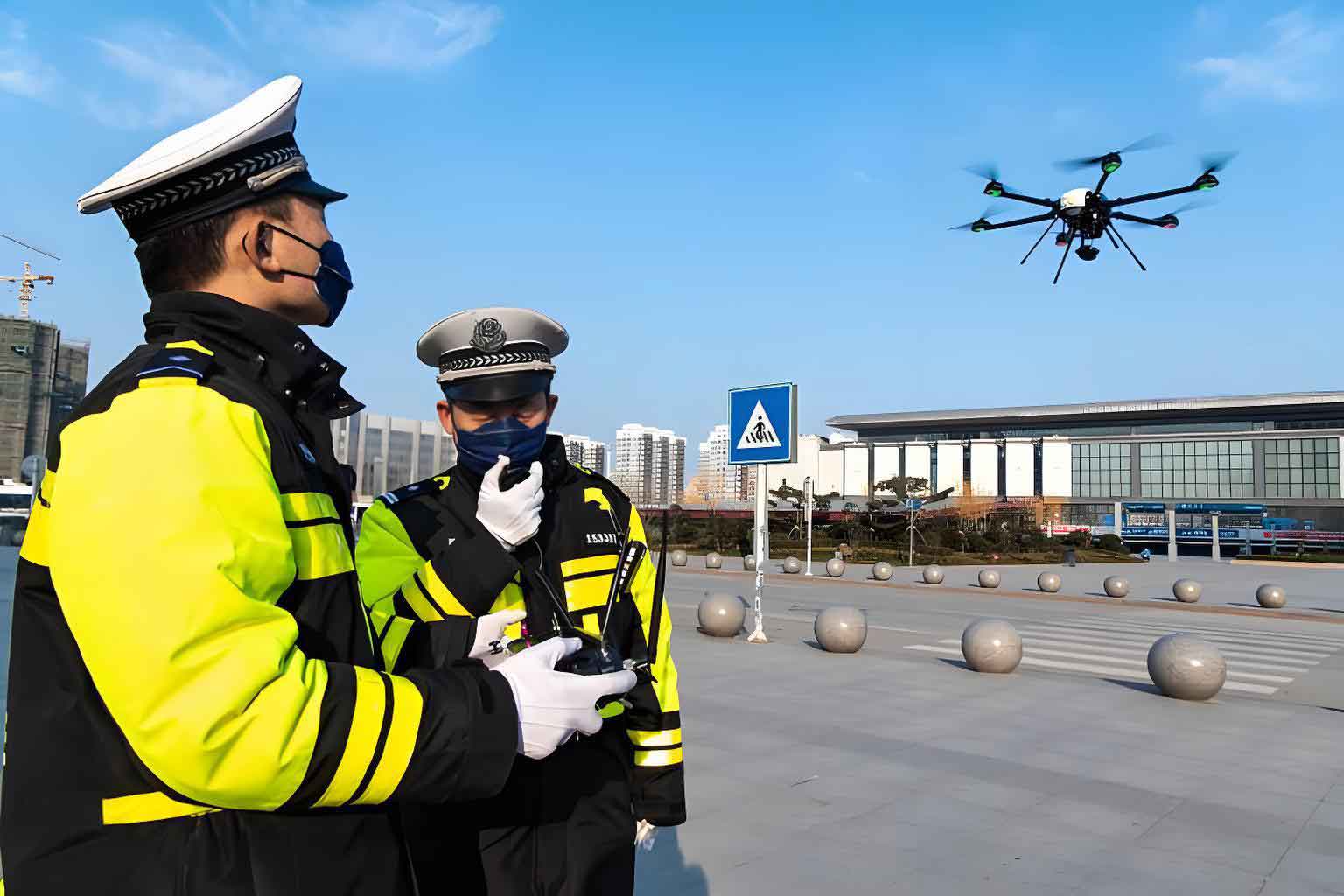
Fundamentally, a Police UAV is defined as an unmanned aircraft, operated remotely or autonomously, that is specifically equipped and deployed by law enforcement agencies to perform policing tasks. This distinguishes it from commercial or recreational drones by its integration into secure command networks, its adherence to stringent reliability standards, and its operational focus on public safety missions. During the pandemic, the primary advantage of the Police UAV was its ability to execute “non-contact” missions. This capability directly addressed the contagious nature of the virus, allowing for continuous monitoring, communication, and intervention without exposing police officers or first responders to unnecessary risk. The operational efficiency gains can be conceptually modeled. For instance, the improvement in patrol and prevention efficiency can be represented by a simple metric comparing the area covered and tasks performed relative to officer input and time:
$$E_{\text{UAV}} = \frac{A_{\text{coverage}} \times N_{\text{operations}}}{T_{\text{mission}} \times P_{\text{officers}}}$$
Where \(E_{\text{UAV}}\) represents the efficiency factor of the Police UAV deployment, \(A_{\text{coverage}}\) is the effective area monitored, \(N_{\text{operations}}\) is the number of discrete tasks (e.g., loudspeaker announcements, temperature screenings), \(T_{\text{mission}}\) is the total mission time, and \(P_{\text{officers}}\) is the number of ground officers required for support. In pandemic scenarios, this value was significantly higher than traditional ground-only methods.
The strategic advantages of Police UAVs in pandemic response are multifaceted and interconnected. The following table summarizes these core advantages and their operational impact:
| Strategic Advantage | Operational Impact | Key Mechanism |
|---|---|---|
| Risk Reduction | Minimized direct exposure of officers to contagion zones. | “Non-contact” remote sensing and intervention. |
| Command Efficiency | Real-time situational awareness for faster, more accurate decision-making. | Live HD video/thermal feed to central command. |
| Operational Scalability | Extended patrol range and persistent monitoring with limited personnel. | Rapid deployment, high area coverage rate, and long endurance. |
| System Security & Reliability | Guaranteed operation in harsh conditions and secure data transmission. | Industrial-grade hardware and encrypted, dedicated communication links. |
| Force Multiplier Effect | Alleviated pressure on stretched-thin ground units. | Automation of repetitive, dangerous, or wide-area tasks. |
These advantages were actualized across a diverse spectrum of pandemic-specific mission profiles. The Police UAV transitioned from a niche surveillance tool to a multi-role platform, often described by its functional role in the field. The applications can be systematically categorized as shown below, highlighting how the Police UAV became an indispensable asset:
| Application Role | Primary Sensors/Tools | Typical Pandemic Mission | Key Contribution Metric |
|---|---|---|---|
| Aerial Sentinel (Patrol & Inspection) | HD Zoom Camera, GNSS | Monitoring traffic at checkpoints, inspecting lockdown zones, assessing crowd density in public spaces. | Area covered per hour (km²/hr); Number of incidents identified. |
| Aerial Broadcaster (Public Address & Dissuasion) | Loudspeaker, Spotlight | Broadcasting health guidelines, dispersing unauthorized gatherings, directing queues at testing sites. | Population reached per broadcast; Compliance rate after warning. |
| Aerial Investigator (Covert Surveillance & Search) | Low-light Camera, Thermal Imager | Locating illegal gatherings (e.g., gambling), searching for missing or non-compliant individuals in complex terrain. | Time to locate target; Quality of evidence gathered. |
| Aerial Courier (Logistics & Transport) | Cargo Release Mechanism | Transporting critical medical samples, delivering supplies to quarantined households or isolated frontline posts. | Weight delivered over distance (kg-km); Reduction in delivery time vs. ground. |
| Aerial Sanitizer (Disinfection) | Liquid Spraying System | Spraying disinfectant over large public areas, transportation hubs, and medical facility peripheries. | Volume sprayed per sortie (liters); Area disinfected per hour. |
| Aural Nurse (Health Screening) | Radiometric Thermal Camera, Visible Camera | Conducting preliminary mass temperature screening in crowds, identifying individuals with elevated body temperature. | Individuals screened per minute; Accuracy of temperature measurement (±°C). |
The effectiveness of a Police UAV in temperature screening, for instance, relies on precise radiometric measurement. The accuracy is influenced by the sensor’s performance, distance to target, and atmospheric conditions. The measured apparent temperature \(T_{\text{apparent}}\) must be corrected to estimate the true skin temperature \(T_{\text{skin}}\), which can be approximated by considering emissivity \(\epsilon\) and reflected ambient radiation:
$$T_{\text{skin}} \approx \left( \frac{T_{\text{apparent}}^4 – (1 – \epsilon) T_{\text{ambient}}^4}{\epsilon} \right)^{1/4}$$
High-end Police UAV systems integrate reference “blackbody” sources to calibrate this measurement in real-time, achieving errors as low as ±0.5°C, which is sufficient for rapid mass screening.
However, the rapid deployment of Police UAVs during the crisis also exposed several systemic challenges and gaps that must be addressed to mature this capability. The effectiveness of any Police UAV operation is not solely dependent on the hardware but on a holistic ecosystem encompassing personnel, communication, doctrine, and integration. The challenges and proposed strategic responses are summarized below:
| Challenge Area | Specific Issue | Proposed Strategic Response |
|---|---|---|
| Talent & Training | Acute shortage of certified pilots (remote pilots), data analysts, and tactical commanders for air operations. | Establish dedicated Police Aviation units with clear career paths. Implement standardized training curricula certified by aviation (e.g., AOPA) and law enforcement authorities. Foster partnerships with academies and industry for continuous training. |
| Communication & Data | Limited bandwidth for HD/thermal video; isolation from medical/health command systems; fragmented data sources. | Integrate with 5G/6G networks for high-speed, low-latency links. Develop interoperable data protocols for seamless sharing with public health “information grids.” Employ UAV swarms for distributed data collection and mesh networking. |
| Platform & Payload Diversity | Over-reliance on multi-rotor Police UAVs; limited payload capacity; adaptation of non-police grade drones. | Develop a mixed fleet: Multi-rotors for hover-intensive tasks (inspection, spraying) and fixed-wing Police UAVs for long-range, wide-area patrol. The performance trade-off is clear: $$ \text{Multi-rotor: High Hover Stability, Lower Endurance} \text{Fixed-wing: High Endurance/Speed, No Hover}$$ Innovate in high-payload designs (e.g., hybrid VTOL) for logistics. |
| Precision & Differentiation | One-size-fits-all aerial patrols fail to address nuanced needs of different zones (residential, market, industrial). | Implement data-driven, precision policing from the air. Tailor Police UAV sensor payloads and flight patterns: loudspeaker emphasis in residential areas, crowd analytics in markets, and logistics support for isolated communities. |
| Legal & Procedural Framework | Lack of standardized procedures for aerial evidence collection, “non-contact” enforcement, and integration with ground response. | Formalize the “Air-Ground Integrated Policing” workflow. This involves a clear protocol from alarm receipt at the 110 center, to risk assessment, Police UAV dispatch, live aerial reconnaissance, joint analysis of the feed by ground and command, and coordinated resolution. Legitimize aerial evidence within judicial processes. |
The procedural challenge is particularly critical. A robust operational workflow for Police UAV deployment in emergencies must be codified. This process can be modeled as a decision loop: Upon receiving an alert, the command center assesses the risk level \( R \) based on factors like potential for violence \( V \), public health hazard \( H \), and accessibility \( A \): \( R = f(V, H, A) \). If \( R \) exceeds a threshold indicating suitability for aerial response, a Police UAV asset \( U \) is tasked, selected based on required payload \( L \), range \( D \), and endurance \( E \): \( U = g(L, D, E) \). The Police UAV then conducts reconnaissance, streaming data for real-time analysis, leading to a joint decision for either aerial resolution (e.g., loudspeaker order) or guided ground intervention.
Looking forward, the evolution of Police UAV technology and doctrine must focus on achieving a balance between law enforcement potency and public service capability. The pandemic has irrevocably demonstrated that the mission set for Police UAVs extends far beyond traditional surveillance. The concept of “Police UAV + New Ecosystem” is paramount. This means actively integrating with advancements in AI (for automated anomaly detection), logistics networks (for urban air mobility), and smart city infrastructures. The future Police UAV will not be a standalone tool but an intelligent node within a broader network of public safety and service delivery.
In conclusion, the deployment of Police UAVs during the global health crisis was a testament to technology-empowered policing. These systems provided a vital, flexible, and powerful layer of response, mitigating risks and enhancing capabilities when they were most needed. The lessons learned are clear: investment must continue not only in the Police UAV platforms themselves but in the human capital to operate them, the communication architectures to connect them, and the legal-procedural frameworks to govern them. By systematically addressing the identified challenges, law enforcement agencies can ensure that Police UAV fleets are ready, integrated, and effective components of national emergency response systems, capable of serving and protecting communities through the unique demands of the 21st century.