
The advent of sophisticated drone technology has catalyzed the proliferation of autonomous multi-agent systems. Among the most visually stunning and technically demanding applications is the drone light show, where hundreds, sometimes thousands, of unmanned aerial vehicles (UAVs) operate in tight formation to create dynamic aerial displays. This application epitomizes the core challenge in swarm robotics: achieving precise, safe, and efficient collective motion in densely populated, dynamic airspace. The operational envelope for a drone light show is exceptionally constrained; trajectories are pre-programmed yet must adapt in real-time to unforseen disturbances like wind gusts or unit failures, all while maintaining absolute collision-free guarantees. The failure of even a single unit can lead to a catastrophic chain reaction, turning a mesmerizing spectacle into a hazardous debris field. Therefore, developing robust, intelligent collision avoidance decision-making frameworks is not merely an academic pursuit but a critical engineering requirement for the safe commercialization of such swarm applications.
Traditional approaches to swarm navigation and obstacle avoidance, such as rule-based methods, trajectory prediction, and classical Artificial Potential Field (APF) algorithms, often fall short in these hyper-dense scenarios. While APF is computationally efficient and suitable for distributed control—making it attractive for real-time implementation on drone hardware—it suffers from well-documented pitfalls like local minima, oscillatory paths, and a lack of global awareness. It treats collision avoidance as a reactive, geometry-only problem, responding to immediate threats without assessing the broader swarm’s stability or the evolving risk context. For a complex drone light show involving intricate choreography, a purely reactive system is insufficient. What is needed is a proactive and adaptive system that can assess the safety health of the entire swarm and adjust its control strategy accordingly.
This article proposes a novel, integrated framework for drone swarm collision avoidance that fuses a formal safety assessment with bio-inspired optimization. The core innovation lies in creating a closed-loop system where a multi-dimensional safety evaluation directly informs and modulates the control parameters of the avoidance algorithm. We move beyond simple distance-based metrics to construct a comprehensive safety index system that captures both local conflict risks (e.g., closing velocity, potential field energy) and global swarm coordination metrics (e.g., network degree, clustering coefficient). Principal Component Analysis (PCA) is then employed to distill these correlated metrics into a single, meaningful Composite Safety Score (CSS) for each drone. This score acts as the pivotal state variable, triggering a tiered response strategy: normal APF operation under safe conditions, parameter-adjusted APF under elevated risk, and the activation of a global Pigeon-Inspired Optimization (PIO) algorithm under high-risk conditions to escape local traps and find cooperative solutions. This “assess, classify, and optimally respond” paradigm ensures that the swarm for a drone light show remains cohesive, adaptable, and supremely safe even when the planned formation is compromised.
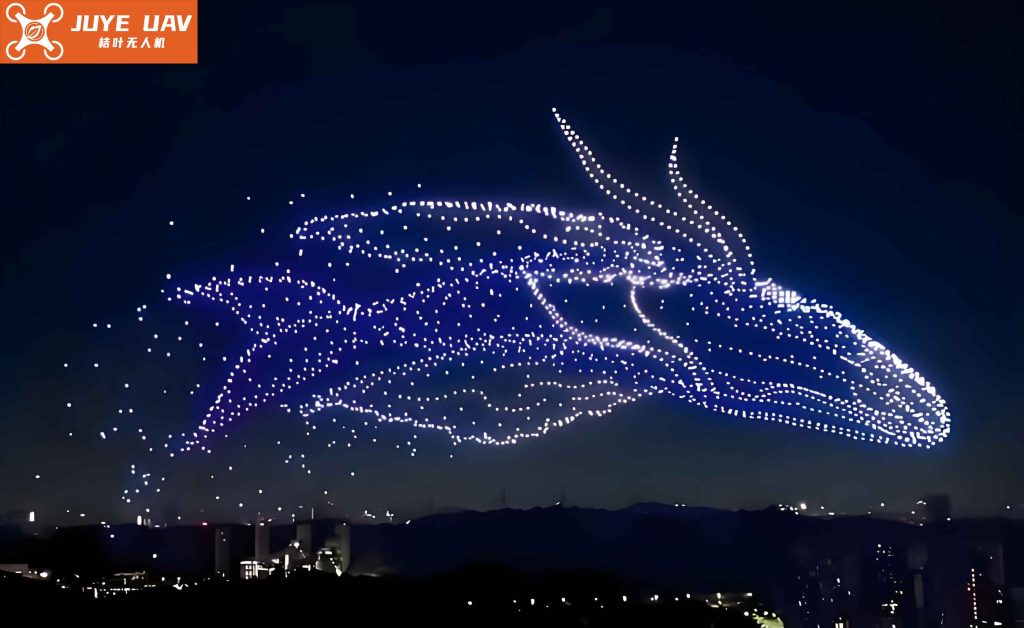
The orchestration of a large-scale drone light show presents a microcosm of the broader challenges in autonomous swarm operations. Drones must fly within meters of each other, follow precise time-synchronized paths, and recover gracefully from individual errors. A safety-agnostic controller might prevent a direct mid-air collision but could inadvertently push one drone into the path of another or cause the formation to unravel. Our proposed framework is designed precisely for this environment. By continuously evaluating not just “am I about to hit something?” but “what is the overall collision risk level for me and my neighbors?”, each drone gains a level of situational awareness that enables more intelligent, cooperative decisions. This is crucial when the swarm must dynamically avoid a sudden, unmodeled obstacle or recalibrate its formation due to a lost unit, ensuring the show’s continuity and safety are preserved.
Formal Safety Assessment Model for Drone Swarms
The foundation of our adaptive control strategy is a quantitative model that assesses the real-time safety state of each agent within the swarm. For a system as interdependent as a drone light show swarm, safety is not an isolated property but an emergent condition of local interactions and global topology. We define a multi-faceted safety evaluation index system that probes different aspects of collision risk and coordination health.
Multi-Dimensional Safety Evaluation Index System
Let a swarm consist of \( N \) drones. For any drone \( i \), its neighbor set \( \mathbb{N}_i \) includes all drones within its perception radius \( R \). We define the following eight core indices, categorized into local risk and global coordination metrics.
Local Risk Indices:
1. Closing Rate Index (\(I_i\)): This predicts impending conflicts by measuring the speed at which drone \(i\) and its neighbor \(j\) are converging. It considers the geometry of their relative motion. The closing rate \(A_{ij}\) is calculated based on their velocities and the angles between their headings and the line connecting them. The index for drone \(i\) is the maximum closing rate with any neighbor:
$$ A_{ij} = \cos(\alpha_{ij}) V_i + \cos(\alpha_{ji}) V_j $$
$$ \alpha_{ij} = \begin{cases} |\chi_i – \varphi_{ij}| & |\chi_i – \varphi_{ij}| \leq \pi \\ 2\pi – |\chi_i – \varphi_{ij}| & |\chi_i – \varphi_{ij}| > \pi \end{cases} $$
$$ I_i = \max_{j \in \mathbb{N}_i} (A_{ij}) $$
where \(\chi_i\) is the heading of drone \(i\), \(\varphi_{ij}\) is the bearing of drone \(j\) relative to \(i\), and \(V\) denotes speed.
2. Local Potential Energy Index (\(E_i\)): This quantifies the spatial crowdedness around drone \(i\) by summing inverse-distance terms with all neighbors, penalizing proximity more severely.
$$ E_i = \sum_{j \in \mathbb{N}_i} \left( \frac{1}{d_{ij}} – \frac{1}{R} \right)^{\tau} $$
where \(d_{ij} = \| \mathbf{p}_i – \mathbf{p}_j \|\) is the Euclidean distance and \(\tau > 1\) (typically \(\tau=2\)).
3. Maximum Potential Index (\(P_i\)): This captures the worst-case proximity risk for drone \(i\), defined as the highest value of the \(E\) index in its immediate vicinity (a surrogate for being the “most squeezed” agent).
$$ P_i = \max_{j \in \mathbb{N}_i} (E_j) $$
4. Repulsive Force Index (\(F_i\)): This is the magnitude of the total repulsive force exerted on drone \(i\) by all neighbors within the standard APF framework, providing a direct measure of the immediate avoidance actuation.
$$ F_i = \left\| \sum_{j \in \mathbb{N}_i} k_r \left( \frac{1}{d_{ij}} – \frac{1}{d_0} \right) \frac{1}{d_{ij}^2} \cdot \frac{\partial d_{ij}}{\partial \mathbf{p}_i} \right\| $$
where \(k_r\) is the repulsive gain and \(d_0\) is the effective range of the repulsive field.
5. Maximum Repulsive Force Index (\(F^{max}_i\)): Similar to \(P_i\), this identifies the single strongest repulsive interaction drone \(i\) is experiencing.
$$ F^{max}_i = \max_{j \in \mathbb{N}_i} \left( k_r \left( \frac{1}{d_{ij}} – \frac{1}{d_0} \right) \frac{1}{d_{ij}^2} \right) $$
Global Coordination Indices:
6. Node Degree (\(D_i\)): The number of neighbors within communication/perception range, indicating local connectivity.
$$ D_i = \sum_{j=1}^{N} l_{ij}, \quad l_{ij} = \begin{cases} 1 & d_{ij} \leq R \\ 0 & d_{ij} > R \end{cases} $$
7. Weighted Node Degree (\(W_i\)): An enhanced version of node degree that weights each connection by the inverse of distance, giving more importance to closer, riskier neighbors.
$$ W_i = \sum_{j=1}^{N} l_{ij} \omega_{ij}, \quad \omega_{ij} = \frac{1}{d_{ij}} $$
8. Average Clustering Coefficient (\(C_i\)): A network-theoretic measure that assesses how tightly interconnected a drone’s neighbors are. A high value suggests a tightly knit cluster, which could be a congestion point in a drone light show formation.
$$ c_{\omega}(i) = \frac{1}{k_i^{\omega}(k_i^{\omega}-1)} \sum_{j,k} \frac{\omega_{ij}+\omega_{jk}}{2} l_{ij} l_{jk} l_{ki} $$
$$ C_i = \frac{1}{N} \sum_{i=1}^{N} c_{\omega}(i) $$
where \( k_i^{\omega} \) is a weighted degree factor and \( c_{\omega}(i) \) is the local clustering coefficient for node \(i\).
Principal Component Analysis for Composite Safety Scoring
Having eight correlated indices is informative but cumbersome for real-time control decision-making. To synthesize this information, we employ Principal Component Analysis (PCA). For each control cycle, we construct a state matrix \( \mathbf{Y} = [y_{ij}]_{N \times M} \) where \(M=8\). The data is standardized to zero mean and unit variance to create \( \mathbf{Y}’ \). PCA is performed on the covariance matrix of \( \mathbf{Y}’ \) to obtain eigenvalues \( \lambda_k \) and eigenvectors \( \mathbf{v}_k \). We select the first \( M’ \) principal components (PCs) such that their cumulative contribution rate exceeds a threshold (e.g., \( \mu = 0.9 \)):
$$ \sum_{k=1}^{M’} \gamma_k \geq \mu, \quad \text{where } \gamma_k = \frac{\lambda_k}{\sum_{j=1}^{M} \lambda_j} $$
The Composite Safety Score (CSS) for drone \(i\), denoted \( F_i \), is then computed as the weighted sum of its scores on these principal components:
$$ \epsilon_i^k = \sum_{j=1}^{M’} v_{kj} \cdot y_{ij}’ $$
$$ F_i = \sum_{k=1}^{M’} \gamma_k \cdot \epsilon_i^k $$
Finally, \( F_i \) is normalized to the range \([0, 1]\):
$$ F_i’ = \frac{F_i – \min(F)}{\max(F) – \min(F)} $$
A score \( F_i’ \) close to 1 indicates high collision risk/poor coordination, while a score near 0 indicates safe, well-coordinated operation. This single, comprehensive score becomes the key input for our tiered control strategy. The mapping from score to action is defined by two threshold parameters, \( \theta_1 \) and \( \theta_2 \), which segment the risk space into three operational regimes.
| Safety Zone | Score Range | Operational Mode | Control Strategy |
|---|---|---|---|
| Safe | \( F_i’ \leq \theta_1 \) | Coordinated Advance | Attractive force dominates; maintain formation/trajectory. |
| Alert | \( \theta_1 < F_i’ < \theta_2 \) | Normal Avoidance | Balance attraction and repulsion; coordinated avoidance maneuvers. |
| Critical | \( F_i’ \geq \theta_2 \) | Emergency Avoidance | Repulsion maximized, attraction suppressed; trigger global PIO optimization. |
Safety-Evaluation-Driven Adaptive Collision Avoidance Framework
The core of our decision-making system is a closed-loop framework that integrates the safety assessment with two complementary control methodologies: an Adaptive Weight Artificial Potential Field (AW-APF) and a Pigeon-Inspired Optimization (PIO) algorithm. The CSS score \( F_i’ \) governs the transition and blending between these methods.
Adaptive-Weight Artificial Potential Field (AW-APF)
The standard APF defines an attractive potential \( U_{att} \) towards the goal and a repulsive potential \( U_{rep} \) from obstacles/neighbors. The control force is the negative gradient of the total potential. Our key modification is to make the gains \( k_a \) (attractive) and \( k_r \) (repulsive) functions of the drone’s safety score:
$$ k_r^i = k_r \cdot (1 + \alpha F_i’) $$
$$ k_a^i = k_a \cdot (1 – \beta F_i’) $$
where \( \alpha, \beta \in [0.5, 1] \) are sensitivity coefficients. The adaptive forces become:
$$ \mathbf{F}_{att}^i = k_a^i (\mathbf{p}_i – \mathbf{p}_{goal}) $$
$$ \mathbf{F}_{rep}^i = \begin{cases} \sum_{j \in \mathbb{N}_i} k_r^i \left( \frac{1}{d_{ij}} – \frac{1}{d_0} \right) \frac{1}{d_{ij}^2} \frac{\partial d_{ij}}{\partial \mathbf{p}_i} & d_{ij} \leq d_0 \\ 0 & d_{ij} > d_0 \end{cases} $$
$$ \mathbf{a}_i^{APF} = \frac{ \mathbf{F}_{att}^i + \mathbf{F}_{rep}^i }{m_i} $$
(where \( m_i \) is mass, often normalized to 1). This mechanism ensures a drone in a drone light show that finds itself in a congested area (high \( F_i’ \)) automatically increases its “caution” by boosting repulsion and dampening the pull towards its nominal target, prioritizing immediate collision avoidance over trajectory tracking.
Pigeon-Inspired Optimization for Global Cooperative Avoidance
When a drone’s CSS score enters the Critical zone (\( F_i’ \geq \theta_2 \)), it indicates that local, gradient-based APF control may be insufficient—it might be trapped in a local minimum or its actions are conflicting with the swarm’s global need. At this point, we activate a PIO algorithm to perform a short-horizon, cooperative search for a better control directive. The PIO algorithm, inspired by pigeon homing behavior, operates in two phases: a map and compass operator (global exploration) and a landmark operator (local refinement and cooperation).
For a drone in critical state, we formulate an optimization problem where the decision variable is a unit vector \( \mathbf{x} \) representing a candidate acceleration direction. The objective is to minimize the predicted safety score. The APF-derived acceleration direction provides the initial population (\( \mathbf{x}_i^0 \)) for the PIO’s “pigeons”.
1. Map and Compass Operator (Iterations \( t \leq N_{c1} \)):
Pigeons (candidate solutions) update their positions based on the global best solution \( \mathbf{x}_{best} \).
$$ \mathbf{V}_i^t = \mathbf{V}_i^{t-1} \cdot e^{-r t} + rand \cdot (\mathbf{x}_{best}^{t-1} – \mathbf{x}_i^{t-1}) $$
$$ \mathbf{x}_i^t = \mathbf{x}_i^{t-1} + \mathbf{V}_i^t $$
where \( r \) is a decay factor and \( rand \) is a random number in [0,1].
2. Landmark Operator (Iterations \( N_{c1} < t \leq N_{c2} \)):
The population is reduced by half each iteration, keeping the better half. Solutions update towards the center of the remaining swarm, promoting convergence. We incorporate a local neighborhood topology (a ring structure) to enhance cooperative information sharing, mimicking the local interactions in a real drone light show swarm.
$$ \mathbf{x}_{center}^{t-1} = \frac{ \sum_{i=1}^{N_p^{t-1}} \mathbf{x}_i^{t-1} \cdot \mathcal{FIT}(\mathbf{x}_i^{t-1}) }{ N_p^{t-1} \cdot \sum_{i=1}^{N_p^{t-1}} \mathcal{FIT}(\mathbf{x}_i^{t-1}) } $$
$$ \mathcal{FIT}(\mathbf{x}_i^{t-1}) = \frac{1}{f(\mathbf{x}_i^{t-1}) + \varepsilon} $$
Here, \( f(\mathbf{x}_i) \) is the fitness—the predicted CSS score if the drone moved in direction \( \mathbf{x}_i \). The update rule considers both the global center and a local neighborhood center \( \mathbf{x}_{localcenter}^{t-1} \), allowing a balance between global and local cooperation.
$$ \mathbf{x}_i^t = \mathbf{x}_i^{t-1} + rand \cdot (\mathbf{x}_{center}^{t-1} – \mathbf{x}_i^{t-1}), \quad \text{if } \bar{\mathcal{FIT}}_{local} < \bar{\mathcal{FIT}}_{global} $$
$$ \mathbf{x}_i^t = \mathbf{x}_i^{t-1} + rand \cdot (\mathbf{x}_{localcenter}^{t-1} – \mathbf{x}_i^{t-1}), \quad \text{if } \bar{\mathcal{FIT}}_{local} \geq \bar{\mathcal{FIT}}_{global} $$
After \( N_{c2} \) iterations, the optimal direction \( \mathbf{x}_{best} \) is obtained. The corresponding PIO-suggested acceleration is \( \mathbf{a}_i^{PIO} = a_{mag} \cdot \mathbf{x}_{best} \), where \( a_{mag} \) is a suitable magnitude.
Strategy Fusion and Final Decision
The final step is a meta-decision: which control directive should the drone execute? This is resolved by a simple yet effective fitness-based arbitration:
$$ \mathbf{a}_i^{final} = \begin{cases} \text{sat}(\mathbf{a}_i^{PIO}, a_{max}) & \text{if } f(\mathbf{a}_i^{PIO}) < f(\mathbf{a}_i^{APF}) \\ \text{sat}(\mathbf{a}_i^{APF}, a_{max}) & \text{otherwise} \end{cases} $$
where \( \text{sat}(\cdot) \) is a saturation function enforcing actuator limits \( a_{max} \), and \( f(\cdot) \) is the immediate fitness (CSS) evaluation of that action. This ensures the drone always chooses the action deemed safest by the unified evaluation metric. The drone’s state is then updated:
$$ \mathbf{v}_i(t+\Delta t) = \mathbf{v}_i(t) + \mathbf{a}_i^{final} \Delta t $$
$$ \mathbf{p}_i(t+\Delta t) = \mathbf{p}_i(t) + \mathbf{v}_i(t+\Delta t) \Delta t $$
This completes the perception-assessment-optimization-action loop for one control cycle.
Simulation Analysis and Performance Evaluation
To validate the proposed Safety-Evaluation-Driven PIO (FSA-PIO) framework, we conducted simulation tests emulating a challenging segment of a drone light show routine. A swarm of 5 drones is tasked with navigating through an environment cluttered with 6 cylindrical obstacles, representing dynamic stage props or no-fly zones. Key simulation parameters are listed below.
| Algorithm | Parameter | Value | Description |
|---|---|---|---|
| APF / AW-APF | \(k_a\) | 5 | Base Attractive Gain |
| \(k_r\) | 15 | Base Repulsive Gain | |
| \(d_0\) | 200 m | Repulsive Field Range | |
| \(\alpha, \beta\) | 0.75 | Adaptive Sensitivity | |
| \(R\) | 300 m | Perception/Comm Radius | |
| PIO | \(N_p\) | 20 | Pigeon Population |
| \(N_{c1}, N_{c2}\) | 100, 80 | Phase Iteration Limits | |
| \(r\) | 0.02 | Compass Factor | |
| – | – | – | |
| Safety | \(\theta_1, \theta_2\) | 0.3, 0.7 | Safety Zone Thresholds |
| \(v_{max}, a_{max}\) | 15 m/s, 10 m/s² | Kinematic Limits |
The swarm successfully navigated the obstacle field without any collisions. The trajectories demonstrated smooth, cooperative avoidance behaviors, with drones in the critical zone executing more assertive, PIO-optimized maneuvers that considered the swarm’s overall flow, akin to drones in a drone light show dynamically adjusting their paths to fill a gap or avoid a malfunctioning neighbor.
A quantitative comparative analysis was performed against three baseline methods: Standard APF, a Particle Swarm Optimization (PSO)-based method, and a standard PIO-based method (without the safety-assessment-driven adaptation). The results, averaged over 10 simulation runs, are compelling.
| Performance Metric / Method | Standard APF | PSO-Based | Standard PIO | Proposed FSA-PIO |
|---|---|---|---|---|
| Avg. Closing Rate Index (I) | 1.42 | 1.17 | 1.12 | 0.95 |
| Avg. Local Potential (E) | 117.8 | 96.5 | 91.1 | 78.9 |
| Avg. Max Repulsion (Fmax) | 19.3 | 14.7 | 13.5 | 10.2 |
| Avg. Weighted Degree (W) | 5.1 | 4.6 | 4.4 | 3.8 |
| Avg. Clustering Coeff. (C) | 0.53 | 0.45 | 0.41 | 0.35 |
| Avg. Composite Safety Score (F’) | 0.75 | 0.67 | 0.62 | 0.51 |
| Number of Conflict Events* | 5.1 | 2.4 | 1.2 | 0.2 |
*A conflict event is logged when the distance between any two drones is less than a minimum safe separation (e.g., 5m).
The data unequivocally shows that the FSA-PIO framework outperforms all baselines across every safety metric. Most importantly, it reduces the number of critical conflict events by an order of magnitude compared to standard APF and significantly outperforms other optimization-only approaches. The lower Composite Safety Score confirms that the swarm operates in a consistently safer and more coordinated state. The adaptive AW-APF handles routine threats efficiently, while the PIO module, triggered only when necessary, provides a powerful global corrective without imposing a continuous computational overhead. This makes the framework highly suitable for the real-time demands of a drone light show, where decisions must be made in milliseconds.
Conclusion and Future Perspectives
This article presented a holistic, safety-evaluation-driven framework for collision avoidance in autonomous drone swarms, with a focused application to the demanding domain of coordinated drone light show performances. The proposed methodology bridges the gap between low-level reactive control and high-level swarm intelligence by introducing a formal, multi-dimensional safety assessment model. The use of Principal Component Analysis to generate a unified Composite Safety Score provides an elegant and effective mechanism to distill complex swarm interactions into a actionable control signal. This score drives a tiered response system: an Adaptive-Weight Artificial Potential Field for graceful, efficient navigation under normal and elevated risk, and a Pigeon-Inspired Optimization algorithm for globally cooperative escape and re-planning under critical conditions.
The simulation results validate the framework’s efficacy, demonstrating superior safety performance and coordination compared to conventional and bio-inspired baseline methods. The system inherently balances the need for fast reaction times (via APF) with the need for globally optimal, cooperative solutions (via PIO), guided at every step by a quantitative measure of risk. For producers of drone light show spectacles, such a system offers a robust technological backbone to ensure breathtaking performances are conducted with an unprecedented level of built-in safety and fault tolerance.
Future work will focus on enhancing the framework’s robustness and scalability. Key directions include: 1) Integrating the safety assessment with predictive models to enable risk anticipation rather than just reaction; 2) Extending the framework to handle highly dynamic environments with moving obstacles and adversarial agents, which is relevant for next-generation interactive drone light show experiences; 3) Developing distributed versions of the PIO optimization to further reduce computational load and increase scalability to swarms of thousands of drones; and 4) Implementing and testing the framework on physical hardware in outdoor environments to validate its performance under real-world communication delays, sensor noise, and environmental disturbances. The pursuit of ever-more intelligent and safe swarm systems continues to be a driving force in unlocking the full potential of autonomous aerial collectives.