
I study robust beamforming for unmanned aerial vehicle (UAV) communication systems in which rate-splitting multiple access (RSMA) is used to serve multiple ground users under realistic jitter. In my view, UAV drones are no longer merely airborne relays or temporary base stations; they are becoming active elements of future wireless networks. Their low cost, flexible deployment, strong line-of-sight (LoS) probability, and three-dimensional mobility make them highly attractive for emergency communications, hotspot offloading, aerial sensing, and integrated air-ground networks. However, the same properties that make UAV drones attractive also introduce serious design challenges. The airframe vibrates, atmospheric turbulence perturbs the attitude, and the antenna array cannot remain perfectly aligned with every served user. As a result, the angle-of-departure (AoD) or angle-of-arrival (AoA) becomes uncertain. This uncertainty reduces beamforming gain, degrades quality of service (QoS), weakens secrecy, and increases required transmit power.
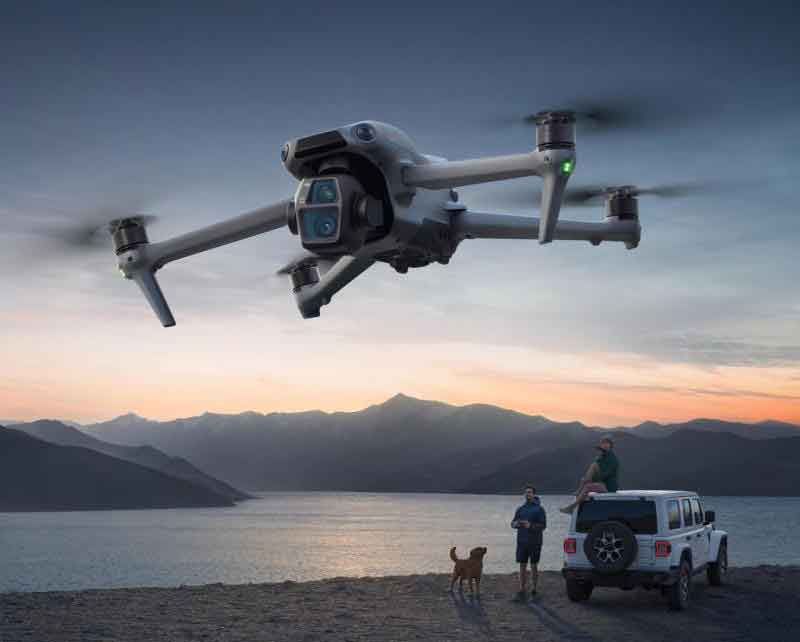
My central idea is to combine RSMA with robust beamforming so that UAV drones can manage multi-user interference, reduce energy consumption, and protect confidential information even when jitter causes angular mismatch. RSMA is especially suitable for this goal because it does not treat all interference as noise, nor does it attempt to decode all interference. Instead, it splits each user message into a common part and a private part. The common parts are combined into a common stream decoded by multiple users, while each private stream is decoded only by its intended user. This structure provides a smooth bridge between space-division multiple access (SDMA) and non-orthogonal multiple access (NOMA). For UAV drones with limited onboard energy, RSMA can improve spectral efficiency and energy efficiency while maintaining user fairness and robustness.
I organize my article around two robust beamforming designs. The first design minimizes total transmit power for a multi-user UAV drone downlink system with RSMA and jitter-induced angle errors. The second design maximizes the secrecy capacity of a multi-user UAV drone downlink system in the presence of an eavesdropper. In both cases, I model jitter as angular uncertainty, derive tractable approximations, and convert non-convex robust constraints into convex or quasi-convex forms. I use second-order Taylor series expansion (STSE), S-Procedure, Bernstein-type inequality, penalty functions, and bisection search. Numerical results show that the proposed robust RSMA designs outperform robust SDMA and robust NOMA baselines in terms of power consumption and secrecy performance.
Table 1. Key abbreviations used in my design.
| Abbreviation | Meaning |
|---|---|
| UAV | Unmanned aerial vehicle |
| RSMA | Rate-splitting multiple access |
| SDMA | Space-division multiple access |
| NOMA | Non-orthogonal multiple access |
| OMA | Orthogonal multiple access |
| ULA | Uniform linear array |
| UPA | Uniform planar array |
| LoS | Line-of-sight |
| QoS | Quality of service |
| SINR | Signal-to-interference-plus-noise ratio |
| CSI | Channel state information |
| PLS | Physical layer security |
| EAEM | Elliptic angle error model |
| PAEM | Probabilistic angle error model |
| STSE | Second-order Taylor series expansion |
| LMI | Linear matrix inequality |
| SOC | Second-order cone |
Background and Motivation
I begin with the observation that sixth-generation networks will require extremely flexible access. Terrestrial base stations alone cannot always provide ubiquitous connectivity, especially in disasters, remote areas, temporary events, or dense hotspots. UAV drones can be deployed quickly and can adjust their positions to create favorable LoS links. In my system model, UAV drones act as aerial base stations that serve multiple single-antenna ground users. Because the UAV drone flies above obstacles, the air-to-ground channel is dominated by a LoS component. This is beneficial for coverage, but it also makes the communication vulnerable to interception. A terrestrial eavesdropper may receive strong LoS signals from the UAV drone. Therefore, security must be designed at the physical layer, not only at upper layers.
I also observe that traditional multiple access schemes have limitations in UAV drone networks. OMA assigns orthogonal resources to users and avoids inter-user interference, but its spectral efficiency is limited. SDMA uses spatial beams to separate users and treats residual interference as noise. NOMA superposes users in the power domain and applies successive interference cancellation. NOMA can improve spectral efficiency, but it requires careful power allocation, user ordering, and receiver complexity. When many users are present, NOMA becomes complicated and may suffer from error propagation. RSMA provides a more flexible interference management framework. In RSMA, the common stream carries messages that multiple users can decode, and private streams carry user-specific data. The common stream can absorb part of the interference, and the private streams can be designed with robust beamforming.
Table 2. Comparison of multiple access schemes for UAV drone downlinks.
| Scheme | Interference treatment | Main advantage | Main limitation |
|---|---|---|---|
| OMA | Orthogonal resources | Simple and robust | Low spectral efficiency |
| SDMA | Interference as noise | Simple spatial separation | Performance degrades under high load |
| NOMA | Partial decoding via SIC | High spectral efficiency | Complex power allocation and ordering |
| RSMA | Common and private streams | Flexible interference management | Needs joint beamforming and rate design |
My work focuses on two performance criteria: energy minimization and secrecy capacity maximization. For energy minimization, I consider that UAV drones have limited battery capacity. Reducing transmit power extends flight time and improves network sustainability. For secrecy maximization, I consider that the broadcast nature of wireless channels allows an eavesdropper to intercept both common and private streams. I therefore formulate robust beamforming problems that guarantee QoS or secrecy under angle uncertainty caused by jitter.
UAV Drone Communication and Jitter
I model a rotary-wing UAV drone hovering above a service area. Let the UAV drone position be \(\mathbf{q}_u=[x_u,y_u,h_u]^T\), where \(h_u\) is the flying height. The ground users are located at \(\mathbf{q}_m=[x_m,y_m,0]^T\) for \(m=1,\dots,M\). The distance between the UAV drone and user \(m\) is
$$d_m = \left\|\mathbf{q}_u-\mathbf{q}_m\right\|_2.$$
Because the UAV drone has a high LoS probability, I use a LoS channel model. If the UAV drone is equipped with a uniform linear array (ULA) of \(N\) antennas, the channel vector to user \(m\) can be written as
$$ \mathbf{h}_m = \sqrt{\eta} d_m^{-2} \mathbf{a}_m, \quad \eta=\left(\frac{c}{4\pi f_c}\right)^2,$$
where \(c\) is the speed of light, \(f_c\) is the carrier frequency, and \(\mathbf{a}_m\) is the array response. For a ULA with half-wavelength spacing,
$$ \mathbf{a}_m = \left[1,e^{-j\pi \cos\theta_m},\ldots,e^{-j\pi (N-1)\cos\theta_m}\right]^T.$$
Here, \(\theta_m\) is the signal direction angle. Under jitter, the actual angle is not exactly the estimated angle. I write
$$ \theta_m = \bar{\theta}_m + \Delta\theta_m,$$
where \(\bar{\theta}_m\) is the estimated angle and \(\Delta\theta_m\) is the jitter-induced angle error. This error is the main source of channel uncertainty in my design. I consider two models. In the elliptic angle error model (EAEM), the error is bounded:
$$ \left|\Delta\theta_m\right|^2 \le \varepsilon_m^2.$$
In the probabilistic angle error model (PAEM), the error is Gaussian:
$$ \Delta\theta_m \sim \mathcal{N}(0,\varsigma_m^2).$$
For a uniform planar array (UPA) with \(N_x \times N_y\) elements, I define \(K=N_xN_y\). The array response to user \(i\) can be written as
$$ \mathbf{a}_i = \left[ e^{j\pi \left(n_x\sin\theta_i\cos\phi_i + n_y\sin\theta_i\sin\phi_i\right)} \right]_{n_x=0,\ldots,N_x-1;\, n_y=0,\ldots,N_y-1}.$$
Under jitter, both the elevation angle and azimuth angle are perturbed:
$$ \theta_i = \bar{\theta}_i + \Delta\theta_i, \quad \phi_i = \bar{\phi}_i + \Delta\phi_i.$$
I collect the angle error as \(\mathbf{e}_i=[\Delta\theta_i,\Delta\phi_i]^T\) and impose
$$ \left\|\mathbf{e}_i\right\|_2^2 \le \varepsilon_i^2.$$
Table 3. Array geometry and jitter models.
| Array type | Parameters | Jitter variables | Typical use in my design |
|---|---|---|---|
| ULA | \(N\) elements, angle \(\theta_m\) | \(\Delta\theta_m\) | Energy minimization with multi-user RSMA |
| UPA | \(N_x\times N_y\) elements, angles \(\theta_i,\phi_i\) | \(\Delta\theta_i,\Delta\phi_i\) | Secure RSMA with eavesdropper |
RSMA Transmission Model
I now describe the RSMA signal model. The UAV drone transmits a common stream \(s_c\) and \(M\) private streams \(s_{p,m}\). The transmit signal is
$$ \mathbf{x} = \mathbf{w}_c s_c + \sum_{m=1}^{M} \mathbf{w}_m s_{p,m},$$
where \(\mathbf{w}_c\) and \(\mathbf{w}_m\) are the beamforming vectors for the common and private streams. The received signal at user \(m\) is
$$ y_m = \mathbf{h}_m^H \mathbf{x} + n_m,$$
where \(n_m\sim\mathcal{CN}(0,\sigma_m^2)\). User \(m\) first decodes the common stream by treating all private streams as interference. The corresponding SINR is
$$ \gamma_{c,m} = \frac{\left|\mathbf{h}_m^H \mathbf{w}_c\right|^2}{\sum_{j=1}^{M}\left|\mathbf{h}_m^H \mathbf{w}_j\right|^2+\sigma_m^2}.$$
After decoding and removing the common stream, user \(m\) decodes its private stream while treating other private streams as interference:
$$ \gamma_{p,m} = \frac{\left|\mathbf{h}_m^H \mathbf{w}_m\right|^2}{\sum_{j\ne m}\left|\mathbf{h}_m^H \mathbf{w}_j\right|^2+\sigma_m^2}.$$
The achievable rates are
$$ R_{c,m} = \log_2(1+\gamma_{c,m}), \quad R_{p,m} = \log_2(1+\gamma_{p,m}).$$
Because the common stream must be decoded by all users, its rate is limited by the worst user:
$$ R_c = \min_m R_{c,m}.$$
Table 4. RSMA stream roles in my UAV drone design.
| Stream | Decoded by | Interference treatment | Main benefit |
|---|---|---|---|
| Common stream \(s_c\) | All users | Private streams treated as interference | Absorbs part of multi-user interference |
| Private stream \(s_{p,m}\) | User \(m\) | Other private streams treated as interference | Delivers user-specific data |
Energy Minimization Design
In my first design, I aim to minimize the total transmit power of the UAV drone while guaranteeing both common and private rate thresholds. I define \(\mathbf{W}_c=\mathbf{w}_c\mathbf{w}_c^H\) and \(\mathbf{W}_m=\mathbf{w}_m\mathbf{w}_m^H\). The optimization problem is
$$ \min_{\mathbf{W}_c,\{\mathbf{W}_m\}} \operatorname{tr}(\mathbf{W}_c)+\sum_{m=1}^{M}\operatorname{tr}(\mathbf{W}_m)$$
$$ \text{s.t. } R_{c,m}\ge R_{c,m}^{th}, \quad \forall m,$$
$$ R_{p,m}\ge R_{p,m}^{th}, \quad \forall m,$$
$$ \mathbf{W}_c\succeq 0,\quad \mathbf{W}_m\succeq 0,\quad \operatorname{rank}(\mathbf{W}_c)=1,\quad \operatorname{rank}(\mathbf{W}_m)=1.$$
The rate constraints can be rewritten in terms of SINR thresholds. Let
$$ \gamma_{c,m}^{th}=2^{R_{c,m}^{th}}-1, \quad \gamma_{p,m}^{th}=2^{R_{p,m}^{th}}-1.$$
For the ULA channel, the constraints become
$$ \mathbf{a}_m^H\left(\mathbf{W}_c-\gamma_{c,m}^{th}\sum_{j=1}^{M}\mathbf{W}_j\right)\mathbf{a}_m \ge \gamma_{c,m}^{th}\sigma_m^2 d_m^2/\eta,$$
$$ \mathbf{a}_m^H\left(\mathbf{W}_m-\gamma_{p,m}^{th}\sum_{j\ne m}\mathbf{W}_j\right)\mathbf{a}_m \ge \gamma_{p,m}^{th}\sigma_m^2 d_m^2/\eta.$$
Because the angle error appears inside \(\mathbf{a}_m\), these constraints are infinite-dimensional and non-convex. To make the problem tractable, I approximate the beamforming gain \(\mathbf{a}_m^H\mathbf{W}\mathbf{a}_m\) using second-order Taylor expansion with respect to \(\Delta\theta_m\). I obtain
$$ \mathbf{a}_m^H\mathbf{W}\mathbf{a}_m \approx \Delta\theta_m^T \mathbf{P}_m \Delta\theta_m + \mathbf{q}_m^T \Delta\theta_m + r_m.$$
This approximation is accurate for small and moderate jitter. It transforms the uncertain gain into a quadratic function of the angle error. Then I apply S-Procedure for the bounded error model. The S-Procedure converts infinitely many inequalities over an ellipsoid into a finite linear matrix inequality. For the EAEM, I introduce auxiliary variables \(\delta_{c,m}\ge 0\) and \(\delta_{p,m}\ge 0\), and the robust constraints become LMIs of the form
$$ \begin{bmatrix} \delta_{c,m}\mathbf{I}-\mathbf{P}_{c,m} & \mathbf{Q}_{c,m} \\ \mathbf{Q}_{c,m}^T & r_{c,m}-\delta_{c,m}\varepsilon_m^2-\gamma_{c,m}^{th}\sigma_m^2 d_m^2/\eta \end{bmatrix} \preceq 0,$$
$$ \begin{bmatrix} \delta_{p,m}\mathbf{I}-\mathbf{P}_{p,m} & \mathbf{Q}_{p,m} \\ \mathbf{Q}_{p,m}^T & r_{p,m}-\delta_{p,m}\varepsilon_m^2-\gamma_{p,m}^{th}\sigma_m^2 d_m^2/\eta \end{bmatrix} \preceq 0.$$
For the PAEM, the angle error is Gaussian. I use the Bernstein-type inequality to obtain a safe approximation of the outage probability constraint. The constraint
$$ \Pr\left\{R_{p,m}\ge R_{p,m}^{th}\right\}\ge 1-\rho$$
can be conservatively approximated by a set of linear matrix inequalities and second-order cone constraints. I introduce slack variables \(\mu_{1,m}\) and \(\mu_{2,m}\), and write
$$ r_{p,m}-2\ln(\rho)\mu_{1,m}+\ln(\rho)\mu_{2,m}+\gamma_{p,m}^{th}\sigma_m^2 d_m^2/\eta \ge 0,$$
$$ \left\|\begin{bmatrix}\sqrt{2}\varsigma_m \mathbf{Q}_{p,m} \\ \varsigma_m^2 \mathbf{P}_{p,m}\end{bmatrix}\right\|_F \le \mu_{1,m},$$
$$ \mu_{2,m}\mathbf{I}+\varsigma_m^2\mathbf{P}_{p,m}\succeq 0, \quad \mu_{1,m}\ge 0.$$
The rank-one constraints are non-convex. I relax them and add a penalty term. Since \(\operatorname{rank}(\mathbf{W})=1\) if and only if \(\operatorname{tr}(\mathbf{W})-\lambda_{\max}(\mathbf{W})=0\), I replace the rank constraints with a penalty function. I use the first-order Taylor expansion of \(\lambda_{\max}(\mathbf{W})\):
$$ \lambda_{\max}(\mathbf{W}) \ge \lambda_{\max}(\mathbf{W}^{(i)}) + \operatorname{tr}\left(\mathbf{u}_{\max}(\mathbf{W}^{(i)})\mathbf{u}_{\max}^H(\mathbf{W}^{(i)})(\mathbf{W}-\mathbf{W}^{(i)})\right).$$
The resulting convex problem is solved iteratively with CVX. I also solve an initial feasibility problem by introducing a slack variable \(z\ge 0\). This slack variable measures the distance from the constraints to feasibility.
Algorithm for Energy Minimization
Table 5. Iterative robust energy-minimization algorithm.
| Step | Operation |
|---|---|
| 1 | Initialize beamforming matrices and penalty factor. |
| 2 | Approximate beamforming gains using STSE. |
| 3 | Convert bounded angle-error constraints using S-Procedure. |
| 4 | Convert probabilistic constraints using Bernstein-type inequality. |
| 5 | Relax rank-one constraints and add penalty term. |
| 6 | Solve the convex problem and update variables. |
| 7 | Repeat until convergence. |
The computational complexity of my energy-minimization algorithm is determined by the number of variables, the number of LMIs, and the dimensions of the matrix variables. For the EAEM design, the complexity scales approximately as
$$ \mathcal{O}\left(4M\left((M+1)N+2M\right)\left(16(M+1)N+8M+2M\right)\ln(1/\epsilon)\right).$$
For the PAEM design, the complexity is approximately
$$ \mathcal{O}\left(10M\left(20n+7Mn+n^3\right)\ln(1/\epsilon)\right),$$
where \(n=\mathcal{O}((M+1)N)\). These expressions show that the robust design remains tractable for practical numbers of UAV drone antennas and ground users.
Simulation Results for Energy Minimization
I simulate three ground users and one UAV drone. The ULA has \(N=8\) antennas, the UAV drone height is \(100\) m, the carrier frequency is \(2\) GHz, and the noise power is \(-110\) dBm. The angle error bound is \(1^\circ\), and the outage probability threshold is \(0.1\). I compare my robust RSMA design with robust SDMA, robust NOMA, and non-robust RSMA.
Table 6. Simulation parameters for energy minimization.
| Parameter | Value |
|---|---|
| Number of users \(M\) | 3 |
| ULA antennas \(N\) | 8 |
| UAV height \(h_u\) | 100 m |
| Carrier frequency \(f_c\) | 2 GHz |
| Noise power \(\sigma_m^2\) | -110 dBm |
| Angle error bound \(\varepsilon_m\) | 1° |
| Outage threshold \(\rho\) | 0.1 |
| Penalty factor \(\mu\) | 1 |
The beam patterns show that the common beam points toward all users, while the private beam of each user points toward its intended user. The robust design places the main lobe near the estimated user direction and broadens the beam enough to cover the jitter region. The non-robust design places a narrow beam at the estimated angle, so it suffers severe rate loss when the actual angle deviates. I also generate many random angle errors and compute the empirical rate distributions. The robust scheme satisfies the rate thresholds in almost all realizations, while the non-robust scheme fails frequently. For the probabilistic model, the cumulative distribution function of the private rate is above the required threshold with probability greater than \(90\%\).
I also study the power ratio between private and common streams. As the rate threshold increases, the UAV drone allocates more power to the common stream because the common stream helps manage interference. However, compared with non-robust RSMA, my robust RSMA design allocates less power to the common stream and more power to private streams. This is because robust beamforming already controls interference under angle uncertainty, so the common stream does not need to absorb as much uncertainty.
The total transmit power increases with the rate threshold. The EAEM design requires slightly more power than the PAEM design because the bounded-error assumption is more conservative. The power penalty of the EAEM design is about \(4\) dBm, while the PAEM penalty is about \(2\) dBm. When comparing multiple access schemes, my robust RSMA design requires lower total power than robust SDMA and robust NOMA when the rate threshold is high. At low rate thresholds, robust NOMA can be slightly better, but as the threshold grows, RSMA becomes superior because it handles interference more flexibly.
Secure RSMA Design with Eavesdropper
In my second design, I consider a UAV drone equipped with a UPA and serving multiple users in the presence of an eavesdropper. I denote the eavesdropper channel by \(\mathbf{H}_e\) and the user channels by \(\mathbf{H}_m\). The received signals at user \(m\) and the eavesdropper are
$$ y_m = \mathbf{H}_m^H\mathbf{x}+n_m, \quad y_e = \mathbf{H}_e^H\mathbf{x}+n_e.$$
The SINRs for the common and private streams at user \(m\) are
$$ \gamma_{c,m} = \frac{\left|\mathbf{H}_m^H\mathbf{w}_c\right|^2}{\sum_{j=1}^{M}\left|\mathbf{H}_m^H\mathbf{w}_j\right|^2+\sigma_m^2},$$
$$ \gamma_{p,m} = \frac{\left|\mathbf{H}_m^H\mathbf{w}_m\right|^2}{\sum_{j\ne m}\left|\mathbf{H}_m^H\mathbf{w}_j\right|^2+\sigma_m^2}.$$
The eavesdropper SINRs are
$$ \gamma_{c,e} = \frac{\left|\mathbf{H}_e^H\mathbf{w}_c\right|^2}{\sum_{j=1}^{M}\left|\mathbf{H}_e^H\mathbf{w}_j\right|^2+\sigma_e^2},$$
$$ \gamma_{p,m,e} = \frac{\left|\mathbf{H}_e^H\mathbf{w}_m\right|^2}{\left|\mathbf{H}_e^H\mathbf{w}_c\right|^2+\sum_{j\ne m}\left|\mathbf{H}_e^H\mathbf{w}_j\right|^2+\sigma_e^2}.$$
The achievable rates at user \(m\) are
$$ R_{c,m}=\log_2(1+\gamma_{c,m}), \quad R_{p,m}=\log_2(1+\gamma_{p,m}).$$
The eavesdropper rates are
$$ R_{c,e}=\log_2(1+\gamma_{c,e}), \quad R_{p,m,e}=\log_2(1+\gamma_{p,m,e}).$$
I define the secrecy rates for the common and private streams as
$$ R_{c,m}^{sec}=\left[R_{c,m}-R_{c,e}\right]^+, \quad R_{p,m}^{sec}=\left[R_{p,m}-R_{p,m,e}\right]^+.$$
The total secrecy rate for user \(m\) is
$$ R_m^{sec}=R_{c,m}^{sec}+R_{p,m}^{sec}.$$
My optimization problem maximizes the minimum secrecy rate or the average secrecy capacity subject to a common rate threshold and a maximum transmit power:
$$ \max_{\mathbf{W}_c,\{\mathbf{W}_m\}} \min_m R_m^{sec}$$
$$ \text{s.t. } R_{c,m}-R_{c,e}\ge R_{c,m}^{th},$$
$$ R_{p,m}-R_{p,m,e}\ge C_P,$$
$$ \operatorname{tr}(\mathbf{W}_c)+\sum_{m=1}^{M}\operatorname{tr}(\mathbf{W}_m)\le P_{\max},$$
$$ \operatorname{rank}(\mathbf{W}_c)=1,\quad \operatorname{rank}(\mathbf{W}_m)=1.$$
This is a max-min problem and is non-convex. I split it into an outer problem and an inner problem. The outer problem searches over the secrecy-rate target \(C_P\) using bisection. The inner problem minimizes transmit power while satisfying the secrecy constraints for a fixed \(C_P\). The inner problem is still non-convex because of the angle uncertainty and rank-one constraints. I use STSE and S-Procedure to convert the uncertain constraints into LMIs. I also introduce auxiliary variables \(f_{c,m},g_{c,m},s_{c,m},t_{c,m}\) and \(f_{p,m},g_{p,m},s_{p,m},t_{p,m}\) to handle the logarithmic differences. The resulting constraints have the form
$$ \ln(1+f_{i,m})-\ln(1+g_{i,m})-\ln(1+s_{i,m})+\ln(1+t_{i,m})\ge \ln 2 \, R_{i,m}^{th}.$$
Then I approximate the logarithmic terms by first-order Taylor expansion. For the UPA channel, the beamforming gain is a function of both elevation and azimuth errors. I approximate it as
$$ \mathbf{a}_i^H\mathbf{W}\mathbf{a}_i \approx \mathbf{e}_i^T\mathbf{P}_i\mathbf{e}_i+\mathbf{Q}_i^T\mathbf{e}_i+r_i,$$
with \(\mathbf{e}_i=[\Delta\theta_i,\Delta\phi_i]^T\). The robust constraints become
$$ \mathbf{e}_i^T\mathbf{P}_{j,i}\mathbf{e}_i+\mathbf{Q}_{j,i}^T\mathbf{e}_i+r_{j,i}\ge \frac{\gamma_{j,m,i}^{th}\sigma_i^2}{d_i^2/\eta},$$
for the required lower bounds and the reverse inequality for upper bounds. Using S-Procedure, each robust constraint is converted into an LMI:
$$ \begin{bmatrix} \delta_{j,i}\mathbf{I}-\mathbf{P}_{j,i} & \mathbf{Q}_{j,i} \\ \mathbf{Q}_{j,i}^T & r_{j,i}-\delta_{j,i}\varepsilon_i^2-\Gamma_{j,i} \end{bmatrix}\preceq 0.$$
Finally, I apply the penalty method to enforce rank-one solutions. The inner power-minimization problem becomes a convex semidefinite program that can be solved by CVX. The outer bisection updates the secrecy target until convergence.
Algorithm for Secure Beamforming
Table 7. Two-stage secure robust beamforming algorithm.
| Stage | Operation |
|---|---|
| Outer stage | Use bisection to search for the optimal secrecy-rate target \(C_P\). |
| Inner stage | For fixed \(C_P\), minimize transmit power under robust secrecy constraints. |
| Approximation | Apply STSE to approximate UPA beamforming gains. |
| Robustification | Apply S-Procedure to convert angle-error constraints into LMIs. |
| Rank handling | Relax rank-one constraints and add penalty term. |
| Iteration | Repeat inner solution until convergence; update bisection bounds. |
The complexity of the secure design is approximately
$$ \mathcal{O}\left(26M\left(164n+56Mn+n^3\right)\ln(1/\epsilon)\right),$$
where \(n=\mathcal{O}((M+1)K)\) and \(K=N_xN_y\) is the number of UPA elements. This complexity is acceptable for moderate array sizes and user numbers.
Simulation Results for Secure Beamforming
I simulate three legitimate users and one eavesdropper. The UPA has \(6\times 6\) elements, the UAV drone height is \(100\) m, the carrier frequency is \(2\) GHz, and the noise power is \(-110\) dBm. The angle error bound is \(2^\circ\). I compare my robust RSMA design with non-robust RSMA, robust SDMA, and robust NOMA.
Table 8. Simulation parameters for secure design.
| Parameter | Value |
|---|---|
| Number of users \(M\) | 3 |
| UPA dimensions \(N_x,N_y\) | 6, 6 |
| UAV height \(h_u\) | 100 m |
| Carrier frequency \(f_c\) | 2 GHz |
| Noise power \(\sigma_e^2=\sigma_m^2\) | -110 dBm |
| Angle error bound \(\varepsilon_i\) | 2° |
| Penalty factor \(\mu\) | 1 |
I first verify the accuracy of the UPA second-order Taylor approximation. For small error bounds, the difference between the exact beamforming gain and the approximate gain is on the order of \(10^{-4}\). For a \(5^\circ\) error, the difference is around \(10^{-2}\). For a \(9^\circ\) error, the difference is mostly within \([-0.05,0.05]\) and never exceeds \(0.1\). This confirms that my approximation is accurate for realistic UAV drone jitter.
The secure beam patterns show that the common beam covers all legitimate users, while the private beam of a user points to that user and places a deep null toward the eavesdropper. The null depth is more than \(20\) dB in the eavesdropper region. This means that the private stream can be delivered with low leakage. The average secrecy capacity increases with the maximum transmit power. My robust RSMA design achieves higher average secrecy capacity than non-robust RSMA, robust SDMA, and robust NOMA. Because the users are spatially separated, robust SDMA can outperform robust NOMA in some cases, but robust RSMA remains the best overall.
Discussion
I draw several conclusions from my designs. First, jitter is not a minor impairment for UAV drones. It directly changes the array response and creates angle uncertainty. If ignored, it causes beam misalignment, rate outage, and secrecy loss. Second, RSMA is a strong complement to robust beamforming because the common stream can absorb residual interference while private streams can be designed for secure and reliable transmission. Third, deterministic bounded-error models are conservative but safe. Probabilistic models can reduce power consumption while still guaranteeing a target outage probability. Fourth, UPA provides more degrees of freedom than ULA and is more suitable for three-dimensional UAV drone coverage, especially for secure transmission. Fifth, the two-stage bisection and penalty framework can solve the secrecy maximization problem efficiently.
Table 9. Summary of my two robust designs.
| Design | Objective | Array | Error model | Main tools | Main result |
|---|---|---|---|---|---|
| Energy minimization | Minimize transmit power | ULA | EAEM and PAEM | STSE, S-Procedure, Bernstein inequality, penalty | Lower power than robust SDMA and NOMA |
| Secure beamforming | Maximize secrecy capacity | UPA | EAEM | Bisection, STSE, S-Procedure, penalty | Higher secrecy than baselines |
Future Directions
I see several extensions of my work. First, I have assumed that the UAV drone is hovering. In practice, UAV drones move continuously. Joint trajectory optimization, beamforming, and rate allocation could further improve energy efficiency and security. Second, I have considered only a single UAV drone. Multiple UAV drones may cooperate as a swarm, which introduces inter-drone interference and requires distributed robust beamforming. Third, I have focused on angle errors caused by jitter. Other impairments, such as hardware calibration errors, phase noise, and imperfect synchronization, should be included in future robust designs. Fourth, hybrid beamforming could reduce power consumption for large UPA arrays while maintaining acceptable spectral efficiency. Fifth, I can extend the probabilistic security design so that secrecy outage probability is explicitly controlled. Sixth, RSMA can be integrated with reconfigurable intelligent surfaces, satellite networks, and terrestrial cellular systems to build flexible air-ground integrated networks.
Conclusion
I have presented robust beamforming designs that combine RSMA with jittering UAV drones. In the first design, I minimize transmit power for multi-user downlink UAV drone communication under both bounded and probabilistic angle errors. I use STSE to approximate array gains, S-Procedure to handle bounded uncertainty, Bernstein-type inequality to handle probabilistic constraints, and a penalty method to obtain rank-one beamformers. In the second design, I maximize secrecy capacity in the presence of an eavesdropper. I use a UPA, model both elevation and azimuth jitter, and solve the resulting max-min problem by a two-stage bisection and power-minimization algorithm. My numerical results show that the proposed robust RSMA designs satisfy QoS and secrecy requirements, reduce power consumption, and outperform robust SDMA and robust NOMA baselines. I believe that robust RSMA beamforming will be an important enabling technique for reliable, energy-efficient, and secure UAV drone networks in future wireless systems.