
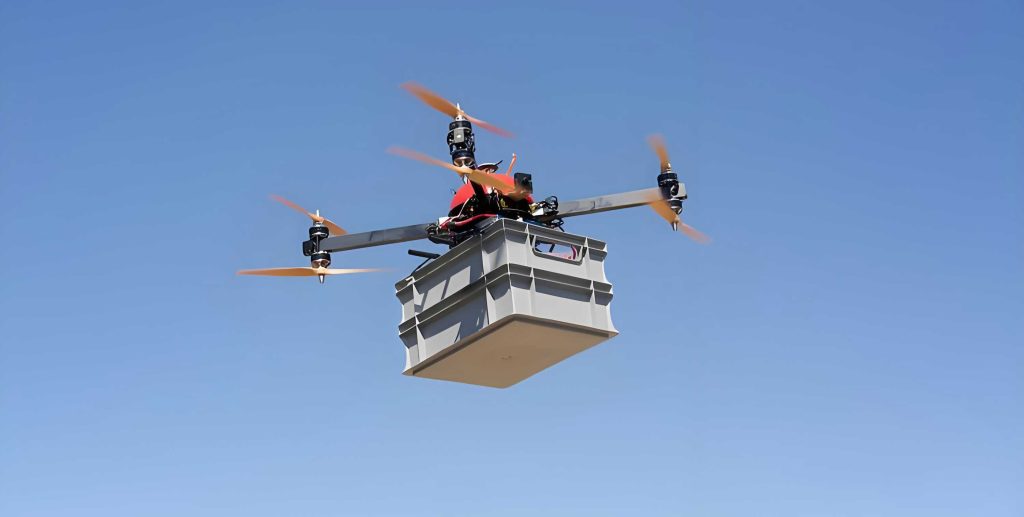
In the context of the rapid development of the low-altitude economy, UAV drones have emerged as a transformative technology with significant potential across various sectors, most notably in emergency response. When disasters such as earthquakes or floods strike, rapid and efficient material distribution is crucial for saving lives and minimizing property damage. Traditional ground vehicles often face insurmountable challenges due to road damage and traffic congestion. In contrast, UAV drones offer unique advantages: high speed, flexibility to bypass ground obstacles, and reduced reliance on human labor. This study investigates the critical problem of post-disaster emergency logistics network design incorporating UAV drones, with a specific focus on addressing the inherent uncertainty in demand and the practical limitations of resources like UAV drones batteries.
We consider a three-tier logistics network comprising a central warehouse, candidate temporary rescue facilities, and disaster-stricken demand points (customers). The core operational mode involves trucks transporting both relief supplies and UAV drones batteries from the warehouse to established temporary facilities. Subsequently, UAV drones stationed at these facilities are deployed to deliver supplies to nearby customers. The fundamental challenge lies in making strategic first-stage decisions—where to locate temporary facilities, how much relief material and how many UAV drones batteries to allocate to each—before the actual, uncertain customer demands are fully realized. After demand realization, operational second-stage decisions involve planning the UAV drones delivery routes and quantities. Our goal is to minimize the total system cost, which includes facility setup costs, UAV drones delivery costs, and penalties for unmet demand, under the worst-case realization of demand within a defined uncertainty set.
The notations used throughout the mathematical formulation are summarized in the table below.
| Symbol | Definition |
|---|---|
| $I$, $J$, $K$ | Sets of customers, candidate facilities, and UAV drones batteries, indexed by $i$, $j$, $k$. |
| $D_i$, $\hat{D}_i$, $\tilde{D}_i$ | Nominal demand, maximum demand deviation, and random post-disaster demand for customer $i$. |
| $r_i$ | Penalty cost per unit of unmet demand for customer $i$. |
| $f_j$ | Fixed cost of establishing facility $j$. |
| $d_{ij}$, $c_{ij}$ | Distance and unit delivery cost between customer $i$ and facility $j$ for UAV drones. |
| $w_k$, $B_k$ | Weight and capacity (in Wh) of battery $k$ for UAV drones. |
| $Q_d$, $C_d$, $w_D$ | Number, maximum payload, and net weight of available UAV drones. |
| $Q_c$, $C_v$ | Total relief material at the warehouse and vehicle capacity. |
| $y_j$ | First-stage binary variable: 1 if facility $j$ is opened. |
| $z_{kj}$ | First-stage binary variable: 1 if battery $k$ is allocated to facility $j$. |
| $x_j$ | First-stage variable: amount of relief material allocated to facility $j$. |
| $q_{ijk}$ | Second-stage variable: amount delivered to customer $i$ from facility $j$ using battery $k$ of UAV drones. |
| $u_i$ | Second-stage variable: unmet demand for customer $i$. |
To model the uncertainty in post-disaster demand, we employ a budgeted uncertainty set, a common approach in robust optimization. Let $\xi_i \in [0, 1]$ represent the deviation fraction for customer $i$’s demand. The uncertainty set $Z$ is defined as:
$$
Z = \left\{ \tilde{D} \in \mathbb{R}^{|I|}_+ : \tilde{D}_i = D_i + \hat{D}_i \xi_i, \ 0 \leq \xi_i \leq 1, \ \sum_{i \in I} \xi_i \leq \Gamma \right\}
$$
where $\Gamma$ is the uncertainty budget controlling the level of conservatism.
A critical component of our model is the energy consumption function for UAV drones. The energy $b_{ij}(q_{ijk})$ consumed by a UAV drone to deliver $q_{ijk}$ units to customer $i$ from facility $j$ is modeled as:
$$
b_{ij}(q_{ijk}) = \frac{(2a_i + 1) g d_{ij}}{k_s \eta} q_{ijk}
$$
where $g$ is gravity, $d_{ij}$ is distance, $k_s$ and $\eta$ are UAV drones constants, and $a_i = w_D / (2E_i)$ with $E_i$ being the expected demand for customer $i$ under budget $\Gamma$. This function directly links payload weight to energy consumption, a more accurate representation than simpler linear approximations.
We formulate the problem as a two-stage robust optimization model. The first-stage problem, deciding on facility location ($y_j$), battery allocation ($z_{kj}$), and material pre-positioning ($x_j$), is as follows:
$$
\begin{aligned}
\min \quad & \sum_{j \in J} f_j y_j + \max_{\tilde{D} \in Z} Q(\mathbf{y}, \mathbf{z}, \mathbf{x}, \tilde{D}) \\
\text{s.t.} \quad & \sum_{j \in J} y_j \leq Q_d \\
& \sum_{j \in J} x_j \leq Q_c \\
& \sum_{j \in J} z_{kj} \leq 1 \quad \forall k \in K \\
& z_{kj} \leq y_j \quad \forall j \in J, k \in K \\
& x_j \leq Q_c y_j \quad \forall j \in J \\
& \sum_{j \in J} \left( x_j + \sum_{k \in K} z_{kj} w_k + y_j w_D \right) \leq C_v \\
& y_j \in \{0,1\}, x_j \geq 0, z_{kj} \in \{0,1\} \quad \forall j \in J, k \in K
\end{aligned}
$$
The second-stage problem $Q(\mathbf{y}, \mathbf{z}, \mathbf{x}, \tilde{D})$, which determines the optimal UAV drones delivery plan $(q_{ijk}, u_i)$ for a given first-stage decision and demand realization, is:
$$
\begin{aligned}
Q(\mathbf{y}, \mathbf{z}, \mathbf{x}, \tilde{D}) = \min \quad & \sum_{k \in K} \sum_{i \in I} \sum_{j \in J} c_{ij} q_{ijk} + \sum_{i \in I} r_i u_i \\
\text{s.t.} \quad & \sum_{k \in K} \sum_{i \in I} q_{ijk} \leq x_j \quad \forall j \in J \\
& q_{ijk} \leq C_d \quad \forall i \in I, j \in J, k \in K \\
& \sum_{j \in J} \sum_{k \in K} q_{ijk} + u_i \geq \tilde{D}_i \quad \forall i \in I \\
& \sum_{i \in I} \frac{(2a_i + 1) g d_{ij}}{k_s \eta} q_{ijk} \leq B_k z_{kj} \quad \forall j \in J, k \in K \\
& q_{ijk} \geq 0, u_i \geq 0 \quad \forall i \in I, j \in J, k \in K
\end{aligned}
$$
To solve this challenging two-stage robust model exactly, we employ the Column-and-Constraint Generation (C&CG) algorithm. The algorithm iterates between a Master Problem (MP) and a Subproblem (SP). The MP incorporates first-stage decisions and optimality cuts derived from worst-case scenarios identified by the SP. The SP, for a given first-stage solution $(\hat{\mathbf{y}}, \hat{\mathbf{z}}, \hat{\mathbf{x}})$, finds the worst-case demand scenario $\boldsymbol{\xi}$ and the corresponding second-stage cost. By applying duality theory and linearization techniques, the SP is reformulated into a solvable mixed-integer linear program (MILP). The C&CG algorithm framework is summarized below:
Algorithm Framework (C&CG):
1. Set lower bound $LB = -\infty$, upper bound $UB = \infty$, iteration counter $l=0$.
2. Obtain an initial first-stage solution $(\mathbf{y}^0, \mathbf{z}^0, \mathbf{x}^0)$.
3. Solve the SP with the initial solution to get the first worst-case scenario $\boldsymbol{\xi}^1$. Set $l=1$, create corresponding second-stage variables $(\mathbf{q}^l, \mathbf{u}^l)$ and add optimality cut (20)-(25) to the MP.
4. Repeat
a. Solve the MP, obtain optimal solution $(\hat{\mathbf{y}}, \hat{\mathbf{z}}, \hat{\mathbf{x}}, \hat{s})$. Update $LB = \hat{s}$.
b. Fix first-stage variables to $(\hat{\mathbf{y}}, \hat{\mathbf{z}}, \hat{\mathbf{x}})$ and solve the SP to get a new worst-case scenario $\boldsymbol{\xi}^l$ and optimal value $\phi$. Update $UB = \min(UB, \phi)$.
c. If $(UB – LB)/UB \leq \epsilon$ or time limit reached, then STOP.
d. Else, set $l = l+1$, create variables $(\mathbf{q}^l, \mathbf{u}^l)$, add the corresponding cut to the MP, and go to Step 4a.
We conduct numerical experiments to evaluate the proposed model and algorithm. Test instances are randomly generated within a $10 \text{km} \times 10 \text{km}$ area, with parameters for customer demand, facility costs, and UAV drones specifications (modeled after the MD4-3000 UAV drone). Instances are labeled as $|J|-|I|-Q_d$ (e.g., 3-10-3). The C&CG algorithm is implemented in Python using Gurobi 11.0.0.
The efficiency of the C&CG algorithm is assessed across different instance sizes and uncertainty budgets $\Gamma$. Key results are summarized in the following table.
| Instance | $\Gamma$ | CPU (s) | Gap (%) | Iterations ($L$) |
|---|---|---|---|---|
| 3-10-3 | 1 | 0.71 | 0.00 | 2 |
| 3 | 0.64 | 0.00 | 2 | |
| 5 | 0.79 | 0.00 | 2 | |
| 7 | 0.89 | 0.00 | 3 | |
| 9 | 0.82 | 0.00 | 2 | |
| 4-15-3 | 1 | 528.15 | 0.00 | 4 |
| 3 | 599.83 | 0.00 | 2 | |
| 5 | 1228.78 | 0.00 | 3 | |
| 7 | 388.24 | 0.00 | 2 | |
| 9 | 280.42 | 0.00 | 5 | |
| 6-15-4 | 1 | 43.15 | 0.00 | 2 |
| 3 | 234.48 | 0.00 | 2 | |
| 5 | 433.64 | 0.00 | 3 | |
| 7 | 487.78 | 0.00 | 4 | |
| 9 | 442.84 | 0.00 | 3 |
The results demonstrate that the C&CG algorithm can find optimal solutions efficiently for moderate-sized instances, typically within a few seconds for 10 customers and within several hundred seconds for 15 customers. The number of customers $|I|$ has a more pronounced impact on computational time than the number of candidate facilities $|J|$ or the uncertainty budget $\Gamma$.
A core contribution of our robust optimization approach is its ability to hedge against uncertainty. We compare the performance of our robust model (R) with a deterministic model (D) that uses nominal demand values. Let $D_n$ and $D_w$ be the deterministic model’s cost under nominal and worst-case demand, respectively. Let $R_n$ and $R_w$ be the robust model’s cost under nominal and worst-case demand (using its first-stage decisions). We define $Per_n = (R_n – D_n)/D_n$ and $Per_w = (R_w – D_w)/D_w$. Comparative results are shown below.
| $\Gamma$ | Instance | $D_n$ | $R_n$ | $Per_n$ (%) | $D_w$ | $R_w$ | $Per_w$ (%) |
|---|---|---|---|---|---|---|---|
| 1 | 4-10-3 | 131.1 | 140.0 | 6.7 | 265 | 140 | -75.7 |
| 5-15-4 | 137.7 | 148.0 | 7.4 | 282 | 148 | -47.5 | |
| 6-10-4 | 110.8 | 118.0 | 6.4 | 288 | 118 | -59.0 | |
| 3 | 4-10-3 | 131.1 | 150.0 | 14.4 | 568 | 150 | -73.5 |
| 5-15-4 | 137.7 | 161.1 | 16.9 | 713 | 162 | -77.2 | |
| 6-10-4 | 110.8 | 132.4 | 19.4 | 768 | 134 | -82.5 |
The robust model incurs a modest increase in nominal cost ($Per_n$ between 2% and 20%) but achieves dramatic cost savings under the worst-case scenario ($Per_w$ between -47% and -83%). This highlights the value of incorporating uncertainty into the planning process for UAV drones rescue operations. The robust solution effectively trades off a small increase in regular operational cost for a massive reduction in extreme-scenario cost and significantly improves demand fulfillment rates during crises.
Further analysis examines the impact of the UAV drones battery energy consumption model and resource availability. We compare our nonlinear energy function (Function 1, $b_{ij}(q_{ijk})$) with a simplified linear function (Function 2, $b_{ij}(q_{ijk}) = c_{ij} q_{ijk}$). The results are presented below.
| Instance | $\Gamma$ | Function 1 | Function 2 | ||
|---|---|---|---|---|---|
| Bat. Num. | Cost | Bat. Num. | Cost | ||
| 5-10-4 | 1 | 4 | 130 | 8 | 130 |
| 5 | 4 | 149 | 8 | 149 | |
| 9 | 4 | 157 | 7 | 157 | |
| 6-10-4 | 1 | 5 | 118 | 7 | 118 |
| 5 | 4 | 142 | 9 | 142 | |
| 9 | 3 | 152 | 9 | 152 | |
While both functions lead to the same optimal cost, Function 1 consistently results in a lower number of batteries being allocated in the first stage. This demonstrates that our proposed energy model more accurately captures the coupling between payload and energy consumption for UAV drones, enabling efficient resource planning without sacrificing performance. A sensitivity analysis on the number of available UAV drones batteries confirms its critical role. System cost decreases sharply as battery count increases from an insufficient level, then plateaus once an adequate supply is reached, emphasizing that battery resources are a key constraint alongside the number of UAV drones themselves.
In conclusion, this study addresses the critical problem of post-disaster facility location and resource allocation for UAV drones-assisted rescue operations under uncertainty. We develop a two-stage robust optimization model that integrates strategic decisions on facility setup, material pre-positioning, and UAV drones battery allocation with operational UAV drones delivery planning under uncertain demand. The proposed C&CG algorithm solves the model effectively. Our computational experiments yield several key managerial insights: 1) The truck-UAV drones collaborative delivery mode can significantly enhance the resilience and reach of emergency logistics networks. 2) Proactively accounting for demand uncertainty through robust optimization is essential, as it provides substantial protection against worst-case scenarios with only a marginal increase in nominal operational costs. 3) The energy consumption of UAV drones and the availability of batteries are pivotal factors that must be explicitly considered in planning to ensure operational feasibility and cost-effectiveness. This work deepens the application of UAV drones in emergency rescue and provides a decision-making framework for emergency management authorities to design robust post-disaster material distribution strategies. Future research could focus on developing acceleration techniques for the C&CG algorithm and exploring dynamic robust models where demand uncertainty evolves over multiple time periods.