
As a practitioner deeply involved in modern agricultural extension, I have witnessed firsthand the transformative shift in crop management practices. Rice, being a cornerstone of global food security, demands relentless innovation to protect its yield from the persistent threat of pests and diseases. For years, the conventional methods of pesticide application, reliant on manual or tractor-mounted sprayers, presented significant challenges: inefficiency, uneven coverage, high labor intensity, and potential health risks for operators. The advent and integration of agricultural UAV technology, or unmanned aerial vehicles, into plant protection regimes marks a pivotal leap towards precision, safety, and sustainability. This technology is not merely an alternative tool; it represents a fundamental rethinking of how we approach crop health management in the 21st century.
The core advantage of the agricultural UAV lies in its ability to transcend the limitations imposed by traditional topography and fragmented land holdings. In regions where rice paddies are small, irregularly shaped, or situated on challenging terrain, large ground machinery is often impractical or even impossible to deploy. Manual spraying becomes a strenuous, time-consuming, and hazardous task. The agricultural UAV elegantly solves this by operating from the air, effortlessly navigating over canals, bunds, and uneven landscapes. This aerial mobility ensures that every parcel of land, regardless of its accessibility to ground vehicles, receives timely and effective treatment. It democratizes high-level plant protection, making it available to farmers with diverse plot sizes and geographies.
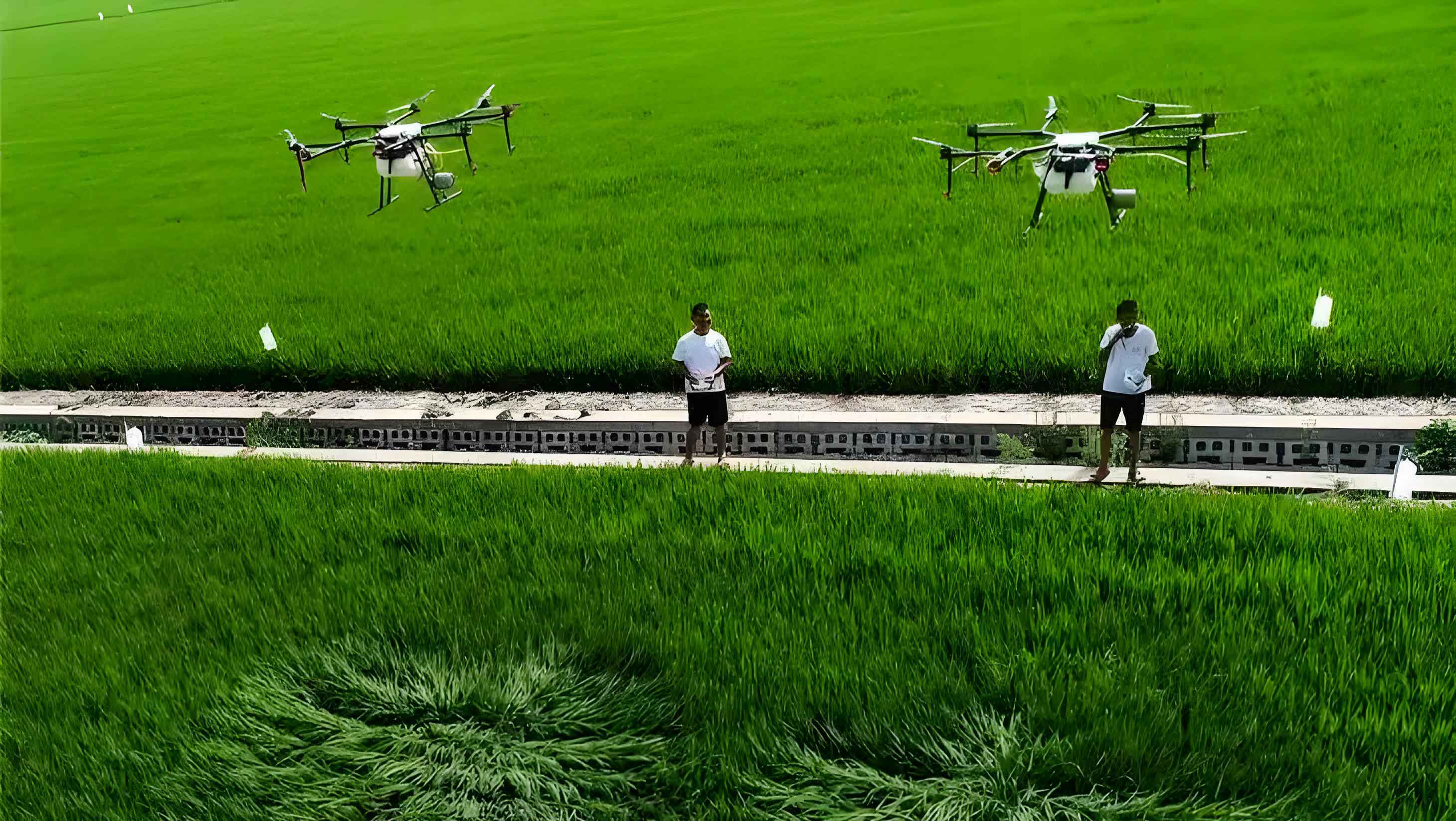
Beyond accessibility, the precision engineering of modern agricultural UAV systems drives unprecedented efficiency in resource utilization. Unlike boom sprayers that deliver a blanket application, UAVs can be programmed for site-specific management. The key parameters—flight altitude, speed, and spray rate—are digitally controlled, leading to a highly uniform deposition of agrochemicals. This precision minimizes the notorious problems of over-application and under-application. The concentrated downdraft generated by the rotors of an agricultural UAV helps to penetrate the rice canopy, ensuring better coverage on the undersides of leaves where many pests reside. Studies and field observations consistently show that UAV-based spraying can reduce pesticide volume by 20-30% compared to conventional methods while achieving superior or equivalent control efficacy. This is encapsulated in the concept of deposition efficiency ($\eta_d$), which can be modeled as a function of operational parameters and droplet characteristics:
$$ \eta_d = \frac{M_{deposited}}{M_{sprayed}} = f(v, h, D_v, \rho_{air}, \theta) $$
Where $v$ is flight velocity, $h$ is flight height, $D_v$ is the volume median diameter of droplets, $\rho_{air}$ is air density, and $\theta$ is the canopy structure parameter. Optimizing these variables is central to agricultural UAV operation.
The operational workflow for deploying an agricultural UAV in rice pest and disease management is a systematic process that integrates planning, technology, and agronomic knowledge. It begins long before the UAV takes off.
1. Pre-Operation Planning and Scouting: The first step involves a detailed assessment of the target field. Using GPS and mapping software, the field boundary is digitized. Crucially, obstacles such as trees, power lines, or poles are marked to create a no-fly zone within the flight control software. Concurrently, accurate pest and disease scouting is conducted to identify hotspot areas, assess infestation severity, and determine the appropriate control threshold. This information dictates whether a full-field or variable-rate application is needed.
2. Meteorological Considerations: Weather conditions are paramount for safe and effective agricultural UAV operation. Missions should be scheduled when wind speed is below 4 m/s (approximately 15 km/h) to prevent spray drift. High temperatures and low humidity can lead to rapid droplet evaporation, reducing efficacy. Therefore, optimal windows are typically early morning or late afternoon. Modern UAVs often have integrated weather stations, but consulting reliable forecasts remains essential.
3. Formulation Selection and Tank Mix Preparation: The choice of pesticide formulation is critical for agricultural UAV systems. To prevent clogging of the ultra-fine nozzles, water-based formulations like Suspension Concentrates (SC), Emulsions in Water (EW), and Soluble Liquids (SL) are preferred. Wettable Powders (WP) or Soluble Powders (SP) are generally unsuitable. Furthermore, due to the low application volume (typically 15-30 liters per hectare), adjuvants like surfactants, spreaders, or anti-evaporants are often added to enhance droplet retention, spread, and uptake. The concentration of the spray solution is carefully calculated based on the recommended dosage per hectare and the UAV’s calibrated flow rate. The concept of application rate ($AR$) is fundamental:
$$ AR = \frac{Q}{v \cdot w} $$
where $Q$ is the flow rate from the spray system (l/min), $v$ is the ground speed (m/min), and $w$ is the effective spray swath width (m). The operator adjusts $Q$ and $v$ to achieve the target $AR$.
4. Determination of Optimal Operational Parameters: Setting the correct flight parameters is the key to precision. Based on the pesticide label, droplet spectrum requirements, and field conditions, the operator sets the following:
| Parameter | Typical Range for Rice | Agronomic Rationale |
|---|---|---|
| Flight Height (h) | 1.5 – 3.0 meters above canopy | Ensures correct swath overlap and droplet deposition; too high causes drift, too low causes uneven coverage. |
| Flight Speed (v) | 3 – 6 m/s | Balances operational efficiency with sufficient spray time over target area. Affects droplet settling time. |
| Spray Swath Width (w) | 4 – 6 meters | Determined by nozzle type, pressure, and height. Critical for planning flight lines and overlap. |
| Application Volume | 15 – 30 L/ha | Ultra-Low Volume (ULV) to Low Volume (LV) range. Requires high-quality formulations. |
The relationship between these parameters ensures the Required Droplet Density (RDD) is achieved on the target surface. The number of droplets per unit area ($N_d$) can be estimated by:
$$ N_d = \frac{AR \cdot C \cdot 10^6}{\frac{\pi}{6} D_v^3 \cdot \rho} $$
where $C$ is the concentration of active ingredient, $D_v$ is the volume median diameter, and $\rho$ is the density of the spray liquid. The operator’s goal is to configure the agricultural UAV to deliver an $N_d$ that exceeds the biological threshold for the target pest or pathogen.
5. Execution and In-Field Protocol: The operation must follow strict safety and procedural guidelines. A clear, level take-off and landing zone is established. The area is cordoned off with warning signs. The pilot, maintaining a safe distance (e.g., >10m), initiates the autonomous flight plan. During the mission, constant visual monitoring is required to watch for unexpected obstacles or system anomalies. The pilot must be prepared to switch to manual override instantly. Personal protective equipment (PPE) is mandatory, even for the remote pilot, due to potential drift during loading and take-off/landing phases.
6. Post-Operation Maintenance and Evaluation: After completing the spray mission, a thorough cleaning ritual is critical. The tank, lines, pumps, and nozzles must be flushed with clean water to prevent corrosion and clogging from residual chemicals. Batteries are recharged following proper protocols to ensure longevity. From an agronomic perspective, the job is not done. Fields should be monitored after 24-48 hours and again after 5-7 days to assess control efficacy. This feedback loop is essential for validating the agricultural UAV application parameters and planning any necessary follow-up treatments.
To fully harness the potential of this technology, a multi-faceted approach to enhancing its application level is necessary.
1. Advanced Technical Training and Certification: Operating an agricultural UAV is an interdisciplinary skill combining aviation basics, agronomy, and pesticide science. Establishing standardized, certified training programs for pilots is non-negotiable. Training must cover flight mechanics, mission planning, maintenance, emergency procedures, and, crucially, the principles of integrated pest management (IPM) and pesticide stewardship. A certified operator is not just a pilot but a crop health technician.
2. Development of UAV-Optimized Formulations and Adjuvants: The agrochemical industry must continue to innovate alongside UAV technology. There is a growing need for specialized formulations engineered explicitly for ultra-low-volume aerial application—products with optimal viscosity, solubility, and adjuvant packages that maximize foliar uptake and rainfastness while being benign to UAV components. Collaboration between UAV manufacturers and chemical companies is vital.
3. Integration with Digital Agriculture Platforms: The future of the agricultural UAV lies in its integration into broader Farm Management Information Systems (FMIS). Imagine a workflow where satellite or drone-based multispectral imagery detects a developing disease hotspot, prescribes a treatment map, and automatically uploads it to the spray agricultural UAV. Post-application, the same system evaluates efficacy. This closed-loop, data-driven approach, powered by IoT and AI, maximizes the precision and economic return of every intervention.
4. Robust Regulatory Frameworks and Incentives: Clear, science-based regulations governing the aerial application of pesticides via UAVs are needed to ensure safety and environmental protection. Simultaneously, governments and financial institutions can play a catalytic role by providing subsidies, low-interest loans, or service-contract guarantees to make this technology more accessible to smallholder farmers and service providers, accelerating its adoption.
5. Research and Standardization: Ongoing research is required to refine best practices. This includes developing crop- and pest-specific parameter libraries (optimal $v$, $h$, $D_v$), studying off-target drift models under various conditions, and establishing standardized methods for measuring and reporting deposition efficacy from agricultural UAV applications. Public-sector agricultural research institutions are key players in this arena.
In conclusion, the agricultural UAV is far more than a flying sprayer. It is the centerpiece of a new paradigm in crop protection—one characterized by precision, intelligence, and responsibility. Its ability to perform timely, targeted, and efficient interventions in rice crops addresses critical challenges of labor shortage, operational efficiency, and environmental footprint. As the technology matures, supported by better training, optimized inputs, and digital integration, its role will expand from mere application to becoming an essential sensor and decision-making node in the smart farming ecosystem. The widespread adoption of agricultural UAV technology is not just an improvement in technique; it is a necessary evolution to meet the dual imperatives of safeguarding global rice production and promoting sustainable agricultural practices for future generations.