
In the context of rapid urbanization, high-rise building fires pose significant challenges due to their complex structures, dense populations, and rapid fire spread. As a researcher in fire safety engineering, I have focused on developing an integrated fire UAV system that combines multi-rotor drones, fire-extinguishing bombs, and advanced fire detection technologies. This system aims to provide a fast, efficient, and safe solution for combating high-rise building fires, leveraging the agility and payload capacity of unmanned aerial vehicles. The core innovation lies in deploying fire UAVs equipped with specialized灭火弹 that can be precisely launched and detonated above fire sources, ensuring optimal dispersion of灭火剂. This article details the system’s design, experimental validation, and key findings, emphasizing the role of fire UAVs in modern消防 operations.
The increasing frequency of high-rise building fires, as highlighted by statistical data showing a 10% rise in such incidents in recent years, underscores the need for advanced消防 strategies. Traditional消防 methods often struggle with accessibility and safety risks for rescue personnel. My research addresses these gaps by integrating a六旋翼无人机 platform with a灭火弹 system, enabling remote fire suppression from a safe distance. The fire UAV system operates by autonomously navigating to the fire’s altitude, identifying the fire core through monitoring systems, and launching灭火弹 that penetrate barriers like windows to disperse灭火剂 effectively. This approach minimizes human exposure to hazards while enhancing灭火 efficiency through targeted delivery. Throughout this article, I will elaborate on the system’s components, including the无人机 flight control, fire monitoring algorithms,灭火弹 design, and experimental outcomes, all centered around the fire UAV concept.
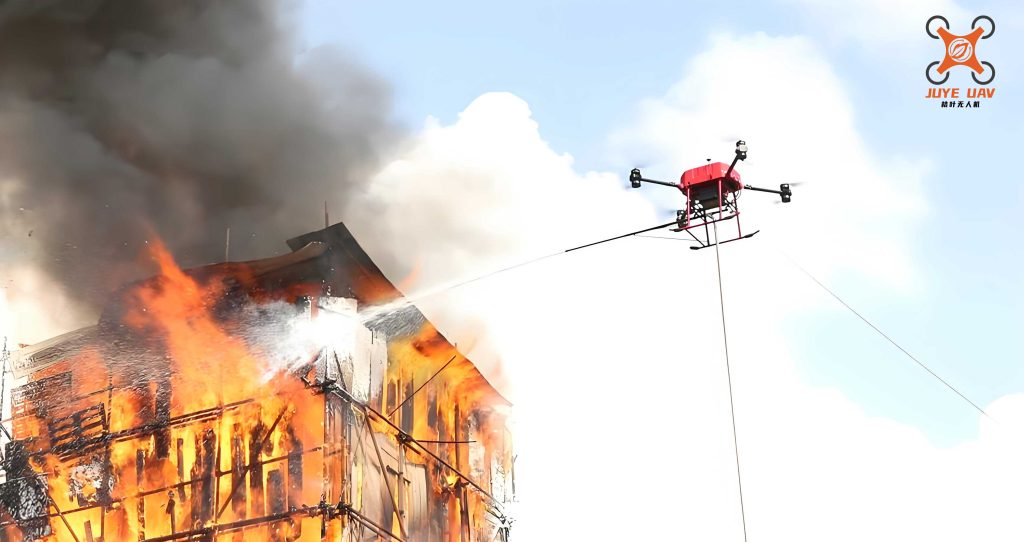
The fire UAV system’s workflow begins with the deployment of a六旋翼无人机, chosen for its stability and payload capacity. Upon detecting a fire in a high-rise building, the fire UAV ascends to the corresponding height, where its onboard sensors, including infrared and visual cameras, capture real-time data. The ground control station processes this information to locate the fire’s center and determine the optimal launch angle for the灭火弹. Based on fire type, the fire UAV releases a灭火弹 containing appropriate灭火剂, such as ultra-fine dry powder, which detonates above the flames to create a灭火剂 cloud that suffocates and cools the fire. This method leverages the fire UAV’s mobility to overcome limitations of fixed消防 platforms, allowing for rapid response in complex urban environments. The integration of wireless Mesh networks ensures seamless communication between the fire UAV and control units, facilitating coordinated operations.
In designing the消防无人机 system, I prioritized flight stability under heavy loads. The六旋翼无人机 employs advanced control algorithms to manage torque and lift coefficients, ensuring smooth operation even when carrying灭火弹. The flight dynamics can be modeled using equations for force balance. For instance, the total lift force $F_l$ generated by the rotors is given by:
$$F_l = \sum_{i=1}^{6} k_f \cdot \omega_i^2$$
where $k_f$ is the lift coefficient and $\omega_i$ is the angular velocity of rotor $i$. To counteract disturbances, a Lyapunov-based backstepping controller is implemented, enhancing the fire UAV’s resilience to external forces like wind gusts. This stability is crucial for accurate灭火弹 deployment, as any instability could compromise targeting precision. Additionally, the fire UAV incorporates a dual-line torsion method and AutoCAD modeling to identify inertial parameters, optimizing aerodynamic performance. These improvements allow the fire UAV to maintain flight integrity during灭火弹 launch, where reaction forces are mitigated by the drone’s own propulsion system.
Fire monitoring is a critical component of the fire UAV system. To address high false-alarm rates in high-rise fire detection, I developed an infrared camera gimbal tracking system that automatically detects, recognizes, and locates fires. The system framework includes onboard sensors, a core processing unit, and ground-based communication devices. For flame recognition, static features are extracted to account for UAV抖动, including high-temperature segmentation, circularity, area change rate, and texture characteristics. The segmentation process uses thresholding: for an image $I(x,y)$, a threshold $T$ is applied to create a binary image $I'(x,y)$:
$$I'(x,y) = \begin{cases} 0, & \text{if } I(x,y) \leq T \\ 255, & \text{if } I(x,y) > T \end{cases}$$
With $T$ set to 155 based on empirical tests, this isolates high-temperature regions. Circularity $e$ is calculated to assess flame irregularity:
$$e = \frac{4\pi S}{L^2}$$
where $S$ is the contour area and $L$ is the perimeter. Area change rate $\Delta S_i$ evaluates dynamic variations:
$$\Delta S_i = \left| \frac{S_i – S_{i-1}}{S_i} \right|$$
Texture features are derived from gray-level co-occurrence matrices (GLCM), with parameters like entropy, energy, contrast, and correlation used to distinguish flames from false positives. These algorithms enable the fire UAV to accurately identify fire sources, ensuring targeted灭火弹 launches. The table below summarizes key flame recognition parameters and their roles in the fire UAV system:
| Parameter | Description | Role in Fire UAV |
|---|---|---|
| Threshold T | Segments high-temperature pixels | Initial fire detection |
| Circularity e | Measures contour roundness | Filters non-flame objects |
| Area Change Rate | Quantifies shape dynamics | Reduces false alarms |
| GLCM Features | Describes texture patterns | Enhances recognition accuracy |
The灭火弹发控 technology on the fire UAV involves a launch mechanism comprising固定爪,滑轨, and electromagnetic valves. Controlled via a 51单片机, this system ensures secure灭火弹 attachment during flight and precise release upon command. The mechanism works by using springs to limit灭火弹 movement, preventing accidental drops, while electromagnetic forces open固定爪 for launch.滑轨 guide the灭火弹 to provide initial velocity, ensuring it clears the fire UAV smoothly. This design allows the fire UAV to handle灭火弹 weighing up to 10 kg without stability loss. The reaction force $F_r$ from launch is absorbed by the无人机’s动力系统, modeled as:
$$F_r = m_b \cdot a_b$$
where $m_b$ is the灭火弹 mass and $a_b$ is its acceleration. The fire UAV’s control system adjusts rotor speeds to compensate, maintaining hover stability. This capability is vital for operational safety, as it prevents the fire UAV from destabilizing during critical灭火 operations.
Turning to the灭火弹 design, I engineered a structure comprising a弹体,尾翼,引信装置, and灭火剂. The弹体 features a conical head to reduce air resistance and a cylindrical body to maximize灭火剂 capacity, made from ABS plastic for lightweight durability. Key dimensions include a diameter of 120 mm and length of 650 mm, with a center of mass 320 mm from the tip. The internal structure includes a central爆管 surrounded by灭火剂, optimized for even dispersion upon detonation. Based on studies, a比药量 of 2% is used, meaning the explosive charge is 2% of the total mass, to achieve optimal灭火剂抛撒. The引信 system incorporates sensors and a microcontroller to trigger detonation at the ideal position, typically 3–5 m above the fire source, ensuring灭火剂 cloud coverage. The table below outlines the灭火弹’s特征参数:
| Feature | Value | Impact on Fire UAV Performance |
|---|---|---|
| Mass | 10 kg | Determines UAV payload requirements |
| Diameter | 120 mm | Affects aerodynamic drag |
| Length | 650 mm | Influences灭火剂 capacity and stability |
| Center of Mass | 320 mm from tip | Ensures stable flight trajectory |
| Moment of Inertia | 0.087 kg·m² | Impacts rotational dynamics |
For灭火剂 selection, I opted for ultra-fine dry powder due to its high灭火 efficiency and anti-reignition properties. Upon detonation, the灭火剂 particles disperse radially and axially, forming a cloud that isolates oxygen and absorbs heat. The dispersion radius $R_d$ can be approximated using empirical formulas related to charge mass and environmental conditions. In the fire UAV context, this ensures rapid fire suppression even in confined spaces like high-rise buildings. The装药 structure is central-charge type, as simulations show it yields uniform灭火剂 distribution. The引信 system uses signal发射器 and接收器 to calculate detonation timing, with temperature sensors as backups, allowing the灭火弹 to explode precisely when positioned above flames for maximum effectiveness.
To validate the fire UAV system, I conducted extensive field experiments involving六旋翼无人机,灭火弹, and monitoring equipment. The test setup included igniting controlled fires to simulate high-rise building scenarios. The fire UAV was deployed to carry and launch灭火弹, with cameras recording flight and爆破 events. Key steps involved parameter calibration, UAV system checks,灭火弹 mounting, and sequential launches under varying conditions. Results demonstrated that the fire UAV could maintain stable flight during and after灭火弹发射, with no significant抖动 observed in video feeds. The灭火弹 detonated as planned, producing灭火剂 clouds with radii of 5–10 m, effectively covering fire sources. Post-experiment analysis confirmed that flames were extinguished without reignition, validating the system’s灭火 efficiency. The optimal爆破 distance of 3–5 m from the fire source was verified, ensuring灭火剂弥散 covered the target area thoroughly. These findings highlight the fire UAV’s capability as a reliable tool for high-risk消防 operations.
The experiments also quantified performance metrics. For instance, the fire UAV’s flight stability was assessed by measuring angular deviations $\theta$ during launch, which remained below 5 degrees, thanks to the control algorithms. The灭火剂 dispersion efficiency $\eta$ was calculated as the ratio of covered area to fire area:
$$\eta = \frac{A_c}{A_f}$$
where $A_c$ is the灭火剂 cloud area and $A_f$ is the fire area. In tests, $\eta$ exceeded 90% for most scenarios, indicating high effectiveness. Additionally, the fire UAV’s response time $t_r$ from detection to launch averaged under 30 seconds, crucial for preventing fire spread. These results underscore the advantages of using fire UAVs for rapid intervention in complex urban settings. The table below summarizes experimental outcomes relevant to fire UAV operations:
| Metric | Result | Implication for Fire UAV Deployment |
|---|---|---|
| Flight Stability | < 5° deviation | Ensures accurate targeting |
| Dispersion Radius | 5–10 m | Provides wide coverage per灭火弹 |
| Optimal Detonation Distance | 3–5 m | Maximizes灭火剂 effectiveness |
| Response Time | < 30 s | Enables quick fire containment |
| Anti-Reignition | No reignition observed | Enhances long-term safety |
In conclusion, my research on the fire UAV system demonstrates its potential to revolutionize high-rise building消防. By integrating六旋翼无人机 with advanced灭火弹 and fire detection technologies, the system offers a fast, safe, and efficient solution for mitigating火灾 risks. The fire UAV’s ability to stabilize under load, accurately identify fires, and deploy灭火弹 precisely addresses key challenges in traditional消防 methods. Experimental evidence confirms that灭火弹爆破 at 3–5 m above fires yields optimal灭火剂弥散, effectively extinguishing flames without reignition. This fire UAV system is adaptable to various high-risk environments, such as airports, forests, and industrial sites, reducing reliance on human消防 personnel and enhancing overall safety. Future work could explore scaling the fire UAV for larger fires or integrating AI for autonomous decision-making, further solidifying the role of fire UAVs in modern消防 infrastructure.
Throughout this study, the fire UAV concept has been central, emphasizing how unmanned systems can transform emergency response. The combination of robust engineering, algorithmic processing, and practical validation makes the fire UAV a promising tool for global消防 efforts. As urbanization continues, leveraging technologies like fire UAVs will be essential for protecting lives and property from the growing threat of high-rise building fires. By continuing to refine these systems, we can pave the way for smarter, safer cities where fire UAVs play a pivotal role in disaster management and prevention.