
The proliferation of small, low-altitude, slow-moving (so-called “low, slow, and small” or LSS) rotary-wing unmanned aerial vehicles (UAVs) presents a significant and growing challenge for security operations in urban and sensitive environments. While offering immense utility, their potential for misuse in conflicts, terrorist activities, and espionage necessitates the development of effective, scalable, and safe countermeasures. Traditional anti-UAV methods often face limitations: kinetic “hard-kill” solutions like missiles or lasers can be prohibitively expensive, cause excessive collateral damage, and are ill-suited for dense urban settings. “Soft-kill” electronic warfare methods, such as jamming or spoofing, may be ineffective against autonomous or hardened drones and risk disrupting friendly communications. This analysis details the research and development of a novel, cost-effective anti-UAV solution: a fiber-based entanglement projectile deployed via a precision fixed-point airburst system.
Our proposed system innovates by employing a non-lethal, area-denial mechanism. It is designed to launch a specialized projectile to a computed point in space proximate to a target drone or drone swarm. Upon command, the projectile airbursts, dispersing a cloud of lightweight, high-strength fibrous filaments. These filaments are engineered to entangle the rotors of anti-UAV targets, causing immediate aerodynamic disruption, loss of stability, and forced landing or crash, thereby neutralizing the threat with minimal risk of secondary damage from falling debris or explosive shrapnel.
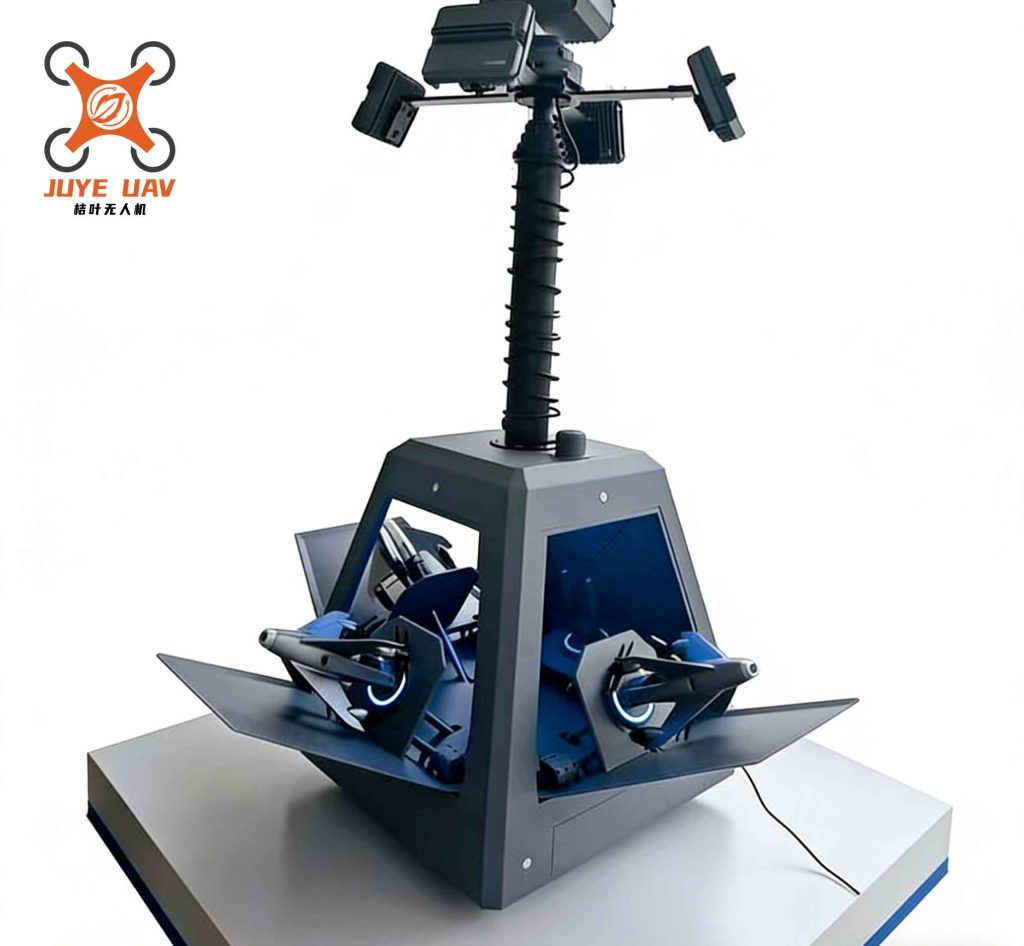
The core of this anti-UAV system is built upon a repurposed and enhanced 64mm Fixed-Point Airburst Anti-Riot Weapon System. The complete system architecture integrates two primary subsystems: the Launch Control & Guidance Platform and the Smart Fiber Projectile.
The Launch Control & Guidance Platform consists of:
1. A 64mm programmable launch tube.
2. A fire control system (FCS) with an integrated ballistic computer.
3. A target acquisition module combining optical sighting, laser rangefinding, and environmental sensors (for wind, temperature, pressure).
4. A wireless induction setter for programming the projectile’s fuze in-bore.
The system operates through a sequenced workflow: The operator acquires the target. The FCS uses target coordinates, environmental data, and stored muzzle velocity tables to solve the fire control problem in real-time, calculating the precise azimuth, elevation, and time-of-flight (TOF) to the desired airburst point. The launcher is automatically slewed to the correct aim point. The induction setter encodes the computed TOF and transfers it to the projectile’s fuze just before firing. Upon firing, the fuze is activated and begins its countdown. A miniature onboard velocimeter measures the actual muzzle exit velocity, allowing the fuze to perform a final, in-flight correction to the TOF for exceptional airburst accuracy. At the computed moment, the fuze initiates the warhead, achieving a precise airburst.
The Smart Fiber Projectile is the effector element of this anti-UAV strategy. It comprises a cartridge case (which remains in the launcher) and the projectile itself. The projectile is a complex assembly featuring a non-metallic composite body for safety, a precision electronic time fuze, and the specialized fiber warhead.
The warhead’s design is critical for effective anti-UAV performance. It contains a central explosive charge surrounded by a radially arranged payload of fibrous “damage elements.” The selection of the fiber material is paramount. It must possess a unique combination of properties: high tensile strength for durability, low density for extended hang time, flexibility for effective entanglement, and resistance to heat/flame from the explosive dispersal charge. A comparative analysis of candidate materials is summarized below:
| Material | Tensile Strength | Density | Thermal/Flame Resistance | Remarks |
|---|---|---|---|---|
| E-Glass Fiber | High | Moderate-High | Good | Brittle upon impact; less ideal for entanglement. |
| Ultra-High-Molecular-Weight Polyethylene (UHMWPE) | Very High | Very Low | Moderate | Excellent strength-to-weight ratio but higher cost. |
| Aramid (e.g., Kevlar®) | Very High | Low | Excellent | High strength, good flexibility, outstanding cut/heat resistance. Cost-effective and widely available. |
| Carbon Fiber | Exceptional | Very Low | Good in inert atmospheres | Extremely brittle; prone to shattering, not suitable for flexible entanglement. |
Based on this analysis, a high-performance aramid fiber was selected as the optimal anti-UAV damage element. Its balanced portfolio of properties ensures it survives the explosive dispersal, unfurls effectively, and maintains integrity during the violent interaction with high-speed rotors. The fibers are cut to specific lengths and may be tipped with small, lightweight weights to control their descent dynamics and increase the probability of rotor engagement.
The terminal effect—rotor entanglement—is a complex dynamic process. We can model key phases. First, the airburst creates a radially expanding cloud of filaments. The initial radial velocity $v_r$ of a fiber element can be approximated by considering the imparted impulse from the explosive products:
$$ v_r \approx \frac{I}{m_f} $$
where $I$ is the specific impulse imparted to the fiber bundle and $m_f$ is the mass of a fiber element. As the cloud expands, drag forces quickly decelerate the fibers. The drag force $F_d$ on a fiber is given by:
$$ F_d = \frac{1}{2} C_d \rho_a A v^2 $$
where $C_d$ is the drag coefficient (high for a fibrous tangle), $\rho_a$ is air density, $A$ is the characteristic frontal area, and $v$ is the velocity relative to air. This results in a rapid decrease in radial speed, causing the fibers to “float” and creating a persistent hazard zone.
When a fiber contacts a rotor blade spinning at angular velocity $\omega$, the engagement dynamics begin. The filament may slide along the blade until it encounters a leading edge, hub, or another filament, at which point it begins to wind. The torque $\tau_w$ induced on the rotor by a winding filament can be expressed as:
$$ \tau_w = F_t \cdot r $$
where $F_t$ is the tangential component of the fiber’s tension force and $r$ is the moment arm from the rotor hub. This applied torque opposes the motor’s driving torque $\tau_m$. The net torque dictates the angular acceleration $\alpha$ of the rotor:
$$ \sum \tau = \tau_m – \tau_w = I_{rotor} \cdot \alpha $$
where $I_{rotor}$ is the rotor’s moment of inertia. As more filaments entangle, $\tau_w$ increases, leading to a reduction in $\alpha$ and ultimately a decrease in rotor speed $\omega$. The loss of lift $L$ on that rotor is immediate, as lift is proportional to the square of the rotational speed for a given blade geometry:
$$ L \propto \omega^2 $$
Even a partial speed reduction on one rotor creates a severe control moment, causing the multi-rotor UAV to tumble and crash. This mechanical anti-UAV mechanism is inherently robust against electronic countermeasures.
To validate this anti-UAV concept, high-fidelity simulations were conducted using ANSYS/LS-DYNA explicit dynamics software. A simplified model consisted of a single rotor blade segment rotating at a typical speed of 120 revolutions per second ($\approx 754 \text{ rad/s}$) and a single aramid fiber element. The material model for the fiber incorporated nonlinear, rate-dependent tensile properties. The simulation captured the sequential engagement, wrapping, and loading phases. Results clearly showed the development of significant stress in the fiber and a corresponding reactive load on the rotor structure. Most critically, the simulation tracked a rapid decay in the rotor’s angular velocity following contact, quantitatively demonstrating the efficacy of the entanglement anti-UAV mechanism. The velocity profile followed a decay curve that could be fitted to a form like:
$$ \omega(t) = \omega_0 e^{-\beta t} $$
where $\omega_0$ is the initial angular velocity and $\beta$ is a damping coefficient encompassing the complex frictional and winding interactions.
Following simulation, functional prototypes were manufactured. The warhead was loaded with precisely arranged aramid fibers. Field tests were conducted against commercially available quadcopter drones. The 64mm launch system successfully placed airbursts within a few meters of the intended intercept point. Upon detonation, the fibrous cloud deployed as designed. Drones flying into or through the cloud consistently suffered immediate rotor entanglement. The observable effects ranged from instant, unstable descent to complete loss of control and ground impact, confirming the simulation predictions and the practical viability of this anti-UAV approach. The system demonstrated a high probability of neutralization for single drones and shows inherent scalability for engaging groups within the effective burst radius.
In conclusion, the fixed-point airburst fiber projectile represents a paradigm shift in tactical anti-UAV defense. It synthesizes precision guidance, smart fuzing, and novel terminal mechanics to create a solution that is:
1. Precise: The guided airburst minimizes miss distance.
2. Safe: The non-fragmenting, non-incendiary projectile drastically reduces collateral damage risks.
3. Cost-Effective: It utilizes relatively inexpensive materials and launcher technology.
4. Reliable: The physical entanglement mechanism is effective against all rotor-based UAVs regardless of their electronic sophistication or countermeasure shielding.
5. Scalable: A single burst can address multiple targets in a zone.
Future development will focus on optimizing fiber payload configurations for different engagement envelopes, integrating more advanced seekers for moving targets, and exploring network-enabled capabilities for coordinated, multi-launcher anti-UAV operations. This technology establishes a critical tool for safeguarding airspace against rogue drone threats in complex environments.