
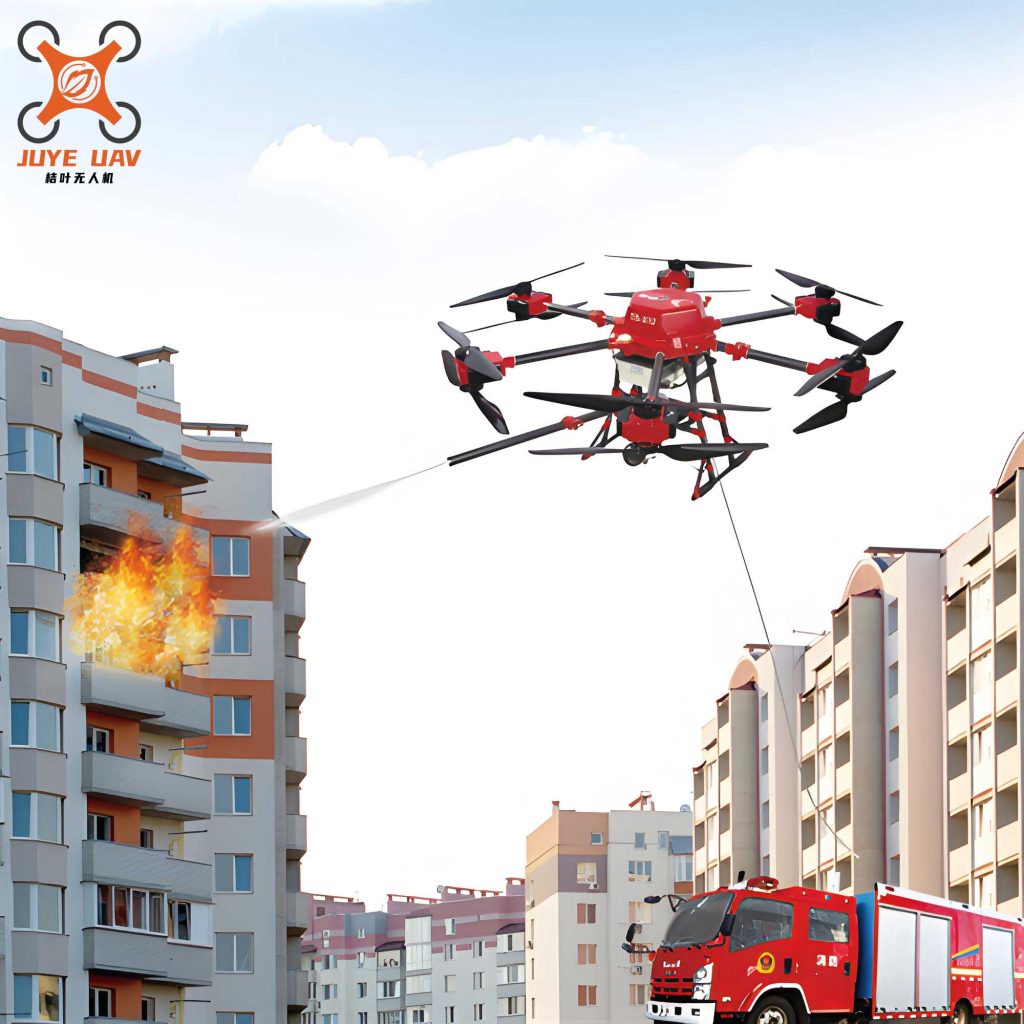
In the rapidly evolving field of aerial firefighting, the integration of unmanned aerial vehicles, particularly fire UAVs, has revolutionized emergency response strategies. As a researcher involved in this innovative domain, I have focused on developing a critical component: the electric ignitor for fire UAV engines. This ignitor ensures reliable ignition, stable internal ballistics, and overall safety for fire UAV operations. The importance of fire UAVs in modern firefighting cannot be overstated; they enable precise monitoring, payload delivery, and enhanced operational efficiency in hazardous environments. Our team embarked on designing a high-safety electric ignitor to meet the stringent demands of fire UAV systems, aiming to improve performance, reliability, and environmental sustainability. This article delves into our comprehensive study, covering structural design, material selection, production processes, and rigorous testing, all tailored to advance fire UAV technology.
The core function of our electric ignitor is to initiate combustion in the fire UAV engine reliably and safely. Through iterative design and testing, we optimized every aspect, from the ignitor’s physical architecture to its chemical composition. The development process involved selecting appropriate materials, such as semiconductor bridge igniters over traditional bridge wires, and fine-tuning药剂 formulations to achieve optimal pressure and flame output. Our work aligns with industry trends toward greener and more efficient pyrotechnics, contributing to the broader adoption of fire UAVs in civil and emergency services. By sharing our findings, we hope to underscore the technical advancements that make fire UAVs more dependable and effective in real-world scenarios.
To begin, let’s explore the structural design of the electric ignitor. The ignitor comprises several key components: a cup body, a cup cover, an ignition head, primary and secondary charges, and lead wires. The cup body features a threaded connection port, a main charge chamber, and multiple flame ejection ports. This design ensures secure assembly and efficient flame propagation. The cup body’s internal cavity houses the primary charge, which generates high-pressure gases upon ignition, while the flame ports direct the output toward the fire UAV engine. The cup cover includes a threaded section for attachment, a bolt for ease of assembly, and a through-hole for the ignition head leads, sealed with adhesive to prevent moisture ingress. This robust construction is essential for withstanding the operational stresses encountered by fire UAVs during flight and ignition sequences.
The ignition head is a pivotal element in our design. We evaluated two types: bridge wire and semiconductor bridge (SCB). Initial tests with bridge wire heads revealed inconsistencies in resistance values, typically ranging from 0.88 to 1.18 Ω, due to variations in wire length. This led to unreliable electrical performance and potential corrosion issues over time, compromising the long-term stability required for fire UAV applications. In contrast, semiconductor bridge heads offered superior consistency, with resistance tightly controlled at 1.0 ± 0.2 Ω. Their enhanced safety features, such as higher electrostatic discharge tolerance, made them ideal for fire UAV engines, which demand an 8-year shelf life. We conducted comparative trials, summarized in Table 1, confirming the SCB’s advantages in reliability and safety for fire UAV ignitors.
| Ignition Head Type | Sample Size (units) | Resistance R (Ω) | Safety Current I (A) | Firing Current I (A) |
|---|---|---|---|---|
| Bridge Wire (Double Bridge) | 50 | 0.88–1.18 | 0.3 | 0.7 |
| Semiconductor Bridge | 50 | 1.0–1.1 | 0.8 | 3.5 |
Following the ignition head selection, we focused on the药剂 formulations. The primary charge must exhibit fast burning rates, high gas production, and strong flame喷射能力 to effectively ignite fire UAV engines. Initially, we tested a conventional药剂 A, but it fell short in peak pressure output, averaging 1.58–2.55 MPa in a 300 mL chamber. To address this, we developed an enhanced gas-producing药剂 A, optimized through配方 adjustments. This new药剂 showed improved performance, with peak pressures reaching 2.98–3.51 MPa. However, to meet the target of ≥3.5 MPa for fire UAV applications, we further adjusted the charge mass. The relationship between charge mass and peak pressure can be expressed using a simplified empirical formula:
$$ P = k \cdot m^n $$
where \( P \) is the peak pressure, \( m \) is the charge mass, and \( k \) and \( n \) are constants derived from experimental data. Through systematic testing, we determined that a charge mass of 4.5 g yielded pressures of 4.00–4.75 MPa, satisfying the requirements for fire UAV engines. Table 2 outlines the results from these trials, highlighting the optimal mass selection.
| Charge Mass m (g) | Sample Size (units) | Peak Pressure P (MPa) | Burn Time t (ms) |
|---|---|---|---|
| 3.5 | 50 | 2.98–3.67 | 60–78 |
| 4.0 | 50 | 3.61–3.98 | 58–70 |
| 4.5 | 50 | 4.00–4.75 | 56–66 |
| 5.0 | 50 | 4.95–5.70 | 55–65 |
For the ignition charge, we transitioned from a less sensitive X ignition药 to a more reactive Y ignition药. The Y药, commonly used in electronic initiators, demonstrated excellent firing reliability. In tests, all 200 samples ignited at a current of 3.5 A, whereas the X药 had a high failure rate. This shift ensured consistent ignition for the fire UAV engine, crucial for mission-critical operations. The combustion kinetics of the Y药 can be modeled using the Arrhenius equation:
$$ \frac{d\alpha}{dt} = A e^{-\frac{E_a}{RT}} (1-\alpha)^m $$
where \( \alpha \) is the extent of reaction, \( A \) is the pre-exponential factor, \( E_a \) is the activation energy, \( R \) is the gas constant, \( T \) is temperature, and \( m \) is the reaction order. This formulation underscores the药剂’s rapid response under electrical stimulation, aligning with the dynamic needs of fire UAV systems.
With the components finalized, we optimized the overall assembly structure. The initial design occasionally showed unreliable ignition due to mismatched冲量 between the Y ignition药 and the primary charge. We introduced a layered configuration with a separation pad to enhance energy transfer. The final structure includes the cup body, primary charge (gas-producing药剂 A), ignition charge (Y药), semiconductor bridge head, and sealed cover. This arrangement ensures sequential activation: electrical energy heats the SCB, igniting the Y药, which then triggers the primary charge to produce high-pressure gases and flames for the fire UAV engine. The flame ejection ports are strategically placed to maximize output direction and efficiency, vital for the fire UAV’s propulsion system.
The production process leverages existing infrastructure for pyrotechnic devices. We established a streamlined workflow, as illustrated in Figure 1 (though not referenced directly, the流程 is described). It begins with component preparation—cup body and cover machining, followed by ignition head assembly with SCB and Y药. The primary charge is carefully loaded into the cup body, with质量控制 ensuring consistency. Next, the ignition head is inserted and sealed, and the cover is threaded on. Finally, lead wires are attached, and the entire unit undergoes inspection and packaging. This process emphasizes safety and precision, critical for manufacturing ignitors that will be deployed in fire UAVs across diverse environments. Each step adheres to strict protocols to prevent defects, such as moisture ingress or electrical shorts, which could compromise fire UAV missions.
To validate the ignitor’s performance, we conducted extensive tests based on military standard GJB 1885-1994. These evaluations covered electrical, safety, and environmental aspects, all relevant to fire UAV operations. Key metrics included resistance,安全 current, firing current, and output pressure. For instance, the all-resistance measurement confirmed values within 1.0 ± 0.2 Ω, ensuring compatibility with fire UAV control systems. Safety tests, such as 12-meter drop and vibration trials, verified that the ignitor remains inert under accidental impacts, a common concern for fire UAVs handling during transport. Environmental simulations, including temperature cycles from -40°C to 50°C, demonstrated robustness for fire UAV deployments in extreme climates. Table 3 summarizes the comprehensive test results, highlighting the ignitor’s reliability for fire UAV applications.
| Test Category | Requirement | Sample Size | Outcome |
|---|---|---|---|
| Appearance | No scratches, rust, or defects | 200 | Pass |
| Dimensions | Per design specifications | 200 | Pass |
| Lead Length | 200 ± 20 mm | 200 | Pass |
| Reliability | >99% confidence | 125 | Pass |
| 12m Drop | No ignition | 2 | Pass |
| 2m Drop | No damage, functional after | 10 | Pass |
| Vibration | No ignition or damage | 123 | Pass |
| Temperature Shock | Functional after cycles | 20 | Pass |
| Moisture Absorption | ≤1.5% water content | 10 | Pass |
| High Temperature | Functional at 50°C | 40 | Pass |
| Low Temperature | Functional at -40°C | 40 | Pass |
| Resistance | 1.0 ± 0.2 Ω | 200 | Pass |
| Electrostatic Sensitivity | No ignition at 25 kV | 20 | Pass |
| Insulation Resistance | >20 MΩ | 20 | Pass |
| Safety Current | No ignition at 800 mA for 5 min | 20 | Pass |
| Firing Test | Ignition at ≥4 A for 50 ms | 78 | Pass |
| Output Pressure | ≥3.5 MPa in 300 mL chamber | 77 | Pass |
The innovation of our electric ignitor lies in several key aspects tailored for fire UAVs. First, the use of semiconductor bridges replaces traditional bridge wires, offering higher reliability and consistent resistance. This directly enhances the ignition precision needed for fire UAV engines, which operate in variable conditions. Second, the safety profile is superior, with a high安全 current of 800 mA and inherent anti-static properties, reducing risks during handling and storage for fire UAV teams. Third, the customized gas-producing药剂 delivers strong flame喷射能力, with peak pressures exceeding 3.5 MPa, ensuring rapid and effective engine start-up for fire UAVs. Fourth, the design is environmentally friendly, producing minimal residue upon ignition, which aligns with sustainable practices in fire UAV operations. These innovations collectively improve the performance and safety of fire UAV systems, making them more viable for widespread use.
From a technical perspective, the ignitor’s output characteristics can be analyzed using fluid dynamics and combustion theory. The pressure buildup in the chamber follows the ideal gas law, modified for rapid combustion:
$$ P(t) = \frac{n(t)RT}{V} $$
where \( n(t) \) is the number of moles of gas produced over time, \( R \) is the universal gas constant, \( T \) is the combustion temperature, and \( V \) is the chamber volume (300 mL). For our药剂, the gas production rate is high, leading to a steep pressure rise that benefits fire UAV engine ignition. The flame velocity \( v_f \) can be estimated using the formula:
$$ v_f = \sqrt{\frac{2 \gamma}{\gamma – 1} R T_c \left[1 – \left(\frac{P_a}{P_c}\right)^{\frac{\gamma-1}{\gamma}}\right]} $$
where \( \gamma \) is the specific heat ratio, \( T_c \) is the combustion temperature, \( P_c \) is the chamber pressure, and \( P_a \) is atmospheric pressure. This velocity ensures that flames reach the fire UAV engine combustion zone promptly, facilitating reliable ignition.
In terms of production scalability, our工艺流程 is designed for high-volume output. We implemented quality control measures at each stage, such as automated resistance testing for ignition heads and pressure checks for assembled units. This ensures that every ignitor meets the strict standards required for fire UAV deployments. The use of standardized components, like the cup body and cover, allows for efficient manufacturing, reducing costs and lead times. As fire UAV adoption grows, this scalability becomes crucial for meeting market demands while maintaining safety and performance.
The economic and social impacts of this development are significant. By enhancing the reliability of fire UAV engines, our ignitor contributes to more effective firefighting operations, potentially saving lives and property. Fire UAVs equipped with these ignitors can respond faster to emergencies, cover larger areas, and reduce risks to human firefighters. Moreover, the ignitor’s long shelf life and low maintenance needs lower operational costs for fire UAV fleets, promoting broader adoption in resource-limited settings. From an industry standpoint, this project aligns with trends toward advanced pyrotechnics and automation, positioning fire UAV technology as a key player in modern disaster management.
Looking ahead, further research could explore integration with smart fire UAV systems. For example, ignitors could be coupled with sensors to enable adaptive ignition timing based on environmental conditions. Additionally, ongoing optimization of药剂 formulations may yield even higher efficiencies or reduced environmental footprints. As fire UAVs evolve, so too will their ignition systems, driving continuous innovation in this field.
In conclusion, our high-safety electric ignitor represents a substantial advancement for fire UAV engine technology. Through meticulous design, material selection, and testing, we have created a component that offers exceptional reliability, safety, and performance. The use of semiconductor bridges, optimized药剂, and robust assembly processes ensures that fire UAVs can operate effectively in diverse and challenging scenarios. This work not only supports the growth of fire UAV applications but also contributes to the broader goals of industrial progress and public safety. As we continue to refine these systems, the potential for fire UAVs to transform firefighting and other critical services will only expand, underscored by innovations like the electric ignitor detailed here.