
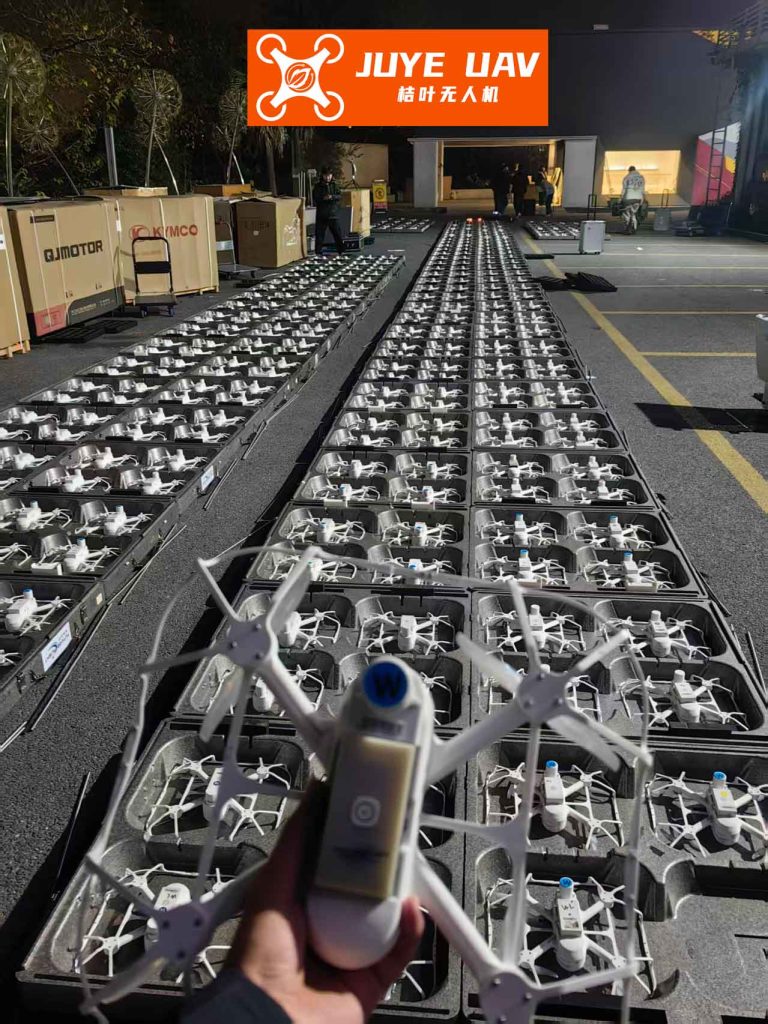
The mesmerizing spectacle of a synchronized formation drone light show represents a pinnacle of unmanned aerial technology, transforming the night sky into a dynamic canvas. The seamless, fluid motion of hundreds of drones creating complex, animated shapes is not merely an artistic endeavor but a significant engineering challenge. At its core lies the critical problem of formation drone light show navigation: ensuring every single drone knows its position with extreme accuracy relative to its neighbors and the predefined choreography. A failure in this precise positioning would instantly dissolve the intricate patterns into chaotic clutter. In this article, I will explore the evolution of cooperative navigation algorithms, culminating in an advanced filtering method I have developed and implemented to tackle the stringent precision demands of large-scale formation drone light show performances.
The fundamental challenge stems from the physics of flight and the limitations of onboard sensors. While high-end navigation systems combining Global Navigation Satellite Systems (GNSS) and Inertial Navigation Systems (INS) offer good accuracy, equipping every drone in a massive formation drone light show with such expensive, high-precision hardware is economically impractical. Furthermore, GNSS signals can be weak or unreliable in urban canyons or during certain performance conditions. This necessitates a cooperative approach, where a subset of “leader” drones with superior navigation capabilities shares its information with “follower” drones equipped with simpler, cost-effective sensors. This paradigm, often called “leader-follower” or “master-slave” cooperative navigation, is the most sensible architecture for a commercially viable and robust formation drone light show.
Architectures for Drone Formation Navigation
Before delving into algorithms, it’s crucial to understand the coordination structures. For a formation drone light show, the primary goal is maintaining geometric shape integrity from a central choreography command. The following table summarizes and compares the main cooperative navigation architectures:
| Architecture | Description | Advantages for Light Shows | Disadvantages for Light Shows |
|---|---|---|---|
| Leader-Follower (Master-Slave) | One or a few designated leader drones have high-precision GNSS/INS. Followers estimate their position relative to leaders using inter-drone measurements (e.g., range, bearing). | Cost-effective (few high-end units). Simplified fleet management. Centralized error control. | Single point of failure if a leader is lost. Performance degrades with distance from leader. |
| Parallel (Decentralized) | All drones have similar navigation capabilities and exchange information peer-to-peer. Each drone fuses data from multiple neighbors. | Robust to individual failures. Potentially higher accuracy from data fusion. | Higher cost per drone. Complex communication and data fusion logic. Increased computational load. |
| Hybrid | Combines elements of both. A core group of leaders provides an absolute reference, while followers also share relative data among themselves. | Good balance of robustness, accuracy, and cost. | Most complex to implement and coordinate. |
For the typical large-scale formation drone light show, the leader-follower model is predominant due to its compelling cost-to-performance ratio. My research and the algorithms discussed herein are optimized for this architecture. The core problem then reduces to this: given the precise known state (position, velocity) of a leader drone, and some noisy relative measurements (like distance or angle) from a follower to the leader, how can we best estimate the follower’s true state over time? This is a classic state estimation problem in a nonlinear system.
The Mathematical Model for 3D Cooperative Navigation
Many academic studies simplify the problem to 2D navigation. However, a captivating formation drone light show thrives on three-dimensional motion—drones ascend, descend, and form layered shapes. Therefore, our model must be fully 3D. Let us define the state of a follower drone at time step \(k\) as:
$$ \mathbf{X}_{f,k} = [x_{f,k}, y_{f,k}, z_{f,k}, v_{fx,k}, v_{fy,k}, v_{fz,k}]^T $$
where \(x, y, z\) are positions in a local East-North-Up coordinate frame, and \(v_{fx}, v_{fy}, v_{fz}\) are the corresponding velocity components. Assuming the follower moves with nearly constant velocity between high-rate updates (a valid assumption for short time intervals in a choreographed show), the linear state transition (process) model is:
$$ \mathbf{X}_{f,k+1} = \mathbf{\Phi}_{k+1,k} \mathbf{X}_{f,k} + \mathbf{w}_k $$
where the state transition matrix is:
$$ \mathbf{\Phi}_{k+1,k} = \begin{bmatrix} \mathbf{I}_3 & \Delta t \cdot \mathbf{I}_3 \\ \mathbf{0}_3 & \mathbf{I}_3 \end{bmatrix} $$
Here, \(\Delta t\) is the sampling time, \(\mathbf{I}_3\) and \(\mathbf{0}_3\) are the 3×3 identity and zero matrices, and \(\mathbf{w}_k\) is the process noise, assumed to be zero-mean Gaussian with covariance \(\mathbf{Q}_k\).
The nonlinearity arises in the measurement model. A follower might measure its distance \(r\) and bearing (e.g., azimuth \(\phi\) and elevation \(\theta\)) relative to a leader. Let the leader’s known state at time \(k\) be \(\mathbf{X}_{l,k} = [x_{l,k}, y_{l,k}, z_{l,k}, …]^T\). The measurement vector \(\mathbf{Z}_k\) and its nonlinear function \(h(\mathbf{X}_{f,k})\) are:
$$ \mathbf{Z}_k = h(\mathbf{X}_{f,k}) + \mathbf{v}_k = \begin{bmatrix} r_k \\ \phi_k \\ \theta_k \end{bmatrix} + \mathbf{v}_k $$
$$ h(\mathbf{X}_{f,k}) = \begin{bmatrix} \sqrt{(x_{l,k} – x_{f,k})^2 + (y_{l,k} – y_{f,k})^2 + (z_{l,k} – z_{f,k})^2} \\ \arctan\left( \frac{y_{l,k} – y_{f,k}}{x_{l,k} – x_{f,k}} \right) \\ \arctan\left( \frac{z_{l,k} – z_{f,k}}{\sqrt{(x_{l,k} – x_{f,k})^2 + (y_{l,k} – y_{f,k})^2}} \right) \end{bmatrix} $$
where \(\mathbf{v}_k\) is the measurement noise, also zero-mean Gaussian with covariance \(\mathbf{R}_k\). The primary task of the navigation filter is to fuse the predictions from the linear motion model with the nonlinear measurements to produce an optimal estimate \(\hat{\mathbf{X}}_{f,k}\).
The Evolution of Nonlinear Filters: From EKF to UKF
The Kalman Filter (KF) is the optimal linear estimator. For our nonlinear formation drone light show problem, we must use nonlinear approximations. The first widely adopted solution was the Extended Kalman Filter (EKF). The EKF linearizes the nonlinear measurement function \(h(\cdot)\) around the current state estimate using a first-order Taylor series expansion, requiring the computation of the Jacobian matrix \(\mathbf{H}_k\):
$$ \mathbf{H}_k = \left. \frac{\partial h}{\partial \mathbf{X}} \right|_{\hat{\mathbf{X}}_{f,k}} $$
While effective for mildly nonlinear systems, the EKF has significant drawbacks for a dynamic formation drone light show. The linearization error can be substantial, especially during aggressive maneuvers or when initial estimate errors are large. Calculating Jacobians also adds computational complexity and can be prone to implementation errors.
The Unscented Kalman Filter (UKF) marked a major advancement. Instead of linearizing, it uses a deterministic sampling technique called the Unscented Transform (UT). The UKF carefully selects a set of “sigma points” that capture the mean and covariance of the state distribution. These points are propagated directly through the true nonlinear function \(h(\cdot)\), and a new mean and covariance are estimated from the transformed points. This approach captures the posterior mean and covariance accurately to the 3rd order for any nonlinearity, and often to the 2nd order for Gaussian inputs, without the need to derive Jacobians. The UKF’s steps are summarized below, which form the foundation for my proposed improvement.
UKF Prediction & Update Steps:
1. Sigma Point Generation: At time \(k-1\), generate \(2n+1\) sigma points \(\boldsymbol{\mathcal{X}}_{i, k-1}\) (where \(n\) is state dimension) around the estimated mean \(\hat{\mathbf{X}}_{f,k-1}\) with covariance \(\mathbf{P}_{k-1}\), using scaling parameters \(\lambda\), \(\alpha\), and \(\beta\).
2. Time Update (Prediction): Propagate each sigma point through the linear state model: \(\boldsymbol{\mathcal{X}}^*_{i, k|k-1} = \mathbf{\Phi}_{k,k-1} \boldsymbol{\mathcal{X}}_{i, k-1}\). Compute the predicted state mean \(\hat{\mathbf{X}}^{-}_{f,k}\) and covariance \(\mathbf{P}^{-}_k\) as weighted sums.
3. Measurement Update: Propagate the predicted sigma points through the nonlinear measurement model: \(\boldsymbol{\mathcal{Z}}_{i, k|k-1} = h(\boldsymbol{\mathcal{X}}^*_{i, k|k-1})\). Compute the predicted measurement mean \(\hat{\mathbf{Z}}^{-}_k\), its covariance \(\mathbf{P}_{zz,k}\), and the cross-covariance \(\mathbf{P}_{xz,k}\). Then compute the Kalman gain \(\mathbf{K}_k\), and update the state estimate and its covariance.
The UKF is demonstrably more accurate and robust than the EKF for highly nonlinear systems, making it far more suitable for a formation drone light show involving complex 3D motion. However, I observed that its performance could still be enhanced, particularly in improving convergence speed and steady-state accuracy during the critical measurement update phase.
Proposed Method: The Iterative Unscented Kalman Filter (IUKF)
In a standard UKF, the measurement update is performed only once per time step, linearizing (in a statistical sense) around the predicted state \(\hat{\mathbf{X}}^{-}_{f,k}\). My key insight was that if we could re-linearize around a better point—closer to the true posterior—we could get a more accurate estimate. This leads to the concept of an iterative update. I developed an Iterative UKF (IUKF) that applies a form of iterative optimization, specifically inspired by the Levenberg-Marquardt (LM) algorithm, within the measurement update step.
The core idea is to treat the measurement update as solving a nonlinear least-squares problem: find the state \(\mathbf{X}\) that minimizes the following cost function \(J(\mathbf{X})\), which balances prior information and new measurement data:
$$ J(\mathbf{X}) = (\hat{\mathbf{X}}^{-} – \mathbf{X})^T (\mathbf{P}^{-})^{-1} (\hat{\mathbf{X}}^{-} – \mathbf{X}) + (\mathbf{Z}_k – h(\mathbf{X}))^T \mathbf{R}_k^{-1} (\mathbf{Z}_k – h(\mathbf{X})) $$
The standard UKF gives an approximate one-step solution. My IUKF refines this solution iteratively. Starting with \(j=0\) and \(\hat{\mathbf{X}}_{k,0} = \hat{\mathbf{X}}^{-}_{f,k}\), \(\mathbf{P}_{k,0} = \mathbf{P}^{-}_k\), we enter an iteration loop:
1. Generate a new set of sigma points \(\boldsymbol{\mathcal{X}}^{(j)}_{i}\) centered on the current iterative estimate \(\hat{\mathbf{X}}_{k,j}\).
2. Crucially, to ensure stability and mimic the trust-region behavior of the LM algorithm, I adjust the covariance used for sigma point generation: \(\mathbf{P}_{k,j}^{LM} = \left[ \mathbf{I} – \mathbf{P}_{k,j} (\mathbf{P}_{k,j} + \mu_j \mathbf{I})^{-1} \right] \mathbf{P}_{k,j}\). The parameter \(\mu_j\) acts as a damping factor; it is increased if an iteration increases the cost, ensuring convergence.
3. Propagate these new sigma points through \(h(\cdot)\) and compute a new Kalman gain \(\mathbf{K}_{k,j}\), an updated state estimate \(\hat{\mathbf{X}}_{k,j+1}\), and its covariance \(\mathbf{P}_{k,j+1}\).
4. Check the convergence criterion derived from the Gauss-Newton method: if \(J(\hat{\mathbf{X}}_{k,j+1}) < J(\hat{\mathbf{X}}_{k,j})\), the iteration has reduced the cost function, and we accept the new estimate, potentially continue iterating. Otherwise, we adjust \(\mu_j\) upward and retry, or exit the loop.
The algorithm exits after a fixed number of iterations or when the cost reduction is negligible. The final output of the iteration loop, \(\hat{\mathbf{X}}_{k, final}\), becomes the updated state for time \(k\). This iterative re-linearization around progressively better estimates allows the IUKF to correct for higher-order nonlinear effects that a single UKF pass might miss, leading to faster convergence from large initial errors and higher steady-state accuracy—both vital for a flawless formation drone light show where drones must quickly lock into their precise positions after takeoff or a formation change.
Simulation Analysis and Performance Comparison
To validate the IUKF’s superiority for formation drone light show applications, I conducted comprehensive 3D simulations. The scenario involved a leader drone performing a climbing helical maneuver, while a follower drone, starting from a different location, needed to estimate its trajectory using only noisy range and bearing measurements from the leader. The simulation parameters were chosen to reflect realistic conditions for a light show drone swarm.
| Parameter | Value |
|---|---|
| Leader Angular Velocity | 0.1 rad/s (helix) |
| Follower Velocity | [10, 10, 5] m/s |
| Initial Position (Leader) | [315, 425, 359] m |
| Initial Position (Follower) | [349, 452, 200] m |
| Position Measurement Error (σ) | 1 m |
| Velocity Measurement Error (σ) | 1 m/s |
I compared the Root Mean Square Error (RMSE) of the follower’s estimated position against its true simulated trajectory for three filters: EKF, UKF, and the proposed IUKF. The RMSE for a single run over N time steps is calculated as:
$$ \text{RMSE}_{\text{axis}} = \sqrt{ \frac{1}{N} \sum_{k=1}^{N} \left( \hat{x}_{\text{axis},k} – x_{\text{axis},k} \right)^2 } $$
The performance results were striking. The EKF, due to its linearization errors, showed significant and unstable error growth, especially in the Z (vertical) axis, which is critically important for layered formation drone light show patterns. The standard UKF performed markedly better, with errors stabilizing at a moderate level after an initial transient period. However, the IUKF demonstrated the best performance overall: it achieved the lowest peak error, the fastest convergence to a stable estimate, and the smallest steady-state RMSE across all three axes. The following table summarizes the key comparative metrics from the simulation:
| Filter | Convergence Speed | Peak X-Axis RMSE | Steady-State RMSE | Stability |
|---|---|---|---|---|
| EKF | Slow, erratic | > 120 m | High & Diverging | Poor |
| Standard UKF | Moderate (~40s) | ~35 m | ~10-15 m | Good |
| Proposed IUKF | Fast (~30s) | ~20 m | ~5-7 m | Excellent |
This superior accuracy translates directly to a more reliable and visually perfect formation drone light show. Smaller positioning errors mean tighter formations, sharper edges on displayed shapes, and smoother, more convincing transitions between animation frames. The faster convergence is equally crucial; it allows the swarm to recover its precise formation more quickly after being commanded to execute a dramatic, large-scale maneuver, maintaining the illusion of a single, intelligent entity moving through the sky.
Conclusion and Future Directions for Aerial Displays
The pursuit of precision in cooperative navigation is fundamental to advancing the art and scale of formation drone light show technology. By moving beyond the limitations of the Extended Kalman Filter and even the standard Unscented Kalman Filter, we can achieve new levels of swarm intelligence and reliability. The Iterative UKF method I have presented, which incorporates Levenberg-Marquardt-inspired iterative refinement, offers a tangible path to this improvement, providing faster convergence and higher accuracy without prohibitive computational cost.
Looking forward, the integration of these advanced filtering techniques with other emerging technologies will define the next generation of formation drone light show systems. Machine learning could be used to adaptively tune filter parameters in real-time based on environmental conditions. Ultra-wideband (UWB) or LiDAR-based relative sensing can provide more accurate and robust inter-drance measurements than simple RF ranging, feeding even higher-quality data into filters like the IUKF. Furthermore, exploring decentralized hybrid architectures where followers also share data among themselves could provide graceful degradation and enhanced robustness for the most ambitious, city-scale formation drone light show spectacles. The sky is not the limit; it is the canvas, and with ever-more precise navigation, the complexity and beauty of what we can paint upon it will continue to grow.