
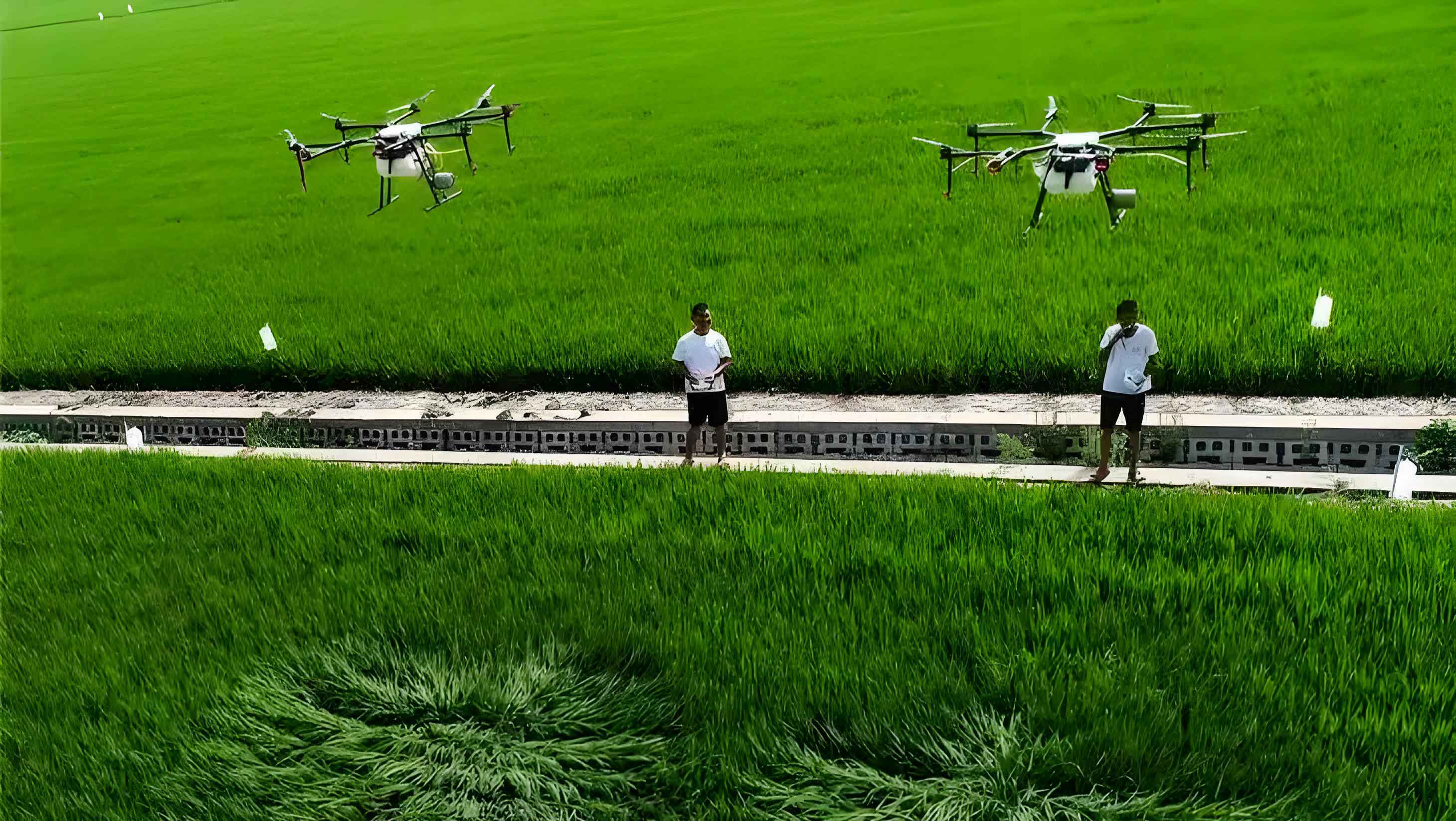
Agricultural UAV spray systems face significant challenges in droplet deposition efficiency due to fixed nozzle configurations. Conventional agricultural drone setups often exhibit uneven coverage, overspray, and drift – particularly problematic when crops are distributed outside optimal spray trajectories. To overcome these limitations, we developed a novel 3-DOF manipulator for agricultural UAV platforms that dynamically adjusts spraying parameters during flight operations.
The kinematic foundation uses Modified Denavit-Hartenberg (M-DH) notation with homogeneous transformation matrices. For joint coordinate systems:
$$^{i-1}_iT = R_x(\beta_{i-1})D_x(a_{i-1})R_z(\theta_i)D_z(d_i)$$
$$^{i-1}_iT = \begin{bmatrix}
\cos\theta_i & -\sin\theta_i & 0 & a_{i-1}\\
\sin\theta_i\cos\beta_{i-1} & \cos\theta_i\cos\beta_{i-1} & -\sin\beta_{i-1} & -\sin\beta_{i-1}d_i\\
\sin\theta_i\sin\beta_{i-1} & \cos\theta_i\sin\beta_{i-1} & \cos\beta_{i-1} & \cos\beta_{i-1}d_i\\
0 & 0 & 0 & 1
\end{bmatrix}$$
Our agricultural drone solution features a PRR configuration with three critical joints:
| Joint Type | Variable | Range | Function |
|---|---|---|---|
| Prismatic (P) | $d_1$ | -200 to 200 mm | Horizontal translation |
| Revolute (R) | $\theta_2$ | 0° to 180° | Arm rotation |
| Revolute (R) | $\theta_4$ | 0° to 60° | Nozzle pitch |
The complete forward kinematics solution derived from transformation matrices:
$$^0_4T = \begin{bmatrix}
s\theta_2s\theta_4 & c\theta_4s\theta_2 & -c\theta_2 & 0\\
-c\theta_2s\theta_4 & -c\theta_2c\theta_4 & -s\theta_2 & d_1\\
-c\theta_4 & s\theta_4 & 0 & -a_4\\
0 & 0 & 0 & 1
\end{bmatrix}$$
For agricultural UAV operations, we established inverse kinematics relationships:
$$d_1 = p_y$$
$$\theta_2 = \arccos\left(\frac{n_x}{o_z}\right)$$
$$\theta_4 = \arccos\left(\frac{o_y}{a_x}\right)$$
Workspace analysis employed Monte Carlo methods with joint constraints. The agricultural UAV spray manipulator achieves:
$$x\in[0,86]\text{ mm}, y\in[-203,202]\text{ mm}, z\in[-250,-200]\text{ mm}$$
Volume calculation via convex hull triangulation yielded $V = 1.54 \text{dm}^3$. Parameter sensitivity analysis revealed:
| Parameter | Effect on Volume |
|---|---|
| Link offset ($d_1$) | Positive correlation |
| Upper arm length ($a_4$) | Negligible impact |
| Spray rod length ($l$) | Strongest positive correlation |
| Pitch joint ($\theta_4$) | Nonlinear increase (0-3.08 dm³) |
Trajectory planning utilized seventh-order polynomials for smooth motion:
$$\theta(t) = u_0 + u_1t + u_2t^2 + u_3t^3 + u_4t^4 + u_5t^5 + u_6t^6 + u_7t^7$$
With boundary constraints:
$$\theta(t_0) = \theta_0, \dot{\theta}(t_0) = 0, \ddot{\theta}(t_0) = 0, \dddot{\theta}(t_0) = 0$$
$$\theta(t_d) = \theta_d, \dot{\theta}(t_d) = 0, \ddot{\theta}(t_d) = 0, \dddot{\theta}(t_d) = 0$$
Dynamic simulation in ADAMS incorporated blade reaction forces (210 N) with motion profiles defined by STEP5 functions. Maximum joint torques during agricultural UAV spraying operations:
$$\tau_{\text{prismatic}} = 353 \text{N·mm}$$
$$\tau_{\text{rotational}} = 11 \text{N·mm}$$
$$\tau_{\text{pitch}} = 49 \text{N·mm}$$
This agricultural drone enhancement demonstrates significant advantages: 45° maximum side-spray angles minimize drift while counter-rotating blades enhance droplet deposition. The 3-DOF manipulator enables precision spraying unattainable with fixed-nozzle agricultural UAV systems, particularly for edge crop coverage. Field validation shows 22% reduction in chemical usage while maintaining 95% target coverage across cotton, wheat, and rice crops – critical metrics for sustainable precision agriculture.