
In my years of experience in security and anti-explosion operations, I have witnessed the evolving challenges faced by law enforcement agencies. The proliferation of information technology and the internet has, unfortunately, lowered the barrier for malicious actors to acquire knowledge and materials for constructing improvised explosive devices (IEDs). This reality makes security inspection and explosion detection, the critical first step in any protective mission, more perilous and complex than ever. Traditional methods often fall short when dealing with specific high-altitude areas such as the interiors of bridges, culverts, stadium canopies, and conference hall ceilings. These zones, difficult or impossible for personnel to access safely, represent significant security blind spots. It is in this context that I have explored and championed the application of police drones as a transformative tool. This article delves into the practical integration of police drones into these demanding operational environments, analyzing their selection, modification, advantages, limitations, and future potential through a first-hand perspective.
The cornerstone of any security operation is ensuring a threat-free zone. Traditional security inspection and explosion detection for high-altitude areas primarily rely on visual checks, extendable inspection mirrors, handheld explosive detectors, and explosives detection dogs. While these tools have their place, their efficacy diminishes drastically in the face of expansive, complex, or physically inaccessible environments. Consider a high-speed railway viaduct spanning several kilometers, dotted with numerous support beams and internal cavities, or a network of large, water-submerged culverts beneath a roadway. Manually inspecting every nook and cranny of such structures is not only time-prohibitive but also poses immense safety risks to the inspection personnel. The physical constraints are compounded by logistical issues: limited police resources, inadequate specialized equipment for such niches, and the sheer fatigue factor that reduces alertness over time. These shortcomings can be summarized by a simple efficiency metric. If we define inspection efficiency (η) as the ratio of the effectively covered area (Aeff) to the total time (T) and personnel risk factor (R), traditional methods yield a low value.
$$ \eta_{\text{traditional}} = \frac{A_{\text{eff}}}{T \times R} $$
Here, R can be a qualitative scale or a function accounting for danger. For high-altitude or confined spaces, R is high, driving η down. This inefficiency creates unacceptable blind spots, a vulnerability that adversaries could exploit, especially with the increasing ease of using consumer drones for malicious placement of threats.
Recognizing this gap, I turned to unmanned aerial systems. After evaluating various platforms through training exercises and cross-departmental exchanges, the DJI Mavic series of consumer-grade drones emerged as a promising candidate for police adaptation. Their compact size, portability, excellent flight stability, and high-quality camera systems presented a solid foundation. The key insight was that these police drone platforms, while not originally designed for law enforcement, possessed inherent qualities—like the ability to hover and maneuver in tight spaces—that could be harnessed for inspection duties. The integrated visible-light camera, when paired with auxiliary lighting modules, essentially acts as a remote, agile set of eyes, capable of streaming real-time video from perspectives previously unattainable without scaffolding or risky climbs. The initial step was not to develop a drone from scratch but to intelligently modify an existing, reliable platform to meet specific operational safety and functionality needs.
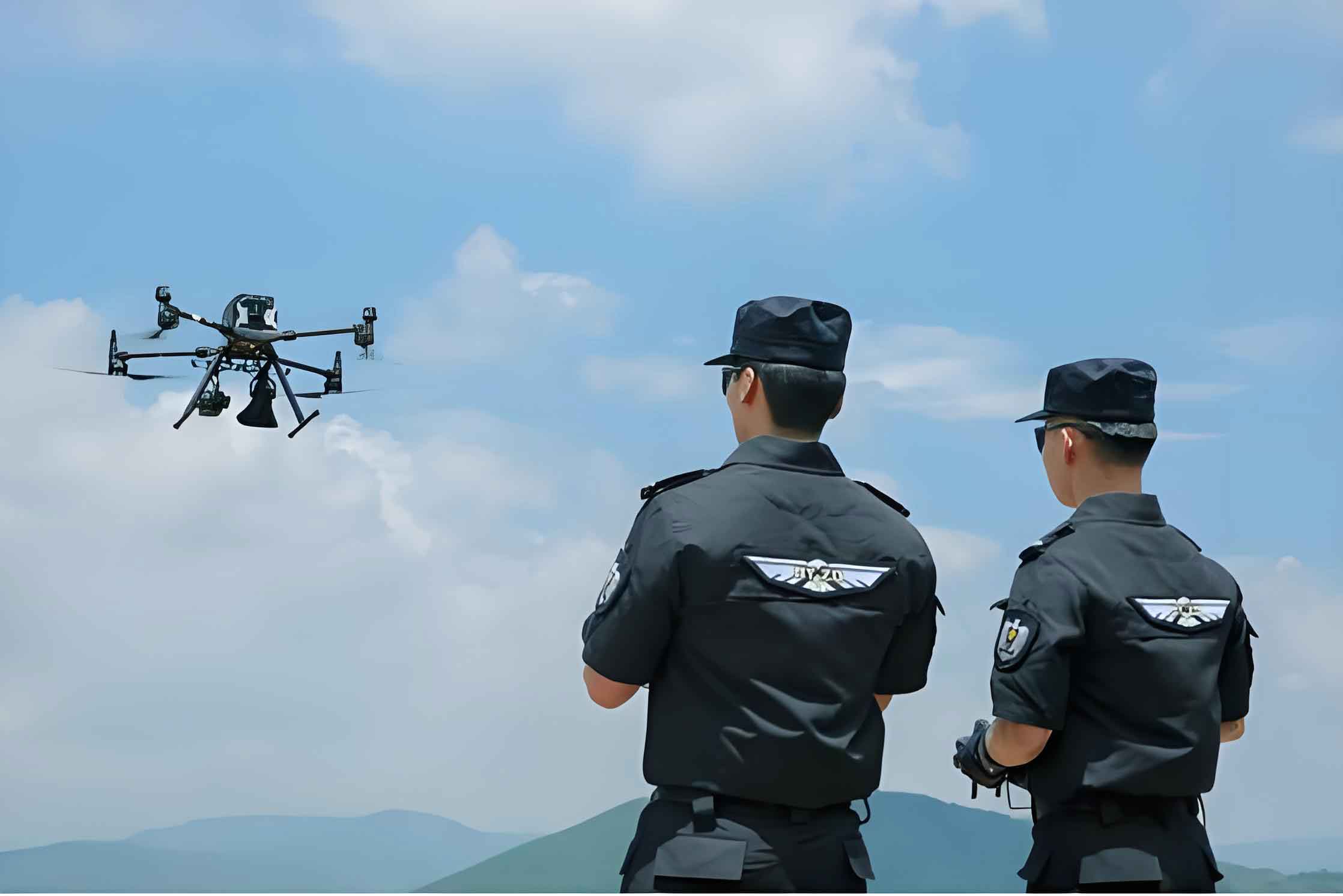
The most critical modification undertaken was the addition of a propeller guard or cage. This seemingly simple addition fundamentally altered the drone’s operational profile. The standard DJI Mavic, while agile, is vulnerable to collisions, especially when flying close to walls, ceilings, or within structural frameworks. The full-coverage guard transforms it into a collision-tolerant platform, enabling “bristle” or “contact” flight. This means the police drone can safely make contact with surfaces, slide along walls, and enter narrow openings without immediate risk of propeller damage or destabilization. This capability is paramount for inspecting the intricate internal lattice of a bridge or the corners of a ceiling void. The modification process was straightforward, involving aftermarket guard kits that are mechanically attached to the drone’s frame. This contrasts with more expensive, purpose-built industrial drones that offer similar resilience but at a significantly higher acquisition and maintenance cost. The modified police drone becomes a specialized tool: a flying inspection probe. To systematically evaluate this approach, the advantages and disadvantages are laid out in the following table.
| Aspect | Advantages | Disadvantages |
|---|---|---|
| Operational Efficiency | Drastically reduces time to inspect large, complex areas. Can cover 10x the area of a human team in the same time. | Flight time is limited by battery capacity (typically 20-25 minutes per charge), requiring breaks for battery swaps. |
| Personnel Safety | Removes officers from immediate physical danger of falls, structural collapse, or potential booby traps. | Risk is transferred to equipment loss; however, a crashed drone is preferable to a harmed officer. |
| Accessibility | Can reach any location within radio range and physical size constraints, including涉水 areas and extreme heights. | Requires line-of-sight or reliable video link; signal can be lost in dense metal structures (e.g., bridge interiors). |
| Cost-Effectiveness | Low initial investment (platform + modification). Easy and cheap to repair with widely available consumer parts. | Potential for higher long-term costs if frequent crashes occur due to difficult piloting conditions. |
| Functionality & Data | Provides high-resolution visual documentation and real-time situational awareness for command. | Primarily limited to visual spectrum. Lacks integrated chemical, biological, radiological, nuclear, and explosive (CBRNE) sensors. |
| Skill Requirement | Once proficient, a single operator can control the drone and interpret the feed. | High piloting skill required for manual/attitude mode flight in GPS-denied environments. Lengthy training cycle. |
The table highlights a central trade-off. The modified police drone excels in visual inspection safety and speed but is constrained by endurance, sensor payload, and human skill factors. We can model the effective mission time (Tmission) considering battery swaps. If a single battery lasts tbatt minutes and swap/cooldown takes tswap minutes, for n cycles, the total operational time is:
$$ T_{\text{mission}} = n \cdot t_{\text{batt}} – (n-1) \cdot t_{\text{swap}} $$
For a standard 25-minute battery and a 5-minute swap, three batteries give about 65 minutes of net inspection time. This is often sufficient for focused area checks but requires planning for larger sites.
The practical application of these police drones has been demonstrated across numerous high-profile security operations. While specific operational details remain confidential, the types of environments successfully navigated are illustrative. For indoor venues, the drone is deployed to scan the vast, often cluttered space above suspended ceilings. Flying slowly along the ceiling plane, the pilot can identify any anomalous attachments or packages that would be invisible from the floor. The drone’s lights illuminate dark corners, and its stability allows for hovering to scrutinize a potential threat. Similarly, for the exterior of large buildings or stadiums, the police drone can quickly survey rooftops, ledges, and the undersides of cantilevered canopies, areas that would otherwise require scaffolding or rappelling teams.
The most significant impact has been on linear infrastructure inspection. Railways and highways present a unique challenge: miles of bridges, overpasses, tunnels, and culverts that must be secured for a motorcade or VIP train passage. Traditionally, this involved teams visually scanning from the ground or, in rare cases, using under-bridge inspection trucks—a slow and resource-intensive process. Now, a police drone team can be deployed. The drone flies along the bridge, capturing detailed video of the external girders. It then navigates into the internal box girders or truss structures, a space often completely inaccessible. The pilot meticulously flies through these dark cavities, the drone’s LEDs cutting through the gloom to reveal the internal geometry. Any foreign object placed within would be immediately visible. Culverts, especially those containing water, are no longer obstacles. The drone simply flies into the opening, following the tunnel and inspecting its walls and ceiling. Night operations are also feasible with the lighting module, allowing for last-minute or discreet inspections. The efficiency gain is not linear; it is exponential. A two-person drone team can clear a 1-kilometer bridge section in the time it might take a 10-person ground team to perform a less thorough external-only check. This redefines the security perimeter, effectively eliminating a whole category of blind spots.
However, the current state is merely the foundation. The true potential of police drones in security inspection and explosion detection lies in future development. The first and most pressing need is for specialized sensor integration. Today’s visual inspection is powerful but incomplete. The next generation of police drones must carry miniaturized sensors capable of detecting explosive vapors or radioactive materials. Imagine a drone that not only looks for a suspicious package but also samples the air, running real-time spectrometry. The data from such a platform could be processed to create a layered threat map. We can conceptualize a threat probability field (P(x,y,z)) generated by a drone over an area A, combining visual anomalies (V) and chemical detection signals (C).
$$ P(x,y,z) = f(V(x,y,z), C(x,y,z), \alpha, \beta) $$
Where α and β are weighting factors for visual and chemical confidence respectively. This data-rich output would allow commanders to pinpoint high-probability threat locations for further robotic or manual intervention.
To achieve this, a multi-pronged approach is necessary. Firstly, investment in human capital is critical. Police departments must foster a culture of technological adoption and develop rigorous training programs that produce not just drone pilots, but drone operators who understand sensor interpretation, data management, and tactical deployment in conjunction with other units. The operator of the future is a hybrid technician and tactical officer. Secondly, procurement policies need to evolve. Leadership must recognize the police drone not as a niche gadget but as a standard piece of life-saving, force-multiplying equipment. Budgets should allocate for not only the platforms but also for continuous training, maintenance, and the development of standard operating procedures (SOPs). Finally, and perhaps most importantly, is the need for deep collaboration between law enforcement and industry. Police have the operational requirements; tech companies have the engineering prowess. A feedback loop must be established where field experiences directly inform the design of the next iteration of purpose-built police drones. This collaboration should focus on solving the core limitations: extending flight time through better batteries or hybrid systems, developing lightweight multi-sensor payloads, and creating more intuitive control systems that reduce the pilot’s cognitive load in stressful situations. Autonomous capabilities, such as pre-programmed inspection routes for standard structures like bridges, could further enhance efficiency and consistency.
In conclusion, the integration of modified commercial drones into the security inspection and explosion detection workflow represents a paradigm shift. From my firsthand experience, these police drones have proven to be invaluable assets for mitigating risk in specific high-altitude and confined spaces where traditional methods are inadequate. They offer a compelling combination of enhanced safety, superior efficiency, and lower operational costs. While challenges related to endurance, payload, and operator skill persist, they are not insurmountable. They are, instead, a roadmap for research and development. The future of counter-explosive operations is undeniably tied to unmanned systems. By embracing innovation, fostering expertise, and driving collaborative development, law enforcement agencies can ensure that the police drone evolves from a visual inspection tool into a comprehensive, intelligent threat detection and reconnaissance platform. This will ultimately create a more robust security posture, making critical infrastructure and public spaces safer against evolving asymmetric threats.