
The pursuit of “New Quality Combat Capability” represents a fundamental strategic shift in modern public security operations. This concept transcends mere numerical superiority in personnel or conventional equipment. It embodies a qualitative leap characterized by high technology, elevated efficiency, and profound integration, fostering innovation, interoperability, and sustainability. In this transformative landscape, police drones have emerged not merely as tools, but as pivotal force multipliers and intelligent nodes within an increasingly networked and data-driven policing ecosystem. My analysis, drawing upon extensive operational observation and systems thinking, posits that the full realization of police drone potential is contingent upon moving beyond fragmented, tool-centric deployment towards a holistic framework encompassing standardized management, strategic talent development, and deep systemic integration.
The evolution from isolated gadget to integral system component is the critical path. A police drone is fundamentally a mobile, intelligent sensor and action platform. Its value is not intrinsic but derived from the data it captures, the speed of its deployment, and its seamless connection to command and decision-making structures. The core challenge lies in transitioning from viewing these assets as standalone units to treating them as essential elements of the “Professional Mechanisms + Big Data” operational model. This model aims to synthesize specialized skills, agile processes, and vast information streams into a cohesive, responsive whole. Within this framework, police drones act as the aerial capillaries of the sensory network, feeding real-time, high-fidelity data into the analytical heart of the organization, thereby enabling precise, intelligence-led policing.
The operational applications of police drones are vast and demonstrably effective, directly contributing to the attributes of New Quality Combat Capability. Their roles can be systematically categorized, as shown in the table below, highlighting how different functions translate into enhanced operational quality.
| Operational Domain | Specific Applications | Contribution to New Quality Combat Capability |
|---|---|---|
| Traffic Management & Command | Real-time traffic flow monitoring, incident detection (accidents, congestion), VIP route surveillance, large-scale event traffic control, assessment of complex interchange geometries. | High Efficiency: Enables rapid situation assessment over wide areas, replacing multiple ground units. Sustainability: Persistent monitoring without officer fatigue. |
| Emergency Response & Investigation | Rapid aerial assessment of accident scenes, 3D mapping and modeling for forensic reconstruction, search and rescue operations in difficult terrain, hazardous material incident monitoring. | High Technology: Employs photogrammetry and RTK positioning for centimeter-accurate models. High Quality: Provides comprehensive, court-admissible scene documentation. |
| Public Order & Patrol | Crowd monitoring during public gatherings, surveillance over large, open areas (parks, borders), perimeter security for critical infrastructure, tracking of suspicious subjects or vehicles. | Innovation: Offers a dynamic, elevated vantage point unavailable to ground forces. Interoperability: Live feeds integrate directly into command center dashboards. |
| Specialized Law Enforcement | Monitoring of illegal activities (e.g., forbidden fishing, unlicensed mining), environmental protection patrols, anti-smuggling surveillance. | Sustainability & Safety: Covers vast and often inaccessible areas, reducing risk to officers. |
The efficacy of a police drone in these roles can be conceptualized by a simple value model, where its output is a function of its technical capabilities and its integration level:
$$ V_{drone} = f(T, I) = \alpha \cdot \sum_{i=1}^{n} (C_i \cdot w_i) + \beta \cdot \log(1 + L_{int}) $$
Where:
– $V_{drone}$ represents the operational value generated.
– $T$ is the technical capability factor, summed over $n$ components $C_i$ (e.g., flight time, camera resolution, payload capacity) each weighted by $w_i$.
– $I$ is the integration factor, which scales logarithmically with the level of systemic integration, $L_{int}$.
– $\alpha$ and $\beta$ are coefficients denoting the relative importance of technology versus integration in the specific operational context.
This formula illustrates a critical insight: while advanced hardware ($T$) is important, its value multiplies significantly through deep integration ($I$). A top-tier police drone operating in a silo provides limited value compared to a standard model fully networked into the command-and-control infrastructure.
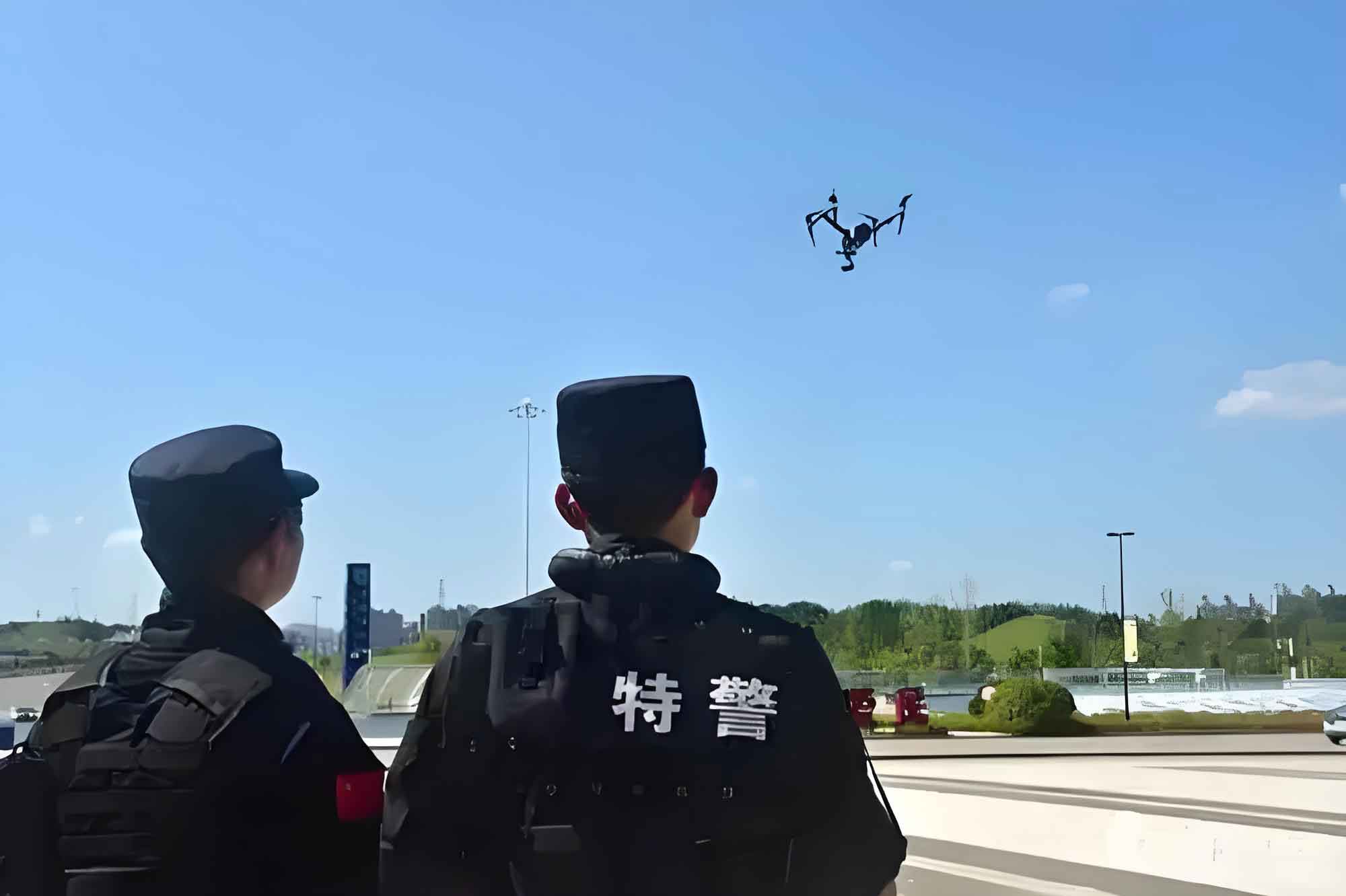
The visual representation of police drones in action underscores their physical presence and utility. However, the journey from this image to a mature capability reveals significant institutional and procedural bottlenecks. From my perspective, the primary impediments are not technological but organizational, falling into three interrelated categories.
First, a prevalent focus on form over substance and training. Many agencies procure advanced police drone platforms as prestige symbols or box-ticking exercises, without a corresponding investment in the human and systemic capital required to wield them effectively. There is often a lack of a long-term strategic roadmap for Unmanned Aircraft Systems (UAS) development. Management is typically decentralized, with various departments purchasing and operating their own equipment without central oversight. This leads to an opaque inventory, unclear accountability, and uneven technical standards. Crucially, the operator cadre is underdeveloped. Most “pilots” are part-time, lack formal certification from authoritative bodies like the national police aviation office, and operate with limited practical experience. Training is often ad hoc, reactionary, and fails to build a sustainable talent pipeline. This creates significant safety risks and severely limits the tactical proficiency and innovative application of the police drone fleet.
Second, a tendency towards isolated single-platform use over network interconnection. The dominant paradigm treats the police drone as a standalone “eye in the sky,” rather than a dynamic data node within a broader intelligence-led policing (ILP) architecture. The real-time video or sensor data from the drone often remains trapped on the operator’s controller, failing to feed seamlessly into the integrated command platform where it can be correlated with other data streams—from fixed CCTV, automatic license plate recognition (ALPR), criminal databases, and social media monitoring. This failure to interconnect prevents the realization of a key tenet of New Quality Combat Capability: the fusion of multi-source intelligence for predictive policing and real-time, coordinated response. The police drone’s unique mobility and perspective are thus underutilized, as its data does not contribute to the synthetic operational picture essential for modern command and control.
Third, an emphasis on immediate tactical employment over long-term strategic management. The pressure to demonstrate quick utility often sidelines the establishment of robust lifecycle management protocols. Comprehensive policies governing daily use, maintenance schedules, data handling, flight logging, airspace coordination, and accident reporting are frequently absent or rudimentary. Without these frameworks, the longevity, reliability, and legal compliance of the police drone program are jeopardized. Equipment degrades faster without proper care, and operational liabilities increase. This short-termism contradicts the “sustainability” pillar of New Quality Combat Capability, which requires systems that are not only effective today but also maintainable, scalable, and accountable for the future.
To overcome these bottlenecks and truly harness police drones for New Quality Combat Capability, a tripartite strategy focused on institutional design, human capital, and technological fusion is imperative.
I. Optimizing Top-Level Design and Standardization
The foundational step is the establishment of clear, centralized governance. Police drone operations must transition from a decentralized, ad-hoc model to a professionally managed function. This begins with the formal designation of a lead department—be it under a newly created Aviation Office, the Logistics/Equipment division, or the Command Center—with the unambiguous mandate for oversight. This central authority is responsible for the core institutional frameworks, as detailed below:
| Management Pillar | Key Responsibilities | Outcome for New Quality Combat Capability |
|---|---|---|
| Regulatory & Standardization Framework | Developing and enforcing UAS policies, airspace application procedures, maintenance standards, data security protocols, and operational manuals. Implementing a unified registration and licensing system for all agency drones and pilots. | High Quality & Sustainability: Ensures safe, legal, and consistent operations, building a reliable and accountable system. |
| Strategic Procurement & Fleet Management | Conducting needs assessments, standardizing equipment specifications across units, managing centralized procurement for economies of scale, and maintaining a holistic view of the agency’s aerial assets. | High Efficiency: Eliminates redundancy, optimizes budgets, and ensures interoperability of equipment across departments. |
| Tactical Development & Evaluation | Researching and promulgating standardized tactics, techniques, and procedures (TTPs). Organizing regular cross-departmental exercises and capability evaluations to foster best-practice sharing. | Innovation & Interoperability: Drives continuous tactical improvement and ensures different units can operate together seamlessly. |
The organizational fusion degree $O_f$ can be modeled as a function of centralization and standardization:
$$ O_f = 1 – \frac{E_{decentralized}}{E_{optimal}} $$
Where $E_{decentralized}$ is the entropy (or disorder) in the decentralized system (e.g., varying standards, poor communication), and $E_{optimal}$ is the minimum possible entropy under a perfect centralized system. The goal of top-level design is to minimize $E_{decentralized}$, thus maximizing $O_f$ towards 1.
II. Building Strategic Human Capital and Institutional Capacity
Technology is meaningless without skilled human operators. A professional, career-oriented development path for police drone personnel is non-negotiable. This extends beyond basic flight training to encompass a comprehensive competency ecosystem.
Talent Acquisition and Development: Agencies must actively identify and nurture talent, creating a dedicated career track for UAS operators, technicians, and tactical coordinators. Training must be systematic, continuous, and certified. Partnerships with accredited flight schools, universities, and technology providers are essential. The curriculum should include not only piloting skills but also air law, meteorology, mission planning, data analysis, basic maintenance, and legal evidentiary standards. A “train-the-trainer” model should be employed to develop an in-house cadre of instructors, ensuring sustainability.
Tactical Proficiency and Innovation: Regular, scenario-based training is crucial. This should simulate high-stress, complex environments such as night operations, adverse weather, congested urban canyons, and coordinated multi-drone missions. Furthermore, dedicated “tactics development cells” should be encouraged to experiment with new applications, such as using drones for covert surveillance, loudspeaker announcements in crowd control, or delivering critical supplies in emergencies. The lessons from these exercises must be formally captured and disseminated.
The growth of operational capability $C_{op}$ over time $t$ can be expressed as a learning curve, dependent on investment in training $I_t$ and practical experience $E$:
$$ C_{op}(t) = C_0 + \gamma \int_0^t I_t(\tau) \, d\tau + \delta \cdot \ln(1 + E(t)) $$
Here, $C_0$ is the initial capability, $\gamma$ is the training efficiency coefficient, and $\delta$ is the experience gain coefficient. This highlights that both formal investment ($I_t$) and accumulated practical missions ($E$) are vital for growth.
III. Driving Deep Operational and Technological Fusion
This is the ultimate frontier for unlocking New Quality Combat Capability. The police drone must cease to be an endpoint and become a seamless component of the digital policing infrastructure.
Technical Integration into the “Police Brain”: The primary task is to develop or adopt secure, low-latency data links and Application Programming Interfaces (APIs) that allow live drone feeds—both video and telemetry—to be ingested directly into the central command and control platform, the Computer-Aided Dispatch (CAD) system, and geographic information systems (GIS). This enables the real-time fusion of aerial data with ground-based sensor networks. For instance, a drone identifying a suspicious vehicle can automatically trigger a query in the ALPR database, with results overlaid on the operator’s screen. This creates a true “common operational picture.”
Leveraging Cutting-Edge Technologies: The payload is key. Beyond standard cameras, integration of specialized modules multiplies utility:
– Multispectral/Thermal Sensors: For search and rescue, fugitive tracking at night, or detecting illegal crops.
– Automated Object Recognition: AI-driven software can analyze live video to automatically flag anomalies (e.g., unattended bags, unusual crowd gathering, specific vehicle types).
– 5G Connectivity: Enables ultra-high-definition video streaming, real-time edge computing, and control over much greater distances with minimal latency.
– LIDAR Payloads: For rapid, highly accurate 3D mapping of disaster zones or major crime scenes.
Inter-Agency and Cross-Sectoral Collaboration: Police drone units should not operate in a vacuum. Formal cooperation protocols should be established with other government entities that use drones, such as fire departments, emergency medical services, environmental protection agencies, and infrastructure inspectors. Shared resources, coordinated airspace deconfliction, and joint training for large-scale disaster response (e.g., earthquakes, floods) dramatically enhance overall societal resilience and operational efficiency. The police drone unit can act as a force multiplier for the entire government response apparatus.
The level of systemic fusion $F_{sys}$ can be conceptualized as a multi-layered construct:
$$ F_{sys} = \frac{1}{3} \left( \frac{D_{in}}{D_{total}} + \frac{A_{shared}}{A_{total}} + \frac{P_{joint}}{P_{total}} \right) $$
Where:
– $D_{in}/D_{total}$ is the ratio of drone data streams integrated into central platforms versus total streams generated.
– $A_{shared}/A_{total}$ is the ratio of joint airspace/operations protocols established with partner agencies versus potential partners.
– $P_{joint}/P_{total}$ is the ratio of joint training exercises or operations conducted versus total training events.
A value of $F_{sys} = 1$ represents perfect, seamless fusion across data, operations, and training domains.
In conclusion, the journey of the police drone from a novel gadget to a cornerstone of New Quality Combat Capability is a microcosm of the broader transformation required in public security. It demands a shift from purchasing products to cultivating systems; from training individuals to building professions; and from executing isolated missions to enabling networked intelligence. The ultimate formula for success synthesizes these elements:
$$ \text{New Quality Combat Capability}_{\text{(UAS)}} = \text{Standardized Governance} \times \text{Professional Talent} \times \text{Deep Technical Fusion} $$
This is a multiplicative, not additive, relationship. Failure in any one factor critically diminishes the whole. By meticulously designing robust institutions, investing relentlessly in human capital, and pursuing deep technological interoperability, police agencies can ensure their drone programs truly become intelligent, persistent, and unifying forces—transforming aerial surveillance into aerial insight and action, and fundamentally elevating the quality, efficiency, and reach of public security in the 21st century.