
As a crucial component of modern policing technology, the police drone has fundamentally transformed law enforcement operations, offering unprecedented capabilities in surveillance, search, and tactical support. Public security institutes, as the primary incubators for future law enforcement officers, bear the critical responsibility of cultivating highly skilled professionals proficient in police drone operations and applications. This article aims to explore and construct a systematic, practical, and innovative talent cultivation model for police drone specialists within public security higher education, addressing current shortcomings and aligning with the strategic national goal of “Scientifically Advancing Police Work.”
I. Analysis of the Current State of Police Drone Talent Cultivation
The rapid adoption of police drones across various law enforcement scenarios has created a significant demand for qualified operators and analysts. However, the existing cultivation system within public security institutes faces substantial challenges that hinder the production of graduates ready for immediate, effective deployment.
A. Comparative Analysis of Domestic and International Cultivation Models
Globally, advanced models for police drone training, such as those in the United States, emphasize a deep integration of theory and practice. Their training systems extend beyond basic piloting skills to encompass comprehensive modules on legal frameworks for aerial law enforcement, tactical command and coordination, intelligence gathering, and real-time data analysis. This holistic approach produces operators who are not merely pilots but integrated law enforcement assets. In contrast, the domestic model within Chinese public security institutes is often characterized by a significant theory-practice imbalance. The curriculum tends to be confined within traditional academic frameworks, with practical training limited by inadequate facilities, restricted airspace, and a scarcity of advanced equipment. This gap results in graduates who possess theoretical knowledge but lack the practical acumen and situational judgment required in dynamic policing environments.
| Aspect | Advanced International Model (e.g., U.S.) | Current Domestic Model (Typical) |
|---|---|---|
| Curriculum Focus | Integrated theory, advanced piloting, legal applications, tactical coordination, data fusion. | Heavy on generic UAV theory and basic flight operations; limited警务-specific application. |
| Training Equipment | Diverse fleet (multi-rotor, fixed-wing, VTOL, tethered) with advanced payloads (thermal, multispectral, LiDAR). | Often limited to basic multi-rotor training drones; scarce access to specialized police drone systems. |
| Practical Training Scenario | High-fidelity, scenario-based training in complex, simulated law enforcement environments (urban, night, adverse weather). | Basic flight skill drills;缺乏 realistic, multi-dimensional scenario simulation integrated with other police tactics. |
| Outcome | Operators capable of independent mission planning, execution, and data exploitation in support of policing objectives. | Graduates with certificate-level piloting skills but needing extensive on-the-job training for actual police drone deployment. |
B. Deficiencies in the Current Cultivation Model
The primary shortcomings can be summarized in several key areas:
1. Fragmented Curriculum Integration: Most institutes lack a dedicated “Police Drone” major. Instead, related courses are grafted onto existing specialties like Criminal Investigation or Public Order Management. Courses such as “Introduction to UAVs” or “Basics of Police Drone Operations” are often too generic, focusing on universal flight principles rather than the specific tactical, legal, and analytical demands of police work. There is a notable absence of courses on tactical team coordination, post-mission data analysis, or emergency communications for drone units, leading to a disjointed knowledge structure.
2. Inadequate Practical Training Infrastructure: Hands-on training is severely constrained. Equipment is often limited in both variety (primarily small multi-rotors) and quantity, resulting in minimal actual stick time per student. Training grounds are inadequate for simulating complex, real-world scenarios like high-risk vehicle pursuits, search and rescue in difficult terrain, or large-scale event monitoring. The logistical and financial burden of maintaining and repairing equipment further destabilizes the training pipeline.
3. Disconnect from Operational Realities: The training seldom mirrors the high-pressure, multifaceted nature of actual police operations. Students are taught to fly but not necessarily to apply the police drone as an intelligent node within a broader law enforcement ecosystem. This creates a competency gap where technical skill does not translate into effective operational utility.
II. Demand Analysis and Foundational Principles for Police Drone Cultivation
To bridge the existing gaps, the cultivation model must be fundamentally reoriented around the core demands of modern policing. The following principles should serve as the foundation for this new model.
| Principle | Core Concept | Operational Implication for Curriculum |
|---|---|---|
| Demand-Oriented | Training must be directly derived from and responsive to actual police operational needs. | Curriculum modules built around specific scenarios: traffic accident reconstruction, suspect tracking, crowd monitoring at large events, night-time surveillance, search and rescue. |
| Systematic | Cultivation must provide a complete, interlinked knowledge and skill architecture. | Structured progression from basic theory → core operation → tactical application → data analysis → maintenance, ensuring all competencies are covered. |
| Practical | Emphasis on hands-on, scenario-based learning that replicates real-world conditions. | Majority of training hours devoted to practical exercises in simulated high-stress, complex environments with variable weather and lighting. |
| Innovative | Cultivation must be agile and forward-looking, adapting to rapid technological evolution. | Dynamic course content update mechanism; incorporation of AI-driven analytics, swarm technology concepts, and counter-drone tactics; fostering creative problem-solving. |
The competency of a police drone operator in a complex environment can be conceptualized as a function of multiple variables, including technical proficiency (P), situational awareness (A), and decision-making speed (D). A simple model for assessing operational readiness (R) could be:
$$R = \alpha \cdot P + \beta \cdot A + \gamma \cdot D$$
where \(\alpha\), \(\beta\), and \(\gamma\) are weighting coefficients specific to different mission types (e.g., \(\alpha\) might be higher for precise mapping tasks, while \(\beta\) and \(\gamma\) are critical for dynamic tracking). The cultivation model must aim to maximize \(R\) across all relevant mission profiles.
Furthermore, the probability of mission success \(P_{success}\) can be related to training effectiveness. If \(N_{total}\) represents the number of critical decision points in a simulated mission and \(N_{effective}\) represents the number handled correctly by the trainee, then training efficacy \(E\) for that scenario is:
$$E = \frac{N_{effective}}{N_{total}} \times 100\%$$
A cultivation system must systematically design scenarios to improve \(E\) across a wide range of \(N_{total}\).
III. Constructing the Police Drone Talent Cultivation Model
A. Defining the Cultivation Objective
The overarching goal is to produce graduates who are not just police drone pilots, but Police Drone Tactical Operators (PDTOs). A PDTO is defined by a triad of core competencies:
1. Technical Mastery: Proficiency in operating diverse police drone platforms and payloads (e.g., thermal, RTK, multispectral), coupled with skills in mission planning, data link management, and basic troubleshooting.
2. Tactical Integration: The ability to seamlessly integrate police drone operations into broader police tactics, understanding how aerial assets support ground units in scenarios like containment, search, or evidence collection.
3. Analytical & Legal Acumen: Competence in processing and interpreting collected data (imagery, video, geospatial) to produce actionable intelligence, alongside a firm grasp of aviation regulations, airspace law, and privacy considerations specific to law enforcement use of drones.
B. Curriculum Design and Structure
1. Theoretical Course Design: The theoretical foundation must be comprehensive yet focused. A modular approach is recommended, as summarized in the table below.
| Course Module | Core Content | Suggested Hour Allocation |
|---|---|---|
| Foundational Theory | Aerodynamics, flight control systems, UAV propulsion and energy, basic electronics and communication原理. | 30% |
| Legal & Regulatory Framework | Civil Aviation Regulations, National Airspace System, law enforcement exemptions, privacy laws, evidence handling procedures for aerial data. | 20% |
| Police Drone Technology & Operations | Sensor technology (visual, thermal, multispectral), data link systems, mission planning software, navigation (GNSS, RTK), basic data processing workflows. | 35% |
| Safety & Security Management | Flight risk assessment, emergency procedures, contingency planning, physical and cyber security of police drone systems, maintenance protocols. | 15% |
2. Practical Course Arrangement: Practical training should be structured in three escalating tiers of complexity:
Tier 1: Foundational Practice. Focus on core psychomotor skills: basic flight maneuvers (takeoff, landing, hovering, pattern flight), manual and automated mission execution, payload activation, and pre/post-flight checklists.
Tier 2: Specialized Application Practice. Scenario-based training focused on specific police applications:
- Traffic Management: Accident scene documentation, traffic flow analysis, highway chase support.
- Search & Rescue: Grid search patterns, thermal signature identification, coordination with ground teams.
- Public Order & Surveillance: Crowd monitoring, large-event security overwatch, suspect tracking in urban/rural settings.
- Forensic Investigation: Aerial photography of crime scenes, 3D mapping and modeling, search for evidence.
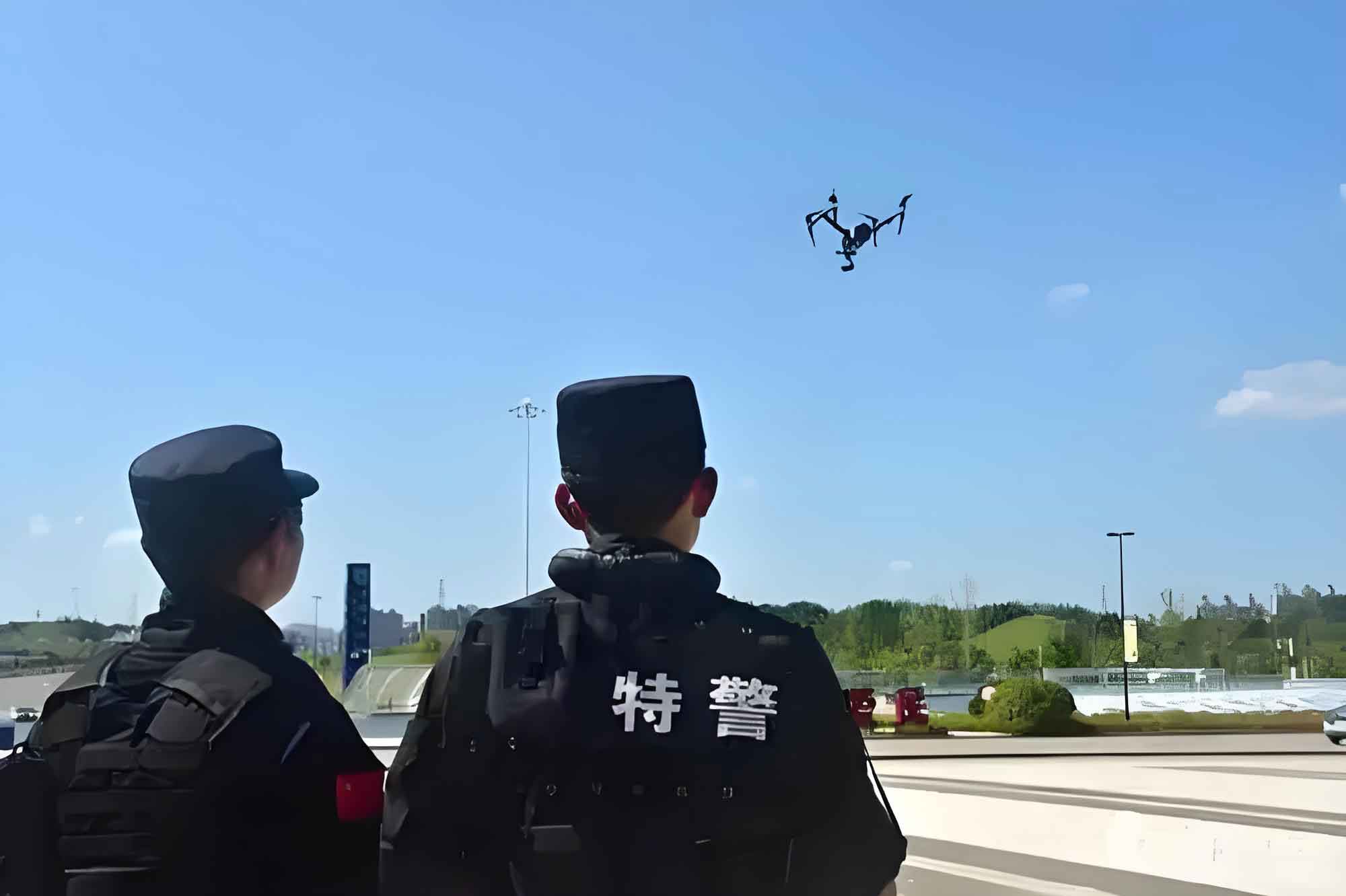
Tier 3: Comprehensive Integrated Practice. Large-scale, multi-unit exercises where the police drone team must operate as part of a full law enforcement response. This includes joint exercises with other police units, simulated high-risk warrant services, and complex disaster response drills, testing communication, command decisions, and real-time adaptation.
IV. Implementation Pathways for the Cultivation Model
A. Development of Integrated Training Bases
Establishing dedicated, well-resourced Police Drone Training Bases is paramount. These bases require:
| Component | Requirements |
|---|---|
| Hardware Infrastructure | A diverse fleet of training police drones (multi-rotor, fixed-wing, hybrid), equipped with operational payloads. Dedicated maintenance workshop with tools and spare parts. Mobile command vehicle/station. |
| Training Environment | Large, secured airspace. Varied terrain features (open fields, wooded areas, mock urban structures, water bodies). Capability for night operations and limited adverse weather training. |
| Software & Simulation | High-fidelity flight simulators with police drone models. Mission planning and simulation software. Data processing suites (e.g., Pix4D, DroneDeploy, specialized video analytics). |
| Management Structure | A permanent, professional base management team responsible for logistics, maintenance, airspace coordination, and safety oversight, freeing instructors to focus on teaching. |
B. Deepening Industry-Education Cooperation
A synergistic partnership with leading police drone manufacturers and service providers is essential. This cooperation can take multiple forms:
$$C_{effectiveness} = R_{tech} \times I_{curriculum} \times A_{personnel}$$
where \(C_{effectiveness}\) is the overall effectiveness of the cooperation, \(R_{tech}\) represents the relevance and timeliness of technology transferred, \(I_{curriculum}\) is the degree of industry input into curriculum design, and \(A_{personnel}\) is the level of access students have to industry experts. Maximizing each variable is key.
1. Joint Laboratory/Research Center: Companies provide the latest equipment and software for testing and training; institutes provide research on operational needs and human factors.
2. Curriculum Co-Design: Industry experts help develop and teach specialized modules on emerging technologies (e.g., drone swarms, AI-based automated detection, counter-UAV systems).
3. Internship & Capstone Projects: Students work on real-world problems posed by partner companies or police departments, developing practical solutions.
C. Project-Based Learning (PBL) Pedagogy
PBL places students in the role of problem-solvers for authentic, complex challenges. A sample project framework for a police drone course is:
| Project Phase | Student Tasks | Deliverables |
|---|---|---|
| 1. Briefing & Planning | Analyze a scenario (e.g., “Missing person in mountainous border region”). Conduct airspace and risk assessment. Plan flight paths, sensor use, and communication protocol. | Detailed Mission Plan, Risk Assessment Matrix. |
| 2. Execution | Deploy police drone in simulated environment. Execute plan, adapt to injected complications (e.g., sudden weather change, loss of GPS). Coordinate with simulated ground teams. | Raw sensor data (imagery, video, telemetry logs). |
| 3. Analysis & Reporting | Process collected data to find target or evidence. Geotag findings. Analyze operational effectiveness. | Analytical Report with annotated maps/images, After-Action Review highlighting lessons learned. |
D. Online Interactive Learning Platforms
A digital ecosystem complements physical training, offering scalability and accessibility.
1. Virtual Simulation & E-Learning: Hosting interactive 3D models of police drones, systems tutorials, and virtual flight simulators accessible from any location. This platform can host lecture videos, case studies, and interactive quizzes.
2. Performance Analytics: The platform can track student progress through modules and simulations, generating individualized learning analytics. For example, it can identify that a student consistently struggles with flight planning in windy conditions, prompting targeted remedial content.
3. Collaborative Workspace: Forums and project workspaces where students can collaborate on mission plans, discuss cases, and receive feedback from instructors remotely, fostering a community of practice.
The return on investment (ROI) for such a platform can be modeled by considering the reduction in physical resource cost per training hour (\(C_{physical}\)) and the increase in training throughput (\(T\)). If \(N\) is the number of students, a simplified relation is:
$$ ROI \propto \frac{N \cdot T}{C_{physical} + C_{platform}} $$
where \(C_{platform}\) is the amortized cost of the digital platform. A well-designed platform increases \(T\) significantly while moderating increases in \(C_{physical}\), leading to a favorable ROI over time.
V. Conclusion
The evolution of the police drone from a novel gadget to a core tactical asset necessitates a parallel evolution in how we cultivate the operators who wield it. The proposed cultivation model—built on the principles of demand-orientation, systematic design, practical emphasis, and innovation—provides a comprehensive framework. By implementing it through robust training bases, deep industry partnerships, project-based learning, and digital tools, public security institutes can transition from producing basic drone pilots to graduating fully capable Police Drone Tactical Operators. These professionals will be equipped to leverage the full potential of police drone technology, enhancing public safety and operational efficacy in an increasingly complex security landscape. The continuous optimization of this model is not just an educational imperative but a strategic necessity for modern, technology-enabled policing.