
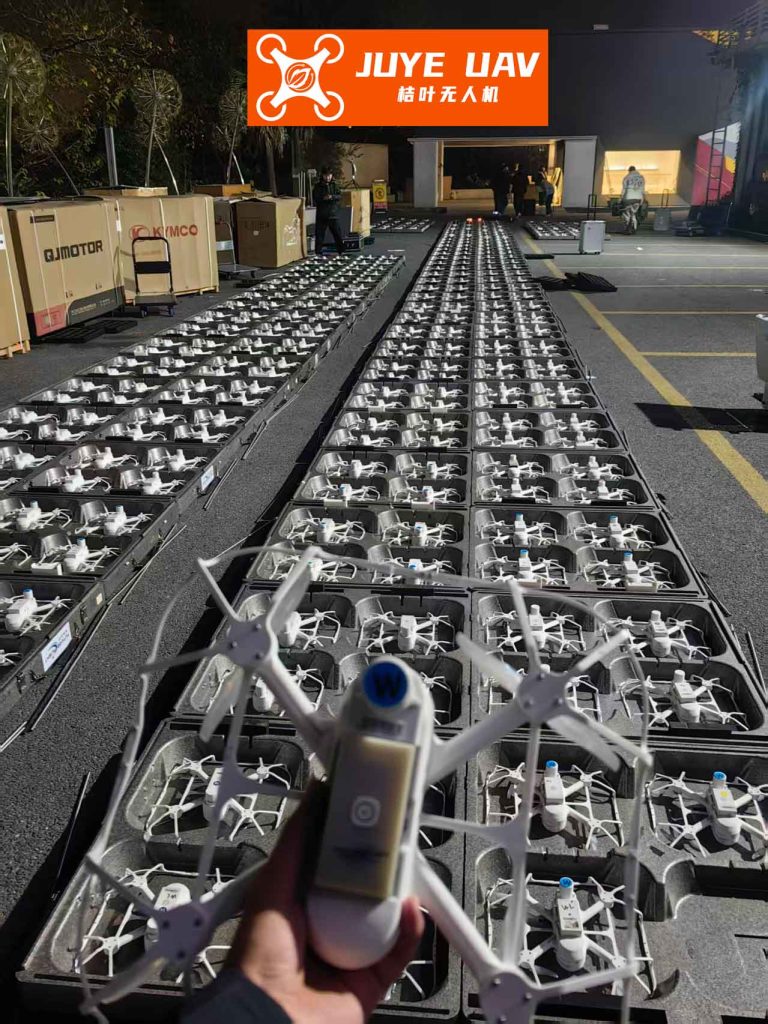
In the realm of modern entertainment and large-scale events, formation drone light shows have emerged as a captivating spectacle, where hundreds or even thousands of drones orchestrate intricate aerial patterns, creating stunning visual displays. However, behind the mesmerizing synchronization lies a complex challenge: managing the energy consumption of each drone during formation changes to ensure prolonged and reliable performances. As an educator in autonomous systems, I have developed a simulation-based teaching module to address this very issue, focusing on optimizing energy usage during dynamic reconfiguration in formation drone light shows. This article delves into the design and implementation of this pedagogical tool, which integrates theoretical models with practical algorithms to train students in solving real-world problems in swarm robotics.
The core problem in formation drone light shows is the unbalanced energy expenditure among drones during transitions between shapes. Traditional assignment methods, such as the Hungarian algorithm, minimize total travel distance but often allocate excessively long paths or high climbs to individual drones. This leads to disproportionate battery drain, causing some drones to deplete energy faster than others, ultimately shortening the entire show’s duration due to the “bucket effect.” To mitigate this, my teaching approach emphasizes energy-balanced task allocation and collision-free trajectory planning, using simulation environments to validate solutions. The simulation not only reinforces control theory concepts but also fosters innovative thinking by encouraging students to refine algorithms for efficiency and robustness.
In designing the simulation teaching system, I start by framing the problem as a multi-drone formation change scenario typical in formation drone light shows. Consider a fleet of n drones that must transition from an initial formation, say a “F” shape, to a target formation, like a “Z” shape, in three-dimensional space. Each drone is modeled as a point mass with coordinates in a global frame. The goal is to assign each drone to a target position in the new formation while minimizing overall energy consumption and ensuring balanced energy use across the fleet. This is crucial for formation drone light shows, where uniformity in performance time is essential for seamless displays.
The task allocation problem is formulated as a linear assignment problem. Let Ai represent the i-th drone and Bj denote the j-th target position. We define a binary decision matrix X = (xij), where xij = 1 if drone i is assigned to target j, and 0 otherwise. The cost coefficient cij captures the energy cost for drone i to reach target j, incorporating both Euclidean distance and climb penalties, as climbing consumes more power in formation drone light shows due to increased thrust. The cost is expressed as:
$$c_{ij} = \| \mathbf{p}_i^0 – \mathbf{p}_j \| + b \cdot e^{|p_{i,z}^0 – p_{j,z}|}$$
Here, **p**i0 is the initial position of drone i, **p**j is the position of target j, pi,z0 and pj,z are their heights, and b is a climb factor that amplifies the cost for ascent, reflecting real-world energy dynamics in formation drone light shows. The objective is to minimize total cost subject to assignment constraints:
$$\min \sum_{i=1}^n \sum_{j=1}^n c_{ij} x_{ij}$$
$$\text{subject to } \sum_{i=1}^n x_{ij} = 1, \quad \sum_{j=1}^n x_{ij} = 1, \quad x_{ij} \in \{0,1\}$$
This linear programming model is solved iteratively within an optimization framework to find the initial assignment. However, to address energy balance, I incorporate an improved Particle Swarm Optimization (PSO) algorithm that adjusts assignments based on fitness functions promoting equitable energy distribution. PSO is a metaheuristic inspired by swarm intelligence, where particles represent potential solutions—each being a specific assignment matrix—and evolve through social and cognitive learning. The velocity and position update equations for particle k are:
$$\mathbf{v}_i^{k+1} = w \mathbf{v}_i^k + c_1 r_1 (\mathbf{l}_{\text{best},i} – \mathbf{s}_i^k) + c_2 r_2 (\mathbf{g}_{\text{best}} – \mathbf{s}_i^k)$$
$$\mathbf{s}_i^{k+1} = \mathbf{s}_i^k + \mathbf{v}_i^{k+1}$$
where w is inertia, c1 and c2 are learning factors, r1 and r2 are random numbers, **l**best,i is the particle’s best position, and **g**best is the global best. For formation drone light shows, the fitness function f(X) combines average travel distance and the range of distances to balance energy:
$$f(X) = \alpha_1 \cdot \frac{\sum_{i=1}^n \sum_{j=1}^n \text{dis}_{ij} x_{ij}}{n} + \alpha_2 \cdot (\text{dis}_{\text{max}} – \text{dis}_{\text{min}})$$
with α1 + α2 = 1, disij = ||**p**i0 – **p**j||, and dismax and dismin being the maximum and minimum distances in assignment X. Tuning α1 and α2 allows emphasis on total energy or balance, critical for prolonged formation drone light shows.
Once an energy-optimal assignment is derived, the next step in simulation teaching is trajectory planning with collision avoidance. Drones must reach their targets simultaneously without collisions, a common requirement in formation drone light shows to maintain visual integrity. I employ null-space behavior control, which prioritizes tasks hierarchically. Each drone has two primary tasks: moving to its target (high priority) and avoiding other drones (triggered when within a safety distance). The combined velocity command **v**r,i for drone i is computed as:
$$\mathbf{v}_{r,i} = \mathbf{v}_{a,i} + (\mathbf{I} – \mathbf{J}_{a,i}^\dagger \mathbf{J}_{a,i}) \mathbf{v}_{m,i}$$
where **v**a,i is the avoidance velocity from the collision task, **v**m,i is the movement velocity toward the target, **J**a,i is the Jacobian for avoidance, and † denotes pseudo-inverse. This ensures lower-priority tasks (movement) are projected onto the null-space of higher-priority ones (avoidance), resolving conflicts. The movement task is defined by a reference trajectory **p**id(t) based on uniform timing:
$$\mathbf{p}_i^d(t) = \mathbf{p}_i^0 + \frac{\mathbf{p}_j – \mathbf{p}_i^0}{T} t$$
with T = dmax/vmax, where dmax is the maximum assigned distance and vmax is drone max speed. This guarantees synchronized arrivals, vital for cohesive transitions in formation drone light shows.
To illustrate the simulation teaching in action, I present a case study with 18 drones—a typical squad size for formation drone light shows. The initial formation is a “F” pattern, and the target is a “Z” pattern, with coordinates set in 3D space. Students implement two algorithms in MATLAB: Algorithm 1 uses traditional PSO without energy balance, and Algorithm 2 incorporates the fitness function with climb penalties and distance range minimization. The results are compared through metrics like energy consumption disparity and total flight time. Below is a table summarizing key performance indicators from the simulation:
| Algorithm | Total Distance (units) | Max-Min Distance Gap (units) | Estimated Show Extension (%) | Collision Incidents |
|---|---|---|---|---|
| Algorithm 1 (Traditional PSO) | 450.2 | 120.5 | 0 | 3 |
| Algorithm 2 (Improved PSO with Behavior Control) | 462.8 | 15.3 | 22 | 0 |
As shown, Algorithm 2 sacrifices a slight increase in total distance but drastically reduces the distance gap, leading to more balanced energy use and a projected 22% extension in show duration—a significant gain for formation drone light shows. The integration of behavior control eliminates collisions, ensuring safety. Students visualize these outcomes through plots of drone trajectories and distance profiles, deepening their understanding of trade-offs in swarm optimization.
In the simulation, energy consumption is modeled proportionally to distance and climb, with climb costs scaled exponentially per the cost coefficient. For formation drone light shows, this mirrors real battery drain where vertical maneuvers are more taxing. The fitness evolution over PSO iterations demonstrates convergence toward optimal balance:
$$f_{\text{best}}(k) = \min_{i} f(\mathbf{s}_i^k)$$
After about 25 iterations, fbest stabilizes, indicating a robust assignment. Students are encouraged to experiment with parameters like b, α1, and safety distances to see impacts on performance. This hands-on exploration cultivates skills in algorithmic tuning for real-world applications, such as adapting to different formation drone light show patterns or environmental conditions.
The pedagogical impact of this simulation module extends beyond theory. By engaging with formation drone light shows as a motivating context, students grasp complex concepts like multi-agent coordination, optimization, and real-time control. They learn to derive mathematical models from practical problems—for instance, formulating energy costs based on drone dynamics—and implement solutions in software. The use of tables and formulas in debriefings reinforces analytical thinking; for example, a table comparing climb factors might be used:
| Climb Factor (b) | Average Climb Cost per Drone | Effect on Assignment Stability | Suitability for Formation Drone Light Shows |
|---|---|---|---|
| 0.1 | Low | High, but may ignore climbs | Poor for hilly terrains |
| 1.0 | Moderate | Balanced | Good for standard shows |
| 5.0 | High | Low, prioritizes flat paths | Excellent for energy-sensitive shows |
Furthermore, the simulation teaching addresses broader challenges in formation drone light shows, such as communication delays or wind disturbances, by allowing students to integrate additional control layers. For example, robustifying the behavior control with predictive elements can compensate for latency, a common issue in large-scale formation drone light shows. Through iterative design and testing, students develop a holistic view of swarm system engineering.
In conclusion, this simulation-based approach for energy consumption optimization in formation drone light shows serves as a powerful educational tool, bridging theoretical control concepts with tangible applications. By focusing on energy-balanced task allocation and collision-free navigation, it prepares students to tackle inefficiencies that shorten performances in formation drone light shows. The module’s emphasis on algorithms like PSO and null-space behavior control, coupled with interactive simulations, fosters innovation and critical thinking. As formation drone light shows continue to evolve, such training will be invaluable for developing next-generation autonomous systems engineers capable of creating longer-lasting, safer, and more spectacular aerial displays. The integration of formulas, tables, and visualizations not only enriches learning but also mirrors the interdisciplinary nature of modern robotics, making it a cornerstone of my teaching methodology in autonomous systems courses.