
The aftermath of a severe natural disaster, such as a major earthquake, presents a critical challenge for emergency medical services. The demand for life-saving resources, particularly blood plasma for treating trauma-induced coagulopathy, surges dramatically at field hospitals and medical centers. Conventional ground-based logistics networks are often crippled by compromised infrastructure, blocked roads, and unstable conditions, severely hindering the timely delivery of these essential supplies. This logistical failure can directly translate to preventable loss of life during the crucial golden rescue window, typically the first 72 hours post-event.
In this context, unmanned aerial vehicles (UAVs), or drones, have emerged as a transformative technology for emergency logistics. Their ability to operate independent of ground-based transit networks makes them uniquely suited for post-disaster scenarios. While the application of drones for general relief goods delivery has been studied, the specific problem of emergency plasma distribution involves unique complexities. These include the perishable nature of the product, strict requirements for blood type compatibility and substitution protocols, and the paramount importance of both high overall delivery success and equitable distribution across all affected medical facilities. This is where the concept of a coordinated police drone fleet becomes vital. Managed under a unified emergency command, such as a police or civil defense department, a police drone logistics network can be pre-positioned and optimized for the highest priority medical missions, ensuring a disciplined and reliable response.
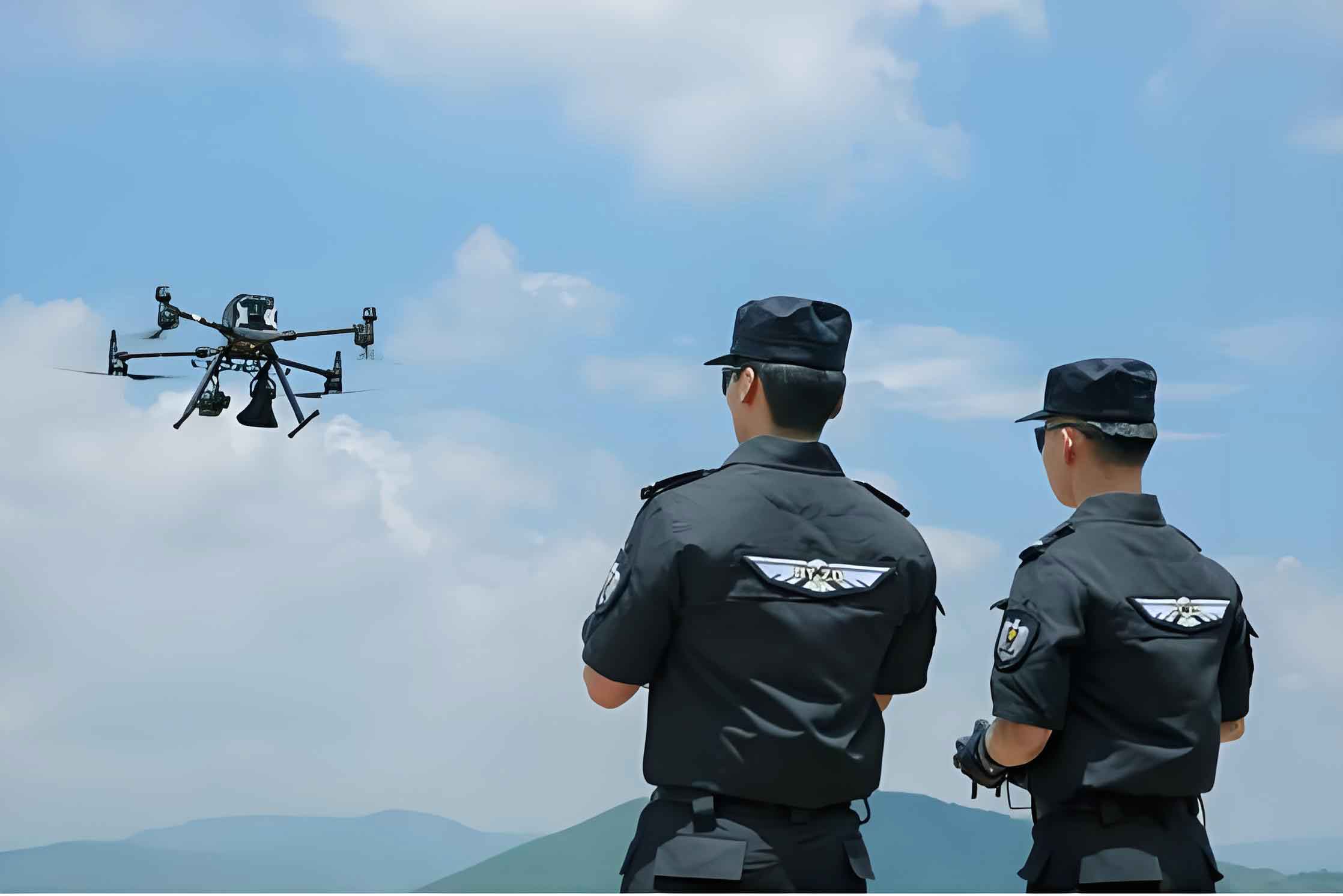
Existing research on post-disaster drone delivery often employs stochastic programming, which optimizes decisions based on a known probability distribution of uncertain parameters like supply and demand. However, in the chaotic aftermath of a disaster, accurately estimating these probability distributions is nearly impossible. Historical data is sparse, and each disaster has unique characteristics. To address this limitation, this article proposes a novel two-stage Distributionally Robust Optimization (DRO) model for designing a police drone-based emergency plasma delivery system. The model accounts for the profound uncertainty in both plasma supply from donation centers and demand from hospitals by considering the worst-case scenario within an ambiguity set of possible distributions, leading to more resilient planning. The primary objectives are to maximize the system’s robustness in meeting plasma demand under uncertainty and to ensure fairness in distribution among hospitals, all under strict budgetary constraints for deploying the police drone network.
1. System Architecture and Problem Formalization
The proposed system is designed as a two-echelon network. The first echelon consists of a set of regional blood centers, indexed by $i \in I = \{1, …, |I|\}$. These centers collect whole blood from donors, process it, and store various types of plasma. The second echelon comprises a set of hospitals or major medical points of need, indexed by $j \in J = \{1, …, |J|\}$, scattered across the region vulnerable to disasters.
The planning horizon is divided into two sequential stages:
Stage 1 – Pre-Disaster Preparedness: This is the strategic planning phase. Before any disaster occurs, decisions must be made on investing in the police drone delivery infrastructure. The core decision involves selecting which specific delivery routes (from blood center $i$ to hospital $j$) to establish. Establishing a route implies the pre-positioning of necessary support infrastructure, such as secure landing pads, charging stations, and communication relays, ensuring that a police drone can reliably operate on that path post-disaster. This investment is subject to a limited total budget $F$. A route is only feasible if the flight distance $d_{i,j}$ is within the operational range $L$ of the police drone fleet.
Stage 2 – Post-Disaster Response: This is the operational phase within the golden rescue period (e.g., 72 hours) after a specific disaster strikes. Given the pre-configured network from Stage 1, the model determines the optimal quantity of each plasma type to deliver from every blood center to every connected hospital. This stage is characterized by high uncertainty. The available supply of plasma at each center and the demand at each hospital are not known beforehand and are modeled as random variables.
A critical medical aspect incorporated into the model is blood type compatibility. For modeling clarity and without loss of generalizability, plasma types are aggregated into two categories: (1) Type AB plasma, which is the universal donor plasma and can be used for patients of any blood type in emergencies, and (2) Generic Type G plasma (representing pooled A, B, and O types), which does not have universal compatibility. Therefore, AB-type plasma can substitute for G-type demand, but not vice-versa. Let $\alpha_i$ and $\beta_i$ denote the random supply of AB and G-type plasma at center $i$, respectively. Let $\theta_j$ and $\eta_j$ denote the random demand for AB and G-type plasma at hospital $j$, respectively. The vector of all random parameters is $\boldsymbol{\zeta} = (\boldsymbol{\alpha}, \boldsymbol{\beta}, \boldsymbol{\eta}, \boldsymbol{\theta})$.
Uncertainty is represented via a finite set of $S$ disaster scenarios, indexed by $s$, each with an associated probability $p_s$. The set of all scenario probabilities is $\mathbf{p} = (p_1, …, p_S)$. In traditional stochastic programming, $\mathbf{p}$ is assumed known. In our DRO approach, we acknowledge this vector is uncertain and belongs to an ambiguity set $\mathcal{D}$ centered around an estimated nominal distribution $\mathbf{p^0}$ (e.g., from historical data).
2. Mathematical Model Formulation
2.1. Two-Stage Stochastic Programming Base Model
We first formulate a two-stage stochastic program as the foundation.
Sets and Indices:
$I$: Set of blood centers, $i \in I$.
$J$: Set of hospitals, $j \in J$.
$S$: Set of disaster scenarios, $s \in S$.
First-Stage Parameters:
$d_{i,j}$: Distance between center $i$ and hospital $j$.
$L$: Maximum flight range (endurance) of a police drone.
$\hat{R}_{i,j}$: Maximum plasma volume capacity on route $(i,j)$ per rescue period.
$e_{i,j}$: Cost to establish the drone delivery route from $i$ to $j$.
$F$: Total budget for route establishment.
First-Stage Decision Variable:
$x_{i,j} \in \{0,1\}$: Binary variable equal to 1 if a police drone route is established between blood center $i$ and hospital $j$, 0 otherwise.
Second-Stage Random Parameters (scenario-dependent):
$\alpha_i^s$: Supply of AB-type plasma at center $i$ in scenario $s$.
$\beta_i^s$: Supply of G-type plasma at center $i$ in scenario $s$.
$\eta_j^s$: Demand for AB-type plasma at hospital $j$ in scenario $s$.
$\theta_j^s$: Demand for G-type plasma at hospital $j$ in scenario $s$.
Second-Stage Decision Variables (scenario-dependent):
$q_{i,j}^{AB,s}$: Quantity of AB-type plasma shipped from $i$ to $j$ in scenario $s$ (used for AB demand or as substitute).
$q_{i,j}^{G,s}$: Quantity of G-type plasma shipped from $i$ to $j$ in scenario $s$.
$f_j^{AB,s}$: Shortage of AB-type plasma at hospital $j$ in scenario $s$.
$f_j^{G,s}$: Shortage of G-type plasma at hospital $j$ in scenario $s$.
$u$: Auxiliary variable representing the maximum shortage ratio across all hospitals and scenarios.
The first-stage model focuses on minimizing the sum of route establishment costs and the expected value of the second-stage operational cost (which embodies shortage).
$$ \min \sum_{i \in I} \sum_{j \in J} e_{i,j} x_{i,j} + \mathbb{E}_{\boldsymbol{\zeta}} [Q(\mathbf{x}, \boldsymbol{\zeta})] $$
subject to:
$$ d_{i,j} \cdot x_{i,j} \leq L \quad \forall i \in I, j \in J $$
$$ \sum_{i \in I} \sum_{j \in J} e_{i,j} x_{i,j} \leq F $$
$$ x_{i,j} \in \{0,1\} \quad \forall i \in I, j \in J $$
where $\mathbb{E}_{\boldsymbol{\zeta}} [Q(\mathbf{x}, \boldsymbol{\zeta})] = \sum_{s \in S} p_s Q(\mathbf{x}, \boldsymbol{\zeta}^s)$ is the expectation of the second-stage value function.
The second-stage problem for a given scenario $s$ and first-stage decision $\mathbf{x}$ is formulated with a fairness objective—minimizing the maximum percentage shortage across all hospitals. This promotes equitable distribution, a key ethical principle in disaster response managed by a police drone unit.
$$ Q(\mathbf{x}, \boldsymbol{\zeta}^s) = \min \, u $$
subject to:
$$ \hat{R}_{i,j} \cdot x_{i,j} \geq q_{i,j}^{AB,s} + q_{i,j}^{G,s} \quad \forall i \in I, j \in J $$
$$ f_j^{AB,s} + \sum_{i \in I} q_{i,j}^{AB,s} \geq \eta_j^s \quad \forall j \in J $$
$$ f_j^{G,s} + \sum_{i \in I} (q_{i,j}^{G,s} + q_{i,j}^{AB,s}) \geq \theta_j^s \quad \forall j \in J $$
$$ \sum_{j \in J} q_{i,j}^{AB,s} \leq \alpha_i^s \quad \forall i \in I $$
$$ \sum_{j \in J} q_{i,j}^{G,s} \leq \beta_i^s \quad \forall i \in I $$
$$ \frac{f_j^{AB,s} + f_j^{G,s}}{\eta_j^s + \theta_j^s} \leq u \quad \forall j \in J $$
$$ q_{i,j}^{AB,s}, q_{i,j}^{G,s}, f_j^{AB,s}, f_j^{G,s} \geq 0 \quad \forall i \in I, j \in J $$
The constraints enforce: (1) delivery capacity on established routes, (2-3) demand satisfaction definitions for AB and G plasma (including substitution of AB for G), (4-5) supply limitations at blood centers, and (6) the definition of the maximum shortage ratio $u$.
2.2. Two-Stage Distributionally Robust Optimization (DRO) Model
To handle the ambiguity in the probability distribution $\mathbf{p}$, we replace the expectation with a robust counterpart. The DRO model seeks the first-stage decision that minimizes the worst-case expected cost over all probability distributions within an ambiguity set $\mathcal{D}$.
$$ \min_{\mathbf{x}} \left( \sum_{i \in I} \sum_{j \in J} e_{i,j} x_{i,j} + \sup_{\mathbf{p} \in \mathcal{D}} \mathbb{E}_{\mathbf{p}} [Q(\mathbf{x}, \boldsymbol{\zeta})] \right) $$
subject to the first-stage constraints (2)-(4).
We define the ambiguity set $\mathcal{D}$ using an $L_1$-norm (or total variation) distance around the nominal distribution $\mathbf{p^0}$:
$$ \mathcal{D} = \{ \mathbf{p} \in \mathbb{R}^{|S|}_+ : \sum_{s \in S} |p_s – p_s^0| \leq \sigma, \sum_{s \in S} p_s = 1 \} $$
The parameter $\sigma \geq 0$ controls the size of the ambiguity set, i.e., the decision-maker’s level of confidence in $\mathbf{p^0}$. A larger $\sigma$ implies greater uncertainty and leads to a more conservative (robust) solution, crucial for reliable police drone contingency planning.
2.3. Model Reformulation and Solution
The inner supremum problem, $\sup_{\mathbf{p} \in \mathcal{D}} \sum_{s \in S} p_s Q(\mathbf{x}, \boldsymbol{\zeta}^s)$, is a linear program in $\mathbf{p}$. Applying strong duality theory, we can reformulate it as its dual minimization problem. This transforms the overall semi-infinite DRO model into a single, finite deterministic equivalent model that can be solved using commercial mixed-integer linear programming (MILP) solvers like Gurobi or CPLEX.
The dual of the inner problem introduces dual variables $\lambda \geq 0$, $\mu$ (unrestricted), and $\rho_s^+, \rho_s^- \geq 0$ for each scenario $s$. The equivalent monolithic formulation becomes:
$$ \min_{\mathbf{x}, \lambda, \mu, \boldsymbol{\rho^+}, \boldsymbol{\rho^-}} \sum_{i \in I} \sum_{j \in J} e_{i,j} x_{i,j} + \sigma \lambda + \mu + \sum_{s \in S} p_s^0 (\rho_s^+ – \rho_s^-) $$
subject to the first-stage constraints (2)-(4) and, for all $s \in S$:
$$ \lambda + \rho_s^+ – \rho_s^- \geq 0 $$
$$ \mu + \rho_s^+ – \rho_s^- \geq Q(\mathbf{x}, \boldsymbol{\zeta}^s) $$
$$ \lambda, \rho_s^+, \rho_s^- \geq 0, \mu \text{ unrestricted} $$
Here, $Q(\mathbf{x}, \boldsymbol{\zeta}^s)$ is defined by the second-stage LP for scenario $s$. This final model is a large-scale MILP that integrates the robust hedging against distributional ambiguity directly into the optimization of the police drone network.
3. Computational Experiments and Analysis
To validate the proposed DRO model, a series of numerical experiments were conducted based on a realistic case study. The geographic and operational data was synthesized from public sources pertaining to a major metropolitan area’s emergency medical infrastructure.
3.1. Experimental Setup and Data
The network consists of $|I|=3$ major blood centers and $|J|=7$ key tertiary hospitals. Historical data on seismic activity and casualty figures from the past 15 years was used to construct $|S|=7$ distinct disaster scenarios, each characterized by a specific seismic magnitude and corresponding projected plasma supply and demand figures. The operational parameters for the police drone fleet are based on a commercial multi-rotor logistics UAV model.
| Parameter | Description | Value / Distribution |
|---|---|---|
| $L$ | Police Drone Maximum Range | 15 km (baseline) |
| $\hat{R}_{i,j}$ | Route Capacity per period | ~Uniform(300, 400) units |
| $e_{i,j}$ | Route Establishment Cost | ~Uniform(20,000, 30,000) monetary units |
| $F$ | Total Budget | 350,000 monetary units (baseline) |
| $\sigma$ | Ambiguity Set Budget Parameter | 0.03 |
| Nominal $\mathbf{p^0}$ | Nominal Scenario Probability | Uniform (1/7 for each scenario) |
The plasma supply and demand for two representative scenarios are summarized below to illustrate the scale and variability.
| Facility | Scenario S2 (Major Quake) | Scenario S5 (Moderate Quake) | ||
|---|---|---|---|---|
| AB-type | G-type | AB-type | G-type | |
| Blood Center 1 | 67.4 | 1572.9 | 64.2 | 538.2 |
| Blood Center 2 | 81.7 | 1739.3 | 77.8 | 694.9 |
| Blood Center 3 | 61.3 | 1904.5 | 58.3 | 411.2 |
| Hospital 1 | 71.8 | 825.9 | 11.5 | 132.6 |
| Hospital 2 | 94.4 | 1086.0 | 17.3 | 199.9 |
| Hospital 3 | 305.8 | 3517.4 | 33.2 | 382.3 |
3.2. Model Comparison: Robustness to Uncertainty
We compare the performance of the proposed DRO model against seven deterministic models (DE1-DE7). Each deterministic model DEk is solved assuming scenario $k$ will occur with certainty (i.e., $p_k=1, p_{s\neq k}=0$). All models were implemented in Java and solved using Gurobi 9.1.2.
First, we solve all eight models using the original 7-scenario data with their nominal probabilities. The total demand satisfaction rate (Total Delivered Plasma / Total Demand) is calculated. The DRO model achieves a competitive satisfaction rate of 92.14%, demonstrating efficient network design.
The critical test, however, evaluates the models’ performance under unforeseen distributional shifts. We generate 10 new out-of-sample test scenarios by perturbing the supply and demand values of the original scenarios, simulating real-world uncertainty that differs from historical patterns. We then fix the first-stage network design from each model and evaluate its performance on these new, unseen scenarios.
| Model | Network Design Basis | Avg. Demand Satisfaction on New Test Scenarios | Performance vs. DRO |
|---|---|---|---|
| DE1 | Optimized for Scenario 1 | 82.32% | -6.20 pp |
| DE2 | Optimized for Scenario 2 | 86.09% | -2.43 pp |
| DE3 | Optimized for Scenario 3 | 81.63% | -6.89 pp |
| DE4 | Optimized for Scenario 4 | 83.21% | -5.31 pp |
| DE5 | Optimized for Scenario 5 | 82.58% | -5.94 pp |
| DE6 | Optimized for Scenario 6 | 81.33% | -7.19 pp |
| DE7 | Optimized for Scenario 7 | 82.29% | -6.23 pp |
| DRO | Robust over Ambiguity Set | 88.52% | Reference |
(pp = percentage points)
The results are decisive. The DRO-based police drone network significantly outperforms all deterministic models when faced with distributional ambiguity, improving the total plasma demand satisfaction rate by 2.4 to over 7 percentage points. This demonstrates the superior robustness of the DRO approach for planning critical emergency logistics where the future is fundamentally uncertain.
3.3. Sensitivity Analysis
3.3.1. Impact of Police Drone Endurance
The operational range $L$ is a key technological constraint for any police drone fleet. Adverse weather conditions common post-disaster can reduce effective range. We analyze the sensitivity of the system’s performance by varying $L$ from 12 km to 15 km.
The total demand satisfaction rate consistently decreases as the drone range shortens, confirming the intuitive relationship between accessibility and system performance. The decline is non-linear, as losing certain critical long-distance connections can disproportionately affect remote hospitals. The optimized network configuration changes drastically: at 15 km range, the DRO model establishes 13 routes; at 12 km, only 3 feasible routes remain, severely limiting distribution flexibility and robustness.
| Drone Endurance (L) | Number of Routes Established | Representative Connected Hospitals per Center |
|---|---|---|
| 15 km | 13 | Center 1: Hospitals 1,3,4,5; Center 2: Hospitals 2,3,6,7; Center 3: Hospitals 1,2,5,6,7 |
| 12 km | 3 | Center 1: Hospital 1; Center 2: Hospitals 6,7; Center 3: None |
3.3.2. Impact of Budget on Fairness
A core objective is equitable distribution. We analyze how the budget $F$ affects fairness by comparing the distribution of satisfaction rates across hospitals under the baseline budget (100%) and a constrained budget (70% of baseline). The fairness metric is the range between the highest and lowest hospital-specific satisfaction rates across all scenarios.
While a lower budget naturally reduces the overall satisfaction rate, the DRO model’s min-max fairness objective effectively controls disparity. Under both budget levels, the difference in satisfaction rates between the best-served and worst-served hospitals in any given scenario is maintained within a 10-percentage-point band. This highlights the model’s ability to enforce distributional equity even under significant resource scarcity, a crucial feature for a police drone deployment intended to serve all affected communities impartially.
| Budget Level | Avg. Total Satisfaction Rate | Max-Min Satisfaction Gap Across Hospitals (Worst-case Scenario) | Fairness Achievement |
|---|---|---|---|
| 100% (Baseline) | 92.14% | 8.7 percentage points | High (Gap < 10pp) |
| 70% (Constrained) | 84.35% | 9.5 percentage points | High (Gap < 10pp) |
4. Conclusion and Future Directions
This study presents a comprehensive two-stage Distributionally Robust Optimization framework for the strategic design and operational planning of a police drone-enabled emergency plasma delivery system for post-disaster response. By explicitly accounting for the deep uncertainty in both supply and demand through an ambiguity set of probability distributions, the model generates solutions that are significantly more robust than those derived from traditional deterministic or stochastic programming approaches. The computational experiments confirm that the DRO-based system maintains a higher plasma demand satisfaction rate when faced with unforeseen distributional shifts and effectively enforces equity among receiving hospitals under varying budget constraints.
The integration of a police drone fleet into this model is not merely terminological. It implies a command-and-control structure capable of executing the pre-planned, optimized logistics network under disciplined protocols during a crisis. The model provides the blueprint for such a fleet’s infrastructure investment and operational guidelines.
Future research can extend this work in several promising directions. First, a more granular representation of blood type compatibility (considering all eight major types and Rh factors) would enhance medical realism. Second, the model could be integrated with ground vehicle routing for a hybrid multimodal logistics system, where police drones handle the “last-mile” or cross-terrain challenges while trucks manage bulk transfers between major hubs. Third, the framework’s applicability extends beyond natural disasters to other large-scale emergency scenarios, such as mass casualty incidents or public health crises, where rapid, reliable, and fair distribution of critical medical supplies is paramount. In these contexts, the agility and reliability of a police drone logistics network could prove equally invaluable.