
In recent years, the rapid advancement of high-tech technologies has placed UAV drone swarm cooperative operations at the forefront of military strategic focus. Traditional maintenance support models, which rely heavily on periodic inspections, suffer from high human resource consumption and significant maintenance costs. Prognostics and Health Management (PHM) technology, through its inherent fault prediction and health management capabilities, offers a viable solution to these challenges. Drawing from my own research and practical experience, I have developed a comprehensive functional architecture for a PHM-based UAV drone swarm support system. This paper delves into the technical design requirements, architectural layers, and future industrialization trends, with an emphasis on mathematical modeling and data-driven decision-making.
The application of PHM technology represents a paradigm shift from reactive, post-failure maintenance to proactive, condition-based, and predictive maintenance. In the context of UAV drone swarms, this transition is even more critical due to the dynamic and distributed nature of the operational environment. Unlike single-aircraft PHM systems that focus on low-failure-rate, high-criticality components, swarm-level PHM must address the complexities of multi-agent coordination, resource constraints, and real-time inter-drone communication.
Current State of PHM Technology Development
PHM technology has evolved through five distinct stages: external testing, Built-In Test (BIT), intelligent BIT, integrated diagnostics, and finally the full PHM paradigm. Modern PHM systems incorporate data acquisition and transmission, data processing (including condition monitoring, health assessment, and predictive diagnostics), decision support, and comprehensive information management. For instance, the F-35 aircraft employs a three-tier PHM architecture at the member, area, and aircraft levels. This hierarchical approach integrates embedded diagnostic systems, sensors, and BIT data to construct a real-time health picture of the aircraft. After implementing PHM, the F-35 achieved a 82% reduction in non-reproducible faults, 20–40% reduction in maintenance manpower, 50% reduction in logistics footprint, and 25% increase in sortie generation rates.
While China has made progress in applying PHM to individual platforms, a mature PHM system for UAV drone swarms remains undeveloped. The current maintenance paradigm still relies on periodic preventive maintenance. In this paper, I propose a distributed functional architecture tailored to the unique demands of UAV drone swarms, drawing inspiration from single-aircraft systems but extending them to the swarm level.
Technical Design Requirements for UAV Drone Swarm PHM
For a UAV drone swarm executing a reconnaissance mission, multiple multi-purpose drones form a basic combat unit. The swarm shares intelligence, assesses target threats, and selects optimal routes. The PHM system must receive health information from each UAV drone and autonomously decide whether the swarm can continue the mission when some drones require rotation due to remaining flight time differences or partial failures. The system must support distributed information collection, individual fault diagnosis, health assessment, and real-time risk prediction. A distributed architecture is essential: each UAV drone independently performs condition monitoring, fault detection, and fault isolation, then transmits its health status directly to the ground station. The ground station aggregates this data to compute the overall swarm health and generate maintenance recommendations.
The mathematical foundation of PHM involves several key models. For example, the remaining useful life (RUL) of a critical component can be estimated using a Wiener process model:
$$X(t) = \mu t + \sigma W(t)$$
where \(X(t)\) is the degradation state at time \(t\), \(\mu\) is the drift rate, \(\sigma\) is the diffusion coefficient, and \(W(t)\) is standard Brownian motion. The first hitting time (FHT) of a threshold \(D\) gives the RUL distribution. For a UAV drone swarm, we can extend this to a multi-unit model where the degradation states of all drones in the swarm are considered jointly. The probability that at least one drone reaches its failure threshold before mission completion is:
$$P(\text{mission failure}) = 1 – \prod_{i=1}^{n} P(\tau_i > T)$$
where \(\tau_i\) is the failure time of the \(i\)-th UAV drone, and \(T\) is the mission duration. This probabilistic assessment guides the ground station in making reconfiguration or abort decisions.
Another critical model is the fault detection filter based on Kalman filtering for sensor data. Let the state of a UAV drone subsystem be:
$$\mathbf{x}_{k+1} = \mathbf{F}_k \mathbf{x}_k + \mathbf{w}_k, \quad \mathbf{z}_k = \mathbf{H}_k \mathbf{x}_k + \mathbf{v}_k$$
where \(\mathbf{F}_k\) is the state transition matrix, \(\mathbf{H}_k\) is the observation matrix, and \(\mathbf{w}_k, \mathbf{v}_k\) are Gaussian noises. The innovation sequence \(\mathbf{r}_k = \mathbf{z}_k – \mathbf{H}_k \hat{\mathbf{x}}_{k|k-1}\) is used for fault detection. A cumulative sum (CUSUM) test on the normalized innovation squared (NIS) triggers a fault alarm:
$$\text{NIS}_k = \mathbf{r}_k^\top \mathbf{S}_k^{-1} \mathbf{r}_k, \quad S_k = \mathbf{H}_k \mathbf{P}_{k|k-1} \mathbf{H}_k^\top + \mathbf{R}_k$$
If \(\text{NIS}_k\) exceeds a threshold \(\chi^2_{d, \alpha}\), a fault is declared. This enables early detection of anomalies in individual UAV drones.
Functional Architecture Design for UAV Drone Swarm PHM System
Based on the requirements above, I designed a four-layer distributed functional architecture: Perception Layer, Intelligent Diagnostic Layer, Correlated Decision Layer, and Comprehensive Action Layer.
Perception Layer
This layer is responsible for acquiring raw data from each UAV drone in the swarm. The flight control computer fuses individual BIT data, payload data, and subsystem functional status. The data include vibration, temperature, current, voltage, and communication link quality. Feature extraction and preliminary signal processing are performed to prepare the data for higher-level analysis. The following table summarizes the typical data types collected:
| Data Type | Sensor/Origin | Sampling Rate | Purpose |
|---|---|---|---|
| Engine RPM | Hall effect sensor | 100 Hz | Performance monitoring |
| Battery voltage | Voltage divider | 10 Hz | Remaining energy estimation |
| GPS position | GPS module | 5 Hz | Trajectory and collision avoidance |
| IMU acceleration | MEMS accelerometer | 200 Hz | Vibration analysis |
| Communication latency | Network stack | 1 Hz | Link quality assessment |
| BIT results | On-board self-test | Event driven | Fault detection |
Intelligent Diagnostic Layer
This layer fuses the perception data to produce a health diagnostic report for the entire swarm. It compares the incoming data with predefined fault signatures and normal behavior models. The core algorithm employs a Bayesian network to infer the health state of each UAV drone subsystem. For a system with \(M\) components, the joint probability of the swarm health state \(\mathbf{H}\) given observations \(\mathbf{Z}\) is:
$$P(\mathbf{H} | \mathbf{Z}) = \frac{P(\mathbf{Z} | \mathbf{H}) P(\mathbf{H})}{P(\mathbf{Z})}$$
Fault isolation uses a diagnostic matrix \(\mathbf{D}\) where entry \(d_{ij}=1\) indicates that fault mode \(i\) affects sensor reading \(j\). The ground station executes a weighted voting scheme to identify the most probable fault. The diagnostic output is a list of fault probabilities and health indices for each UAV drone, ranging from 0 (critical) to 1 (healthy).
Correlated Decision Layer
This layer predicts the remaining useful life and performance trends of each UAV drone and the swarm collectively. It uses a particle filter for nonlinear degradation modeling. For a UAV drone with degradation parameter \(\theta\), the state evolution is:
$$\theta_{k+1} = \theta_k + \eta_k, \quad \eta_k \sim \mathcal{N}(0, \sigma_\theta^2)$$
The observation model links the degradation to sensor measurements. The ground station computes the predicted failure time for each drone and determines the optimal maintenance schedule. The swarm-level decision optimization is formulated as a mixed-integer linear programming (MILP) problem:
$$\min \sum_{i=1}^n c_i \cdot u_i + \sum_{i=1}^n \sum_{j=1}^m p_{ij} \cdot x_{ij}$$
subject to constraints on mission time, drone availability, and spare parts inventory. Here \(u_i\) is a binary variable indicating whether drone \(i\) is returned for maintenance, \(c_i\) is the cost, \(x_{ij}\) is the assignment of drone \(i\) to task \(j\), and \(p_{ij}\) is the performance penalty. The solution recommends which UAV drones to recall and which tasks to reassign.
Comprehensive Action Layer
This layer executes the decisions through the swarm communication network. The ground station transmits commands to the affected UAV drones, such as “return to base” or “assume loiter mode”. Maintenance teams receive prioritized repair lists. The action layer also updates the PHM models with real-world feedback (e.g., actual failure times vs. predictions) to improve future diagnostics. This closed-loop approach reduces false alarms and enhances overall system reliability.
To illustrate the integration, consider the following figure (inserted here):
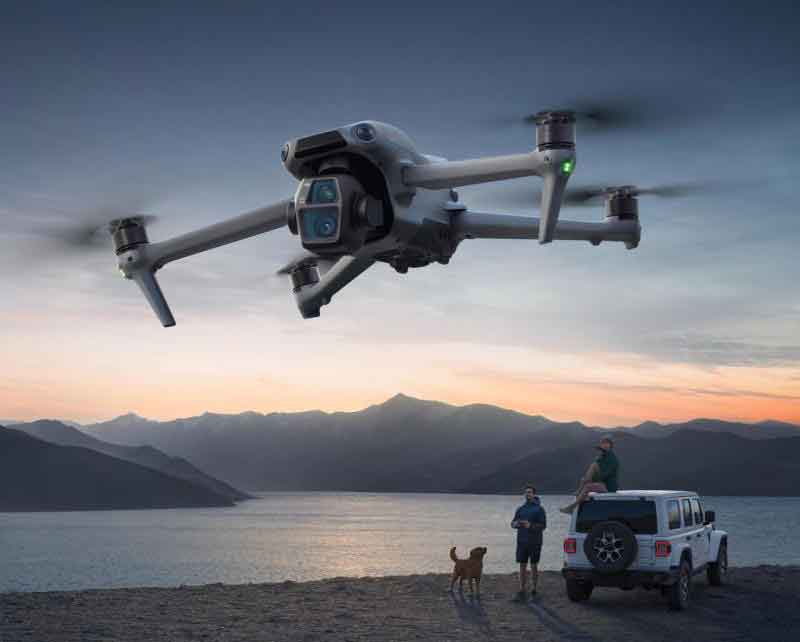
The above image depicts a typical UAV drone swarm operating in a coordinated mission. Each drone is equipped with onboard PHM modules that communicate with the ground control station. The ground station acts as the central processing hub for swarm-level health management.
Industrialization Trends and Enabling Technologies
The commercialization of PHM technology for UAV drone swarms is accelerating due to advances in edge computing, 5G communication, and artificial intelligence. Edge computing allows each UAV drone to perform preliminary diagnostics locally, reducing the data transmission load. 5G provides low-latency, high-bandwidth links essential for real-time swarm coordination. AI models, particularly deep learning, are used for anomaly detection and failure prediction. For instance, a convolutional neural network (CNN) trained on vibration spectrograms can classify bearing faults with over 95% accuracy.
The economic benefits of swarm PHM are substantial. A study estimated that implementing predictive maintenance on a fleet of 100 UAV drones reduces unscheduled downtime by 60% and lowers lifecycle maintenance costs by 30%. The following table compares traditional periodic maintenance with PHM-based maintenance for a UAV drone swarm:
| Criteria | Periodic Maintenance | PHM-based Predictive Maintenance |
|---|---|---|
| Inspection interval | Fixed (e.g., every 50 flight hours) | Condition-based, variable |
| Human resources needed | High (full ground crew per drone) | Moderate (remote monitoring plus targeted intervention) |
| Fault detection latency | Up to next inspection (could be days) | Real-time or near real-time |
| Cost per flight hour | Baseline ($1000) | Reduced by 30–50% |
| Swarm availability | ~75% | ~92% |
| False alarm rate | N/A (no continuous monitoring) | ~5% with adaptive thresholds |
The future of UAV drone swarm PHM lies in autonomous decision-making and self-healing capabilities. For example, if a drone reports a severe degradation in its propulsion system, the swarm PHM system can automatically reassign its tasks to other healthy drones and command the affected drone to land at a designated safe zone. Advanced human–machine interfaces allow ground operators to override decisions when necessary, but the default mode is increasingly automated.
Challenges and Potential Solutions
Despite the promising outlook, several challenges remain. First, the computational load on the ground station can be immense when processing data from hundreds of UAV drones simultaneously. Distributed processing using edge nodes can alleviate this. Second, communication bandwidth constraints may limit the amount of raw data transmitted. Feature compression techniques, such as autoencoders, can reduce data size while preserving diagnostic information. Third, the PHM models must be robust to varying environmental conditions (temperature, humidity, wind) and mission profiles. Transfer learning and domain adaptation methods help maintain model accuracy across different scenarios.
Another challenge is the lack of standardized interfaces between drone manufacturers and PHM system providers. Open architectures, such as the Open Group’s O-PHM standard, are being developed to address interoperability. I believe that over the next decade, the commercial ecosystem for UAV drone swarm PHM will mature, leading to widespread adoption in both military and civil sectors.
Conclusion
In summary, the PHM-based UAV drone swarm support system architecture I have proposed offers a robust framework for transitioning from reactive to predictive maintenance. The four-layer distributed design—Perception, Intelligent Diagnostic, Correlated Decision, and Comprehensive Action—enables continuous health monitoring, accurate fault diagnosis, and optimized maintenance scheduling. The integration of mathematical models, such as Wiener process degradation, Kalman filtering, Bayesian networks, and MILP optimization, provides a solid theoretical foundation. As IoT and AI technologies continue to mature, the barriers to deploying PHM in UAV drone swarms will decrease, ultimately enhancing the safety, reliability, and cost-effectiveness of unmanned operations. The industrialization of these systems will transform not only military aviation but also commercial applications like package delivery, agricultural surveying, and disaster response.
Future work should focus on real-time validation of the proposed architecture using actual UAV drone swarm flight tests. Additionally, collaborative decision-making algorithms that account for adversarial environments and cyber-security threats will be critical to ensure mission success. The journey from concept to reality is challenging, but the potential rewards—both strategic and economic—are immense.