
As a researcher deeply involved in forest protection technologies, I have focused on exploring innovative methods to combat the persistent and devastating threat of forest fires. Traditional ground-based firefighting, while effective, often faces limitations in terms of access, speed, and personnel safety, especially in complex terrains or during the initial stages of a fire outbreak. The integration of Unmanned Aerial Vehicles (UAVs) into forestry operations has opened a new frontier. My research specifically investigates the application of fire UAVs equipped with self-detonating fire-extinguishing projectiles for the targeted suppression of incipient fires. This method promises rapid response, precision delivery, and enhanced safety for firefighters. This article details a systematic study conducted to optimize the key operational parameters of such a fire UAV system to maximize its effectiveness.
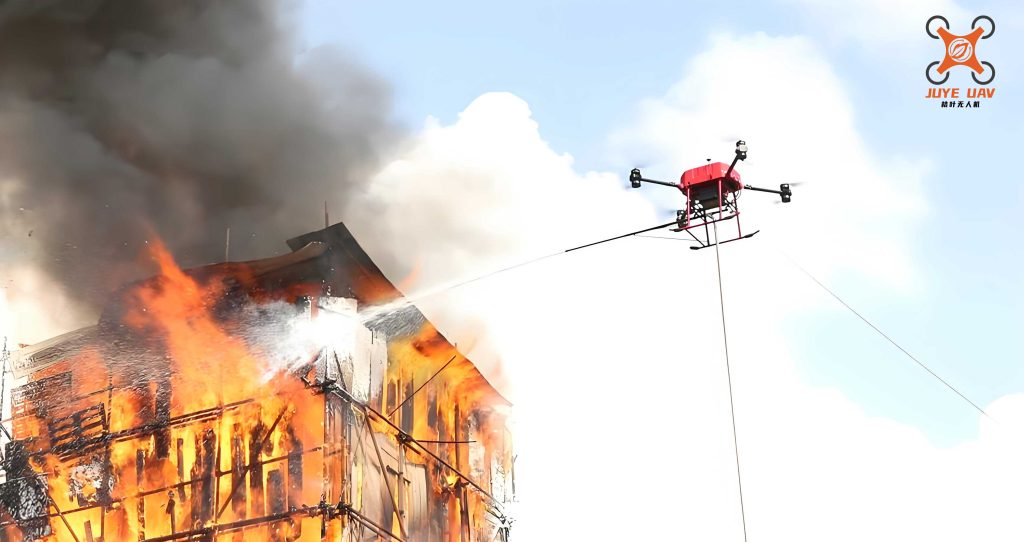
The core challenge in deploying a fire UAV for灭火 lies in determining the optimal combination of variables that govern the灭火弹’s performance upon delivery. The shape of the projectile influences its stability and rolling behavior upon impact with the sloped, uneven forest floor. The飞行高度 of the fire UAV during release affects the impact force and final resting position of the projectile relative to the fire source. Most critically, the payload capacity of the灭火弹 directly determines the volume of extinguishing agent available to suppress the flames. Isolating and understanding the individual and interactive effects of these factors is essential for developing a reliable operational protocol.
Experimental Design and Methodology
The study was designed as a controlled field experiment. The primary platform was a multi-rotor fire UAV (MG-1S model). The fire-extinguishing projectiles were self-detonating capsules filled with foam concentrate, designed to burst upon reaching a specific temperature threshold when exposed to fire. Three independent variables (factors) were selected, each with three levels:
- Factor A (Projectile Shape): A1 (Square), A2 (Circular), A3 (Triangular).
- Factor B (UAV Release Height): B1 (5 meters), B2 (10 meters), B3 (15 meters).
- Factor C (Extinguishing Agent Capacity): C1 (1 kg), C2 (2 kg), C3 (4 kg).
The dependent variable, or response, was the total time required to fully extinguish a standardized, controlled ground fire with a flame height not exceeding 0.5 meters. A Taguchi L9 (3^3) orthogonal array was employed to efficiently study the multi-factor space with a minimal number of experimental runs. This design is ideal for identifying the most influential factors. Each combination in the array was replicated three times to account for variability. The test site featured low mountainous terrain with an average slope of 28°, representative of common fire-prone landscapes. Environmental conditions during testing were consistently a southwest wind at Beaufort scale 2, clear skies, and an ambient temperature of 28°C.
Data collection involved precise timing from the moment of projectile release to the complete absence of visible flames and smoldering. Given the payload limitations of the fire UAV for the 1 kg and 2 kg capacities, multiple sorties were required to deliver the total agent needed to extinguish the test fire. The time for the UAV to return and reload (approximately 2 minutes per sortie) was incorporated into the total灭火时间. The 4 kg projectile was capable of extinguishing the fire in a single drop. Data were processed using statistical software for analysis of variance (ANOVA) and multiple comparison tests to determine significant differences between factor levels.
Results and Analysis: Orthogonal Experiment
The results from the orthogonal experimental array are summarized in the table below. The primary metric is the average灭火时间 for each factor-level combination.
| Experiment # | Factor A (Shape) | Factor B (Height) | Factor C (Capacity) | Average Extinguishing Time (min) |
|---|---|---|---|---|
| 1 | Square (A1) | 5m (B1) | 1kg (C1) | 10.0 |
| 2 | Square (A1) | 10m (B2) | 2kg (C2) | 5.0 |
| 3 | Square (A1) | 15m (B3) | 4kg (C3) | 2.0 |
| 4 | Circular (A2) | 5m (B1) | 2kg (C2) | 10.0 |
| 5 | Circular (A2) | 10m (B2) | 4kg (C3) | 6.0 |
| 6 | Circular (A2) | 15m (B3) | 1kg (C1) | 17.0 |
| 7 | Triangular (A3) | 5m (B1) | 4kg (C3) | 1.0 |
| 8 | Triangular (A3) | 10m (B2) | 1kg (C1) | 12.0 |
| 9 | Triangular (A3) | 15m (B3) | 2kg (C2) | 6.0 |
The shortest灭火时间 (1.0 minute) was achieved in Experiment 7 (A3, B1, C3), utilizing a triangular projectile released from 5 meters with a 4 kg capacity. To determine the relative importance of each factor, the range (R) analysis was performed on the mean responses for each level. The calculated ranges were:
- Range for Factor A (Shape), R_A = 5.3
- Range for Factor B (Height), R_B = 1.3
- Range for Factor C (Capacity), R_C = 10.0
The order of influence, from greatest to least, is clearly: C (Capacity) > A (Shape) > B (Height). This indicates that the amount of extinguishing agent is the most critical determinant of a fire UAV‘s effectiveness in this context, followed by the shape of the delivery projectile. The release height of the fire UAV showed the smallest effect, suggesting that operators have flexibility in choosing a safe altitude without drastically compromising performance.
Statistical Analysis and Multiple Comparisons
A more detailed statistical analysis, including ANOVA and post-hoc multiple comparison tests (e.g., Tukey’s HSD), was conducted on the mean灭火时间 for each level within a factor. This allows us to see which specific levels perform significantly better or worse.
The analysis for Factor A (Shape) revealed that the circular projectile (A2) resulted in a significantly longer average灭火时间 (11.0 min) compared to both the square (A1, 5.7 min) and triangular (A3, 6.3 min) shapes, which were not statistically different from each other. This can be attributed to the circular shape’s tendency to roll away from the target upon hitting the sloped ground, reducing the effectiveness of agent delivery directly onto the fire source.
For Factor B (Height), statistical tests confirmed no significant difference between the three release altitudes (5m: 7.0 min, 10m: 8.0 min, 15m: 8.3 min). This is a practically important finding for fire UAV operations, as it allows pilots to maintain a safer stand-off distance from intense heat and smoke without a severe penalty in灭火效率.
Factor C (Capacity) showed the most pronounced differences. The 1 kg capacity (C1) led to a significantly longer灭火时间 (13.0 min) than both the 2 kg (C2, 7.0 min) and 4 kg (C3, 3.0 min) levels. Furthermore, the 4 kg capacity was significantly better than the 2 kg capacity. The relationship can be modeled approximately as a negative exponential decay:
$$ T \approx \alpha \cdot e^{-\beta C} + \gamma $$
where \( T \) is the extinguishing time, \( C \) is the capacity, and \( \alpha, \beta, \gamma \) are constants derived from the data. This underscores the paramount importance of maximizing the single-drop payload of the fire UAV to achieve rapid knockdown.
Based on this comprehensive analysis, the optimal configuration identified is A3B1C3: a triangular-shaped projectile carrying 4 kg of extinguishing agent, released from a fire UAV flying at 5 meters altitude. This configuration minimizes灭火时间.
Investigation of Nocturnal Firefighting Efficacy
A secondary, comparative experiment was conducted to evaluate the performance of the fire UAV system during nighttime operations versus daytime. Identical fire scenarios were set, and the same optimal projectile (triangular, 4kg) was used. The key operational metrics were compared, as shown below:
| Metric | Daytime Operation | Nighttime Operation | Efficiency Improvement (%) |
|---|---|---|---|
| Target Acquisition/Lock-on Time | 18.4 min | 15.6 min | +15.2% |
| Projectile Delivery Accuracy | ~100% | ~100% | ~0% |
| Total Fire Suppression Time | 42.0 min | 38.5 min | +8.3% |
The results indicate a clear operational advantage at night. The fire UAV operator can locate and lock onto the fire target 15.2% faster due to the high visual contrast of flames against the dark background. Furthermore, the total suppression time is reduced by 8.3%. This is likely because after the initial UAV drop, any remaining spot fires, embers, or sparks are more visible to ground crews at night, allowing for quicker mop-up. This finding highlights a significant tactical benefit: a fire UAV system is not only viable but can be more efficiently deployed for initial attack on fires that start or are discovered after dark, when traditional aerial assets may be grounded.
Discussion on Extinguishing Mechanism and Physical Model
The effectiveness of the self-detonating projectile can be analyzed through a simplified physical model. The primary灭火 mechanism is the rapid deposition of a foam blanket, which acts by smothering the fire (oxygen exclusion) and cooling the fuel. The key parameters are the volume of agent \( V \), the area covered \( A_{cover} \), and the blanket thickness \( d \). Assuming the foam spreads uniformly from the point of burst, the covered area is proportional to the volume:
$$ A_{cover} \propto V^{2/3} $$
However, for effective suppression, a minimum thickness \( d_{min} \) is required. Therefore, the effective coverage area \( A_{eff} \) for a given volume \( V \) and agent density \( \rho_{agent} \) is:
$$ A_{eff} = \frac{V \cdot \rho}{d_{min} \cdot \rho_{agent}} $$
where \( \rho \) is a spreading efficiency factor (0 < \( \rho \) ≤ 1) accounting for terrain and vegetation interference. The triangular shape likely yields a higher \( \rho \) than the circular one, as its facets hinder rolling, keeping more agent concentrated at the impact site. The capacity factor’s dominance in our experiments directly relates to \( V \) in this model. A larger \( V \) linearly increases \( A_{eff} \), directly translating to faster suppression of a fixed fire area. The lack of sensitivity to release height \( B \) suggests that, within the tested range (5-15m), the impact energy is sufficient to reliably trigger the thermal detonator and does not cause catastrophic dispersal of the agent before it can act on the fire.
Model Validation and Operational Trade-offs
The empirical results strongly support the theoretical model’s emphasis on agent volume. The orthogonal experiment serves as a validation in a complex, real-world environment. An important operational trade-off emerges for fire UAV fleet managers. While the 4 kg payload is optimal for performance, it may reduce flight time or require a larger, more expensive UAV platform compared to one carrying 1 kg or 2 kg projectiles. The operational decision can be framed as an optimization problem: minimize total response and suppression cost subject to UAV platform constraints. Let \( T(C) \) be the suppression time function from our experiments, \( W(C) \) be the weight penalty affecting sortie time/number, and \( N \) be the number of sorties needed. The total time \( T_{total} \) might be modeled as:
$$ T_{total} = N \cdot (T_{flight}(W(C)) + T_{load}) + T(C) $$
For small, remote initial-attack fires, the single-sortie, high-capacity (4kg) option minimizes \( T_{total} \) despite \( T_{flight} \) potentially being longer per sortie because \( N=1 \) and \( T(C) \) is very small. For larger fires or when swarm tactics with smaller UAVs are considered, the trade-off analysis becomes more complex.
Optimization Modeling for Broader Application
Building on the experimental findings, a generalized optimization framework for fire UAV deployment can be proposed. The goal is to minimize a composite objective function \( Z \) that includes not just time, but also cost and risk:
$$ \text{Minimize: } Z = w_1 \cdot T_{sup} + w_2 \cdot C_{op} + w_3 \cdot R_{risk} $$
Where:
- \( T_{sup} \): Total suppression time (function of A, B, C).
- \( C_{op} \): Operational cost (UAV size, number of projectiles, agent cost).
- \( R_{risk} \): Risk metric (UAV loss probability, based on flight height B and proximity to fire).
- \( w_1, w_2, w_3 \): Weights assigned by decision-makers based on priorities.
Our study provides the critical empirical data to define \( T_{sup} = f(A, B, C) \). We found \( f \) is most sensitive to C (capacity), moderately sensitive to A (shape), and least sensitive to B (height) within our test domain. This means for a high \( w_1 \) (urgency), the solution pushes towards high C (4kg) and optimal A (triangular), while B can be adjusted to minimize \( R_{risk} \) (higher altitude) without greatly affecting \( T_{sup} \). If \( w_2 \) (cost) is high, the solution might shift towards a smaller, cheaper UAV with lower C, accepting a longer \( T_{sup} \). This model transforms our specific experimental conclusions into a scalable decision-support tool for fire UAV fleet configuration and tactical dispatch.
Comparison with Existing and Alternative Technologies
The fire UAV with灭火弹 occupies a unique niche in the forest fire suppression toolbox. It is instructive to compare its profile with other methods:
| Technology/Method | Key Advantages | Key Limitations | Best Use Case |
|---|---|---|---|
| Fire UAV with Extinguishing Projectile | Rapid response, access to difficult terrain, night operation capable, precise initial attack, low risk to personnel. | Limited payload/endurance, weather-sensitive (wind), requires skilled operator. | Incipient fires (<0.5 ha), spot fires behind lines, night-time initial attack, terrain inaccessible to crews. |
| Manned Air Tankers/Helicopters | Very large payload, long range, high speed for area coverage. | Very high cost, limited availability, requires nearby base/water source, safety risks to crew, often grounded at night/poor weather. | Major fire fronts, large-scale retardant/water drops. |
| Ground Firefighting Crews | High precision for mop-up, can construct firebreaks, adaptable. | Slow access in rough terrain, physically demanding, high safety risk on fireline. | Direct attack on perimeter, holding and mop-up operations after aerial support. |
| Satellite/Ir UAV Surveillance | Very wide area monitoring, hot spot detection. | No suppression capability, data latency, cloud cover interference. | Early detection, fire spread monitoring, situational awareness. |
This comparison underscores that the fire UAV is not a replacement for tankers or ground crews but a complementary “first-strike” and tactical support asset. Its value is maximized when integrated into a coordinated response plan, where it can quickly contain a small fire before it escalates, or support ground crews by tackling hazardous spot fires.
Economic and Scalability Analysis
For widespread adoption, the economic case for fire UAV systems must be compelling. The primary costs include capital expenditure (UAV platform, launcher/payload mechanism, ground control station) and operational expenditure (batteries, maintenance, extinguishing agents, pilot training). The benefit is the potential reduction in economic and ecological loss by catching fires early. A simplified cost-benefit ratio for an initial attack system can be considered:
$$ CE = \frac{C_{UAV\_system}}{A_{extinguished\_per\_year} \cdot V_{loss\_per\_hectare\_avoided}} $$
Where \( CE \) is a cost-effectiveness ratio (lower is better), \( A_{extinguished\_per\_year} \) is the annual area of fires suppressed at the incipient stage by the fire UAV, and \( V_{loss} \) is the value (timber, property, ecosystem services, suppression cost savings) of preventing one hectare from burning. Our research on optimizing灭火时间 directly increases \( A_{extinguished\_per\_year} \) by making each sortie more effective, thereby improving the CE ratio. Scalability is high, as multiple fire UAVs can be deployed as a swarm from a single command vehicle, covering a larger area or attacking multiple points on a fire simultaneously. The optimization of单个灭火弹 performance is the foundational step for effective swarm tactics.
Environmental and Safety Considerations
The use of a fire UAV system also presents distinct environmental and safety advantages. From an environmental perspective, the precise application of a concentrated foam agent minimizes the volume of chemicals introduced into the ecosystem compared to broad-area drops from large air tankers. The agent used in this study was a biodegradable foam concentrate, further mitigating ecological impact. From a firefighter safety standpoint, the benefit is profound. The fire UAV can operate in conditions deemed too risky for ground crew insertion, such as rapidly spreading fires on steep slopes, in dense smoke, or during the night. It can also be used to create a safety zone or dampen a fire’s intensity ahead of ground crews, making their subsequent work safer. The finding that release height has minimal impact on effectiveness is crucial here; it allows the fire UAV pilot to maintain a safe standoff distance from the fire’s thermal updrafts and turbulence without sacrificing mission performance.
Innovation Points and Future Research Directions
The core innovation of this work lies in the systematic, empirical optimization of the physical delivery parameters for a fire UAV灭火弹 system. Moving beyond qualitative assessments, we quantified the influence of shape, height, and capacity, providing a clear hierarchy of factors and an optimal configuration. The nocturnal efficiency finding is a significant and practical insight that had not been prominently highlighted in prior literature. Future research should build on this foundation in several directions. First, testing with a wider range of UAV platforms and larger灭火弹 capacities (e.g., 8kg, 10kg) is needed to model performance scalability. Second, integrating real-time thermal imaging and machine learning for autonomous target identification and release point calculation would enhance the fire UAV‘s operational autonomy and accuracy. Third, developing “smart” projectiles with variable burst heights or spreading patterns could adapt to different fuel types (grass vs. shrub vs. litter). Finally, large-scale field exercises integrating fire UAVs with ground crews and traditional aerial assets are essential to develop effective interoperability protocols and战术.
Conclusion
This research demonstrates that the application of fire UAVs equipped with self-detonating灭火弹s is a highly promising and optimizable technology for the initial attack on forest fires. Through structured orthogonal experimentation, we determined that灭火弹 capacity is the most critical factor for rapid suppression, followed by projectile shape, while UAV release height has minimal impact within the operational envelope tested. The optimal configuration identified—a triangular 4 kg projectile released from a low altitude of 5 meters—provides a benchmark for system design. Furthermore, we established that fire UAV operations can be more efficient at night, offering a crucial capability for 24/7 fire response. The fire UAV system, when configured based on these empirical findings, serves as a force multiplier in forest protection. It enables rapid, precise, and safe intervention against incipient fires, particularly in challenging terrain or time periods, potentially preventing small ignitions from escalating into costly and destructive conflagrations. The integration of such optimized fire UAV systems into modern forest fire management strategies represents a significant step forward in leveraging technology for ecosystem protection and firefighter safety.