
The proliferation of unmanned aerial vehicles (UAVs) has irrevocably altered the modern battlespace. As quintessential assets of new-domain and new-quality combat forces, UAVs serve as critical platforms for intelligence, surveillance, reconnaissance (ISR), and strike missions. This surge in capability has precipitated a parallel and urgent demand for effective anti-UAV countermeasures. Among the spectrum of anti-UAV techniques, navigational spoofing stands out as a potent “soft-kill” method. It garners significant attention due to its high degree of universality against GNSS-dependent platforms, strong adaptability to various scenarios, exceptional cost-effectiveness, and inherent covertness. Unlike disruptive jamming, spoofing aims to subtly deceive, not deny, leading to controlled misdirection or capture of the hostile drone.
This discourse delves into the technological evolution, theoretical underpinnings, and tactical application of navigational spoofing within the anti-UAV context. We first establish the intrinsic link between high-fidelity signal simulation and effective spoofing by deconstructing the “receiver-spoofer” paradigm. Subsequently, we construct two principal analytical models that form the theoretical backbone for UAV deception, grounded in the Guidance, Navigation, and Control (GNC) framework. Finally, we examine the integration of spoofing within broader anti-UAV “detect-disrupt-destroy” kill chains, outlining its operational utility. Analysis indicates that the field is advancing towards systematic, multi-layered countermeasure suites. While significant progress has been made in spoofer development and miniaturization, research into next-generation intelligent, distributed, and multi-platform spoofing systems remains an area for continued exploration. Fostering deeper industry-academia-research collaboration is paramount to propelling the high-quality, cross-domain development of this crucial anti-UAV capability.
From Simulation to Deception: The Technical Bridge
The generation of a convincing, “unconditionally trusted” navigational spoofing signal necessitates a perfect emulation of the entire satellite navigation system—from space segment to atmospheric effects. The development of spoofer hardware has logically evolved from the foundation of precision navigation signal simulators.
Principles and Role of GNSS Signal Simulation
GNSS simulation testing involves the controlled, high-fidelity replication of authentic Global Navigation Satellite System (GNSS) signals and their operational environment within a laboratory setting. This provides indispensable verification and validation support for the development, production, and testing of GNSS receivers and systems. The GNSS signal simulator is the core instrument in this process, traditionally subject to stringent export controls by technologically advanced nations. A simulator’s architecture typically comprises a mathematical simulation system and a radio-frequency (RF) signal generation system. The former calculates satellite ephemerides, clock corrections, and atmospheric models, outputting dynamic signal parameters. The latter synthesizes the actual RF waveform based on these parameters, including precise code delay $$T$$, carrier Doppler $$ω$$, and signal amplitude $$A$$.
Mathematical Foundations of User-State Simulation
The simulation models can be categorized into three segments, as summarized below:
| System Segment | Simulation Models |
|---|---|
| Space Segment | Ephemeris & Clock Models, Orbit/Constellation Simulation, Satellite PVT Simulation |
| Environment Segment | Ionospheric & Tropospheric Delay Models, Multipath Channel Models |
| User Segment | Navigation Message Simulation, User Observables Simulation, User Trajectory Simulation |
Two user-state models are particularly critical for spoofing: the user observable model and the user trajectory model.
1. User Observable (Pseudorange) Model: The simulated pseudorange $$ \tilde{\rho} $$ for satellite i is derived through an iterative process to account for the time of transmission. The foundational equation is:
$$
\tilde{\rho}_i = \| \mathbf{p}_{sat,i}(t_s) – \mathbf{p}_{u}(t_r) \| + c \cdot (\delta t_u – \delta t_{sat,i}) + \delta\rho_{ion,i} + \delta\rho_{trop,i} + \delta\rho_{rel,i} + \epsilon
$$
where $$ \mathbf{p}_{sat,i}(t_s) $$ is the satellite position at transmission time $$ t_s $$, $$ \mathbf{p}_{u}(t_r) $$ is the user position at reception time $$ t_r $$, $$ c $$ is the speed of light, $$ \delta t $$ terms are clock biases, $$ \delta\rho $$ terms are atmospheric and relativistic delays, and $$ \epsilon $$ encompasses noise and other errors. The core of spoofing involves manipulating the perceived $$ t_s $$ or the geometric range term.
2. User Trajectory Model: This model generates the time-discretized position trajectory $$ \mathbf{p}_{u}(t) $$ of the user (or the target UAV), serving as the input for calculating the spoofed observables. It encompasses both low-dynamic and high-dynamic motion profiles.
Precision Signal Generation: The Core of Covert Spoofing
The most critical technical challenge is the precise control of signal delays at a sub-sample resolution. One prevalent method employs multi-rate interpolation filters. To achieve a fractional delay $$ \tau $$ (where $$ 0 \leq \tau < T_s $$, and $$ T_s $$ is the sample period), the original signal $$ x[n] $$ is first upsampled by a factor $$ L $$ by inserting $$ L-1 $$ zeros between samples:
$$
x_{up}[m] = \begin{cases} x[n], & \text{if } m = nL \\ 0, & \text{otherwise} \end{cases}
$$
The upsampled signal is then filtered with a specially designed finite impulse response (FIR) filter $$ h_{up}[m] $$. The filter coefficients are derived from the sinc function shifted by the desired fractional delay $$ \tau $$, ensuring band-limited interpolation. The final delayed sample at time $$ nT_s – \tau $$ is computed by the convolution:
$$
y[n] = \sum_{k} h_{up}[kL + (\tau \cdot L / T_s)] \cdot x[n-k]
$$
This allows for the generation of a spoofing signal that is perfectly aligned with, or subtly offset from, the authentic signal at the RF level, enabling seamless takeover.
The “Receiver-Spoofer” Architecture: A Practical Implementation
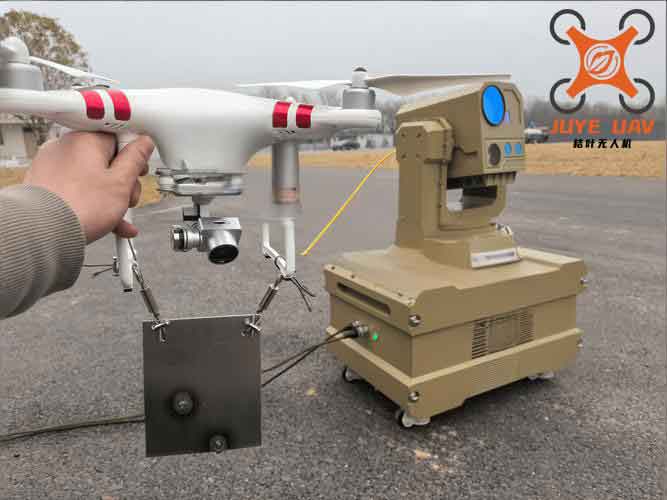
The transition from a simulator to a practical spoofer is epitomized by the “receiver-spoofer” architecture, which balances capability and complexity. The receiver module operates in real-time to estimate the authentic signal environment: it acquires and tracks genuine GNSS signals, decodes navigation messages, and computes the target’s current state (position, velocity, time) and the true pseudoranges/phase observables. This information serves as the essential reference. The spoofer module then performs the inverse process: using the target’s estimated or desired spoofed trajectory, it calculates the corresponding set of falsified pseudoranges $$ \tilde{\rho}_{spoof,i} $$. It encodes these into navigation messages, modulates them onto carrier waves precisely synchronized to the authentic signals, and broadcasts them at a slightly higher power to achieve takeover. This architecture is fundamental to modern anti-UAV spoofing systems.
Theoretical Models for UAV Navigational Spoofing
To effectively model and plan a spoofing attack within an anti-UAV engagement, one must consider the target’s internal control loops. The UAV’s GNC system provides the perfect framework. Spoofing attacks the Navigation module, providing it with false position/velocity data. This corrupted state estimate then propagates through the Guidance and Control modules, causing erroneous flight corrections. Two primary analytical models have been developed to understand and exploit this chain.
State Estimation and Control (SEC) Model
This model focuses on the internal state dynamics of the UAV. It treats the spoofer as an entity attempting to inject a false state estimate into the UAV’s navigation filter (e.g., a Kalman Filter). The model often formulates the problem using Linear Quadratic Gaussian (LQG) control theory. The UAV’s simplified kinematics can be represented in state-space form. The spoofing objective is to design a spoofed measurement sequence that causes the UAV’s state estimator to converge to a desired, false state $$ \mathbf{x}_{spoof} $$. A common approach models the spoofed pseudorange input as a control signal in a feedback loop that includes the UAV’s own controller (e.g., a Proportional-Derivative controller). The analysis involves ensuring that the spoofing-induced innovation sequence remains within the receiver’s validation gate to avoid detection, while the closed-loop system dynamics drive the UAV toward the spoofed trajectory. The spoofing signal $$ \Delta \rho $$ becomes a function of the state estimation error:
$$
\Delta \rho(t) = \mathbf{K} \cdot (\mathbf{x}_{spoof}(t) – \hat{\mathbf{x}}_{uav}(t))
$$
where $$ \mathbf{K} $$ is a gain matrix derived from both the estimator and controller dynamics, and $$ \hat{\mathbf{x}}_{uav} $$ is the UAV’s own state estimate. This model is powerful for analyzing the stability and stealthiness of a spoofing attack from the UAV’s perspective.
Particle Hypothesis and Planning (PHP) Model
In contrast to the SEC model’s internal focus, the PHP model adopts an external, behavioral perspective. It simplifies the UAV to a kinematic particle or a non-holonomic vehicle (like a Dubins car) and focuses on the relationship between the spoofing signal input and the UAV’s resultant “motion behavior”—specifically its heading and cross-track error. The model leverages standard path-following algorithms (e.g., Line-of-Sight guidance) used by UAVs. The core idea is to learn or model the mapping $$ \mathcal{F} $$ between the sequence of spoofed positions $$ \{\mathbf{p}_{spoof}(t)\} $$ broadcast by the spoofer and the resulting sequence of UAV heading angles $$ \{\psi_{uav}(t)\} $$ or lateral deviations:
$$
\{\psi_{uav}(t)\} = \mathcal{F}(\{\mathbf{p}_{spoof}(t)\})
$$
This mapping $$ \mathcal{F} $$ can be derived analytically from the UAV’s known guidance law or learned empirically via data-driven techniques like Support Vector Regression. Once this model is established, the spoofing problem transforms into a trajectory planning problem: find the optimal spoofed trajectory $$ \{\mathbf{p}_{spoof}(t)\} $$ that, when processed by the UAV’s guidance law $$ \mathcal{F} $$, produces the actual UAV flight path $$ \{\mathbf{p}_{actual}(t)\} $$ that matches the attacker’s desired capture or diversion path. This model is particularly useful for anti-UAV operators to plan and predict the outcome of a spoofing engagement.
| Model | Core Focus | UAV Representation | Primary Output | Perspective |
|---|---|---|---|---|
| SEC (State Estimation & Control) | Internal state dynamics, filter corruption. | Dynamic system with estimator and controller. | Spoofing signal as control input; analysis of estimation error convergence. | Inside the UAV’s GNC loop. |
| PHP (Particle Hypothesis & Planning) | External motion behavior, path following. | Kinematic particle or guided vehicle. | Mapping between spoofed track and UAV heading; optimal deception path planning. | Outside the UAV, as an observer/attacker. |
The synergy between these models is key for advanced anti-UAV spoofing. The SEC model provides insights into the constraints for stealth (e.g., maximum allowable pseudorange rate error), which can inform the parameters used in the PHP model’s planning phase. Conversely, the PHP model’s path-planning output defines the macroscopic trajectory that the SEC model must implement through careful state manipulation.
Tactical Employment in Anti-UAV Operations
Navigational spoofing is a versatile tool that can be employed in both defensive and offensive anti-UAV operational modes, often integrated within a larger countermeasure ecosystem.
Defensive/Area Denial Mode: This mode aims to create a “virtual no-fly zone.” A spoofer continuously broadcasts signals that define an impermissible or hazardous navigation solution (e.g., a position far away, or inconsistent signals causing loss of integrity) within a protected volume. Any GNSS-dependent UAV entering this volume will either be unable to navigate or will be driven to autonomously exit it. This is highly effective for persistent, wide-area protection of critical infrastructure. The technique is passive from an engagement radar perspective and offers a low-cost, low-power blanket defense, making it ideal for safeguarding military bases, government facilities, or public events against rogue or intrusive drones.
Offensive/Decoy & Capture Mode: This is a more targeted, active engagement. It requires initial detection, tracking, and classification of a specific hostile UAV by other sensors (e.g., radar, electro-optics). Once identified, the spoofer initiates a sophisticated attack. Starting with a subtle position offset, it gradually “pulls” the UAV’s estimated position away from its true course, guiding it along a pre-planned deception trajectory. This trajectory is calculated using the PHP model to ensure the UAV follows smoothly, often ending in a designated capture zone. The ultimate goal is force preservation and intelligence gathering: once lured to a safe area, the compromised UAV can be forced to land via continued spoofing or complementary link jamming, and then physically captured for forensic analysis. This mode exemplifies the “soft-kill” advantage within an anti-UAV strategy.
Integration in the Kill Chain: Effective anti-UAV warfare relies on a seamless “Detect-Track-Identify-Decide-Neutralize” chain. Navigational spoofing primarily serves the “Neutralize” function but is deeply dependent on the earlier phases. Modern integrated anti-UAV systems (C-UAS) combine spoofing with other tools:
- Detection & Tracking: Radar, RF scanners, and EO/IR cameras provide the initial cue and persistent track.
- Identification & Decision: AI-based classification determines UAV type and intent. The command system decides on the appropriate response (e.g., warn, spoof, jam, destroy).
- Neutralization: Spoofing is employed for covert diversion or capture. If spoofing fails or is inappropriate, the system can escalate to:
- Kinetic Effects: High-power microwaves (HPM) or lasers to disable electronics; net guns or interceptors for physical destruction.
- Electronic Warfare: GNSS jamming or datalink jamming for immediate denial.
Spoofing’s role is often the first and most elegant option, minimizing collateral damage and preserving evidence. The future of anti-UAV technology lies in the tight, automated integration of these heterogeneous effects, with spoofing as a key enabling capability for controlled outcomes.
Conclusion and Future Trajectory
Navigational spoofing has matured into a cornerstone technology for contemporary anti-UAV defense. Its evolution from precision simulation laboratories to field-deployable “receiver-spoofer” systems underscores its technical viability. The development of robust theoretical models, such as the SEC and PHP frameworks, provides a principled approach to designing effective and stealthy deception campaigns, moving the field from art to science. Operationally, spoofing offers unique strategic value, enabling everything from wide-area denial to precision entrapment of high-value hostile drones, filling a critical niche between mere detection and destructive engagement.
The future development path for anti-UAV spoofing points towards greater intelligence, distribution, and resilience. Key research frontiers include:
- AI-Enhanced Spoofing Strategies: Machine learning algorithms that can dynamically adapt spoofing signals in real-time to counter evolving UAV navigation algorithms and anomaly detection techniques.
- Cooperative & Distributed Spoofing: Networks of low-power, synchronized spoofing nodes that can create complex, spatially consistent deception fields, making detection via direction-finding or multi-antenna receivers vastly more difficult. This is crucial against sophisticated UAVs employing Receiver Autonomous Integrity Monitoring (RAIM) or Advanced Receiver Integration (ARI).
- Multi-Platform and Multi-GNSS Spoofing: Developing agile spoofers that can simultaneously target UAVs using different GNSS constellations (GPS, GLONASS, BeiDou, Galileo) and those fusing GNSS with other navigation sources (INS, visual odometry), requiring more sophisticated sensor fusion deception techniques.
As UAV threats continue to diversify and proliferate—especially with the advent of coordinated drone swarms—the importance of scalable, non-kinetic countermeasures like navigational spoofing will only grow. Accelerating progress in this domain demands sustained, collaborative efforts across defense, industry, and academic research institutions to pioneer the next generation of intelligent anti-UAV spoofing systems, ensuring dominance in the contested electromagnetic and navigational domains.