
The coordinated operation of multiple Unmanned Aerial Vehicles (UAVs), known as a drone formation, has transcended from a research concept to a critical operational paradigm. The advantages of a drone formation over a single UAV are manifold, including enhanced area coverage for surveillance, distributed sensor networks, cooperative payload transport, and inherent robustness through redundancy. My research focuses on advancing the control methodologies for these complex drone formation systems, particularly under challenging real-world conditions where system failures are inevitable.
Traditional formation control strategies, such as leader-follower, virtual structure, or behavior-based methods, often lack the predictive capability and explicit constraint handling required for safe, close-proximity flight in dynamic environments. Model Predictive Control (MPC) offers a powerful framework by solving an optimization problem at each time step to determine control actions that minimize a future cost function while respecting system dynamics and constraints. For a large-scale drone formation, a centralized MPC controller becomes computationally intractable. Therefore, Distributed Model Predictive Control (DMPC) is employed, where each UAV solves its own local optimization problem based on information exchanged with its neighbors. The synchronous variant of DMPC is particularly attractive as it coordinates the update cycles of all agents, requiring only one communication exchange per sampling period, thereby significantly reducing communication burdens and simplifying implementation.
As missions for drone formation become more ambitious—involving larger fleets, multi-target operations, or heterogeneous functional groups—treating the entire swarm as a single entity is insufficient. A drone formation must often be subdivided into smaller, coordinated groups. This grouping enhances scalability, allows for simultaneous engagement with multiple objectives, and enables the assignment of distinct roles (e.g., scouts, attackers, communication relays) within the overall drone formation. However, this architectural shift introduces new layers of complexity, especially when considering system faults.
Most existing fault-tolerant control research for multi-agent systems addresses faults where the affected agent can recover or be compensated for, allowing the formation to continue intact. A critical, yet less studied, scenario involves irreparable faults—catastrophic failures like a complete loss of propulsion, critical sensor/actuator damage, or communication module burnout—that force a UAV to become inoperable and exit the drone formation permanently. In a grouped drone formation, the impact of such a fault depends crucially on the role of the failed agent. The loss of a group leader is far more disruptive than the loss of a follower. Therefore, a comprehensive control strategy must integrate a resilient grouping architecture with a proactive fault management policy.
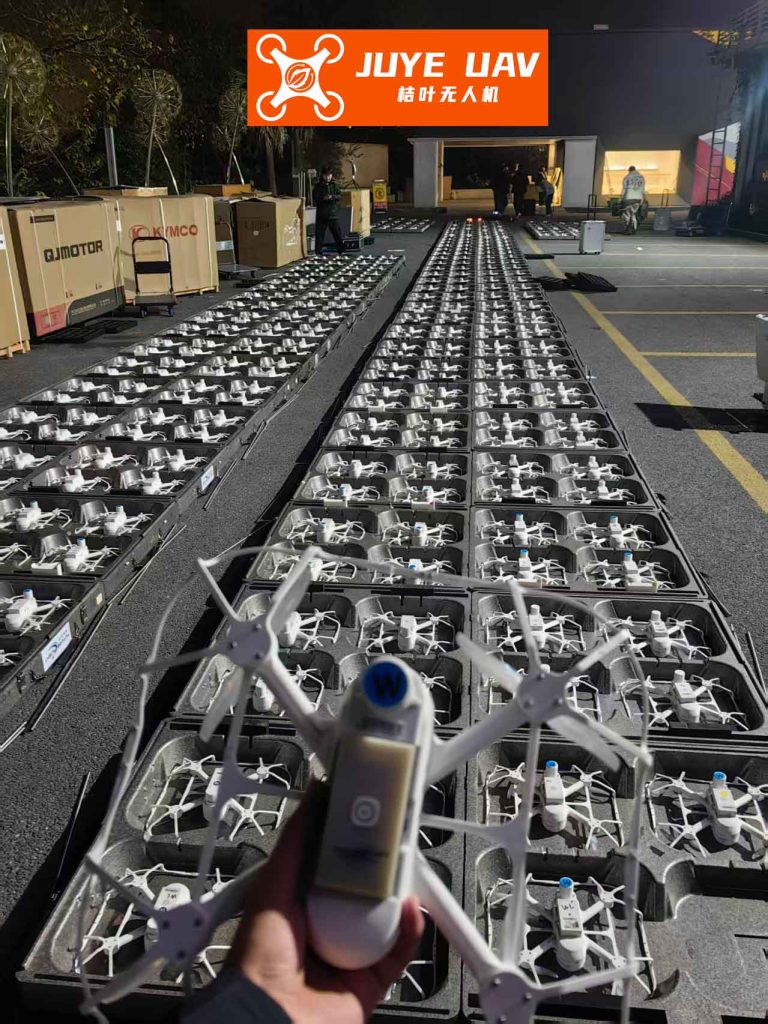
This article presents a novel integrated solution for fault-tolerant grouping formation control. I first establish a hierarchical, grouped control architecture that incorporates virtual leaders. Then, I formally model irreparable faults and propose an Interactive Health Discrimination Mechanism coupled with a “Fault Isolation” strategy. This leads to a robust control scheme for a drone formation under fault conditions. The core of the solution is a synchronous DMPC algorithm, meticulously designed to incorporate the fault model and isolation strategy. I provide a detailed design for a single-group formation controller and then extend it to the full hierarchical grouping architecture. Finally, using Lyapunov theory, I prove the recursive feasibility and stability of the overall drone formation system under the proposed control laws. Numerical simulations demonstrate the superior performance of my approach in maintaining mission objectives even after severe, irreparable faults occur within the drone formation.
1. Hierarchical Grouping Architecture and Problem Formulation
The proposed architecture for a resilient drone formation is built on two organizing principles: grouping (horizontal division) and layering (vertical division). Consider a drone formation $mathcal{F}$ consisting of $N_v$ UAVs. This formation is partitioned into $M$ distinct groups. Each group $m in {1, ldots, M}$ contains one Group Leader and a set of $N_m$ Followers, such that $sum_{m=1}^{M} (1 + N_m) = N_v$. The sets of all leaders and all followers are denoted as $mathcal{N}_L$ and $mathcal{N}_F$, respectively.
The layering establishes a two-tier hierarchy:
- Leader Layer: The $M$ Group Leaders form this layer. Their primary objective is to track a global reference trajectory, denoted by a Virtual Global Leader, while maintaining a desired inter-leader formation pattern.
- Follower Layer: The followers are distributed among the $M$ groups. The primary objective of a follower in group $m$ is to track a Virtual Group Leader for its group while maintaining the desired intra-group formation geometry.
The Virtual Group Leader’s trajectory is not independent; it is derived from the Global Leader’s trajectory with a fixed geometric offset specific to group $m$. This architecture decouples the groups at the follower level—a follower’s reference is tied to its group’s virtual leader, not to the physical leader of another group. This design is fundamental for fault tolerance, as it localizes the impact of a leader failure to its own layer.
Each UAV $i$ in the drone formation is modeled with simplified dynamics. Assuming an inner-loop autopilot reliably tracks velocity commands, the dynamics can be represented as a first-order system in the outer loop. The continuous-time model for UAV $i$ is:
$$
dot{mathbf{z}}_i = begin{bmatrix} dot{mathbf{p}}_i \ dot{mathbf{v}}_i end{bmatrix} = mathbf{A} mathbf{z}_i + mathbf{B} mathbf{u}_i
$$
where $mathbf{z}_i = [mathbf{p}_i^T, mathbf{v}_i^T]^T in mathbb{R}^6$ is the state (position $mathbf{p}_i$ and velocity $mathbf{v}_i$), and $mathbf{u}_i in mathbb{R}^3$ is the velocity command. The matrices are $mathbf{A} = begin{bmatrix} mathbf{0} & mathbf{I} \ mathbf{0} & -tau_v mathbf{I} end{bmatrix}$ and $mathbf{B} = begin{bmatrix} mathbf{0} \ tau_v mathbf{I} end{bmatrix}$, with $tau_v$ as the time constant. This model is discretized with sampling period $T_s$ for the MPC formulation:
$$
mathbf{z}_i(k+1) = mathbf{G} mathbf{z}_i(k) + mathbf{H} mathbf{u}_i(k)
$$
where $mathbf{G}=e^{mathbf{A}T_s}$ and $mathbf{H}=int_0^{T_s} e^{mathbf{A}tau} dtau , mathbf{B}$.
Each UAV is subject to state and input constraints:
$$
begin{aligned}
mathbf{z}_i(k) ∈ mathcal{Z}_i triangleq { mathbf{z} in mathbb{R}^6 : |mathbf{E}_{lambda}^z mathbf{z}| leq bar{z}_{i,lambda}, lambda=1,ldots,6 } \
mathbf{u}_i(k) ∈ mathcal{U}_i triangleq { mathbf{u} in mathbb{R}^3 : |mathbf{E}_{lambda}^u mathbf{u}| leq bar{u}_{i,lambda}, lambda=1,ldots,3 }
end{aligned}
$$
The control objectives for the drone formation are:
- Trajectory Tracking: $lim_{k to infty} (mathbf{p}_i(k) – mathbf{p}_r(k)) = mathbf{d}_{ir}$.
- Formation Keeping: $lim_{k to infty} (mathbf{p}_i(k) – mathbf{p}_j(k)) = mathbf{d}_{ij}, forall j in mathcal{N}_i$.
- Collision Avoidance: $| mathbf{p}_i(k) – mathbf{p}_j(k) | geq 2R, forall j neq i$.
Here, $mathbf{d}_{ir}$ and $mathbf{d}_{ij}$ are constant desired offsets, $mathcal{N}_i$ is the communication neighborhood of UAV $i$, and $R$ is the safety radius.
2. Fault Modeling and the Proposed Control Scheme
An irreparable fault, such as a motor seizure or battery fire, renders a UAV incapable of continuing its mission. From the perspective of the drone formation control system, the primary effect is the abrupt and permanent removal of that agent from the communication and coordination network.
Let the nominal communication topology of the drone formation be described by an undirected graph $mathcal{G}=(mathcal{V}, mathcal{E}, mathbf{W})$, where $mathcal{V}$ is the node set, $mathcal{E}$ the edge set, and $mathbf{W}=[omega_{ij}]$ the adjacency matrix ($omega_{ij}=1$ if UAVs $i$ and $j$ communicate). When UAV $j$ suffers an irreparable fault at time $k_f$, its communication links are severed. This is modeled by a time-dependent health parameter $sigma_j(k, k_f)$ applied to the adjacency weights:
$$
omega’_{ij}(k) = sigma_j(k, k_f) cdot omega_{ij}, quad sigma_j(k, k_f) = begin{cases} 1, & k < k_f \ 0, & k geq k_f end{cases}
$$
where $mathbf{W}’=[omega’_{ij}]$ is the post-fault adjacency matrix.
For the drone formation to adapt, healthy UAVs must be aware of the fault status of their neighbors. I propose an Interactive Health Discrimination Mechanism. Each UAV $i$ periodically performs a self-check, generating a health flag $flag_i(k) in {0,1}$. This flag is embedded in the standard state information broadcast to neighbors. Upon receiving information from neighbor $j$, UAV $i$ checks $flag_j(k)$. If $flag_j(k)=1$, UAV $j$ is considered healthy ($hat{sigma}_j(k)=1$); otherwise (if the flag is 0 or no data is received), it is considered faulty ($hat{sigma}_j(k)=0$). This distributed mechanism allows each UAV to locally update its perception of the network topology, enabling the application of the core “Fault Isolation” Strategy.
The “Fault Isolation” Strategy is simple yet effective: once a UAV $j$ is identified as faulty by neighbor $i$, the corresponding communication link weight $omega_{ij}$ in $i$’s local controller is set to zero. This effectively removes the faulty node from the local control graph of all healthy agents, minimizing its disruptive influence on the cooperative control calculations.
Integrating this strategy with the hierarchical grouping architecture yields the complete Fault-Tolerant Grouping Formation Control Scheme:
- For Followers: A follower tracks its Virtual Group Leader. If a follower in the group fails, it is isolated. The fault is contained within the group, and the remaining followers continue their task unaffected.
- For Leaders: A Group Leader tracks the Virtual Global Leader. If a leader fails, it is isolated at the leader layer. Crucially, because the followers in that leader’s group track a Virtual Group Leader (which is a computed trajectory, not the physical leader), they can continue their mission seamlessly. This avoids the need for complex and risky “leader promotion” strategies within groups.
This scheme ensures that a single irreparable fault, whether in a follower or a leader, does not cascade to cause the failure of an entire group or destabilize the whole drone formation.
3. Synchronous DMPC Algorithm Design
I now design the synchronous DMPC controller that implements the above scheme. The key idea is for each UAV $i$ to solve a local finite-horizon optimal control problem at time $k$, using assumed trajectories $hat{mathbf{z}}_j(cdot|k)$ received from its neighbors $j$ and its own assumed trajectory from the previous step.
3.1 Local Optimization Problem
For UAV $i$ at time $k$, the optimization problem over a horizon $N$ is defined. The cost function $J_i$ balances trajectory tracking, formation keeping with neighbors, and control effort:
$$
J_i(k) = sum_{l=0}^{N-1} L_i(k+l|k) + L_i^f(k+N|k)
$$
$$
L_i(k+l|k) = alpha_i |Delta mathbf{z}_i(k+l|k)|^2 + beta_i sum_{j in mathcal{N}_i} omega_{ij} |mathbf{z}_{ij}(k+l|k)|^2 + rho_i |Delta mathbf{u}_i(k+l|k)|^2
$$
$$
L_i^f(k+N|k) = |Delta mathbf{z}_i(k+N|k)|^2_{mathbf{P}_i}
$$
where:
- $Delta mathbf{z}_i = mathbf{z}_i – (mathbf{z}_r + mathbf{d}_{ir}^z)$ is the tracking error.
- $mathbf{z}_{ij} = mathbf{z}_i – mathbf{z}_j – mathbf{d}_{ij}^z$ is the formation error with neighbor $j$.
- $Delta mathbf{u}_i = mathbf{u}_i – mathbf{u}_r$ is the control deviation from the reference.
- $alpha_i, beta_i, rho_i > 0$ are weighting coefficients.
The problem is subject to the following constraints for $l = 0, …, N-1$:
- Dynamics: $mathbf{z}_i(k+l+1|k) = mathbf{G} mathbf{z}_i(k+l|k) + mathbf{H} mathbf{u}_i(k+l|k)$.
- State/Input Constraints: $mathbf{z}_i(k+l|k) in mathcal{Z}_i$, $mathbf{u}_i(k+l|k) in mathcal{U}_i$.
- Collision Avoidance: A robust constraint based on assumed neighbor positions $hat{mathbf{p}}_j$:
$$|mathbf{p}_i(k+l|k) – hat{mathbf{p}}_j(k+l|k)| geq omega_{ij}[2R + mu_{ij}(k+l|k)]$$ - State Compatibility: To ensure the assumed and optimized states do not diverge excessively, guaranteeing stability:
$$|mathbf{z}_i(k+l|k) – hat{mathbf{z}}_i(k+l|k)| leq nu_i(k)$$
The bound $nu_i(k)$ is computed online from parameters and the previous optimization results. - Terminal Constraint: $Delta mathbf{z}_i(k+N|k) in Omega_i$, a terminal invariant set.
The terminal set $Omega_i = { Delta mathbf{z} : |Delta mathbf{z}|^2_{mathbf{P}_i} leq delta_i }$ and the terminal controller $mathbf{u}_i^kappa(k+N|k) = mathbf{K}_i Delta mathbf{z}_i(k+N|k) + mathbf{u}_r(k+N)$ are designed offline via Linear Matrix Inequalities (LMIs) to ensure recursive feasibility and stability. The matrices $mathbf{P}_i>0$, $mathbf{K}_i$, and scalar $delta_i>0$ are solutions to:
$$
begin{aligned}
&max_{delta_i, mathbf{S}_i, mathbf{Y}_i} text{tr}(mathbf{S}_i) \
&text{subject to:} \
&begin{bmatrix} (bar{u}_{lambda} – u_{r,lambda})^2 & mathbf{E}_lambda^u mathbf{Y}_i \ * & mathbf{S}_i end{bmatrix} geq 0, \
&begin{bmatrix} (bar{z}_{lambda} – z_{r,lambda})^2 & mathbf{E}_lambda^z (mathbf{G}mathbf{S}_i + mathbf{H}mathbf{Y}_i) \ * & mathbf{S}_i end{bmatrix} geq 0, \
&begin{bmatrix} D_i^2 mathbf{I}_3 & mathbf{C} mathbf{S}_i \ * & mathbf{S}_i end{bmatrix} geq 0, \
&begin{bmatrix} mathbf{S}_i & * & * & * \ mathbf{G}mathbf{S}_i+mathbf{H}mathbf{Y}_i & mathbf{S}_i & * & * \ mathbf{Q}_i^{1/2} mathbf{S}_i & mathbf{0} & delta_i mathbf{I} & * \ mathbf{R}_i^{1/2} mathbf{Y}_i & mathbf{0} & mathbf{0} & delta_i mathbf{I} end{bmatrix} geq 0
end{aligned}
$$
where $mathbf{S}_i = delta_i mathbf{P}_i^{-1}$, $mathbf{Y}_i = mathbf{K}_i mathbf{S}_i$, $mathbf{Q}_i = alpha_i mathbf{I} + sum_{j in mathcal{N}_i} 2omega_{ij}(beta_i+beta_j)mathbf{I}$, and $mathbf{R}_i = rho_i mathbf{I}$.
3.2 Integrated Fault-Tolerant Algorithm
The synchronous DMPC algorithm seamlessly integrates the fault isolation strategy. At each time step $k$, UAV $i$:
- Measures its state $mathbf{z}_i(k)$ and receives assumed trajectories and health flags $flag_j(k)$ from neighbors.
- Executes the Interactive Health Discrimination: $hat{sigma}_j(k) = 1$ if $flag_j(k)=1$, else $hat{sigma}_j(k)=0$.
- Updates its local adjacency weights: $omega_{ij}^{text{current}}(k) = hat{sigma}_j(k) cdot omega_{ij}^{text{nominal}}$.
- Solves its local optimization problem (as defined in Section 3.1) using the updated weights $omega_{ij}^{text{current}}(k)$ in the cost and constraints. For a healthy UAV, this yields the optimal control sequence.
- Applies the first control input $mathbf{u}_i^*(k|k)$.
- Computes its assumed trajectory for the next step: $hat{mathbf{z}}_i(l|k+1) = mathbf{z}_i^*(l|k)$ for $l=1,…,N-1$, and $hat{mathbf{z}}_i(N|k+1)$ using the terminal controller. This trajectory is shared with neighbors.
The algorithm works identically for leaders and followers in the hierarchical drone formation. The only difference lies in the reference trajectory: leaders track the Virtual Global Leader’s trajectory $mathbf{z}_r$, while followers in group $m$ track their Virtual Group Leader’s trajectory $mathbf{z}_{r_m} = mathbf{z}_r + mathbf{d}_{mr}^z$.
3.3 Stability Analysis
Under the proposed algorithm, the drone formation system is input-to-state stable with respect to the reference trajectory, even after irreparable faults. The proof is based on Lyapunov theory, considering the sum of all healthy UAVs’ optimal cost functions, $J_Sigma^*(k) = sum_{i in mathcal{N}_r(k)} J_i^*(k)$, as a candidate Lyapunov function.
Theorem (Stability): Consider a drone formation under the proposed synchronous DMPC control law with the fault isolation strategy. If a feasible solution exists at initialization ($k=0$), then:
- Recursive Feasibility: The local optimization problem for every healthy UAV $i in mathcal{N}_r(k)$ remains feasible for all $k geq 0$, regardless of fault occurrences at times $k_f$.
- Stability: The overall system is asymptotically stable. The Lyapunov function satisfies $J_Sigma^*(k+1) – J_Sigma^*(k) leq -sum_{i in mathcal{N}_r(k)} (1-gamma_i) alpha_i |Delta mathbf{z}_i(k)|^2 leq 0$, ensuring convergence of tracking and formation errors.
Proof Sketch: The proof is conducted in three phases.
- Phase 1 (Before fault, $k < k_f$): Feasibility is shown by constructing a candidate solution at $k+1$ from the optimal solution at $k$, appending the terminal controller. Stability follows by analyzing the decrease in $J_Sigma^*$.
- Phase 2 (At the fault instant, $k = k_f$): The isolation strategy sets $omega_{ij}=0$ for the faulty UAV $j$. The candidate solution from Phase 1 remains feasible under the new topology because constraints involving the faulty agent become inactive or trivially satisfied. The change in the Lyapunov function is bounded and non-positive.
- Phase 3 (After fault, $k > k_f$): The system behaves as a new, smaller drone formation with a fixed topology. Recursive feasibility and stability are guaranteed by the same arguments as in Phase 1, relying on the invariant terminal components designed via LMIs.
Thus, the drone formation control system is resilient to irreparable faults.
4. Simulation Results and Performance Analysis
To validate the proposed framework, I present simulations comparing its performance against baseline methods in fault scenarios. The UAV dynamics use $tau_v=3$, $T_s=0.2$s, and prediction horizon $N=5$. Weights are $alpha_i=1, beta_i=1, rho_i=0.1$.
4.1 Scenario 1: Single-Group Formation Under Fault
A drone formation of 7 UAVs in a single group tracks a curved trajectory. At $t=5$s, the central leader (UAV 4) suffers an irreparable fault. Three controllers are compared: 1) A standard consensus-based controller, 2) An Artificial Potential Field (APF) method, and 3) The proposed synchronous DMPC with fault isolation.
The following table summarizes the key performance metrics after the fault:
| Performance Metric | Consensus Control | APF Method | Proposed DMPC |
|---|---|---|---|
| Mission Continuity | Failed – Formation diverges | Maintained | Maintained |
| Tracking Error Settling Time (<7m) | N/A | ~2.4 s | ~1.6 s |
| Formation Error Settling Time (<21m) | N/A | ~2.4 s | ~1.9 s |
| Min. Inter-Agent Distance | Collision Risk | > 2R (Safe) | > 2R (Safe) |
| Lyapunov Function $J_Sigma^*$ | Diverges | Non-monotonic | Strictly decreasing |
The results confirm that the proposed algorithm maintains formation coherence and tracking, exhibits faster convergence (lower settling times), and guarantees strict stability per the Lyapunov proof, unlike the other methods. The fault is successfully isolated, and the remaining drone formation re-stabilizes.
4.2 Scenario 2: Hierarchical Grouped Formation Under Fault
A drone formation of 11 UAVs is divided into 3 groups (with 3 leaders and 8 followers) performing an escort mission. At $t=6$s, a group leader (UAV 3) and two followers from different groups suffer irreparable faults. Three grouping schemes are compared:
- Scheme 1 (Baseline): Followers track the physical leader’s trajectory. No fault handling.
- Scheme 2 (Backup Leader): Followers track the physical leader. Upon leader fault, a pre-designated “backup” follower in the group replaces it.
- Scheme 3 (Proposed): The hierarchical architecture with virtual leaders and the DMPC-based fault isolation strategy.
The performance comparison is stark, as shown below:
| Aspect | Scheme 1 (Baseline) | Scheme 2 (Backup Leader) | Scheme 3 (Proposed) |
|---|---|---|---|
| Effective Survival Rate | 5/11 (45%) – Followers of faulty leader crash. | 8/11 (73%) | 8/11 (73%) |
| Control Input Behavior | N/A for crashed agents. | Abrupt jumps in backup leader & its followers’ controls. | Smooth, no jumps in any healthy agent’s control. |
| Tracking Error Post-Fault | Permanently large for affected group. | Significant spike, then slow recovery. | Continuous, smooth decay, no spike. |
| System Stability Continuity | Lost for part of the formation. | Disrupted; Lyapunov function jumps, needs re-stabilization. | Preserved; Lyapunov function decreases monotonically throughout. |
These results highlight the superiority of the proposed architecture. While Scheme 2 achieves the same survival rate, it does so at the cost of control discontinuity and transient instability, which are hazardous in practice. The proposed Scheme 3, by leveraging virtual leaders and isolation, achieves high survivability while maintaining smooth, stable control for the entire healthy drone formation throughout the fault event. This validates the core thesis: a grouping architecture designed jointly with a fault-isolation strategy within a robust DMPC framework creates a highly resilient drone formation control system.
5. Conclusion
In this work, I have addressed the critical challenge of controlling a multi-UAV drone formation in the presence of irreparable agent failures. The proposed solution is a comprehensive integration of a hierarchical grouping architecture, a distributed fault discrimination and isolation strategy, and a rigorously designed synchronous Distributed Model Predictive Control (DMPC) algorithm. The grouping architecture, featuring virtual leaders, naturally localizes the impact of faults. The “Fault Isolation” strategy, executed via an Interactive Health Discrimination Mechanism, proactively removes faulty agents from the control network. The synchronous DMPC provides the predictive, constrained optimization backbone that ensures stability, satisfies collision constraints, and seamlessly incorporates the changing network topology due to faults.
I provided a detailed formulation of the local optimization problem, including tailored collision avoidance and state compatibility constraints, and designed the terminal components via LMIs to guarantee stability. The formal proof demonstrates recursive feasibility and input-to-state stability even after fault occurrences. Extensive simulations compared the approach against existing methods in both single-group and complex grouped formation scenarios. The results unequivocally show that the proposed framework maintains mission objectives, ensures smoother and safer control actions, and preserves stability continuity far better than baseline or alternative fault-handling strategies like leader promotion.
This work advances the state-of-the-art in reliable autonomous systems, paving the way for the deployment of robust drone formation in safety-critical applications where system failures must be expected and gracefully managed. Future work will focus on extending the framework to handle simultaneous faults in communication links and vehicle dynamics, and on experimental validation with hardware UAV platforms.