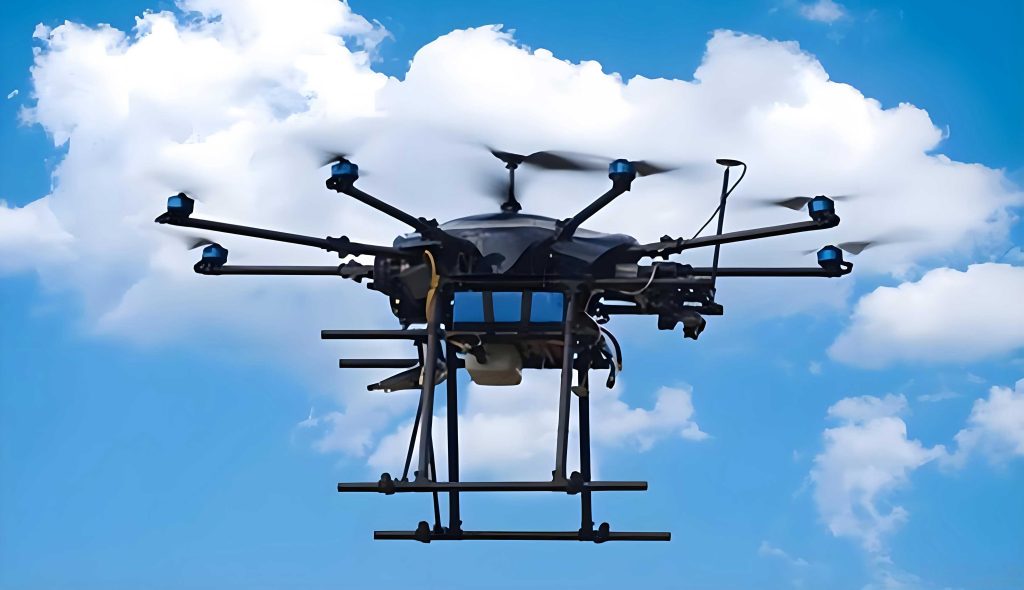
In this paper, we present a comprehensive modeling and resilience evaluation framework for unmanned aerial vehicle (UAV) swarms that are tasked with multiple mission payloads. Our approach integrates communication network topology with task-specific performance metrics, enabling a robust assessment of swarm resilience under various attack scenarios. We focus on three typical military missions: reconnaissance, strike, and command. By defining novel performance functions that combine area coverage, focus, time, and network efficiency, we quantify the degradation and recovery processes of UAV swarm systems. We propose a relay-based recovery strategy that prioritizes the restoration of critical bridging UAVs, significantly improving resilience compared to traditional methods. Extensive simulations demonstrate that our model captures the nuanced behavior of UAV swarms under both random and targeted attacks, providing valuable insights for designing resilient autonomous systems.
1. Introduction
UAV swarms have become indispensable in modern military and civilian applications due to their scalability, cost efficiency, and ability to perform complex collaborative tasks. However, real-world operations expose these swarms to various disturbances such as electromagnetic interference, network jamming, and anti-aircraft strikes, which can degrade mission performance. Ensuring that a UAV swarm can maintain essential functions and recover quickly from disruptions — its resilience — is critical for mission success.
Existing research on UAV swarm resilience often overlooks the coupling between multi-task requirements and communication structures. Many models treat the swarm as a homogeneous network, failing to capture the heterogeneous payloads that execute different mission roles. Moreover, resilience metrics rarely quantify the collapse interval — the region where performance drops to zero under sustained attacks. To address these gaps, we propose a layered network model driven by multi-task payloads, define mission-specific performance indices, and introduce a collapse-aware resilience assessment methodology.
Our key contributions are threefold. First, we construct a hierarchical communication network that reflects both physical communication links and task cooperation relationships among UAVs. Second, we develop performance functions tailored to reconnaissance, strike, and command missions, incorporating area, focus, time, and network efficiency factors. Third, we propose a relay UAV recovery strategy that enhances swarm resilience, and we validate our approach through extensive simulations under four attack types.
2. Layered Network Model for UAV Swarms
We model the UAV swarm as a two-layer network: the communication layer and the task payload layer. The communication layer is an undirected graph \( G = (V, E) \), where vertices represent individual UAV drones and edges represent bidirectional communication links. The task payload layer is a multigraph where nodes are the payloads carried by each UAV drone, and edges represent cooperative relationships for specific tasks (e.g., a UAV drone with a reconnaissance camera coordinates with a UAV drone carrying a strike weapon). These two layers are coupled one-to-one: each communication-layer node maps to exactly one payload-layer node.
To generate a realistic communication network, we start with a fully connected core of \( n_0 \) UAV drones. New UAV drones join by establishing links with existing nodes based on a probability that depends on node degree and physical distance. The probability that a new node \( i \) connects to an existing node \( j \) at time \( t \) is given by:
$$ P_{i \to j}(W_t) = \frac{k_j + \epsilon}{\sum_{l \in V_t} (k_l + \epsilon)} \cdot F(d_{i \to j}) $$
where \( k_j \) is the degree of node \( j \), \( \epsilon \) is a small positive constant to avoid zero probability, and \( F(d_{i \to j}) \) is a distance-dependent function defined as:
$$ F(d) = \begin{cases} 1, & d < r_c \\ \frac{r_c – d}{r_c(1-\eta)}, & r_c \leq d < \frac{r_c}{\eta} \\ 0, & d \geq \frac{r_c}{\eta} \end{cases} $$
Here \( r_c \) is the communication range and \( \eta \) is a tuning parameter. We also impose a maximum degree \( k_{\max} \) per node to prevent congestion and single-point failures. The network dynamically adapts: if a link is removed due to distance or degree constraints, the affected nodes attempt to reconnect using the same probability rule.
Table 1 summarizes the key parameters used in our network construction.
| Parameter | Symbol | Value |
|---|---|---|
| Communication range | \( r_c \) | 50 (units) |
| Degree tuning | \( \eta \) | 0.6 |
| Bias constant | \( \epsilon \) | 0.4 |
| Maximum degree | \( k_{\max} \) | 12 |
| Initial core size | \( n_0 \) | 5 |
The task payload layer is constructed by connecting UAV drones that jointly participate in the same sub-mission. For each mission type (reconnaissance, strike, command), we define a set of required payloads. Two UAV drones share an edge in the payload layer if they cooperate on at least one sub-mission. This layered structure allows us to capture both communication constraints and mission interdependencies.
3. Performance Metrics for Multi-Mission Swarms
We define three mission-specific performance functions that combine network efficiency with task-oriented metrics.
3.1 Reconnaissance Performance
Reconnaissance missions aim to collect maximum information from a target area. The performance depends on the area covered by the swarm and the operational time of the reconnaissance payload. Let \( S(t) \) be the total covered area at time \( t \), and \( S_0 \) the initial coverage. The area factor \( R_S(t) = S(t)/S_0 \). The time factor \( R_T = L/T \), where \( L \) is the active duration of the reconnaissance payload and \( T \) is the total mission time. The reconnaissance performance is:
$$ P_C(t) = \frac{R_S(t) \cdot R_T}{L(t)} \cdot \sigma(t) $$
where \( \sigma(t) \) is the network connectivity ratio (fraction of UAV drones that remain connected). This product reflects that only information from connected UAV drones contributes to reconnaissance value.
3.2 Strike Performance
Strike missions require concentrated firepower on a target. We introduce a focus factor \( R_A(t) = A(t) / (\pi r_c^2) \), where \( A(t) \) is the overlapping area covered by multiple UAV drones (indicative of coordinated strike capability). The strike performance is:
$$ P_D(t) = \frac{R_S(t) + R_A(t)}{2} \cdot X(t) $$
Here \( X(t) \) is the network efficiency defined as:
$$ X(t) = \frac{1}{N(N-1)} \sum_{i \neq j} \frac{1}{d_{ij}(t)} $$
where \( d_{ij}(t) \) is the shortest path length between UAV drones \( i \) and \( j \) in the communication layer. This term ensures that precise target engagement requires good information relay among the swarm.
3.3 Command Performance
Command missions focus on timely dissemination of orders. The performance depends on the number of UAV drones that successfully receive a message and the decay of message value over time. Let \( M_i(t) \) be a message generated by UAV drone \( i \), \( \eta_i(t) \) be the number of recipients, and \( \delta_i \) be a decay factor based on transmission delay. The command performance is:
$$ P_Z(t) = \frac{\sum_{i=1}^{M(t)} \delta_i \cdot \eta_i(t) \cdot R_T}{\sum_{i=1}^{M(t)} \eta_i(t)} $$
where \( M(t) \) is the total number of messages in transit at time \( t \). This metric captures both the breadth and timeliness of command propagation.
We validated the sensitivity of these performance functions against simple metrics like coverage area or network efficiency alone. As shown in our simulations, the proposed functions exhibit higher sensitivity to node failures, making them more suitable for resilience assessment.
4. Attack Model and Resilience Assessment
4.1 Unified Attack Model
We consider four attack types: random electromagnetic interference, central UAV drone attacks, relay UAV drone attacks, and local UAV drone attacks. A unified probability formulation models the likelihood that a UAV drone \( i \) is attacked in phase \( l \):
$$ w_{i,l}(\psi, \alpha) = \frac{[\psi \cdot D_{il} + (1-\psi) \cdot 1]^{\xi}}{\sum_{j} [\psi \cdot D_{jl} + (1-\psi) \cdot 1]^{\xi}} $$
where \( \psi \in \{0,1,2,3\} \) selects the attack type:
- \( \psi = 0 \): random attack (all nodes equally likely, \( D_{il}=0 \))
- \( \psi = 1 \): central attack (\( D_{il} = k_{il} \), node degree)
- \( \psi = 2 \): relay attack (\( D_{il} = b_{il} \), betweenness centrality)
- \( \psi = 3 \): local attack (\( D_{il} = c_{il} \), local clustering coefficient)
\( \xi \) is a tuning parameter controlling attack intensity. Table 2 summarizes the node characteristics used for each attack mode.
| Attack type | \( \psi \) | Feature \( D_{il} \) | Physical meaning |
|---|---|---|---|
| Random electromagnetic interference | 0 | 0 | All UAV drones equally likely |
| Central UAV drone attack | 1 | \( k_{il} \) | Degree: targets hubs with many links |
| Relay UAV drone attack | 2 | \( b_{il} \) | Betweenness: targets bridges in information flow |
| Local UAV drone attack | 3 | \( c_{il} \) | Clustering: targets dense local groups |
4.2 Resilience Metric
We adopt a resilience metric that captures both degradation and recovery phases, incorporating a collapse interval where performance drops to zero. The resilience \( R \) is defined as:
$$ R = \alpha \cdot \delta_d \sigma_d \rho_d + \beta \cdot \delta_r \sigma_r \rho_r $$
where \( \alpha, \beta \) are weights (\( \alpha+\beta=1 \)), and the subscripts \( d \) and \( r \) denote degradation and recovery phases, respectively. The factors are computed from the performance curve over time:
| Factor | Degradation phase | Recovery phase |
|---|---|---|
| Process factor \( \delta \) | \( \delta_d = \frac{1}{y_0(t_r-t_d)} \int_{t_d}^{t_r} y(t) dt \) | \( \delta_r = \frac{1}{y_0(t_s-t_r)} \int_{t_r}^{t_s} y(t) dt \) |
| State factor \( \sigma \) | \( \sigma_d = \frac{y_{\min}}{y_0} \) | \( \sigma_r = \frac{y_s}{y_0} \) |
| Time factor \( \rho \) | \( \rho_d = \frac{\Delta t_d}{T_B} \) | \( \rho_r = \frac{\Delta t_r}{T_B} \) |
Here \( y(t) \) is the mission performance (e.g., \( P_C, P_D, P_Z \)), \( t_d, t_r, t_s \) are times of attack onset, recovery start, and stabilization, \( y_0 \) is initial performance, \( y_{\min} \) is minimum performance, \( y_s \) is steady-state performance after recovery, and \( T_B \) is a baseline time. The collapse interval is defined as the portion of the degradation phase where \( y(t)=0 \); this interval is implicitly captured by \( y_{\min}=0 \) and the integral over that period.
5. Recovery Strategy: Relay-Based Restoration
We propose a recovery strategy that prioritizes UAV drones with high betweenness centrality, as these nodes serve as critical relays for information flow. During the recovery phase, the system computes the betweenness importance \( I_{i,k} \) for each surviving UAV drone \( i \) at stage \( k \):
$$ I_{i,k} = \frac{\sum_{s \neq t \cap i \in \text{paths}_{st}} \sigma_{st}}{\sum_{s \neq t} \sigma_{st}} $$
where \( \sigma_{st} \) is the number of shortest paths between nodes \( s \) and \( t \). UAV drones with higher \( I_{i,k} \) are selected first for reconnection within their communication range. This contrasts with traditional strategies that restore central nodes (high-degree) first. Our simulation results show that relay-based restoration achieves faster and more complete recovery of overall swarm connectivity and task performance, especially for reconnaissance and command missions that rely heavily on multi-hop information transfer.
6. Simulations and Results
We constructed a swarm of 100 UAV drones using the layered network model with parameters from Table 1. The swarm was subjected to four attack types at various proportions (10% to 50% of nodes disabled), followed by either the proposed relay recovery or a traditional degree-based recovery (from literature). Monte Carlo simulations (100 runs per scenario) were performed. We measured the mission-specific performance functions \( P_C, P_D, P_Z \) over time and computed resilience using our metric.
Figure 1 illustrates the typical performance curve for a reconnaissance mission under 30% random interference. The performance drops rapidly after attack, then recovers partially after activating the recovery strategy. The relay recovery consistently outperforms the degree-based recovery in all missions and attack types.
Table 4 shows the average resilience improvements across missions.
| Mission type | Average resilience increase |
|---|---|
| Reconnaissance | 16.5% |
| Strike | 29.3% |
| Command | 21.2% |
We also observed that under high attack proportions (60%–100%), the collapse interval dominates, and recovery strategies show negligible differences due to network fragmentation.
7. Conclusion
We have developed a multi-task payload-driven model for UAV swarms that captures both communication constraints and mission interdependencies. Our performance functions for reconnaissance, strike, and command missions provide fine-grained assessment of swarm capabilities under stress. The proposed relay-based recovery strategy significantly enhances resilience, especially for missions reliant on information relay. Our collapse-interval-aware resilience metric offers a more complete picture of system behavior than traditional metrics. Future work will explore adaptive topology control and machine learning-based recovery optimization for heterogeneous UAV swarms in dynamic environments.