
The advancement of vertical take-off and landing (VTOL) technology represents a significant frontier in modern aerospace, with China’s UAV drone sector being a prominent contributor. Among various configurations, the compound tilt-rotor unmanned aerial vehicle (UAV) offers a unique blend of helicopter-like hover endurance and fixed-wing cruise efficiency. This China UAV drone concept is particularly promising for applications requiring long-range reconnaissance, logistics, and rapid deployment from confined spaces. However, the very feature that grants this versatility—multiple, redundant actuators across different flight modes—introduces complex challenges in control allocation and system reliability. This paper addresses the critical problems of efficiently distributing control commands among over-actuated systems and maintaining stable flight in the presence of actuator failures, which are paramount for the operational safety and autonomy of next-generation China UAV drones.
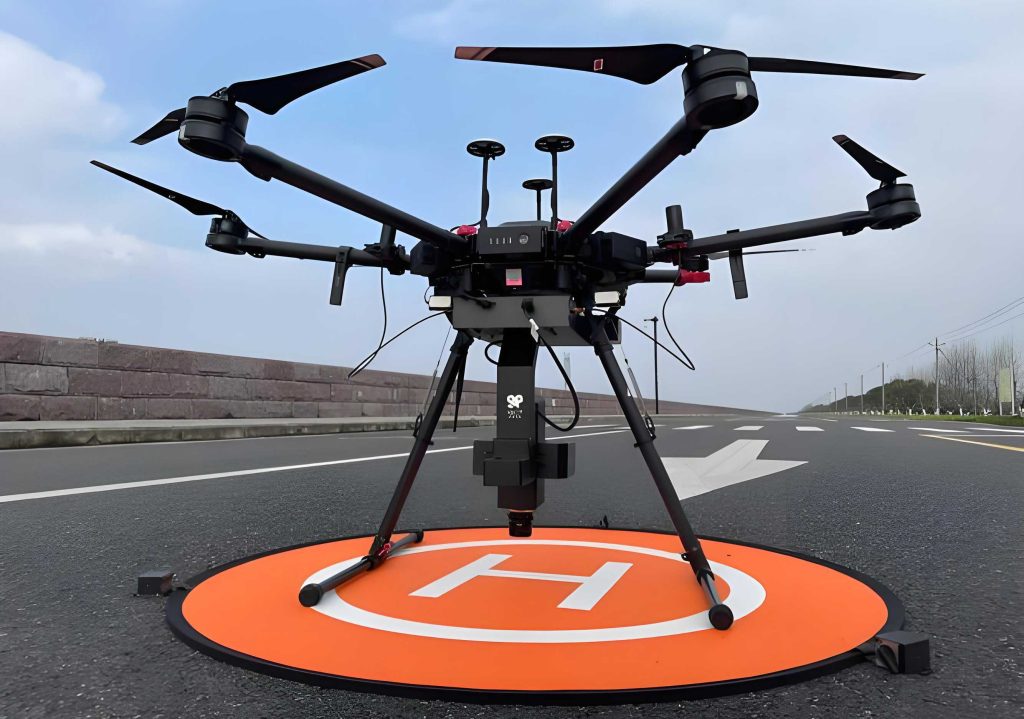
The core challenge lies in managing the transition between distinct flight modes: vertical lift, forward transition, high-speed cruise, and backward transition. Each mode utilizes a different subset and combination of actuators—tilting rotors, fixed rotors, and aerodynamic control surfaces (ailerons, elevator, rudder). An inefficient or unstable control allocation can lead to excessive energy consumption, poor handling quality, or even loss of control. Furthermore, the increased number of actuators elevates the probability of partial or complete failure. Therefore, developing an intelligent control strategy that dynamically optimizes actuator usage for performance and seamlessly reconfigures control authority in fault scenarios is essential for robust China UAV drone operations.
We present a comprehensive framework comprising a robust trajectory-tracking controller, a multi-objective optimal control allocator, and an integrated fault-tolerant control strategy. The controller is based on a Fusion Incremental Nonlinear Dynamic Inversion (FINDI) method, which enhances robustness against model uncertainties and disturbances—a common concern in the complex aerodynamic environment of a transitioning China UAV drone. The control allocator formulates the command distribution as a strictly convex, small-dimensional quadratic programming (SDQP) problem, minimizing tracking error, control effort, and actuator activity based on the current flight mode. Finally, the fault-tolerant layer actively reconfigures the allocation by penalizing faulty actuators and, crucially, engaging tilt-vectored thrust to compensate for lost control authority from damaged aerodynamic surfaces. This holistic approach ensures that the China UAV drone maintains stability and mission capability across its entire flight envelope, even under adverse conditions.
1. System Architecture and Dynamic Modeling of a Compound Tilt-Rotor UAV
The subject of this study is a six-rotor, semi-tilt compound UAV drone, a configuration that emphasizes safety and operational flexibility. Unlike a full-tilt design, this China UAV drone features two tilting rotors mounted on canards and four fixed rotors on the main wing. This hybrid design provides a wider and safer transition corridor, making it a reliable platform for diverse missions.
1.1 Configuration and Design Parameters
The primary aerodynamic lifting surfaces use a Liebeck LA5055 airfoil for high lift-to-drag ratio. The canard provides pitch control and houses the tilting mechanisms. The main wing incorporates a slight sweep and winglets to reduce induced drag. A V-tail at the rear provides directional stability. The key design parameters for this representative China UAV drone are summarized in Table 1.
| Parameter | Description | Value |
|---|---|---|
| $m$ (kg) | Total Mass | 31.2 |
| $b$ (m) | Wingspan | 2.726 |
| $S_{ref}$ (m²) | Reference Wing Area | 0.783 |
| $D_t$ (m) | Tilting Propeller Diameter | 0.508 |
| $D_f$ (m) | Fixed Propeller Diameter | 0.736 |
| $\omega_{t,max}$ (rpm) | Max Speed of Tilting Rotors | 8300 |
| $\omega_{f,max}$ (rpm) | Max Speed of Fixed Rotors | 5200 |
1.2 Mathematical Model
The nonlinear dynamics of the China UAV drone are derived using Newton-Euler equations, defined across multiple coordinate frames: inertial ($\mathcal{F}_E$), body ($\mathcal{F}_B$), wind ($\mathcal{F}_W$), and tilt ($\mathcal{F}_N$). The translational and rotational dynamics are given by:
$$
\begin{aligned}
\dot{\mathbf{P}}^E &= \mathbf{V}^E \\
m \dot{\mathbf{V}}^E &= m\mathbf{g} + \mathbf{R}_B^E \mathbf{F}^B \\
\dot{\boldsymbol{\Theta}} &= \mathbf{R}_{\Omega} \boldsymbol{\Omega}^B \\
\mathbf{J} \dot{\boldsymbol{\Omega}}^B &= \mathbf{M}^B – \boldsymbol{\Omega}^B \times \mathbf{J} \boldsymbol{\Omega}^B
\end{aligned}
$$
where $\mathbf{P}^E$ and $\mathbf{V}^E$ are inertial position and velocity, $\boldsymbol{\Theta}=[\phi, \theta, \psi]^T$ are Euler angles, $\boldsymbol{\Omega}^B=[p, q, r]^T$ is the body angular rate vector, $\mathbf{J}$ is the inertia tensor, $\mathbf{g}=[0,0,9.81]^T$ m/s², and $\mathbf{R}_{\Omega}$ is the transformation matrix from Euler rates to body rates.
The total force $\mathbf{F}^B$ in the body frame is the sum of rotor thrusts and aerodynamic forces:
$$
\mathbf{F}^B = \mathbf{F}^B_{rotor} + \mathbf{F}^B_{aero}
$$
$$
\mathbf{F}^B_{rotor} = \sum_{i=1}^{2} \mathbf{R}_{\chi_i} \begin{bmatrix} 0 \\ 0 \\ -T_{t,i} \end{bmatrix} + \sum_{i=3}^{6} \begin{bmatrix} 0 \\ 0 \\ -T_{f,i} \end{bmatrix}
$$
where $T_{t,i}=C_{F,r} \omega_{t,i}^2$ and $T_{f,i}=C_{F,f} \omega_{f,i}^2$ are the thrusts of tilting and fixed rotors, respectively, and $\mathbf{R}_{\chi_i}$ is the rotation matrix for the $i$-th tilting rotor by angle $\chi_i$. The aerodynamic force $\mathbf{F}^B_{aero} = \mathbf{R}_W^B [ -D_m, Y_m, -L_m]^T$ includes drag ($D_m$), side force ($Y_m$), and lift ($L_m$), computed using standard coefficient models $C_L(\alpha), C_D(\alpha), C_Y(\beta)$.
The total body moment $\mathbf{M}^B$ combines moments from rotor thrust, rotor drag torque, aerodynamic surfaces, and gyroscopic effects:
$$
\mathbf{M}^B = \mathbf{M}^B_{thrust} + \mathbf{M}^B_{rotate} + \mathbf{M}^B_{aero} + \mathbf{M}^B_{gyro}
$$
$$
\mathbf{M}^B_{thrust} = \sum_{i=1}^{2} \mathbf{d}^B_{r,i} \times \left( \mathbf{R}_{\chi_i} \begin{bmatrix} 0 \\ 0 \\ -T_{t,i} \end{bmatrix} \right) + \sum_{i=3}^{6} \mathbf{d}^B_{r,i} \times \begin{bmatrix} 0 \\ 0 \\ -T_{f,i} \end{bmatrix}
$$
$$
\mathbf{M}^B_{aero} = \begin{bmatrix} b C_l q S_{ref} \\ \bar{c} C_m q S_{ref} \\ b C_n q S_{ref} \end{bmatrix}, \quad \begin{aligned} C_l &= C_{l_\beta} \beta + C_{l_{\delta_a}} \delta_a \\ C_m &= C_{m_\alpha} \alpha + C_{m_{\delta_e}} \delta_e \\ C_n &= C_{n_\beta} \beta + C_{n_{\delta_r}} \delta_r \end{aligned}
$$
Here, $\mathbf{d}^B_{r,i}$ is the position vector of the $i$-th rotor hub, $q$ is dynamic pressure, $b$ is wingspan, $\bar{c}$ is mean aerodynamic chord, and $\delta_a, \delta_e, \delta_r$ are aileron, elevator, and rudder deflections. This model forms the basis for the control design of the China UAV drone.
2. Fusion Incremental Nonlinear Dynamic Inversion (FINDI) Control Law
To achieve precise trajectory tracking despite model inaccuracies and disturbances common in China UAV drone operations, we employ an enhanced incremental control law. Starting from a standard nonlinear system $\dot{\mathbf{x}} = \mathbf{f}(\mathbf{x}) + \mathbf{g}(\mathbf{x})\mathbf{u}$, an incremental form can be derived via Taylor expansion around the previous time step $(x_0, u_0)$:
$$
\dot{\mathbf{x}} \approx \dot{\mathbf{x}}_0 + \mathbf{g}(\mathbf{x}_0) \Delta \mathbf{u}
$$
For output $\mathbf{y} = \mathbf{h}(\mathbf{x})$, the standard Incremental NDI (INDI) law is:
$$
\mathbf{u} = \mathbf{u}_0 + \left( \frac{\partial \mathbf{h}}{\partial \mathbf{x}} \mathbf{g}(\mathbf{x}_0) \right)^{-1} (\dot{\mathbf{y}}_{des} – \dot{\mathbf{y}}_0)
$$
However, INDI’s performance degrades with significant model error in $\mathbf{g}(\mathbf{x})$. We introduce a Fusion INDI (FINDI) controller by adding a blended term that reinforces angular acceleration feedback:
$$
\mathbf{u}_F = \mathbf{K}_F \left( \frac{\partial \mathbf{h}}{\partial \mathbf{x}} \mathbf{g}(\mathbf{x}_0) \right)^{-1} (\dot{\mathbf{y}}_{des} – \dot{\mathbf{y}}_0)
$$
The total control becomes $\mathbf{u} = \mathbf{u}_0 + \Delta \mathbf{u} + \mathbf{u}_F$. The blending gain matrix $\mathbf{K}_F$ is tuned to ensure robustness. It can be proven that if the control effectiveness uncertainty $\Delta \mathbf{G}$ is bounded by $|\Delta \mathbf{G}| \leq \epsilon |\mathbf{g}(\mathbf{x}_0)|$, then selecting $\mathbf{K}_F \preceq (1-\epsilon)/(1+\epsilon) \mathbf{I}$ guarantees closed-loop stability and tracking for the China UAV drone.
Applied to the attitude loop, let $\mathbf{y} = \boldsymbol{\Omega}^B$. The incremental angular acceleration is $\dot{\boldsymbol{\Omega}}^B \approx \dot{\boldsymbol{\Omega}}^B_0 + \mathbf{J}^{-1} \Delta \boldsymbol{\tau}$. The FINDI attitude control law is:
$$
\boldsymbol{\tau} = \boldsymbol{\tau}_0 + \mathbf{J} (\dot{\boldsymbol{\Omega}}^B_{des} – \dot{\boldsymbol{\Omega}}^B_0) + \mathbf{J} \mathbf{K}_F (\dot{\boldsymbol{\Omega}}^B_{des} – \dot{\boldsymbol{\Omega}}^B_0)
$$
where $\dot{\boldsymbol{\Omega}}^B_{des} = \mathbf{K}_{\Omega} (\boldsymbol{\Omega}^B_{des} – \boldsymbol{\Omega}^B)$ and $\boldsymbol{\Omega}^B_{des} = \mathbf{K}_{\Theta} (\boldsymbol{\Theta}_{des} – \boldsymbol{\Theta})$. This inner-loop controller provides robust attitude tracking for the China UAV drone across all flight modes.
3. Multi-Objective Optimal Control Allocation via SDQP
The virtual control commands—desired total thrust vector $\mathbf{T}_d$ and moments $\boldsymbol{\tau}_d$—must be mapped to the 14 physical actuators of the China UAV drone. To reduce dimensionality, we assume symmetric deflections for left/right ailerons and elevators, and the tilt angles $\chi_L, \chi_R$ are provided by a separate mode manager. This results in a 9-dimensional control vector $\mathbf{u} = [f_1, f_2, f_3, f_4, f_5, f_6, \delta_a, \delta_e, \delta_r]^T$, where $f_i$ represents the thrust command for the $i$-th rotor.
The linear mapping is $\mathbf{v}_d = \mathbf{G} \mathbf{u}$, where $\mathbf{v}_d = [\mathbf{T}_d^T, \boldsymbol{\tau}_d^T]^T$ and $\mathbf{G} \in \mathbb{R}^{5 \times 9}$ is the control effectiveness matrix, composed of sub-matrices for tilting rotors ($\mathbf{G}_t$), fixed rotors ($\mathbf{G}_f$), and control surfaces ($\mathbf{G}_{\delta}$):
$$
\mathbf{G} = [\mathbf{G}_t \ \mathbf{G}_f \ \mathbf{G}_{\delta}]
$$
$$
\mathbf{G}_t = \begin{bmatrix}
-\cos\chi_L & -\cos\chi_R \\
0 & 0 \\
-\sin\chi_L & -\sin\chi_R \\
d^B_{r,y,1}\sin\chi_L & d^B_{r,y,2}\sin\chi_R \\
-d^B_{r,x,1}\cos\chi_L & -d^B_{r,x,2}\cos\chi_R
\end{bmatrix}, \quad
\mathbf{G}_{\delta} = \begin{bmatrix}
0 & 0 & 0\\
0 & 0 & 0\\
0 & 0 & 0\\
M_{\delta_a} & 0 & 0\\
0 & M_{\delta_e} & 0\\
0 & 0 & M_{\delta_r}
\end{bmatrix}
$$
The allocation problem is formulated as a multi-objective optimization with three cost terms, solved as a strictly convex Quadratic Programming (QP) problem:
$$
\begin{aligned}
\min_{\mathbf{u}} \quad & J_{total} = J_v + J_s + J_u \\
\text{where} \quad & J_v = \frac{1}{2} \| \mathbf{W}_v (\mathbf{G} \mathbf{u} – \mathbf{v}_d ) \|^2_2 \quad \text{(Virtual Control Error)} \\
& J_s = \frac{\gamma}{2} \| \mathbf{u} – \mathbf{u}_{last} \|^2_2 \quad \text{(Actuator Smoothing)} \\
& J_u = \frac{1}{2} \| \mathbf{W}_u (\mathbf{u} – \mathbf{u}_d) \|^2_2 \quad \text{(Control Effort & Modal Weighting)} \\
\text{s.t.} \quad & \mathbf{u}_{min} \leq \mathbf{u} \leq \mathbf{u}_{max}
\end{aligned}
$$
The matrix $\mathbf{W}_u = \text{diag}([L_{M,1}, …, L_{M,9}]) + \sigma \mathbf{I}$ is key for modal weighting. For rotor commands $i=3-6$ (fixed rear rotors), $L_{M,i} = k_2 (1 – \text{sat}(V_x/V_d))$, encouraging their use at low speed. For control surfaces $i=7-9$, $L_{M,i} = k_2 \cdot \text{sat}(V_x/V_d)$, favoring their use at high speed for efficiency. This allows the China UAV drone to optimally shift authority between propellers and aerodynamic surfaces across its flight envelope.
This QP problem, with only 9 decision variables, is efficiently solved in real-time using a Small-Dimensional QP (SDQP) solver, making it highly suitable for the onboard computer of a China UAV drone.
4. Integrated Fault-Tolerant Control Strategy
The over-actuated nature of the China UAV drone provides inherent redundancy, which can be exploited for fault tolerance. We consider two major fault types: (1) Propeller failure (complete loss of thrust), and (2) Control surface impairment (partial or total loss of effectiveness).
Fault Modeling: Actuator fault is modeled by an efficiency diagonal matrix $\boldsymbol{\Lambda}_F$:
$$
\mathbf{u}_F = \boldsymbol{\Lambda}_F \mathbf{u}, \quad \boldsymbol{\Lambda}_F = \text{diag}(\lambda_{F,1}, …, \lambda_{F,9})
$$
For propellers ($i=1..6$), $\lambda_{F,i} \in \{0,1\}$ (0=failed, 1=healthy). For control surfaces ($i=7..9$), $\lambda_{F,i} \in [0,1]$ represents reduced effectiveness.
Reconfiguration Strategy: The system employs two layered strategies based on fault type and flight mode, as outlined in Table 2.
| Flight Phase | Actuator Fault Mode | Reconfiguration Strategy |
|---|---|---|
| Rotor Mode | Single/Double Propeller Failure | Penalty Function Method |
| Fixed-Wing Mode | Aileron/Elevator/Rudder Damage | Vector Thrust Compensation + Penalty |
1. Penalty Function Method: Used for propeller failures or minor surface defects. The weight matrix $\mathbf{W}_u$ in the allocator is reconfigured: $\mathbf{W}_u^{new} = ( \mathbf{L}_M \cdot \boldsymbol{\Lambda}_F^{-1} + \sigma \mathbf{I} )$. If the $i$-th actuator fails ($\lambda_{F,i} \rightarrow 0$), its corresponding weight becomes very large, effectively driving its command to zero and redistributing its required force/moment to healthy actuators.
2. Vector Thrust Compensation Method: Critical for failures of primary aerodynamic controls (aileron, elevator) in fixed-wing mode. Mere penalty redistribution may not provide sufficient control authority. Here, the control effectiveness matrix $\mathbf{G}$ is augmented to include differential tilt angles $\Delta \chi_L, \Delta \chi_R$ as additional virtual controls. The new control vector is $\mathbf{u}^* = [\mathbf{u}^T, \Delta\chi_L, \Delta\chi_R]^T$, and the augmented matrix $\mathbf{G}^* = [\mathbf{G}, \mathbf{G}_T]$ allows the tilting rotors to generate rolling or pitching moments, compensating for the lost aerodynamic surfaces. This innovative use of tilt-vectoring is a key advantage of this China UAV drone configuration for fault tolerance.
The overall fault-tolerant control flow is: detect/identify fault → select reconfiguration strategy → update $\boldsymbol{\Lambda}_F$, $\mathbf{W}_u$, and $\mathbf{G}^*$ if needed → solve the modified SDQP problem. This ensures the China UAV drone maintains stable flight.
5. Simulation Results and Analysis
To validate the proposed framework, numerical simulations were conducted for a full mission profile: vertical take-off, forward transition to cruise, level flight, backward transition, and vertical landing. The proposed “FINDI+SDQP” strategy was compared against a conventional “PID + Pseudo-Inverse (INV)” allocation baseline. External disturbances (sensor noise, 10% inertia mismatch, periodic wind gusts) were added to test robustness.
5.1 Trajectory Tracking and Energy Efficiency
Figure 1 shows the velocity tracking performance. The FINDI+SDQP controller maintained significantly smaller errors, especially during the critical transition phases. The maximum longitudinal velocity error was below 2 m/s, compared to 3.8 m/s for the baseline. Lateral velocity error remained within 0.03 m/s, demonstrating superior cross-track control.
Attitude control was also more precise and stable with FINDI+SDQP, as seen in the box plot of attitude errors (Figure 2). The median and maximum errors in roll, pitch, and yaw were substantially lower, confirming the robustness of the incremental controller with angular acceleration feedback.
Figure 3 illustrates the actuator commands and instantaneous power consumption. The SDQP allocator intelligently manages the rotor speeds. In hover, it shifts more load to the fixed rear rotors ($\omega_{f1}$), allowing the tilting rotors ($\omega_r$) to operate at a more efficient point, reducing power draw. During cruise, the fixed rotors are shut down as expected. The total energy consumption for the complete mission is compared in Figure 4. The FINDI+SDQP strategy achieved a 7.8% reduction in total energy consumption, a significant improvement for the endurance of the China UAV drone.
5.2 Fault-Tolerant Control Validation
Rotor Mode – Single Propeller Failure: At t=20s during hover, Rotor 1 was commanded to zero thrust. The penalty function method successfully redistributed the required forces. The remaining rotors increased thrust appropriately, and attitude deviations were contained within 0.2° (Figure 5).
Rotor Mode – Double Propeller Failure: A more severe failure of two fixed rotors (3 & 4) was simulated. The controller reconfigured the thrust distribution, stabilizing the China UAV drone in an asymmetric quadrotor configuration. Pitch angle deviation peaked at 1.2° but was recovered within 2 seconds (Figure 6).
Fixed-Wing Mode – Control Surface Failure:
- Aileron Failure: At t=50s in cruise, the aileron was locked at 0°. The vector thrust compensation method engaged differential tilting ($\Delta\chi_L, \Delta\chi_R$ up to 2.5°), generating the required rolling moment. Lateral speed perturbation was minimized to 0.75 m/s (Figure 7).
- Elevator Failure: With elevator failure, the tilting rotors were symmetrically deflected by about 2° to provide pitch control, maintaining stable level flight with negligible attitude perturbation (Figure 8).
- Rudder Failure: Differential speed changes between the two tilting rotors were used to generate a yawing moment, compensating for the lost rudder authority.
These simulations comprehensively demonstrate that the proposed integrated control and allocation framework enables the compound tilt-rotor China UAV drone to perform complex missions efficiently and with high resilience to actuator faults.
6. Conclusion
This paper presented a holistic solution for the control of a sophisticated over-actuated compound tilt-rotor China UAV drone. The core contributions are threefold. First, a Fusion Incremental Nonlinear Dynamic Inversion (FINDI) controller was developed, providing robust trajectory and attitude tracking by leveraging angular acceleration feedback to compensate for model uncertainties and disturbances. Second, a real-time multi-objective optimal control allocator was designed, formulating the command distribution as a small-dimensional quadratic programming (SDQP) problem. This allocator minimizes tracking error, control effort, and actuator activity while intelligently shifting authority between propellers and aerodynamic surfaces based on flight mode, resulting in a 7.8% energy saving over a full mission profile. Third, a comprehensive fault-tolerant control strategy was integrated, capable of handling both propeller and control surface failures through a combination of penalty-based redistribution and, innovatively, the activation of tilt-vectored thrust to compensate for critical aerodynamic control losses.
The simulation results across the entire flight envelope, including multiple failure scenarios, validate the effectiveness and robustness of the proposed framework. The methods are computationally efficient and suitable for real-time implementation on embedded flight control systems. This work significantly advances the autonomy and reliability of versatile VTOL platforms like the compound tilt-rotor China UAV drone, paving the way for their safe and efficient deployment in demanding civilian and military applications. Future work will focus on the integration of advanced fault detection and diagnosis (FDD) systems and experimental flight testing to further mature the technology.