
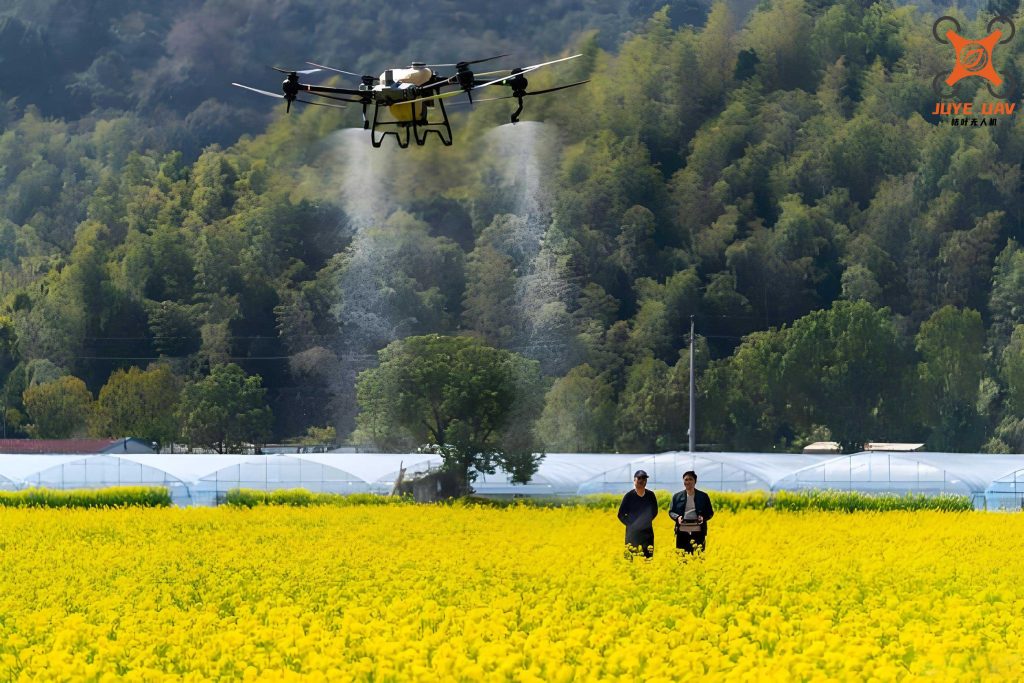
In the rapidly evolving field of agricultural technology, the use of unmanned aerial vehicles (UAVs) has become increasingly prevalent for tasks such as crop spraying, seeding, and fertilization. As a researcher focused on enhancing the efficiency and versatility of these systems, I have developed a modular design approach specifically for quadrotor agricultural UAVs. This method aims to improve upgradeability, assembly, maintenance efficiency, and expand the application scope of agricultural UAVs. In this article, I will detail the modular design process, including the analysis of part relationships, clustering into components, calculation of correlation matrices, and module formation. Additionally, I will present finite element analysis (FEA) results for key functional modules to validate structural integrity and dynamic performance. The goal is to provide a comprehensive framework that can be adapted for various agricultural operations, ensuring robustness and flexibility in real-world scenarios.
The core idea behind modular design is to break down a complex system like an agricultural UAV into independent, interchangeable modules. This not only simplifies manufacturing and assembly but also allows for easy upgrades and repairs. For an agricultural UAV, this means that farmers can quickly switch between different functionalities, such as spraying pesticides or broadcasting seeds, by simply swapping modules. My approach involves a systematic analysis of all parts within the UAV, considering their connections, functions, and geometric parameters. By clustering highly correlated parts into components and then merging similar components into modules, I have streamlined the design process. Furthermore, I employ the Analytic Hierarchy Process (AHP) to assign weights to different relationship levels, ensuring a balanced and objective module division. The resulting modular structure enables the combination of six distinct modules to form either a spraying or broadcasting agricultural UAV, showcasing the versatility of this design.
To begin, let me outline the structural analysis of a typical quadrotor agricultural UAV. The UAV consists of numerous parts that interact in various ways. I start by examining the relationships between any two parts at three levels: connection fixation, function, and geometric parameters. For instance, parts like motors, propellers, and electronic speed controllers (ESCs) are closely linked in terms of connection and function, as they collectively form the propulsion system. By constructing a part relationship diagram, I can visualize these interactions. Based on this, parts with strong correlations are clustered into components. For example, the propulsion-related parts form a power component, while the spraying mechanism parts form a spraying component. This initial clustering reduces complexity and sets the stage for further analysis. The following table summarizes the parts list of the quadrotor agricultural UAV used in this study.
| Code | Part Name | Code | Part Name |
|---|---|---|---|
| E1 | Arm | E15 | Downward Radar |
| E2 | ESC Mount | E16 | Upward Radar |
| E3 | ESC | E17 | Flight Controller |
| E4 | Motor Mount | E18 | UPS |
| E5 | Motor | E19 | ESC Wiring Board |
| E6 | Propeller | E20 | Searchlight |
| E7 | Navigation Light | E21 | Camera |
| E8 | Spraying Fixation Device | E22 | Spray/Broadcast Wiring Board |
| E9 | Centrifugal Atomization Nozzle | E23 | Landing Gear |
| E10 | Central Cabin | E24 | Chemical Tank |
| E11 | Intelligent Battery | E25 | Liquid Level Sensor |
| E12 | RTK | E26 | Water Pump |
| E13 | Dual-frequency Antenna | E27 | Seed Tank |
| E14 | Omnidirectional Radar | E28 | Broadcaster |
After clustering the parts into components, I evaluate the relationships between components using a feature similarity level system. This system assigns similarity coefficients ranging from 0 to 1, where 0 indicates no relationship and 1 indicates the component itself. The similarity levels are defined as follows: 0 for none, 0.2 for weak, 0.4 for general, 0.6 for moderate, 0.8 for close, and 1 for identical. Based on this, I construct correlation matrices for the connection fixation, function, and geometric parameter levels. For example, the functional correlation matrix \( F_{ij} \) for components \( S_i \) and \( S_j \) is represented as:
$$ F_{ij} = \begin{bmatrix}
1 & R_{12} & R_{13} & \cdots & R_{1n} \\
R_{21} & 1 & R_{23} & \cdots & R_{2n} \\
\vdots & \vdots & \vdots & \ddots & \vdots \\
R_{n1} & R_{n2} & R_{n3} & \cdots & 1
\end{bmatrix} $$
where \( R_{ij} \) is the similarity coefficient between component \( S_i \) and \( S_j \). For instance, in the functional level matrix, \( R_{12} = 0.4 \) indicates a general relationship between components \( S_1 \) and \( S_2 \). Similarly, I derive matrices for connection fixation \( P_{ij} \) and geometric parameters \( D_{ij} \). These matrices are crucial for quantifying the interdependencies within the agricultural UAV structure.
To integrate these three levels into a comprehensive assessment, I use the Analytic Hierarchy Process (AHP) to assign weights. AHP involves constructing a judgment matrix to compare the relative importance of each level. The importance scale values are: 1 for equal importance, 3 for slightly more important, 5 for strongly more important, 7 for very strongly more important, and 9 for absolutely more important. Based on expert input, I create the judgment matrix \( A \) for connection fixation, function, and geometric parameters:
$$ A = \begin{bmatrix}
1 & a_{12} & a_{13} \\
a_{21} & 1 & a_{23} \\
a_{31} & a_{32} & 1
\end{bmatrix} $$
Using the root method, I calculate the weight for each level. First, compute the product of each row:
$$ M_p = \prod_{q=1}^{3} a_{pq} \quad \text{for } p = 1, 2, 3 $$
Then, calculate the cubic root:
$$ \tilde{\omega}_p = \sqrt[3]{M_p} $$
Finally, normalize the weights:
$$ \omega_p = \frac{\tilde{\omega}_p}{\sum_{q=1}^{3} \tilde{\omega}_q} $$
For this agricultural UAV, the weights are determined as \( \omega_1 = 0.4 \) for connection fixation, \( \omega_2 = 0.3 \) for function, and \( \omega_3 = 0.3 \) for geometric parameters. These weights reflect the prioritization in modular design, emphasizing structural integrity for the agricultural UAV.
With the weights assigned, I compute the comprehensive strength correlation matrix \( K_{ab} \) between components using the weighted average formula:
$$ K_{ab} = \frac{\omega_1 P_{ij} + \omega_2 F_{ij} + \omega_3 D_{ij}}{\omega_1 + \omega_2 + \omega_3} $$
where \( a \) and \( b \) represent component indices. The resulting matrix \( K \) is a 9×9 matrix for the nine initial components. Values close to 1 indicate high similarity, suggesting that components should be merged into a module. For instance, \( K_{24} = 0.798 \) shows a close relationship between component \( S_2 \) (spraying) and \( S_4 \) (chemical tank), so they are combined into a single module. Similarly, \( K_{36} = 0.8 \) for \( S_3 \) (central cabin) and \( S_6 \) (intelligent battery), and \( K_{78} = 0.798 \) for \( S_7 \) (positioning) and \( S_8 \) (obstacle avoidance). This leads to the formation of six independent modules, as summarized in the table below.
| Module Number | Module Name | Components Included |
|---|---|---|
| Module 1 | Flight Power Module | S1 (Power Component) |
| Module 2 | Central Cabin Module | S3, S6 (Central Cabin, Intelligent Battery) |
| Module 3 | Obstacle Avoidance Navigation Module | S7, S8 (Positioning, Obstacle Avoidance) |
| Module 4 | Flight Control Module | S9 (Control Component) |
| Module 5 | Spraying Module | S2, S4 (Spraying, Chemical Tank) |
| Module 6 | Broadcasting Module | S5 (Broadcasting Component) |
These modules can be assembled in various combinations to create different types of agricultural UAVs. For example, combining Module 1, Module 2, Module 3, Module 4, and Module 5 yields a spraying agricultural UAV, while replacing Module 5 with Module 6 results in a broadcasting agricultural UAV. This modularity enhances the adaptability of the agricultural UAV to diverse farming tasks. The assembly process is simplified because modules are independent and can be connected via standardized interfaces, reducing assembly time and maintenance costs. When an upgrade is needed, only the affected module requires redesign, minimizing downtime for the agricultural UAV.
To ensure the structural reliability of the modular agricultural UAV, I perform finite element analysis (FEA) on key modules, particularly the Central Cabin Module, which bears significant loads during flight. The Central Cabin Module includes components like the RTK, dual-frequency antenna, upper and lower plates, and the battery. It is constructed from materials such as 6061-T6 aluminum alloy and carbon fiber, with properties listed in the table below.
| Parameter | 6061-T6 | Carbon Fiber |
|---|---|---|
| Poisson’s Ratio | 0.330 | 0.300 |
| Density (kg/m³) | 2700 | 1800 |
| Young’s Modulus (MPa) | 6.90×10⁴ | 2.9×10⁵ |
| Yield Strength (MPa) | 240 | 4870 |
For static analysis, I apply boundary conditions to simulate极限 operating conditions. The agricultural UAV’s propulsion system can generate a maximum lift force of 158.59 N per arm. In the FEA model, I fix the center of the Central Cabin Module and apply upward forces of 158.59 N on each of the four arms. The mesh is generated with automatic划分, resulting in 8,181,280 nodes and 4,762,103 elements, with an average element quality of 0.827, which meets the requirement for accuracy. The static analysis reveals the stress and deformation distribution. The maximum stress occurs at the transition areas where the arms connect to the central cabin, with a value of 23.889 MPa. This is well below the tensile strength of carbon fiber (4870 MPa), indicating that the module can withstand极限 loads without failure. The maximum deformation is 0.0046359 mm, which is negligible for the agricultural UAV’s operational requirements.
In addition to static analysis, I conduct modal analysis to evaluate dynamic characteristics. Modal analysis identifies natural frequencies and mode shapes, which are critical for avoiding resonance during operation. The agricultural UAV’s motors operate at a maximum speed of 1900 rpm, corresponding to an excitation frequency of 32.75 Hz. I compute the first four natural frequencies of the Central Cabin Module using预应力 modal analysis in ANSYS. The results are summarized in the table below.
| Mode Order | Natural Frequency (Hz) | Mode Order | Natural Frequency (Hz) |
|---|---|---|---|
| 1 | 182.99 | 3 | 183.09 |
| 2 | 183.01 | 4 | 183.26 |
All natural frequencies are significantly higher than the maximum excitation frequency of 32.75 Hz, ensuring that resonance is avoided. This validates the dynamic stability of the agricultural UAV under working conditions. The mode shapes show minimal deformation, further confirming the robustness of the modular design.
The modular approach offers several advantages for agricultural UAVs. First, it reduces the number of parts from 28 to 6 modules, simplifying inventory management and production. Second, the independence of modules allows for parallel assembly, cutting down manufacturing time. Third, maintenance becomes more efficient because faulty modules can be quickly identified and replaced without dismantling the entire agricultural UAV. Fourth, the design supports customization; farmers can easily switch between spraying and broadcasting modules based on seasonal needs. This flexibility extends the lifespan and utility of the agricultural UAV, making it a cost-effective investment for modern agriculture.
To further illustrate the correlation calculations, let me detail the matrices used. The functional correlation matrix \( F_{ij} \) for the nine components is as follows (with similarity coefficients based on the feature similarity level):
$$ F_{ij} = \begin{bmatrix}
1 & 0.2 & 0.4 & 0.2 & 0.2 & 0.4 & 0.2 & 0.2 & 0.2 \\
0.2 & 1 & 0.2 & 0.8 & 0 & 0.4 & 0.2 & 0.2 & 0.4 \\
0.4 & 0.2 & 1 & 0.6 & 0.6 & 0.8 & 0.4 & 0.2 & 0.4 \\
0.2 & 0.8 & 0.6 & 1 & 0 & 0.4 & 0.2 & 0.2 & 0.4 \\
0.2 & 0 & 0.6 & 0 & 1 & 0.4 & 0.2 & 0.2 & 0.4 \\
0.4 & 0.4 & 0.8 & 0.4 & 0.4 & 1 & 0.4 & 0.4 & 0.4 \\
0.2 & 0.2 & 0.4 & 0.2 & 0.2 & 0.4 & 1 & 0.8 & 0.4 \\
0.2 & 0.2 & 0.2 & 0.2 & 0.2 & 0.4 & 0.8 & 1 & 0.4 \\
0.2 & 0.4 & 0.4 & 0.4 & 0.4 & 0.4 & 0.4 & 0.4 & 1
\end{bmatrix} $$
Similarly, the connection fixation correlation matrix \( P_{ij} \) is:
$$ P_{ij} = \begin{bmatrix}
1 & 0.4 & 0.6 & 0 & 0 & 0.2 & 0 & 0 & 0.2 \\
0.4 & 1 & 0.2 & 0.8 & 0 & 0.2 & 0.2 & 0.2 & 0.2 \\
0.6 & 0.2 & 1 & 0.6 & 0.6 & 0.8 & 0.2 & 0.2 & 0.2 \\
0 & 0.8 & 0.6 & 1 & 0 & 0.4 & 0 & 0 & 0.4 \\
0 & 0 & 0.6 & 0 & 1 & 0.4 & 0 & 0 & 0.4 \\
0.2 & 0.2 & 0.8 & 0.4 & 0.4 & 1 & 0.4 & 0.4 & 0.4 \\
0 & 0.2 & 0.2 & 0 & 0 & 0.4 & 1 & 0.8 & 0.6 \\
0 & 0.2 & 0.2 & 0 & 0 & 0.4 & 0.8 & 1 & 0.6 \\
0.2 & 0.2 & 0.2 & 0.4 & 0.4 & 0.4 & 0.6 & 0.6 & 1
\end{bmatrix} $$
And the geometric parameter correlation matrix \( D_{ij} \) is:
$$ D_{ij} = \begin{bmatrix}
1 & 0.3 & 0.2 & 0.5 & 0.5 & 0.6 & 0.3 & 0.2 & 0.4 \\
0.3 & 1 & 0 & 0.78 & 0 & 0.5 & 0.2 & 0.3 & 0.6 \\
0.2 & 0 & 1 & 0.4 & 0.4 & 0.8 & 0.2 & 0.2 & 0.2 \\
0.5 & 0.78 & 0.4 & 1 & 0 & 0.6 & 0.3 & 0.2 & 0.3 \\
0.5 & 0 & 0.4 & 0 & 1 & 0.6 & 0.3 & 0.2 & 0.3 \\
0.6 & 0.5 & 0.8 & 0.6 & 0.6 & 1 & 0.4 & 0.4 & 0.4 \\
0.3 & 0.2 & 0.2 & 0.3 & 0.3 & 0.4 & 1 & 0.78 & 0.5 \\
0.2 & 0.3 & 0.2 & 0.2 & 0.2 & 0.4 & 0.78 & 1 & 0.4 \\
0.4 & 0.6 & 0.2 & 0.3 & 0.3 & 0.4 & 0.5 & 0.4 & 1
\end{bmatrix} $$
Using the weights \( \omega_1 = 0.4 \), \( \omega_2 = 0.3 \), and \( \omega_3 = 0.3 \), the comprehensive strength matrix \( K \) is calculated as:
$$ K = \begin{bmatrix}
1 & 0.273 & 0.44 & 0.171 & 0.171 & 0.36 & 0.149 & 0.138 & 0.222 \\
0.273 & 1 & 0.178 & 0.798 & 0 & 0.349 & 0.2 & 0.211 & 0.36 \\
0.44 & 0.178 & 1 & 0.578 & 0.578 & 0.8 & 0.316 & 0.2 & 0.316 \\
0.171 & 0.798 & 0.578 & 1 & 0 & 0.422 & 0.149 & 0.138 & 0.389 \\
0.171 & 0 & 0.578 & 0 & 1 & 0.422 & 0.149 & 0.138 & 0.389 \\
0.36 & 0.349 & 0.8 & 0.422 & 0.422 & 1 & 0.4 & 0.4 & 0.4 \\
0.149 & 0.2 & 0.316 & 0.149 & 0.149 & 0.4 & 1 & 0.798 & 0.473 \\
0.138 & 0.211 & 0.2 & 0.138 & 0.138 & 0.4 & 0.798 & 1 & 0.462 \\
0.222 & 0.36 & 0.316 & 0.389 & 0.389 & 0.4 & 0.473 & 0.462 & 1
\end{bmatrix} $$
This matrix guides the module merging process, as described earlier. The high values (e.g., 0.798, 0.8) indicate components that should be combined, leading to the six-module configuration for the agricultural UAV.
In terms of practical implementation, the modular design facilitates rapid prototyping and testing. For instance, the Flight Power Module can be independently optimized for efficiency without affecting the Control Module. This decoupling is particularly beneficial for agricultural UAVs, which often operate in harsh environments and require regular updates. Moreover, the use of standardized interfaces between modules ensures compatibility and reduces the risk of assembly errors. I have designed these interfaces to be robust and easy to connect, using quick-release mechanisms where possible. This is essential for field operations where time is critical, and farmers need to adapt the agricultural UAV quickly.
The finite element analysis not only validates the Central Cabin Module but also provides insights for future improvements. For example, the stress concentrations at arm connections suggest areas where reinforcement might be added, though current levels are within safe limits. Additionally, the modal analysis confirms that vibrational issues are unlikely, but ongoing monitoring is recommended as the agricultural UAV ages. These FEA results are integral to the design cycle, allowing for iterative enhancements while maintaining module independence.
Looking ahead, the modular approach can be extended to other types of agricultural machinery, promoting a standardized ecosystem in precision agriculture. For agricultural UAVs, this means that modules could be shared across different models or brands, reducing costs and fostering innovation. I envision a future where farmers can mix and match modules from various suppliers to create customized solutions for their specific needs. This interoperability would revolutionize the agricultural UAV market, making advanced technology more accessible and sustainable.
In conclusion, the modular design method presented here effectively simplifies the structure of quadrotor agricultural UAVs, enhancing their upgradeability, assembly, and maintenance. By analyzing part relationships at multiple levels and using AHP for weight assignment, I have derived a logical module division that balances structural, functional, and geometric considerations. The resulting six modules can be combined to form versatile agricultural UAVs for spraying or broadcasting tasks. Finite element analysis confirms the structural integrity and dynamic stability of key modules, ensuring reliable performance in极限 conditions. This work underscores the potential of modularity in advancing agricultural UAV technology, offering a scalable and adaptable framework for future developments in smart farming.