
The spectacular visual symphony of a formation drone light show relies on the precise coordination of dozens, even hundreds, of unmanned aerial vehicles (UAVs) moving in complex, tightly synchronized patterns. This coordination must be robust, scalable, and capable of dynamic maneuvers. In this research, we address a critical control challenge for such systems: enabling a formation to accurately track a leader moving with an unknown and time-varying velocity, using only limited bearing (directional) information. Traditional methods often rely on full knowledge of relative positions or distances, which may be unavailable or unreliable in GPS-denied environments or due to sensor limitations common in large-scale formation drone light show deployments. Our approach leverages the theoretical framework of bearing rigidity, combined with distributed estimation and adaptive control, to create a resilient and purely bearing-based control scheme that enables formation translation, scaling, and rotation.
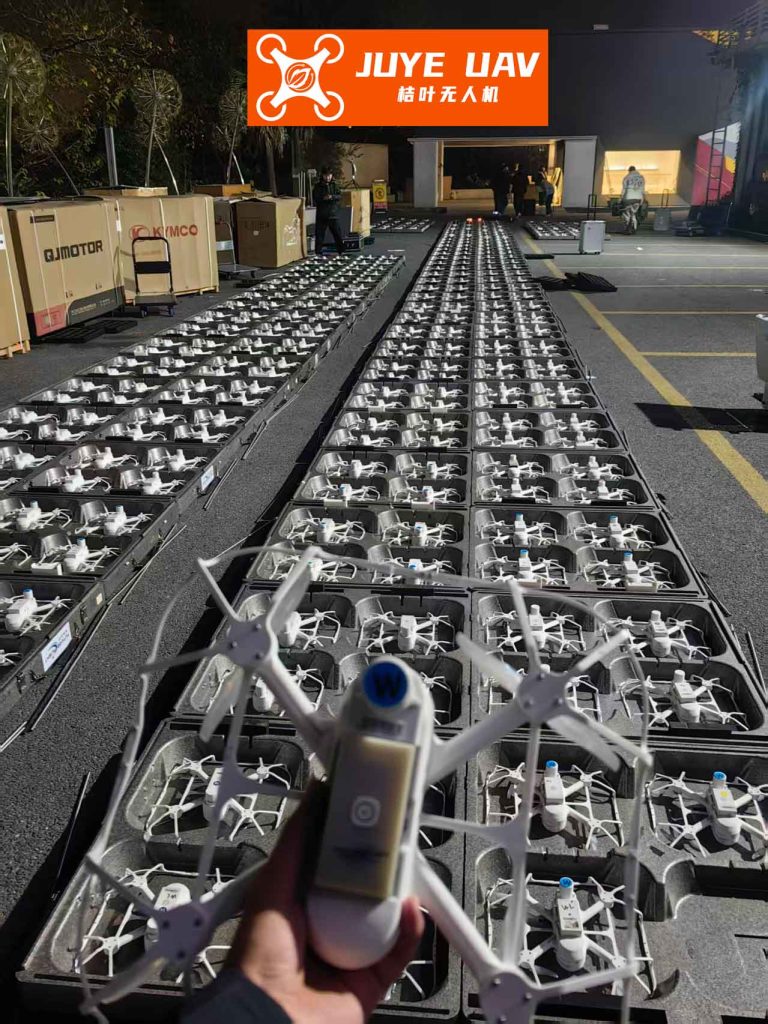
The core challenge in a decentralized formation drone light show is that individual drones, or agents, have only partial and local information. We consider a classic “leader-wingman” structure. A single leader drone follows a predefined, potentially accelerating, trajectory. Only a select few wingmen, termed “first-wingmen,” have direct communication with the leader and can measure the leader’s bearing. The vast majority of drones in the formation drone light show are ordinary wingmen that can only sense the relative bearing to their immediate neighbors in a predefined communication graph. Crucially, no wingman has direct access to the leader’s linear or angular velocity. Our objective is to design distributed control laws so that the entire ensemble achieves a desired geometric shape, maintains it while moving, and can perform collective scaling and rotational maneuvers, all based primarily on bearing measurements.
1. Problem Formulation and Mathematical Foundations
We model the kinematics of each drone in the formation drone light show as a double-integrator, a standard simplification for high-level path planning and formation control. For a formation of \(n\) drones in \(\mathbb{R}^d\) (where \(d=2\) for planar shows and \(d=3\) for volumetric displays), the model is:
$$ \dot{p}_i(t) = v_i(t), \quad \dot{v}_i(t) = u_i(t), \quad i \in \{1,\dots,n\} $$
where \(p_i \in \mathbb{R}^d\), \(v_i \in \mathbb{R}^d\), and \(u_i \in \mathbb{R}^d\) are the position, velocity, and control input (acceleration) of drone \(i\), respectively. Drone 1 is designated as the leader.
1.1 Leader Kinematics and Interaction Topology
The leader’s motion is specified independently. Its velocity is \(v_1(t) = s(t) f(t)\), where \(s(t) > 0\) is the unknown time-varying speed, and \(f(t) \in \mathbb{R}^d\) is the unit vector representing its direction of motion, with \(\|f(t)\| = 1\). The leader’s acceleration is thus \(\dot{v}_1(t) = \dot{s}(t) f(t) + s(t) \dot{f}(t)\). We assume that the angular change \(\dot{f}(t)\) is bounded, i.e., \(\|\ddot{f}(t)\| \leq \eta\), where \(\eta\) is a known constant broadcast only to the first-wingmen.
The communication and sensing network for the formation drone light show is represented by an undirected graph \(\mathcal{G} = (\mathcal{V}, \mathcal{E})\), where \(\mathcal{V} = \{1,\dots,n\}\) is the set of drones, and \(\mathcal{E}\) is the set of edges. An edge \((i, j) \in \mathcal{E}\) exists if drone \(i\) can measure the relative bearing to drone \(j\). The set of neighbors for drone \(i\) is \(\mathcal{N}_i = \{j \in \mathcal{V} : (i, j) \in \mathcal{E}\}\). The graph is constructed to be infinitesimally bearing rigid, a property ensuring the formation’s shape is uniquely determined by the set of inter-agent bearing vectors. A key feature of our setup is that the leader does not receive information from wingmen, creating a directed flow from leader to first-wingmen, while wingmen communicate undirectedly among themselves.
1.2 Desired Formation and Bearing Rigidity
The desired configuration for the formation drone light show is defined by a set of constant bearing vectors \(\{g_{ij}^*\}\) for all \((i,j) \in \mathcal{E}\), derived from a reference configuration \(p^* = [p_1^{*T}, \dots, p_n^{*T}]^T\). The relative bearing vector from drone \(i\) to drone \(j\) is:
$$ g_{ij}(t) = \frac{p_j(t) – p_i(t)}{\|p_j(t) – p_i(t)\|}. $$
To analyze vectors orthogonal to a bearing, we use the orthogonal projection matrix:
$$ P_{g} = I_d – g g^T, $$
which projects any vector onto the orthogonal complement of \(g\). Note that \(P_g \, x = 0\) if and only if \(x\) is collinear with \(g\).
The formation drone light show control problem is to design control inputs \(u_i\) such that:
- Bearing Convergence: \(g_{ij}(t) \to g_{ij}^*\) for all \((i,j) \in \mathcal{E}\).
- Scale Consensus: The distance between the leader and a designated first-wingman converges to a desired scale factor \(d^*\).
- Velocity Consensus: All wingman velocities converge to the leader’s velocity, \(v_i(t) \to v_1(t)\).
We define the tracking errors for position and velocity as \(\delta p_i = p_i – p_i^*\) and \(\delta v_i = v_i – v_1\). Successful control implies \(\delta p_i, \delta v_i \to 0\) as \(t \to \infty\).
2. Distributed Estimation and Control System Design
Since the wingmen in the formation drone light show lack direct knowledge of \(v_1(t)\) and \(\dot{v}_1(t)\), the core of our solution lies in distributed estimators that allow each wingman to reconstruct the leader’s acceleration.
2.1 Distributed Leader Acceleration Estimator
The leader’s acceleration, \(\dot{v}_1 = \dot{s} f + s \dot{f}\), has two unknown components: the scalar speed derivative \(\dot{s}\) and the directional derivative \(s \dot{f}\). We design a two-stage estimator.
2.1.1 Estimation of Leader’s Directional Change \(s \dot{f}\)
Let \(\hat{\varphi}_i \in \mathbb{R}^d\) be drone \(i\)’s estimate of \(s(t)\dot{f}(t)\). The estimation error is \(\delta \varphi_i = \hat{\varphi}_i – s \dot{f}\). We also require an estimate of the bound \(\eta\), denoted \(\hat{\eta}_i\), with error \(\delta \eta_i = \hat{\eta}_i – \eta\). The following distributed adaptive estimator is employed for all wingmen (\(i \in \{2,\dots,n}\)):
$$
\begin{aligned}
\dot{\hat{\varphi}}_i &= -k_{\varphi} \sum_{j \in \mathcal{N}_i} (\hat{\varphi}_i – \hat{\varphi}_j) – \hat{\eta}_i \, \text{sgn}\left( \sum_{j \in \mathcal{N}_i} (\hat{\varphi}_i – \hat{\varphi}_j) \right), \\
\dot{\hat{\eta}}_i &= -k_{\eta} \sum_{j \in \mathcal{N}_i} (\hat{\eta}_i – \hat{\eta}_j) + \left\| \sum_{j \in \mathcal{N}_i} (\hat{\varphi}_i – \hat{\varphi}_j) \right\|_1.
\end{aligned}
$$
For a wingman \(j\) that is a neighbor of the leader, the term \(\hat{\varphi}_j\) is replaced by the true value \(s \dot{f}\) (if measured) and \(\hat{\eta}_j\) by \(\eta\). The gains \(k_{\varphi}, k_{\eta} > 0\). The signum function and the \(\eta\)-estimator work together to ensure robust convergence despite the bounded disturbance \(\ddot{f}\).
Theorem 1 (Convergence of Directional Estimator): If the communication graph \(\mathcal{G}\) is connected, the estimator errors \(\delta \varphi_i\) and \(\delta \eta_i\) converge to zero exponentially fast for all wingmen.
Proof Sketch: Consider the Lyapunov function candidate \(V_1 = \frac{1}{2} \delta \varphi^T (L \otimes I_d) \delta \varphi + \frac{1}{2} \delta \eta^T \delta \eta\), where \(L\) is the Laplacian matrix of the wingmen subgraph. Using the properties of the estimator and the boundedness of \(\ddot{f}\), its derivative can be shown to satisfy \(\dot{V}_1 \leq -\kappa V_1\) for some \(\kappa > 0\), proving exponential stability.
2.1.2 Estimation of Leader’s Speed \(s\)
With a convergent estimate of \(s \dot{f}\), we now estimate the leader’s speed \(s(t)\) itself. Let \(\hat{s}_i\) be drone \(i\)’s estimate. A simple yet effective estimator that leverages the kinematic relationship is:
$$ \dot{\hat{s}}_i = -v_i^T \hat{\varphi}_i. $$
Theorem 2 (Convergence of Speed Estimator): If \(\hat{\varphi}_i \to s \dot{f}\) and the leader’s speed \(s(t)\) is constant or slowly varying relative to the estimator dynamics, then \(\hat{s}_i \to s\).
Proof Sketch: The dynamics of the speed estimation error \(\delta s_i = \hat{s}_i – s\) become \(\delta \dot{s}_i = -v_i^T \delta \varphi_i – \delta s_i (f^T \dot{f}) – \dot{s}\). When \(\delta \varphi_i \to 0\), the error dynamics are driven by \(-\dot{s}\). If \(\dot{s}=0\) (constant speed), \(\delta s_i\) converges to zero. For time-varying \(s(t)\), the estimator acts as a tracking observer, with performance depending on the adaptation gain implicit in the \(\hat{\varphi}_i\) dynamics.
Combined, these estimators provide each wingman with a local estimate of the leader’s full acceleration: \(\hat{a}_i = \dot{\hat{s}}_i f + \hat{\varphi}_i\).
2.2 Bearing-Based Formation Control Law
We now design the control input \(u_i\) using bearing measurements, consensus terms, and the acceleration estimate.
2.2.1 First-Wingman Control Law
The first-wingman (drone 2) has a special role: it must maintain a specific desired distance \(d^*\) from the leader. Its control law is:
$$ u_2 = k_p (p_1 – p_2 + d^* g_{21}^*) + k_v (v_1 – v_2) + \hat{a}_2. $$
The first term enforces the desired relative displacement (bearing and scale). The second term is a velocity consensus term. The third term, \(\hat{a}_2\), is the estimated leader acceleration, which acts as a feedforward compensation to enable perfect tracking of the leader’s time-varying velocity.
2.2.2 Ordinary Wingman Control Law
For an ordinary wingman \(i \in \{3,\dots,n\}\), the control law is:
$$ u_i = -\sum_{j \in \mathcal{N}_i} P_{g_{ij}^*} \left[ k_p (p_i – p_j) + k_v (v_i – v_j) \right] + \hat{a}_i. $$
The summation is the core bearing-formation term. The projector \(P_{g_{ij}^*}\) ensures that control effort is applied only in directions that correct bearing errors. The terms \(k_p (p_i – p_j)\) and \(k_v (v_i – v_j)\) drive position and velocity consensus relative to neighbors, respectively. Finally, \(\hat{a}_i\) provides the necessary feedforward acceleration.
The following table summarizes the information requirements and components of the control law for each agent type in the formation drone light show:
| Agent Type | Information Available | Control Law Components |
|---|---|---|
| Leader (Drone 1) | Predefined trajectory \(p_1^d(t)\), \(v_1^d(t)\). | Open-loop command: \(u_1 = \dot{v}_1^d(t)\). |
| First-Wingman (Drone 2) | Leader’s bearing \(g_{21}\), leader’s velocity \(v_1\), bound \(\eta\), estimates \(\hat{\varphi}_2, \hat{s}_2\). | 1. Scale/Bearing alignment to leader. 2. Velocity consensus with leader. 3. Feedforward \(\hat{a}_2\). |
| Ordinary Wingman (Drone i) | Neighbors’ bearings \(\{g_{ij}\}\), neighbors’ velocities \(\{v_j, j\in\mathcal{N}_i\}\), estimates \(\hat{\varphi}_i, \hat{s}_i\). | 1. Bearing consensus with neighbors. 2. Velocity consensus with neighbors. 3. Feedforward \(\hat{a}_i\). |
2.3 Enabling Formation Rotation: Body-Frame Alignment
The control laws above achieve translation and scaling. For a full formation drone light show, rotation is essential. The issue is that the desired bearings \(g_{ij}^*\) are defined in a fixed inertial frame. If the leader turns, the formation should rotate with it, but the fixed \(g_{ij}^*\) would try to maintain the old orientation.
The solution is to define the desired bearings in a formation body frame that aligns with the leader’s velocity direction. Let \(Q_i(t) \in \text{SO}(d)\) be a rotation matrix representing the estimated body frame of drone \(i\). For a planar show (\(d=2\)), \(Q_i\) is a function of the estimated heading \(\hat{\gamma}_i\):
$$ Q_i = \begin{bmatrix} \cos\hat{\gamma}_i & \sin\hat{\gamma}_i \\ -\sin\hat{\gamma}_i & \cos\hat{\gamma}_i \end{bmatrix}. $$
The heading can be estimated from the direction of the velocity consensus vector or from the estimated leader direction \(\hat{f}_i = \hat{\varphi}_i / \hat{s}_i\). The desired bearing in the body frame is then \(\tilde{g}_{ij}^* = Q_i^T g_{ij}^*\). The modified control law for wingmen becomes:
$$ u_i = -\sum_{j \in \mathcal{N}_i} P_{\tilde{g}_{ij}^*} \left[ k_p (p_i – p_j) + k_v (v_i – v_j) \right] + \hat{a}_i. $$
As the formation converges, all \(Q_i\) align with the leader’s true heading, causing the entire formation drone light show to rotate cohesively.
3. Stability and Convergence Analysis
We analyze the closed-loop system’s stability using Lyapunov theory. The key tool is the bearing Laplacian matrix \(\mathcal{B} \in \mathbb{R}^{dn \times dn}\) for the desired formation, defined as:
$$ [\mathcal{B}]_{ij} = \begin{cases}
\sum_{k \in \mathcal{N}_i} P_{g_{ik}^*}, & \text{if } i=j, \\
-P_{g_{ij}^*}, & \text{if } (i,j) \in \mathcal{E}, \\
0, & \text{otherwise}.
\end{cases} $$
For an infinitesimally bearing rigid formation, if the leader and first-wingman are considered anchors, the sub-matrix \(\mathcal{B}_{ff}\) corresponding to the ordinary wingmen is positive definite.
Theorem 3 (Formation Stability): Consider the multi-drone system under the proposed control laws with the distributed estimators. Assume the communication graph is infinitesimally bearing rigid and the leader’s acceleration is bounded. Then, for sufficiently large control gains \(k_p, k_v > 0\), the closed-loop system is stable, and the formation tracking errors \(\delta p\) and \(\delta v\) converge to a small neighborhood around zero. The size of this neighborhood depends on the ultimate bounds of the estimation errors \(\delta \varphi_i\) and \(\delta s_i\).
Proof Sketch: We consider a composite Lyapunov function:
$$ V = V_1 + \frac{1}{2} k_p \, \delta p^T \mathcal{B}_{ff} \, \delta p + \frac{1}{2} \delta v_f^T \delta v_f + \frac{1}{2} \sum_{i=2}^n \delta s_i^2, $$
where \(V_1\) is from Theorem 1, and \(\delta v_f\) are the velocity errors of the wingmen. Taking the derivative and substituting the dynamics \(\delta \dot{v}_f = -k_p \mathcal{B}_{ff} \delta p – k_v \mathcal{B}_{ff} \delta v_f + (\delta s \cdot f + \delta \varphi)\) yields:
$$ \dot{V} \leq -\kappa_1 V_1 – k_v \delta v_f^T \mathcal{B}_{ff} \delta v_f + \delta v_f^T (\delta s \cdot f + \delta \varphi). $$
Using Young’s inequality and the properties of \(\mathcal{B}_{ff}\), it can be shown that \(\dot{V} \leq -\kappa V + \epsilon\), where \(\kappa>0\) and \(\epsilon\) is a positive constant related to the ultimate bound of the estimation errors. This proves uniform ultimate boundedness (UUB) of all errors. If the estimators converge perfectly (\(\delta \varphi, \delta s \to 0\)), then \(\epsilon=0\) and global asymptotic stability of the desired formation drone light show is achieved.
4. Simulation Results and Performance Evaluation
We validate the proposed scheme through comprehensive numerical simulations for a formation drone light show involving 8 UAVs. The following parameters were used:
| Parameter | Value | Description |
|---|---|---|
| \(n\) | 8 | Number of UAVs (1 Leader, 7 Wingmen). |
| \(k_p, k_v\) | 2.5, 10 | Control gains. |
| \(k_{\varphi}, k_{\eta}\) | 5, 5 | Estimator gains. |
| \(d^*\) | 60 m | Desired leader-to-first-wingman distance. |
| Simulation Time | 120 s | Total duration. |
Scenario 1: 2D Translation with Acceleration. The leader starts with velocity (25, 25) m/s and applies an acceleration of (0.5, 0.5) m/s² between \(t=60\)s and \(t=80\)s. The results demonstrate successful formation acquisition and maintenance. The bearing errors \(\sum \|P_{g_{ij}^*} g_{ij}\|\) and scale error \(| \|p_1-p_2\| – d^* |\) converge to near zero within 30 seconds and exhibit only minor, transient deviations during the acceleration phase, quickly recovering afterwards. The velocity estimates \(\hat{s}_i\) and directional estimates \(\hat{\varphi}_i\) converge accurately to their true values.
Scenario 2: 3D Volumetric Formation. Extending to \(\mathbb{R}^3\), we simulate a cubic formation. The leader accelerates in all three dimensions. The results confirm that the 3D extension of the algorithm works effectively, with the formation achieving and holding the desired 3D shape while tracking the accelerating leader, showcasing its applicability for complex volumetric formation drone light show displays.
Scenario 3: Formation Scaling. At \(t=50\)s, the desired scale \(d^*\) is commanded to change from 60m to 100m. The formation smoothly expands to the new size. The bearing errors remain low throughout the maneuver, confirming that the shape is preserved during scaling. This is a crucial feature for dynamic choreography in a formation drone light show.
Scenario 4: Formation Rotation (2D). Using the body-frame modified control law, the leader executes a turn by applying a lateral acceleration. The formation successfully rotates as a rigid body while maintaining its internal shape. Before full alignment of the body-frame estimates, a transient bearing error is observed, but it converges as the wingmen’s estimated frames align with the leader’s new heading.
The following table summarizes the key performance metrics observed during the 2D translation scenario:
| Performance Metric | Convergence Time (to < 5%) | Steady-State Error | Peak Error During Leader Acceleration |
|---|---|---|---|
| Bearing Error (\(\sum \|P_{g^*}g\|\)) | ~30 s | < 0.01 rad | < 0.05 rad |
| Scale Error (\(|\|p_1-p_2\|-d^*|\)) | ~30 s | < 0.1 m | < 0.13 m |
| Velocity Consensus (\(\max\|v_i-v_1\|\)) | ~35 s | < 0.05 m/s | < 0.02 m/s |
| Speed Estimation Error (\(|\hat{s}_i-s|\)) | ~40 s | < 0.1 m/s | N/A |
5. Conclusion and Future Work
This paper presented a comprehensive distributed control solution for a formation drone light show operating under stringent sensing constraints. By fusing bearing rigidity theory with distributed adaptive estimation, we developed a control framework that enables a swarm to achieve a desired geometric formation, maintain it while tracking a leader with unknown time-varying velocity, and perform scaling and rotational maneuvers. The core innovation lies in the distributed estimator that allows each wingman to reconstruct the leader’s acceleration using only local bearing information and consensus with neighbors, eliminating the need for direct velocity or acceleration sensing from the leader.
The stability of the system was formally analyzed, and extensive simulations in 2D and 3D validated the effectiveness of the approach for translation, scaling, and rotation. The method is highly suitable for real-world formation drone light show applications where reliability and robustness to individual sensor failures are paramount.
Future work will focus on several important extensions. First, incorporating collision avoidance constraints directly into the bearing-based control law is essential for safe operations in dense formation drone light show swarms. Second, addressing more realistic dynamic models, such as underactuated quadrotor dynamics with attitude control loops, will bridge the gap between kinematic control and practical implementation. Finally, experimental validation with a physical swarm of drones will be the ultimate test of the algorithm’s robustness and performance in the presence of real-world noise, communication delays, and disturbances.