
As a military technology analyst, I have witnessed the rapid evolution of unmanned systems, with military UAVs standing at the forefront of this transformation. The dawn of the 21st century has ushered in a new era of warfare, driven by rapid advancements in science and technology. In this context, military equipment is increasingly shifting toward intelligent and unmanned systems. Military UAVs, as a core component of smart weaponry, are redefining modern battlefields. These systems, characterized by their cost-effectiveness, zero casualties, high mobility, and versatility, have become indispensable assets for nations worldwide. The proliferation of military UAVs is not merely a trend but a fundamental shift in military strategy, enabling operations ranging from reconnaissance and surveillance to targeted strikes and electronic warfare. In this article, I will delve into the current global landscape of military UAV development, explore key technological aspects through formulas and tables, and project future trajectories.
The significance of military UAVs cannot be overstated. Historically, warfare relied heavily on manned platforms, but the advent of unmanned systems has introduced a paradigm shift. Military UAVs offer unparalleled advantages: they reduce human risk, lower operational costs, and enhance persistence in contested environments. For instance, the endurance of a military UAV can be modeled using the formula for flight time: $$T = \frac{E}{P}$$ where \(T\) is the endurance in hours, \(E\) is the energy available (e.g., from fuel or batteries), and \(P\) is the power consumption. This simple equation underscores the engineering focus on maximizing efficiency. Moreover, military UAVs integrate advanced technologies such as artificial intelligence, stealth coatings, and secure data links, making them pivotal to modern military operations. Below, I present a table summarizing the key advantages of military UAVs compared to traditional manned aircraft:
| Feature | Military UAV | Manned Aircraft |
|---|---|---|
| Operational Cost | Low (no life support systems) | High (pilot training, safety measures) |
| Risk to Personnel | Zero casualties in combat | High risk of pilot loss |
| Endurance | Can exceed 40 hours (e.g., Global Hawk) | Typically limited to 10-12 hours |
| Stealth Capability | Enhanced through design and materials | Limited by cockpit and life support |
| Mission Flexibility | High (modular payloads) | Moderate (often specialized) |
To illustrate the visual impact of these systems, consider the following image, which captures the essence of a modern military UAV in action. This depiction highlights the sleek design and advanced aerodynamics that enable superior performance.
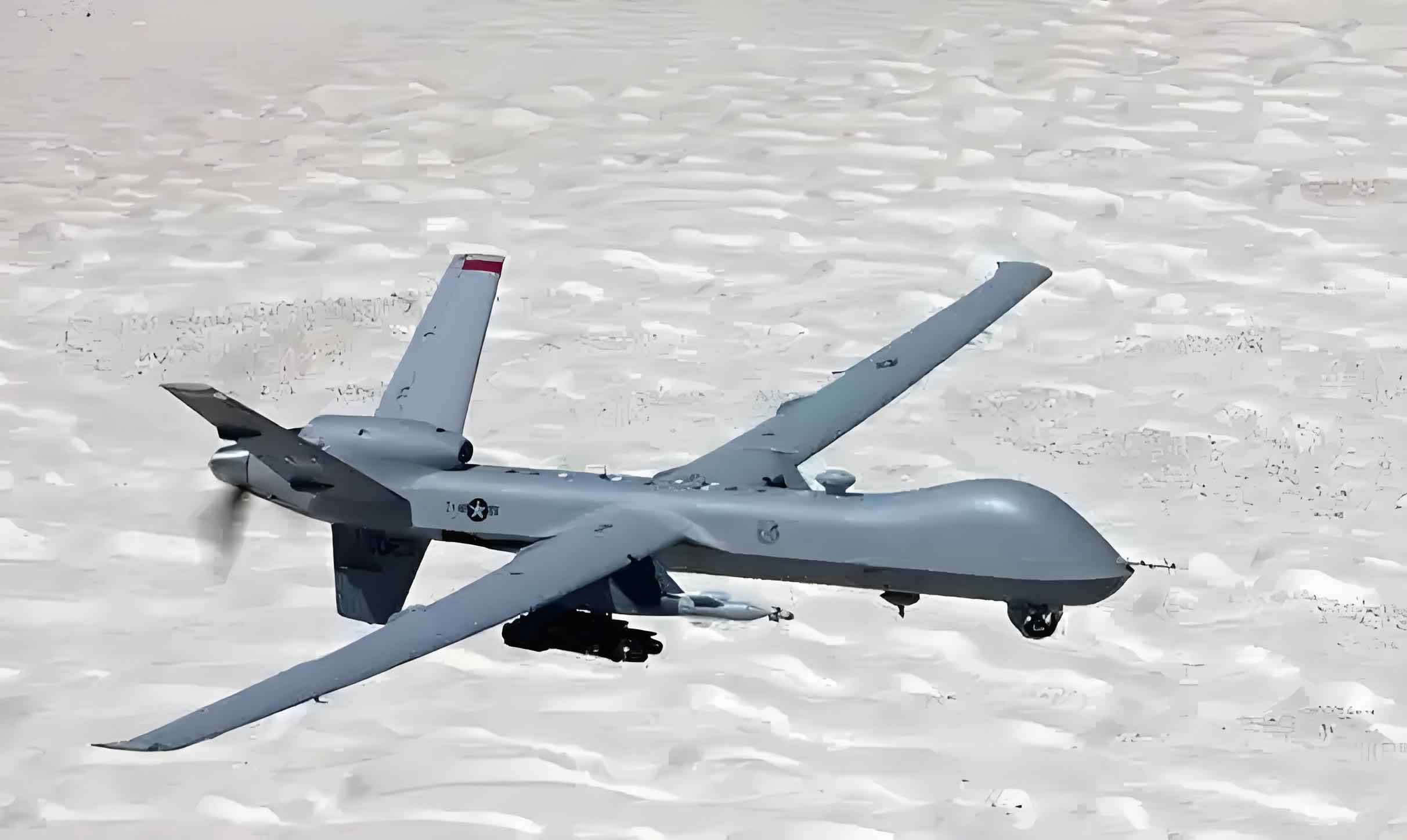
Now, let’s explore the current state of military UAV development across major nations. The United States leads the pack, with a diverse portfolio of systems. American military UAVs, such as the Predator and Global Hawk, have set benchmarks for performance. The Predator series, for example, exemplifies medium-altitude long-endurance (MALE) capabilities. Its operational parameters can be summarized in a table:
| Parameter | RQ-1A/MQ-1B Predator |
|---|---|
| Wingspan | 14.8 m (580.8 inches) |
| Length | 8.1 m (320.4 inches) |
| Endurance | Up to 40 hours |
| Maximum Speed | 135 km/h (70-90 knots) |
| Payload Capacity | Approx. 200 kg |
| Key Missions | Reconnaissance, strike (with Hellfire missiles) |
The Global Hawk, a high-altitude long-endurance (HALE) military UAV, pushes boundaries further. Its range can be expressed mathematically: $$R = V \times T$$ where \(R\) is the range, \(V\) is the cruising velocity, and \(T\) is the endurance. With a range exceeding 26,000 km, it enables global reach. The U.S. Navy’s X-47B represents another leap—a carrier-based unmanned combat air vehicle (UCAV). Its stealth performance is critical, often quantified by radar cross-section (RCS), which can be approximated using the formula: $$\sigma = \frac{4\pi A^2}{\lambda^2}$$ where \(\sigma\) is the RCS, \(A\) is the target area, and \(\lambda\) is the radar wavelength. This underscores the emphasis on reducing detectability.
Moving to Europe, collaborative efforts dominate military UAV development. The Neuron UCAV, a joint project by France, Sweden, Italy, Spain, Switzerland, and Greece, showcases advanced stealth and autonomy. Its design incorporates artificial intelligence for autonomous decision-making. A key metric for such systems is the probability of successful target engagement, which can be modeled as: $$P_s = 1 – (1 – P_d)^n$$ where \(P_s\) is the overall success probability, \(P_d\) is the detection probability per sensor, and \(n\) is the number of协同 sensors. This highlights the importance of sensor fusion. The United Kingdom’s Taranis UCAV similarly emphasizes low observability and long-range strike capabilities. European military UAVs often focus on interoperability within NATO frameworks, as shown in the table below:
| European UAV | Lead Country | Key Features | Status |
|---|---|---|---|
| Neuron | France | Stealth, autonomous operations | Demonstrator |
| Taranis | UK | Low RCS, artificial intelligence | Technology demonstrator |
| Watchkeeper | UK | Tactical reconnaissance, NATO interoperable | In service |
| RT900 Tucan | Germany | Micro-UAV, portable design | Developmental |
Israel stands out as a powerhouse in military UAV innovation. The Heron TP, a large MALE military UAV, exemplifies cutting-edge capabilities. Its endurance and payload capacity make it ideal for persistent surveillance. The Harop loitering munition, a suicide attack military UAV, represents a unique approach. Its effectiveness can be analyzed through cost-benefit ratios: $$CBR = \frac{B}{C}$$ where \(CBR\) is the cost-benefit ratio, \(B\) is the military benefit (e.g., target destruction), and \(C\) is the cost per unit. With low production costs and high precision, such military UAVs offer significant tactical advantages. Israeli systems often integrate advanced electronic warfare suites, enhancing survivability in hostile environments.
Beyond these leaders, other nations like Japan, South Korea, and Russia are actively developing military UAVs. For instance, Russia has fielded systems like the Orion for reconnaissance-strike missions. The global proliferation of military UAVs is evident, with over 50 countries involved in production or deployment. This expansion raises important questions about technology transfer and regulatory frameworks, which I will address later.
Now, let’s delve into the technological underpinnings of military UAVs. Sensor technology is a critical enabler. The resolution of an electro-optical sensor on a military UAV can be described by: $$R = \frac{H \times \lambda}{D}$$ where \(R\) is the ground resolution, \(H\) is the altitude, \(\lambda\) is the wavelength, and \(D\) is the aperture diameter. Higher resolution allows for better target identification. Similarly, synthetic aperture radar (SAR) on military UAVs like the Global Hawk uses signal processing to achieve high-resolution imagery, governed by: $$\Delta x = \frac{\lambda R}{2L}$$ where \(\Delta x\) is the cross-range resolution, \(R\) is the slant range, and \(L\) is the synthetic aperture length. These formulas illustrate the engineering complexities involved.
Artificial intelligence (AI) is revolutionizing military UAV operations. Autonomous navigation relies on algorithms such as simultaneous localization and mapping (SLAM), which can be expressed as: $$p(x_t | z_{1:t}, u_{1:t}) = \eta p(z_t | x_t) \int p(x_t | x_{t-1}, u_t) p(x_{t-1} | z_{1:t-1}, u_{1:t-1}) dx_{t-1}$$ where \(x_t\) is the state, \(z_t\) are observations, and \(u_t\) are controls. This Bayesian framework enables military UAVs to operate in GPS-denied environments. Machine learning models for target recognition use convolutional neural networks (CNNs), with accuracy metrics like: $$Accuracy = \frac{TP + TN}{TP + TN + FP + FN}$$ where \(TP\) is true positives, \(TN\) true negatives, \(FP\) false positives, and \(FN\) false negatives. As AI matures, military UAVs will become more autonomous, though ethical considerations remain paramount.
Looking ahead, I identify several key trends for military UAVs. First, multi-UAV协同作战 is gaining traction. Coordinated swarms of military UAVs can overwhelm defenses and perform complex tasks. The control of such swarms can be modeled using flocking algorithms, such as Reynolds’ rules: $$\vec{v}_i(t+1) = \vec{v}_i(t) + \alpha \vec{f}_s + \beta \vec{f}_a + \gamma \vec{f}_c$$ where \(\vec{v}_i\) is the velocity of UAV \(i\), and \(\vec{f}_s\), \(\vec{f}_a\), \(\vec{f}_c\) are separation, alignment, and cohesion forces, respectively. This enables emergent behavior without central control. The benefits include enhanced surveillance coverage and resilience, as shown in the table:
| Aspect | Single UAV | Multi-UAV Swarm |
|---|---|---|
| Coverage Area | Limited by sensor range | Scalable with swarm size |
| Redundancy | Single point of failure | High (loss of one UAV is tolerable) |
| Mission Complexity | Suitable for simple tasks | Enables complex协同 (e.g., triangulation) |
| Cost | Lower upfront cost | Higher but with greater capability |
Second, manned-unmanned teaming (MUM-T) is evolving. In this paradigm, military UAVs operate alongside manned aircraft, sharing data and tasks. The communication bandwidth required can be estimated by: $$B = N \times R \times D$$ where \(B\) is the bandwidth in bits per second, \(N\) is the number of UAVs, \(R\) is the data rate per UAV, and \(D\) is the data dimensionality. Secure, high-bandwidth links are essential for real-time协同. This approach leverages human judgment while extending reach and persistence.
Third, modularity and commonality are becoming standard. Modern military UAVs are designed with open architectures, allowing payloads to be swapped based on mission needs. The economic benefit can be calculated using: $$Savings = C_d – (C_m + C_i)$$ where \(C_d\) is the cost of developing a dedicated platform, \(C_m\) is the cost of modular components, and \(C_i\) is integration cost. This reduces lifecycle costs and accelerates deployment. Standardized ground control stations further enhance interoperability across different military UAV types.
Fourth, network-centric侦打一体化 is the future. Military UAVs are increasingly integrated into broader C4ISR networks, enabling real-time sensor-to-shooter loops. The time delay for engaging a time-sensitive target can be modeled as: $$T_{total} = T_{detect} + T_{decide} + T_{engage}$$ where each component depends on network latency and processing speed. By minimizing \(T_{total}\), military UAVs achieve faster decision cycles. This trend emphasizes the role of military UAVs as nodes in a distributed combat cloud.
However, challenges persist. Technological hurdles include improving autonomy while ensuring reliability. The probability of system failure for a military UAV can be expressed using reliability engineering: $$R(t) = e^{-\lambda t}$$ where \(R(t)\) is reliability over time \(t\), and \(\lambda\) is the failure rate. Reducing \(\lambda\) through robust design is critical. Cybersecurity is another concern; military UAVs are vulnerable to jamming and hacking. The signal-to-noise ratio (SNR) for secure communications must be maintained: $$SNR = \frac{P_s}{P_n}$$ where \(P_s\) is signal power and \(P_n\) is noise power. Advanced encryption and anti-jam techniques are vital.
Ethical and legal issues also loom large. The deployment of lethal autonomous military UAVs raises questions about accountability. International discussions are ongoing, but consensus remains elusive. From a strategic perspective, the proliferation of military UAVs could lower the threshold for conflict, as they reduce political risks associated with casualties.
In terms of future directions, I anticipate military UAVs expanding into new domains. Space-based UAVs or high-altitude pseudo-satellites (HAPS) could provide persistent coverage. Their orbital mechanics can be described by: $$T = 2\pi \sqrt{\frac{a^3}{\mu}}$$ where \(T\) is the orbital period, \(a\) is the semi-major axis, and \(\mu\) is the gravitational parameter. Additionally, bio-inspired military UAVs mimicking birds or insects offer stealth and agility. The aerodynamic lift for such designs follows: $$L = \frac{1}{2} \rho v^2 S C_L$$ where \(L\) is lift, \(\rho\) is air density, \(v\) is velocity, \(S\) is wing area, and \(C_L\) is the lift coefficient.
To quantify the global impact, consider the market growth for military UAVs. Projections suggest a compound annual growth rate (CAGR) of over 10% in the next decade. This can be modeled as: $$A = P(1 + r)^t$$ where \(A\) is the future market size, \(P\) is the present size, \(r\) is the CAGR, and \(t\) is time in years. Such growth underscores the strategic importance of military UAVs.
In conclusion, military UAVs have irrevocably altered the landscape of modern warfare. From their humble beginnings as reconnaissance tools to today’s sophisticated strike platforms, they embody the convergence of technology and strategy. As I reflect on my analysis, it is clear that the future will see military UAVs becoming more autonomous, networked, and versatile. Nations that invest in these capabilities will gain a decisive edge. However, this must be balanced with ethical stewardship and international cooperation. The journey of military UAVs is far from over; it is a dynamic field where innovation continues to push boundaries. Whether through swarming algorithms, AI-driven missions, or modular designs, military UAVs will remain at the heart of military transformation for years to come.
To encapsulate key parameters, here is a final table comparing representative military UAVs across generations:
| Generation | Example UAV | Endurance (hours) | Max Altitude (m) | Key Technology |
|---|---|---|---|---|
| 1st (1990s) | RQ-2 Pioneer | 5-6 | 3,000 | Basic remote control |
| 2nd (2000s) | MQ-1 Predator | 40 | 7,600 | SATCOM, strike capability |
| 3rd (2010s) | RQ-4 Global Hawk | 42 | 18,000 | HALE, SAR/EO sensors |
| 4th (2020s+) | X-47B | 6-8 (carrier-based) | 12,000 | Stealth, autonomous carrier ops |
| Future | AI-driven swarms | Variable (networked) | 20,000+ | 协同 autonomy, quantum comms |
The evolution of military UAVs is a testament to human ingenuity and the relentless pursuit of tactical advantage. As we move forward, continuous research and development will unlock new potentials, ensuring that military UAVs remain pivotal in safeguarding national security and shaping the future of conflict.