
With the escalating challenge of weed infestation in wheat cultivation, the adoption of agricultural drone technology has gained prominence among large-scale farmers. This study evaluated agricultural UAV-assisted pre-emergence herbicide applications against gramineous weeds in wheat fields. Four treatments were implemented across 2,668 m² using a DJI T30 agricultural drone with standardized flight parameters: speed 2.50 m/s, swath width 3.50 m, altitude 1.50 m, and spray volume 5 L per 667 m².
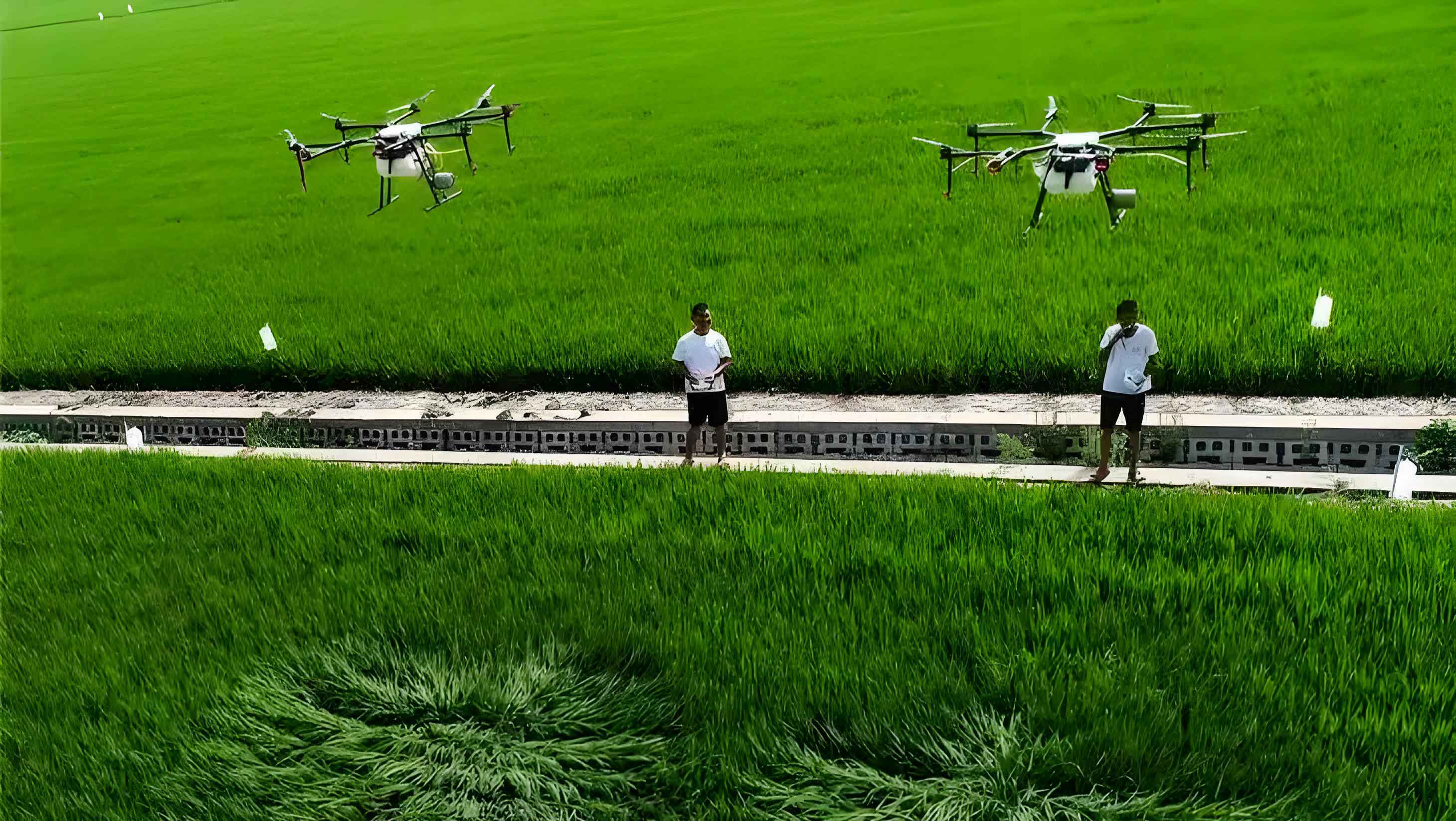
The herbicide combinations and application rates are detailed in Table 1. Weed density assessments at 62 and 90 days post-treatment (DPT) employed random quadrat sampling (1 m² per replicate, three replicates per treatment). Control efficacy was calculated using the formula:
$$\eta = \frac{X_{CK} – X_i}{X_{CK}} \times 100\%$$
where \(\eta\) represents control efficacy, \(X_{CK}\) is weed density in control plots, and \(X_i\) is density in treated plots.
| Treatment | Herbicide Combination | Dosage per 667 m² |
|---|---|---|
| Treatment 1 | Dicloxacone + Isoproturon | 30 mL + 120 mL |
| Treatment 2 | Dicloxacone + Flufenacet | 30 mL + 20 mL |
| Treatment 3 | Pretilachlor + Flufenacet | 100 mL + 20 mL |
| Treatment 4 (CK) | Untreated control | – |
Results demonstrated significant weed suppression using agricultural UAV technology. Treatment 1 achieved 74.97% control efficacy at 62 DPT, increasing to 80.03% at 90 DPT. Treatment 3 showed 67.36% and 68.97% efficacy at respective intervals (Table 2). The agricultural drone application enabled uniform herbicide distribution despite challenging field conditions, reducing gramineous weed density by >70% in optimal treatments.
| Treatment | 62 DPT Efficacy (%) | 90 DPT Efficacy (%) | Dominant Weed Species |
|---|---|---|---|
| Treatment 1 | 74.97 ± 5.29 | 80.03 ± 1.57 | Alopecurus japonicus (80%) |
| Treatment 2 | 37.87 ± 9.87 | 24.21 ± 5.62 | Beckmannia syzigachne (20%) |
| Treatment 3 | 67.36 ± 4.99 | 68.97 ± 0.84 | Alopecurus japonicus |
| Treatment 4 (CK) | 0 | 0 | – |
The operational efficiency of agricultural drones facilitated timely pre-emergence applications critical for weed suppression. Herbicide penetration through crop residue was enhanced by the agricultural UAV‘s downwash airflow, particularly effective in fields with high straw coverage. The technology reduced labor requirements by 85% compared to manual spraying, enabling large-scale applications within optimal agronomic windows.
Integration of agricultural drone technology with chemical weed management demonstrates significant potential for sustainable wheat production. Future research will optimize nozzle configurations and droplet spectra for agricultural UAVs to improve herbicide deposition in dense residue environments. Further studies should examine sequential application strategies combining pre-emergence (agricultural drone-applied) and post-emergence treatments for complete weed management solutions.