
The integration of Unmanned Aerial Vehicles (UAVs), or drones, has fundamentally transformed modern emergency response and firefighting operations. From my extensive observation and analysis of operational needs, the critical gap inhibiting maximal effectiveness is not the availability of sophisticated drone hardware, but rather a profound shortage of highly skilled, mission-ready operators. While drones are increasingly present in agency inventories, their potential in complex disaster scenarios—ranging from structural fires and hazardous material incidents to search-and-rescue in flooded or rugged terrain—remains underutilized. This underscores an urgent, systemic need: the development and implementation of a standardized, rigorous, and operationally focused drone training curriculum specifically designed for the high-stakes environment of public safety.
The operational mandate for drones in emergency response is clear and multifaceted. They serve as force multipliers for incident commanders, providing real-time aerial intelligence that is often otherwise unattainable. Core missions include initial size-up and ongoing reconnaissance, thermal imaging for victim location and hotspot identification, aerial mapping and 3D modeling of disaster zones, temporary communication relay in areas with compromised infrastructure, precision delivery of small payloads (e.g., life preservers, radios, medical supplies), and area lighting during night operations. To meet the “all-disaster, full-response” mandate, communication and reconnaissance units must be capable of establishing robust, mobile networks that provide uninterrupted, clear situational awareness. Consequently, drone operators are not merely remote pilots; they are essential intelligence, surveillance, and reconnaissance (ISR) specialists whose proficiency directly impacts mission success and responder safety.
Foundational Training and Certification Landscape
Before delving into operational drone training, understanding the regulatory and certification framework is essential. In many jurisdictions, legal operation beyond basic recreational use requires formal certification. The regulatory landscape often distinguishes operations based on weight, altitude, and proximity to people. A typical regulatory model mandates that operators obtain a pilot certificate or license if the drone exceeds a certain mass (e.g., 7 kg), operates above a specific altitude (e.g., 120 meters), or is used for commercial/public safety purposes. For emergency service agencies, navigating this landscape involves aligning with nationally recognized aviation authorities.
The primary pathways for professional drone training and certification generally fall into three categories, each with distinct scopes and recognition. The following table summarizes these key systems:
| Certifying Body | Certificate Type | Primary Scope & Recognition | Analogy |
|---|---|---|---|
| Civil Aviation Authority (e.g., delegated to organizations like AOPA) | Remote Pilot Certificate / License | Widely recognized legal credential for commercial and public safety operations. Covers airspace, regulations, weather, and flight operations. | Standard Driver’s License |
| Major Manufacturer (e.g., DJI UTC) | Industry Application Certificate | Focuses on proficiency in specific platforms and their applied workflows (e.g., surveying, inspection, public safety). Often paired with regulatory certification. | Specialized Vehicle Endorsement (e.g., for tow trucks) |
| Aeronautical Sports Association (e.g., ASFC) | Radio Control Model Pilot Certificate | Focuses on advanced manual flight skills for sport and competition. Typically not sanctioned for commercial or official public safety operations. | Race Car Driver’s License |
For emergency services, the first pathway—the formal Remote Pilot Certificate—is typically the non-negotiable legal foundation. However, this certification alone is insufficient for tactical proficiency. It provides the “license to learn” for public safety operations but does not address mission-specific tasks like thermal image interpretation, search patterns, or incident command system integration. Therefore, agency-specific drone training must build upon this regulatory base.
A Theoretical Framework for Skill Acquisition in Drone Training
Effective drone training must be underpinned by pedagogical principles that translate into durable, transferable skills. Skill acquisition can be modeled as a function of structured practice, cognitive load management, and scenario variability. We can propose a simplified performance model:
$$ P(t) = K \cdot (1 – e^{-\lambda S(t)}) $$
Where:
- $P(t)$ is the operator’s performance level at time $t$.
- $K$ represents the maximum attainable performance ceiling for a given individual/task.
- $\lambda$ is the learning rate constant, influenced by training quality and individual aptitude.
- $S(t)$ is the cumulative, structured training stimulus up to time $t$.
This model illustrates that performance improves with deliberate practice $S(t)$ but at a decaying rate, approaching an asymptote $K$. High-quality drone training aims to increase both $\lambda$ (faster learning) and $K$ (higher ultimate skill ceiling) through expert instruction and advanced scenarios.
Cognitive skill development follows a three-stage model relevant to drone training:
- Cognitive Stage: The learner understands the task (e.g., “push the right stick left to yaw counter-clockwise”) but performance is slow, error-prone, and requires full attention.
- Associative Stage: Actions become more fluid and efficient. Errors decrease, and the operator begins to link subtasks (e.g., coordinating yaw with lateral movement to orbit a point).
- Autonomous Stage: The skill becomes automatic, freeing up cognitive resources for higher-order tasks (e.g., analyzing the video feed for hazards while simultaneously flying a smooth search pattern).
The goal of operational drone training is to drive critical flight and sensor management skills to the autonomous stage, allowing the operator to focus on mission analysis and decision-making.
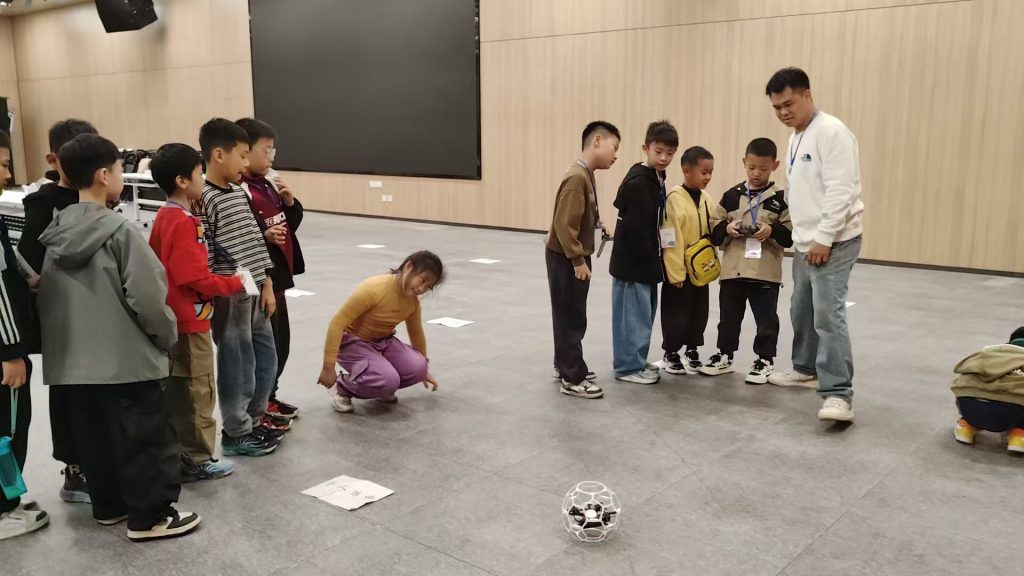
Structured Phases of Operational Fire Rescue Drone Training
A comprehensive drone training program for fire rescue must progress from foundational vehicle control to advanced mission application. The following phased approach ensures competency is built systematically.
Phase 1: Core Vehicle Proficiency and Basic Flight Regimes
This phase focuses on mastering the drone as a physical platform, ensuring the operator can reliably and safely control its basic movements in a controlled environment.
1.1 Pre-Flight Checks and Launch/Recovery Procedures: Consistent habit patterns are critical for safety. Drone training must ingrain a mandatory pre-flight checklist covering:
- Aircraft Inspection: Airframe integrity, propeller condition, battery charge level and secure installation, payload (camera, sensor, speaker) attachment and functionality.
- Control System Check: Remote controller battery, control stick responsiveness, link establishment between controller and aircraft, signal strength.
- Software & Environment: Verification of latest firmware, GPS signal strength, compass calibration, assessment of flight zone for obstacles, personnel, and airspace restrictions. Setting appropriate maximum altitude and distance limits, and crucially, verifying the automated Return-to-Home (RTH) altitude is set above all local obstacles.
Launch and recovery drills involve smoothly lifting off to a low hover (2-5 meters), conducting a final stability check via the telemetry data, and then executing a controlled, vertical descent to a precise landing point, always maintaining orientation.
1.2 Stability and Orientation Control – The Hover Matrix: The cornerstone of manual flight proficiency is the ability to hold a precise position in space while managing the aircraft’s orientation (heading). A fundamental drone training exercise is the “hover matrix.”
The operator launches and maneuvers the drone to a reference point (e.g., over a marked ground target). The training involves holding a stable hover at that point while sequentially rotating the aircraft to specific headings, typically in 90-degree increments (0° or “nose-in”, 90°, 180° or “tail-in”, 270°). At each heading, the operator must maintain position for a sustained period (e.g., 30 seconds), counteracting wind drift. The control inputs required to correct position are reversed when the drone is facing the operator versus facing away, demanding deep spatial reasoning. The exercise culminates in performing slow, continuous 360-degree rotations (both clockwise and counter-clockwise) while keeping the drone pinned over the target point, a task that requires constant, anticipatory control input. The skill acquired here is summarized by the requirement for continuous error correction:
$$ \text{Control Input}(t) = -k_p \cdot \text{Position Error}(t) – k_d \cdot \frac{d(\text{Position Error})}{dt} $$
Where $k_p$ and $k_d$ are the operator’s instinctively learned proportional and derivative gain factors, adjusted for the drone’s orientation.
1.3 Basic Navigational Flight Patterns: With stable hover achieved, drone training introduces controlled movement along defined paths.
- Pattern Flying (Figure-8s): Flying a drone in a smooth, consistent figure-8 pattern around two ground markers teaches coordinated use of pitch, roll, and yaw. The aircraft must maintain a constant altitude and distance from the course while turning. This develops an intuitive feel for the drone’s turning radius and energy management.
- Beyond Visual Line of Sight (BVLOS) Simulation: While strict BVLOS regulations may apply, training for degraded visual conditions is vital. An exercise involves flying the drone to a designated object 100-200 meters away, using the first-person-view (FPV) video feed and map display for navigation. The operator then must command the drone to return using only the map navigation interface, switching back to the camera view only for final approach and landing. This builds trust in instrumentation and automated systems.
Phase 2: Mission-Specific Application Training
This phase transitions from platform control to sensor employment and tactical decision-making, aligning drone training directly with operational objectives.
2.1 Systematic Reconnaissance and Search: The primary mission is information gathering. Drone training for reconnaissance focuses on methodical sensor employment.
- Camera Gimbal Operation: Mastering smooth pan, tilt, and zoom control to track subjects or scan areas without jarring movements that disorient ground personnel viewing the feed.
- Search Pattern Execution: Flying pre-planned, efficient patterns to ensure area coverage. Common patterns include the expanding square search, parallel track search, and sector search. The optimal pattern is a function of the Priority Search Area (PSA) and the sensor’s field of view (FOV). For a parallel track search, the track spacing $S$ should be less than the effective sensor sweep width $W$ to ensure overlap and complete coverage:
$$ S \leq W = 2 \cdot R \cdot \tan\left(\frac{\text{FOV}}{2}\right) $$
where $R$ is the operational altitude/range. Training involves executing these patterns at various altitudes and speeds while maintaining consistent image quality.
2.2 Mapping, Modeling, and Measurement: Drones are powerful tools for creating actionable geospatial intelligence. This segment of drone training covers photogrammetry.
- Data Capture for 2D Orthomosaics & 3D Models: Trainees learn to plan and fly automated grid missions with sufficient frontal and side overlap (typically 70-80%). The required ground sampling distance (GSD) dictates flight altitude. The relationship is:
$$ \text{GSD} = \frac{\text{Sensor Width (mm)} \times \text{Flight Height (m)}}{\text{Focal Length (mm)} \times \text{Image Width (pixels)}} $$
Operators practice setting these parameters in mission planning software for different scenarios: a structural collapse (for detailed 3D modeling), a wildfire perimeter (for rapid 2D mapping), or a flood zone (for pre/post-event comparison).
- Data Processing and Analysis: Basic training in using software to process captured images into maps/models, and then to perform measurements (distance, area, volume) and annotations (marking hazards, entry points, staging areas) for the incident action plan.
2.3 Specialized Operational Scenarios: Drone training must be contextualized for major hazard types. Scenario-based training (SBT) is key here.
- Structural Fire: Training focuses on safe stand-off distances, thermal imaging interpretation to identify fire spread within voids or hotspots, and creating 3D models for pre-planning or post-incident analysis.
- Wildland Fire: Emphasis is on long-endurance flight planning, mapping fire fronts using GPS, identifying spot fires, and assessing fuel types and topography.
- Hazardous Materials (HazMat): Training covers using drones to visually and spectroscopically assess a scene from a safe distance, potentially identifying placards or leaks, without exposing personnel.
- Search and Rescue (SAR): Combines systematic search patterns, thermal imaging for body heat detection (which is influenced by environmental factors $\Delta T$), and possibly payload delivery.
- Water Rescue & Flood: Training for operations over water, managing downdraft effects, and precision dropping of flotation devices. A simplified model for drop accuracy must account for drone altitude $h$, forward speed $v$, and payload drag.
The following table outlines the focal points of drone training across different emergency scenarios:
| Emergency Scenario | Primary Drone Training Objectives | Key Metrics/Skills |
|---|---|---|
| Structural Fire | Thermal assessment, structural integrity visualization, scene size-up, 3D modeling for tactical planning. | Thermal palette interpretation, safe stand-off distance, gimbal control for detailed inspection, photogrammetry overlap settings. |
| Wildland Fire | Perimeter mapping, hotspot detection, progress monitoring, terrain analysis. | Long-range BVLOS procedures, endurance management, geotagging accuracy, rapid 2D map generation. |
| HazMat Incident | Remote visual/spectral assessment, plume tracking, scene recon without exposure. | Sensor selection (RGB, thermal, multispectral), maintaining exclusion zone, data linking for expert analysis. |
| Urban Search & Rescue (USAR) | Victim location in rubble, structural mapping, void identification. | Search pattern efficiency, thermal imaging in cluttered environments, 3D model analysis for void spaces. |
| Flood/Water Rescue | Area assessment, victim location, life-preserver delivery, levee inspection. | Operations over water, wind compensation for precision drops, understanding water current effects on drift. |
Phase 3: Advanced Integration and Sustainment
3.1 Crew Resource Management (CRM) for Drone Teams: As operations scale, drone training must expand beyond the single pilot. CRM principles are adapted for drone crews, which may consist of:
- Pilot-in-Command (PIC): Responsible for safe flight operations.
- Sensor/Payload Operator: Manages the camera, thermal imager, or other mission equipment.
- Mission Coordinator/Observer: Maintains situational awareness, communicates with incident command, scans for air traffic and ground hazards.
Training focuses on clear communication protocols, task delegation, and collective decision-making under stress.
3.2 Maintenance, Logistics, and Data Management: Proficiency extends to maintenance. A basic reliability model for system readiness can be considered:
$$ R(t) = e^{-\lambda_m t} $$
Where $R(t)$ is the probability the system is operational at time $t$, and $\lambda_m$ is the failure rate. Proper maintenance reduces $\lambda_m$. Drone training includes battery cycle management, firmware updates, post-flight inspection, and basic troubleshooting. Training also covers data handling protocols: secure storage, chain of custody for evidentiary footage, and rapid dissemination of intelligence products to command.
Assessment and Standardization of Drone Training
To ensure quality and interoperability, a standardized assessment framework is needed. Competency should be measured against objective criteria for each training phase. A proposed assessment matrix includes both quantitative and qualitative measures:
| Skill Category | Evaluation Metric | Performance Standard (Example) |
|---|---|---|
| Basic Flight Proficiency | Hover stability error (meters from target). Figure-8 course completion time & deviation. | Maintain position within 1m radius for 60s at all headings. Complete figure-8 within 120s, no greater than 2m deviation from path. |
| Reconnaissance | Time to locate specific targets in a search area. Quality of camera work (smoothness, framing). | Locate 5 of 5 hidden targets in a 100m x 100m area within 10 minutes using systematic pattern. Video feed is stable and methodical. |
| Mapping & Modeling | Accuracy of generated model vs. ground truth. Completeness of map coverage. | 3D model measurements within 2% of actual dimensions. Orthomosaic has no gaps or blurring from insufficient overlap. |
| Scenario Execution | Adherence to incident command protocols. Appropriateness of chosen flight pattern/sensor for the given scenario. | Provides clear, concise radio reports. Selects and executes a parallel track search for a missing person in a field. |
Furthermore, the effectiveness of a drone training program itself can be evaluated by the improvement in operational outcomes. A simple metric could be the reduction in time to key intelligence milestones from incident onset, or the increase in successful mission tasks per deployment.
Future Trajectories and Technological Synergy
The future of emergency response drone training will be shaped by technological convergence. Key areas include:
- Artificial Intelligence (AI) and Machine Learning (ML): AI-assisted flight for obstacle avoidance in complex environments, and automated image analysis to flag potential victims, fire spread, or structural defects in real-time. Drone training will evolve to include supervising and interpreting AI-generated alerts.
- Advanced Simulation and Digital Twins: High-fidelity simulators that replicate specific urban canyons, forest types, or weather conditions will allow for risk-free, repetitive drone training in scenarios too dangerous or costly for live flights. Trainees could practice responding to a simulated chemical plant fire or a night-time mountain rescue countless times.
- Swarm Operations: The coordinated use of multiple drones for wide-area coverage or complex tasks. Future drone training curricula will need to incorporate principles of multi-agent coordination, networked communications, and swarm tactics.
- Enhanced Sensor Fusion: Training operators to synthesize data from LiDAR, multispectral imaging, methane detectors, and thermal sensors into a single, coherent operational picture.
The imperative for a robust, standardized, and continuously evolving drone training ecosystem is undeniable. As drone technology advances, so too must the investment in the human element—the operators who translate technological potential into lifesaving action. By adopting a structured, theory-informed, and scenario-based approach to training, emergency services can ensure their drone programs are not merely equipped with advanced tools, but are crewed by true masters of the skies, capable of delivering decisive advantage in the most challenging circumstances. The ultimate measure of successful drone training is a seamless, reliable, and intelligent aerial capability that is fully integrated into the incident command decision-cycle, enhancing both responder safety and community resilience.