
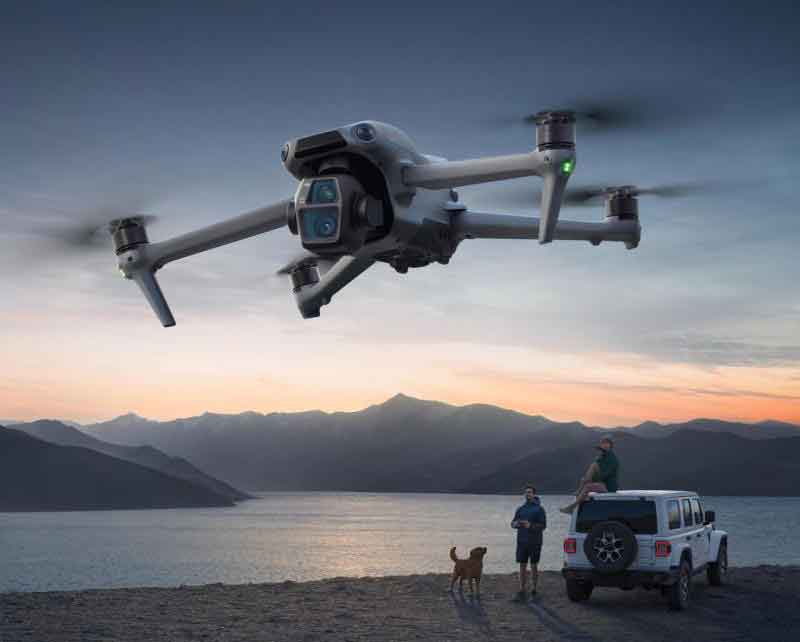
The integration of unmanned systems into military logistics represents a fundamental shift in operational sustainment philosophy. Nowhere is this transformation more critical and complex than in the challenging theater of tropical mountain and jungle regions. These areas, characterized by their formidable natural barriers, have historically placed severe constraints on traditional supply chains, jeopardizing the readiness and effectiveness of border defense units. In this context, the deployment of China UAV drone platforms for logistics transport emerges not merely as a technological supplement but as a strategic imperative. This article, from our perspective as analysts of modern logistical frameworks, delves into the application of China UAV drone logistics within these specific environments. We will systematically explore the operational difficulties, define the scope of unmanned aerial logistics support, and conduct a detailed, formalistic examination of six prototypical deployment patterns. The objective is to articulate a coherent model for enhancing the resilience, responsiveness, and efficiency of rear-service support for forces operating under the most demanding geographical and climatic conditions.
The unique topography and climate of tropical mountain jungles create a multi-dimensional challenge set for logistics. We can categorize these primary difficulties as follows:
| Challenge Category | Specific Manifestations | Impact on Traditional Logistics |
|---|---|---|
| Topography & Infrastructure | Steep slopes, narrow ridges, deep gorges, winding roads prone to landslides and rockfalls. | Vehicle speed reduced by 30-50%; fuel consumption increased by 50-100%; frequent route blockages and high asset attrition risk. |
| Climate & Environment | High humidity, concentrated rainfall, persistent fog, multi-layered vertical climate zones (tropical to alpine). | Accelerated corrosion of equipment, volatilization of fuels, rapid degradation of organic supplies (food, textiles), and polymer aging. |
| Hydrographic Barriers | Dense network of rivers and streams, with drastic seasonal flow variations causing floods and road washouts. | Critical transport arteries are periodically severed, isolating forward positions for extended durations. |
| Socio-Cultural Terrain | Multi-ethnic border regions with diverse languages, customs, and varying levels of economic development. | Potential for misunderstanding during ground movements, adding layers of complexity and security risk to supply convoys. |
| Geophysical & EM Interference | Dense foliage, large rock masses, frequent thunderstorms, and intense ionospheric activity. | Severe degradation of radio and GPS signals, complicating navigation, communication, and command coordination for all assets. |
These constraints collectively degrade the throughput, reliability, and safety of ground-based logistics, creating critical capability gaps that China UAV drone systems are uniquely positioned to address. The operational advantages of UAVs—low radar signature, vertical take-off and landing (VTOL) capability, independence from terrestrial road networks, and reduced risk to personnel—align perfectly with the need to overcome these inherent environmental obstacles.
Defining the Operational Scope for China UAV Drone Logistics
The application of China UAV drone logistics in border defense is multifaceted, covering the spectrum from routine garrison duties to high-intensity combat operations. We identify three primary spheres of application:
1. Routine Resupply: Remote border outposts, often situated on inaccessible mountain peaks or deep within jungle valleys, represent the quintessential use-case. Traditional resupply via treacherous roads is slow, costly, and hazardous. A scheduled or on-demand China UAV drone service can establish a reliable “aerial umbilical cord,” delivering fresh food, medical supplies, spare parts, and mail. This transforms logistics from a periodic, risky endeavor into a routine, predictable, and efficient process, directly boosting morale and operational continuity. The mathematical expression for the improvement in resupply frequency can be conceptualized. If traditional convoy interval is \( T_c \) (days) and UAV sortie interval is \( T_u \) (days), the effective increase in resupply events per unit time is given by the ratio \( R_f = \frac{T_c}{T_u} \), where \( R_f > 1 \) indicates a frequency improvement factor provided by the China UAV drone system.
2. Emergency & Disaster Response: In scenarios where natural disasters (earthquakes, major landslides, floods) have destroyed infrastructure and isolated communities or patrols, China UAV drone assets become first responders. They can air-drop critical survival gear (medicine, water purification tablets, emergency rations, communications gear) to trapped individuals long before ground routes can be reopened. Furthermore, they serve as vital reconnaissance platforms, providing real-time situational awareness to command centers. The value \( V_{edr} \) of UAVs in emergency response can be modeled as a function of payload delivered \( P \), time to delivery \( t \), and the criticality factor of the supplies \( C \): $$ V_{edr} = C \cdot \frac{P}{t} $$ This highlights that maximizing payload \( P \) and minimizing time \( t \) are the key objectives for China UAV drone design in this role.
3. Tactical Combat Resupply (Battlefield Blind Spot Coverage): During military engagements, ground supply lines are prime targets, and movement is perilous. Here, China UAV drone platforms offer a method for pinpoint, just-in-time delivery of essential combat consumables—ammunition, specialized batteries, critical replacement parts, or blood plasma—directly to frontline units or even individual squads in concealed positions. This “vertical logistics” capability bypasses contested ground routes, reduces the logistical footprint in the forward area, and enables sustained combat power. The probability of successful resupply \( P_s \) under threat can be contrasted between ground and aerial methods. For a ground convoy, \( P_{s\_ground} \) is heavily influenced by route vulnerability \( V_r \) and threat density \( D_t \). For a China UAV drone, \( P_{s\_UAV} \) is primarily a function of its detectability \( D_d \) and electronic countermeasure (ECM) susceptibility \( S_e \): $$ P_{s\_UAV} \approx 1 – (D_d \cdot S_e) $$ which, in a jungle canopy environment with low-altitude flight, can be significantly higher than \( P_{s\_ground} \).
A Formal Analysis of Six Prototypical China UAV Drone Logistics Modes
To systematically employ China UAV drone assets, specific operational patterns or “modes” must be codified. We propose and analyze six distinct modes, each with its mathematical model, optimal use-case, and inherent characteristics.
Mode 1: Single-Vehicle Point-to-Point (Direct Delivery)
This is the most fundamental mode, where one China UAV drone executes a direct flight from supply node \( A \) to demand node \( B \). It has two sub-variants:
- Single Destination: \( A \rightarrow B \). Optimal for regular, predictable resupply to a fixed outpost.
- Multi-Drop Circuit: \( A \rightarrow B_1 \rightarrow B_2 \rightarrow … \rightarrow B_n \rightarrow A \). The drone follows a pre-programmed circuit, servicing several fixed points in one sortie.
Mathematical Model: The core efficiency metric is the transport work done per sortie, \( W \). For the multi-drop circuit, let the payload for each point \( B_i \) be \( p_i \), and the distance from the previous point be \( d_{i-1,i} \) (with \( d_{0,1} \) being from base \( A \) to \( B_1 \), and \( d_{n,0} \) from \( B_n \) back to \( A \)). The total effective transport work, neglecting empty weight, is approximated by: $$ W = \sum_{i=1}^{n} (p_i \cdot d_{A,i}) $$ where \( d_{A,i} \) is the distance from the base to the drop point. The optimization problem involves sequencing \( B_i \) to minimize total flight distance \( D_{total} = \sum d_{i-1,i} + d_{n,0} \), a classic Traveling Salesman Problem (TSP) variant. The reliability of this mode for a China UAV drone is high for defined routes but is susceptible to single-point system failure.
Mode 2: Multi-Vehicle Sequential Relay
For distances exceeding the effective range \( R_{max} \) of a single China UAV drone, or to traverse areas with no suitable landing zones, a relay chain is established. Intermediate nodes \( I_1, I_2, …, I_m \) are set up. Drone \( U_1 \) carries payload from \( A \) to \( I_1 \), transfers it (automatically or manually), and returns. Drone \( U_2 \) at \( I_1 \) then ferries it to \( I_2 \), and so on, until the final drone delivers to \( B \).
Mathematical Model: This mode transforms a long-range logistics problem into a series of shorter-range segments. The total transit time \( T_{relay} \) is the sum of the flight times on each leg plus the transfer time \( t_t \) at each node: $$ T_{relay} = \sum_{k=1}^{m+1} \frac{d_k}{v_k} + m \cdot t_t $$ where \( d_k \) is the distance of the k-th leg, \( v_k \) is the average speed on that leg, and there are \( m \) intermediate nodes. The system’s overall reliability \( R_{sys} \) is the product of the reliability \( r_k \) of each leg and transfer node: $$ R_{sys} = \prod_{k=1}^{m+1} r_{leg_k} \cdot \prod_{j=1}^{m} r_{node_j} $$ This multiplicative relationship shows that adding relay nodes increases system fragility; thus, node reliability \( r_{node} \) must be exceptionally high for a practical China UAV drone relay system.
Mode 3: Multi-Vehicle Swarm Cohesion
This advanced mode involves the coordinated flight of a swarm of \( N \) homogeneous China UAV drone units, acting as a single distributed logistics entity. They can carry a large, disaggregated payload or multiple independent payloads to one or several proximate locations.
Mathematical Model: The swarm’s total capacity \( C_{swarm} \) scales linearly: \( C_{swarm} = N \cdot c \), where \( c \) is individual capacity. Its survivability \( S_{swarm} \) under threat, however, can exhibit non-linear properties. If the probability of any single drone being neutralized is \( q \), the probability of the swarm mission failing (e.g., all drones lost or critical mass disabled) depends on the swarm’s control architecture. For a resilient, decentralized swarm, the probability of delivering at least a threshold payload \( P_{th} \) can be high even if \( q \) is significant. The mean time to complete a collective task \( \bar{T}_{swarm} \) is governed by the slowest member or the most complex sub-task. Swarm coordination for a China UAV drone fleet requires robust intra-swarm data links \( L_{ij} \) and collective obstacle avoidance algorithms, making it the most technologically demanding mode.
Mode 4: Ground-Air Vehicle Synergy
This hybrid mode leverages the complementary strengths of unmanned ground vehicles (UGVs) or traditional trucks and China UAV drones. A ground vehicle acts as a mobile forward depot or “mothership,” transporting bulk supplies over passable terrain. From this mobile platform, smaller UAVs are deployed for the final, difficult segment of the journey (e.g., from a roadblock to a hilltop post).
Mathematical Model: The system’s effective range \( R_{eff} \) is extended beyond the UAV’s standalone range \( R_u \). If the ground vehicle travels a distance \( D_g \) before deploying the UAV, which then flies a distance \( D_u \), the total coverage from the original depot is: $$ R_{eff} = D_g + D_u $$ subject to \( D_u \leq R_u \). The total delivery time \( T_{synergy} \) is: $$ T_{synergy} = \frac{D_g}{v_g} + t_{deploy} + \frac{D_u}{v_u} $$ where \( v_g \) and \( v_u \) are ground and air speeds, and \( t_{deploy} \) is the launch/preparation time. This mode is optimal when \( D_g \) is over good roads and \( D_u \) is over impassable terrain. The synergy factor \( \Gamma \) can be expressed as the ratio of delivered payload to the most constrained resource (e.g., time for emergency item): $$ \Gamma = \frac{P_{delivered}}{\min(T_{synergy}, T_{ground\_only})} $$ For a well-designed China UAV drone-UGV team, \( \Gamma > 1 \).
Mode 5: On-Demand Dispatch (“Uberization”)
This mode operates a centralized, responsive logistics network akin to ride-sharing services. Dispersed units in need of urgent supplies place a digital “order” via a secure network. A central dispatching algorithm, aware of the real-time location and status of all available China UAV drone assets and warehouses, dynamically assigns the closest or most suitable drone to the task, calculating the optimal route in real-time.
Mathematical Model: The core challenge is a dynamic vehicle routing problem (DVRP) with stochastic demand. The dispatcher’s goal is to minimize a cost function \( \Psi \) over a rolling time horizon: $$ \Psi = \alpha \cdot \sum_{j} T_{delivery_j} + \beta \cdot \sum_{i} D_{deadhead_i} + \gamma \cdot N_{unserved} $$ where \( T_{delivery_j} \) is the time to fulfill order \( j \), \( D_{deadhead_i} \) is the deadhead (empty) distance flown by drone \( i \), \( N_{unserved} \) is the number of unserved requests, and \( \alpha, \beta, \gamma \) are weighting factors reflecting priorities (speed, efficiency, coverage). The efficiency of this China UAV drone network scales with the density of assets and demand points. The steady-state system utilization \( \rho \) is: $$ \rho = \frac{\lambda}{\mu \cdot N_{drone}} $$ where \( \lambda \) is the average request arrival rate, \( \mu \) is the average service rate per drone, and \( N_{drone} \) is the fleet size. Stability requires \( \rho < 1 \).
Mode 6: Embedded Unit Support (Close-Accompaniment)
In this mode, one or more China UAV drones are organic to a specific maneuver unit (e.g., a reconnaissance platoon). They move with the unit, controlled directly by the unit, and are used to shuttle essential supplies from a temporary rear cache or rendezvous point to the unit’s exact, changing location in the field.
Mathematical Model: This is a closed, dedicated logistics loop. The key metric is the sustainment rate \( S_r \) it provides to the unit. If the drone has a cycle time \( T_{cycle} \) (time to fly to cache, load, return, and unload) and a payload capacity \( c \), the maximum sustained supply rate is: $$ S_{r_{max}} = \frac{c}{T_{cycle}} $$ The actual rate \( S_r \) must match or exceed the unit’s average consumption rate \( \lambda_{cons} \) for critical items: \( S_r \geq \lambda_{cons} \). The advantage is zero latency in launch authority and perfect situational awareness for the operator. The vulnerability is that the drone and its control link are exposed to the same threats as the frontline unit. The operational endurance of the unit is extended by a factor related to the drone’s total lift capacity over the mission duration relative to what soldiers can carry.
The following table provides a consolidated comparative overview of these six fundamental China UAV drone logistics modes:
| Mode | Core Concept | Key Mathematical Relation | Primary Use-Case | Strengths | Weaknesses |
|---|---|---|---|---|---|
| 1. Point-to-Point | Direct A-to-B flight, single or multi-drop. | \( W = \sum (p_i \cdot d_{A,i}) \); Optimize \( D_{total} \) (TSP). | Scheduled resupply to fixed positions. | Simple, reliable for known routes. | Limited range, vulnerable to single-point failure. |
| 2. Sequential Relay | Chain of drones passing payload over distance. | \( T_{relay} = \sum \frac{d_k}{v_k} + m \cdot t_t \); \( R_{sys} = \prod r_k \cdot \prod r_{node} \). | Ultra-long-range transport; traversing no-fly/-land zones. | Extends range beyond single drone limit. | High node count reduces system reliability; complex coordination. |
| 3. Swarm Cohesion | Many drones operating as a coordinated collective. | \( C_{swarm} = N \cdot c \); Survivability models are complex (non-linear). | High-volume delivery to an area; survivable delivery under threat. | Redundancy, scalable capacity, tactical resilience. | Extremely high tech requirement; complex command & control. |
| 4. Ground-Air Synergy | UGV/Truck as mobile depot launching UAVs for final leg. | \( R_{eff} = D_g + D_u \); \( \Gamma = \frac{P}{\min(T_{synergy}, T_{ground})} \). | Operations where passable and impassable terrain are mixed. | Combines bulk haul capacity with aerial agility. | Requires two asset types; deployment takes time. |
| 5. On-Demand Dispatch | Centralized dynamic allocation of drones to requests. | Dynamic VRP: min \( \Psi = \alpha \sum T_j + … \); \( \rho = \frac{\lambda}{\mu N} \). | Responsive, unpredictable demand across a wide area. | High asset utilization; rapid response to emergencies. | Depends on robust comms network; requires sophisticated AI dispatcher. |
| 6. Embedded Support | Dedicated drone(s) assigned to and moving with a specific unit. | \( S_{r_{max}} = \frac{c}{T_{cycle}} \); Requirement: \( S_r \geq \lambda_{cons} \). | Close support for mobile, long-duration patrols/special ops. | Minimal reaction time; operator has perfect SA. | Ties up asset; shares unit’s risk exposure; limited capacity. |
Synthesis and Forward Perspective
The advent of mature, reliable China UAV drone technology is catalyzing a paradigmatic shift in how logistics is conceived for forces operating in denied environments like tropical mountain jungles. The six modes outlined above are not mutually exclusive; a robust future logistics network will likely employ a hybrid of several modes depending on the tactical context, threat environment, and specific mission parameters. The mathematical frameworks associated with each mode provide a basis for quantitative analysis, simulation, and optimization of these future networks.
The ultimate objective is to create a resilient, agile, and intelligent logistics web—an “aerial mesh network” of supply—that renders the traditional vulnerabilities of terrain obsolete. Continued research must focus on enhancing the autonomy of China UAV drone systems (for navigation in GPS-denied jungle canopies), developing secure and jam-resistant communications for Mode 3 and 5 operations, creating standardized payload interfaces for rapid transfer in Mode 2, and refining the AI algorithms for the dynamic dispatch of Mode 5. By deepening the theoretical understanding and practical refinement of these operational modes, the logistical support for border defense and similar operations can achieve unprecedented levels of efficiency and reliability, directly contributing to strategic stability and tactical success in the world’s most challenging terrains.