
In recent years, I have observed the rapid proliferation of civilian drones globally, which has sparked a series of legal challenges. As an enthusiast and researcher in this field, I find that the legal framework surrounding civilian drones remains underdeveloped, leading to significant gaps in addressing safety hazards and privacy concerns. The booming industry of civilian drones, while offering innovative applications, has exposed vulnerabilities that demand urgent attention. This article aims to explore these issues from my perspective, emphasizing the need for robust monitoring mechanisms and accountability systems. I will delve into the legal voids, safety risks, and privacy infringements associated with civilian drones, using tables and formulas to summarize key points, and ensure the frequent mention of “civilian drones” to highlight their centrality in this discourse.
The rise of civilian drones has been phenomenal. From aerial photography and news reporting to power line inspections and disaster relief, these unmanned aerial vehicles (UAVs) have permeated various sectors, showcasing a “full-domain development” trend. However, this accessibility—with costs ranging from a few thousand to tens of thousands of dollars—has transformed civilian drones from specialized tools into common gadgets for hobbyists. This democratization, though beneficial, has ushered in unforeseen legal complexities. In my view, the core problem lies in the absence of comprehensive regulations, which I term the “legal blank space” for civilian drones. This gap not only threatens public safety but also compromises individual privacy, necessitating a multi-faceted approach to governance.
First, let me address the legal voids. Currently, there is no authoritative technical quality standard for civilian drones in many jurisdictions, including my own country. This lack of standardization undermines performance guarantees and fosters a market where subpar products can thrive. Moreover, regulations are often ambiguous, leaving the industry without solid legal支撑. For instance, flight approvals for civilian drones are unclear, leading to widespread “black flights” (unauthorized operations). According to estimates, there are hundreds of enterprises and over ten thousand从业人员 involved in the civilian drone sector, yet without clear起飞审批, regulatory oversight remains fragmented. This regulatory ambiguity exacerbates safety and privacy issues, as I will elaborate later. To illustrate, consider the risk equation for civilian drones: $$R = P \times I$$ where \(R\) represents the overall risk, \(P\) is the probability of an incident (e.g., crash or privacy breach), and \(I\) is the impact severity. Without proper standards, both \(P\) and \(I\) increase, heightening \(R\).
To better understand the legal landscape, I have compiled a table comparing regulatory approaches across regions. This highlights the inconsistencies that contribute to the legal空白.
| Region | Regulatory Status for Civilian Drones | Key Gaps |
|---|---|---|
| United States | FAA Part 107 rules for commercial use, but hobbyist operations less strict. | Privacy regulations vary by state, leading to enforcement challenges. |
| European Union | EASA regulations under implementation, focusing on risk-based分类. | Harmonization across member states is slow, causing confusion. |
| China | Emerging rules like “Light and Small UAV Operation Regulations,” but limited scope. | Lack of technical standards and clear accountability mechanisms. |
| Global Trend | Increasing focus on geo-fencing and remote identification. | Adoption is uneven, and privacy protections are often inadequate. |
As shown, the regulatory patchwork for civilian drones creates uncertainties, underscoring the need for unified standards. In my analysis, this legal空白 stems from the rapid technological advancement outpacing lawmaking. Civilian drones, being relatively new, have not been fully integrated into existing aviation or privacy laws. For example, traditional aviation regulations assume piloted aircraft, but civilian drones operate differently—often at lower altitudes and with autonomous capabilities. This mismatch necessitates tailored legal frameworks. I propose that addressing these gaps requires a proactive stance, involving stakeholders from manufacturers to operators.
Moving to safety hazards, I believe that civilian drones pose significant risks due to their potential for crashes, fires, or operational errors. These incidents can harm property, personal safety, and even public security. From my research, the safety issues can be categorized into three layers: production, government oversight, and operator behavior. Each layer requires specific规范 mechanisms, coupled with责任追究 systems to ensure accountability when accidents occur.
Starting with production, manufacturers of civilian drones play a crucial role in safety. The quality and design of civilian drones directly influence their airworthiness. Manufacturers should prioritize robust production processes and integrate safety features such as collision avoidance systems,定位 equipment, and应急 mechanisms. In mathematical terms, the safety factor \(S\) of a civilian drone can be expressed as: $$S = \sum_{i=1}^{n} f_i \cdot w_i$$ where \(f_i\) represents individual safety features (e.g.,防撞系统, GPS accuracy), and \(w_i\) denotes their权重 based on importance. By optimizing this equation, manufacturers can enhance the overall safety of civilian drones. However, without mandated standards, compliance is voluntary, leading to variability. I advocate for government-imposed technical benchmarks to standardize \(S\) across the industry.
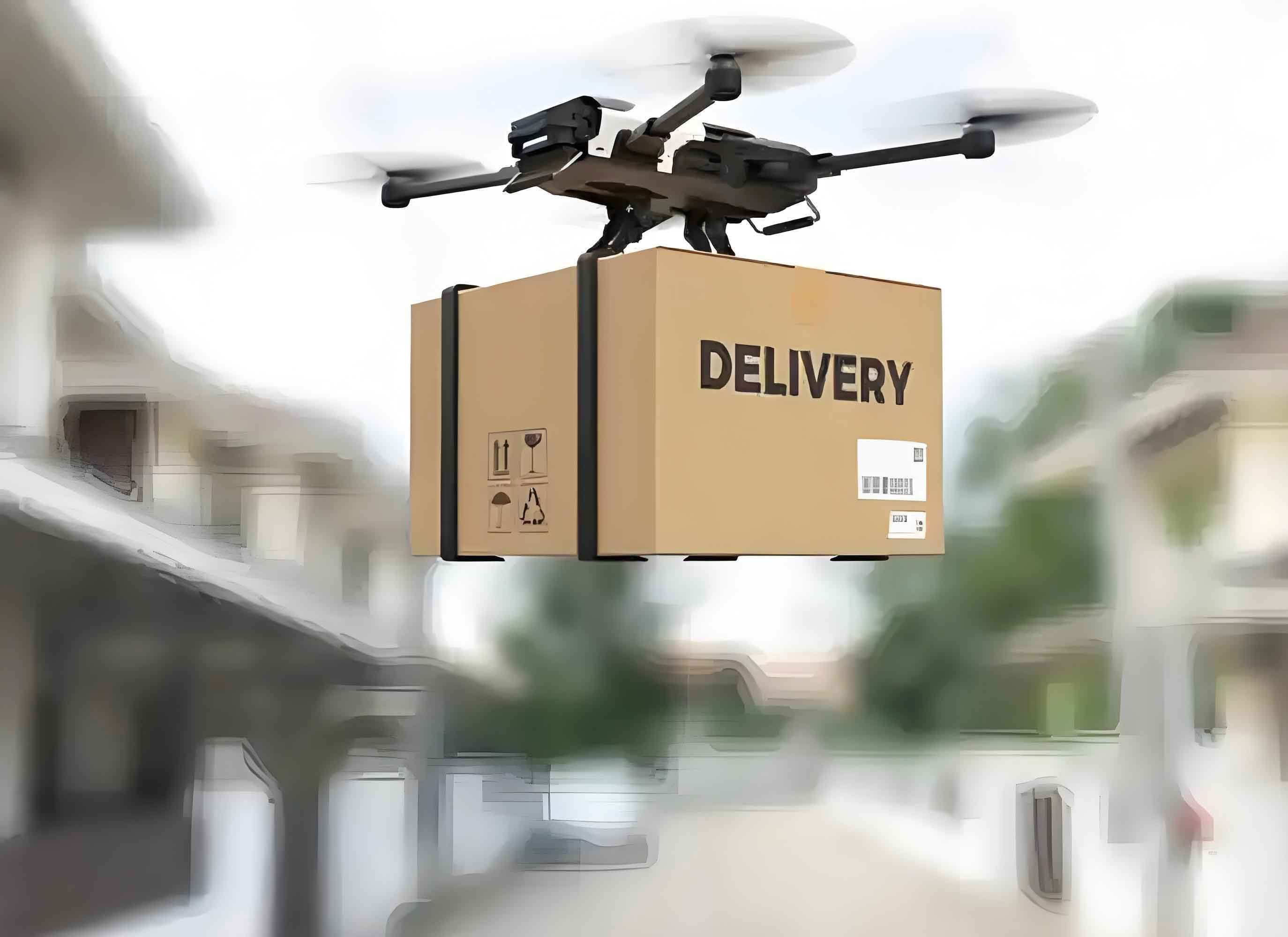
For instance, as seen in the image above, delivery drones represent a growing application of civilian drones. While promising, their operation in urban areas raises safety concerns like mid-air collisions or package drops. This visual underscores the need for stringent production standards to mitigate risks associated with civilian drones.
Next, government监管 is essential for overseeing civilian drones. Authorities should establish a multi-tiered market准入 system based on drone性质, such as weight, purpose, or飞行能力. This can be modeled using a classification matrix. Let \(C\) represent the classification criteria, where \(C = \{c_1, c_2, …, c_m\}\) includes factors like maximum altitude, payload, and autonomy level. Then, the准入门槛 \(T\) can be defined as: $$T = g(C, \alpha)$$ where \(g\) is a function determining eligibility, and \(\alpha\) represents regulatory thresholds (e.g., required certifications). Additionally, governments should mandate operator licensing,类似 to driver’s licenses for civilian drones. This would involve tests on飞行技能 and法规 knowledge, reducing “black flights.” Furthermore,空中交通 management for civilian drones is critical. By planning flight corridors and coordinating with other aircraft, authorities can minimize collision risks. I suggest using real-time monitoring systems, where the risk of incident \(R_{flight}\) during operation is given by: $$R_{flight} = \frac{N_{drones} \cdot t}{A_{airspace}} \cdot \epsilon$$ where \(N_{drones}\) is the number of civilian drones in airspace, \(t\) is time, \(A_{airspace}\) is the allocated area, and \(\epsilon\) is an error factor based on operator compliance. Regulating these variables through政策 can lower \(R_{flight}\).
From the operator perspective,规范 “驾驶资格” is key. Currently, purchasing a civilian drone has no restrictions, leading to unskilled users. I propose legal conditions for操作人员, such as minimum age, training hours, and proficiency assessments. This aligns with the equation for operator competence \(O\): $$O = \frac{H_{training} + K_{test}}{A_{experience}}$$ where \(H_{training}\) is hours of training, \(K_{test}\) is test score, and \(A_{experience}\) is a factor for prior experience. Setting a threshold for \(O\) (e.g., \(O \geq 0.7\)) would filter out incompetent users, enhancing safety for civilian drones. Moreover, implementing a registration mechanism for civilian drones—where each device is linked to an owner—can aid in post-accident accountability. This ties into the责任追究机制, which I will detail later.
To summarize safety measures, I have created a table outlining the three-layer approach for civilian drones.
| Layer | Key Measures for Civilian Drones | Expected Outcome |
|---|---|---|
| Production | Standardize technical quality; mandate safety features like防撞系统. | Reduced hardware failures and improved reliability of civilian drones. |
| Government Oversight | Establish market准入 and operator licensing; manage airspace. | Decreased “black flights” and better coordination for civilian drones. |
| Operator规范 | Require training and certification; enforce registration. | Higher skill levels and traceability of civilian drones. |
Now, let me discuss the责任追究机制 for safety incidents involving civilian drones. When accidents happen, assigning liability is challenging without clear laws. I recommend a framework where责任 is allocated based on negligence. For example, if a civilian drone crashes due to a manufacturing defect, the producer bears责任; if due to operator error, the user is accountable. This can be expressed legally as: $$L = \arg \max_{i \in \{M,G,O\}} N_i$$ where \(L\) is the liable party, \(M\) is manufacturer, \(G\) is government (if监管 failed), \(O\) is operator, and \(N_i\) is the degree of negligence. By defining negligence thresholds in regulations, such as compliance with standards for civilian drones, we can streamline责任追究. Additionally, insurance requirements for civilian drones can facilitate compensation, similar to car insurance. In my view, this mechanism must be integrated into national laws to address the high accident rates of civilian drones effectively.
Turning to privacy侵犯, civilian drones pose a significant threat to personal隐私权. Privacy, as I understand it, involves the right to seclusion and control over personal information. With civilian drones equipped with high-resolution cameras, they can intrude into private spaces like homes or offices, leading to unwarranted surveillance. This冲突 between civilian drones and privacy is escalating, as these devices can easily capture sensitive data. From my analysis, the privacy risks stem from the ability of civilian drones to operate discreetly at various altitudes, making traditional privacy safeguards obsolete. The privacy侵犯 probability \(P_p\) can be modeled as: $$P_p = \frac{A_{coverage} \cdot R_{resolution}}{D_{distance} \cdot P_{protection}}$$ where \(A_{coverage}\) is the area covered by the civilian drone’s camera, \(R_{resolution}\) is image clarity, \(D_{distance}\) is distance from the subject, and \(P_{protection}\) is existing privacy measures. As civilian drones improve in capability, \(P_p\) increases, highlighting the urgency for regulation.
To mitigate this, I advocate for restricting the飞行范围 of civilian drones. Governments should delineate no-fly zones over residential areas or sensitive locations, based on urban planning and public consent. This can be implemented using geo-fencing technology, where civilian drones are programmed to avoid certain coordinates. Mathematically, the allowed flight zone \(Z\) for a civilian drone can be defined as: $$Z = \{ (x,y) \in \mathbb{R}^2 | H_{min} \leq h \leq H_{max}, (x,y) \notin F \}$$ where \(h\) is altitude, \(H_{min}\) and \(H_{max}\) are legal limits, and \(F\) is the set of forbidden areas (e.g., near schools or government buildings). By enforcing such zones, we can reduce privacy intrusions by civilian drones. Moreover, public awareness campaigns about civilian drones and privacy can empower individuals to report violations.
Regarding责任追究 for privacy侵犯, current laws often fall short. For example, in some regions, regulations for civilian drones focus on safety but omit privacy clauses. When civilian drones infringe on privacy, it typically falls under civil law, such as侵权责任法. Victims can seek remedies like cessation of侵害, apologies, or damages. However, proving侵犯 can be difficult with civilian drones due to their transient nature. I suggest enhancing the登记管理 of civilian drones to link incidents to owners. Additionally, defining the边界 of privacy侵犯 is crucial. For instance, capturing images from public airspace might be legal, but zooming into private windows crosses the line. A legal test for civilian drones could be: $$\text{侵犯 occurred if } I_{private} \cap C_{drone} \neq \emptyset$$ where \(I_{private}\) is the individual’s reasonable expectation of privacy, and \(C_{drone}\) is the data collected by the civilian drone. Clarifying this in statutes would aid enforcement.
To encapsulate the privacy concerns, here is a table comparing privacy risks and solutions for civilian drones.
| Privacy Risk from Civilian Drones | Proposed Solution | Legal Basis |
|---|---|---|
| Unauthorized surveillance of homes | Establish no-fly zones and altitude limits for civilian drones. | Integrate into aviation regulations; amend privacy laws. |
| Data collection without consent | Require disclosure and consent mechanisms for civilian drones. | Apply data protection laws (e.g., GDPR for civilian drones). |
| Public dissemination of private footage | Impose penalties for sharing such data from civilian drones. | Use侵权责任法 or specific statutes for civilian drones. |
In conclusion, I firmly believe that the legal issues surrounding civilian drones require immediate attention. The法律空白 in this domain—spanning safety and privacy—can be addressed through a holistic approach. From my perspective, this involves setting technical standards for civilian drones, strengthening government监管, and educating operators. Moreover,责任追究 mechanisms must be clarified to hold parties accountable for incidents involving civilian drones. As civilian drones continue to evolve, so must our legal frameworks. I recommend international cooperation to harmonize regulations, ensuring that civilian drones can thrive safely and respectfully. By embracing innovation while safeguarding public interests, we can bridge the legal gaps and foster a sustainable future for civilian drones. Through continuous research and policy adaptation, the challenges posed by civilian drones can be transformed into opportunities for societal benefit.
To further illustrate the complexity, consider the overall regulatory effectiveness \(E\) for civilian drones, which can be approximated as: $$E = \frac{S_{safety} + P_{privacy}}{C_{cost}}$$ where \(S_{safety}\) is the safety score from implemented measures, \(P_{privacy}\) is the privacy protection level, and \(C_{cost}\) is the economic burden of compliance. By optimizing \(E\), policymakers can balance innovation and regulation for civilian drones. In my ongoing work, I explore these dynamics, emphasizing that civilian drones are not just gadgets but pivotal elements in modern law and technology intersections. As I delve deeper, I remain committed to advocating for robust legal structures that ensure civilian drones serve humanity without compromising our values.