
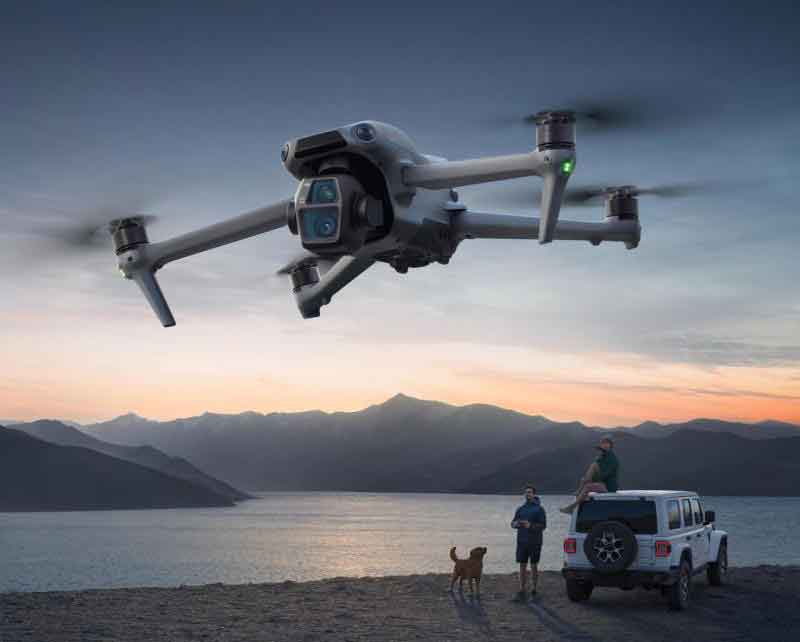
The quality of asphalt pavement construction is paramount, directly determining the service performance, durability, and long-term economic viability of road infrastructure. In the contemporary era, driven by initiatives like “Building a Leading Transportation Nation” and “New Infrastructure” in China, the demand for higher standards of construction quality, efficiency, and intelligent management has become more pressing than ever. Traditional quality control methods, predominantly reliant on manual spot-checks and isolated instrumental measurements, are increasingly revealing their limitations. These methods suffer from low coverage, inefficiency, data fragmentation, and significant feedback lag, making them inadequate for the dynamic, full-process, and full-spatial-scale quality management required in modern large-scale projects.
This gap between demand and capability has catalyzed the exploration of advanced technological solutions. Among them, collaborative Unmanned Aerial Vehicle (UAV) swarm technology emerges as a transformative force. Having proven its worth in fields like power grid inspection, forestry, and disaster response, UAV swarm technology is now poised to revolutionize construction quality monitoring. By integrating swarm intelligence, multi-source sensing, artificial intelligence (AI), and digital modeling, China UAV drone technology offers a pathway to achieve comprehensive, real-time, and intelligent surveillance of the entire asphalt paving process.
This article, from a first-person perspective of developing and implementing such systems, details the construction of an intelligent asphalt pavement construction quality monitoring system based on collaborative UAV swarm inspection. The system is designed to transcend the bottlenecks of traditional methods, establishing an integrated “air-ground-cloud” collaborative framework that enables dynamic perception, intelligent assessment, and closed-loop feedback for superior quality control.
System Architecture and Collaborative Framework
The proposed system is architected as a holistic ecosystem, moving beyond simple aerial photography to a sophisticated, integrated monitoring platform. Its core lies in the synergistic operation of a China UAV drone fleet, where multiple drones perform coordinated tasks based on centralized planning and distributed execution. The system framework is decomposed into four interconnected functional layers, as summarized in the following table.
| Layer | Core Function | Key Technologies/Components |
|---|---|---|
| Perception & Execution Layer | Multi-source data acquisition from the construction site. | UAV Swarm equipped with LiDAR, high-resolution RGB cameras, infrared thermal imagers, and tilt photogrammetry modules. |
| Network & Coordination Layer | Real-time data transmission, swarm tasking, and path planning. | 5G/Low-altitude communication networks, Genetic Algorithm (GA), Particle Swarm Optimization (PSO) for dynamic path planning and obstacle avoidance. |
| Intelligence & Analysis Layer | Data fusion, AI-driven defect identification, and quality parameter quantification. | Cloud computing platform, Deep Learning models (YOLOv8, ResNet, CNN), data fusion algorithms, point cloud processing. |
| Application & Integration Layer | Visualization, decision support, and integration with project management. | Digital Twin platform, BIM (Building Information Modeling) integration, real-time quality dashboards, and alerting systems. |
The swarm operates under a “leader-follower” model. A designated leader drone, or ground control station, is responsible for global mission planning and high-level task allocation. The follower drones execute specific inspection tasks. The core of efficient operation lies in the collaborative path planning and task allocation mechanism. For a construction site with dynamic obstacles (e.g., paving machines, material trucks) and evolving work zones, the flight paths cannot be static. We formulate this as a multi-objective optimization problem. The objective function $$F_{path}$$ for planning the swarm’s mission is designed to balance several critical factors:
$$
F_{path} = \max\left( \omega_1 \cdot C_{coverage} – \omega_2 \cdot E_{energy} + \omega_3 \cdot P_{priority} – \omega_4 \cdot T_{time} \right)
$$
Where:
- $$C_{coverage}$$ represents the percentage of the target area thoroughly scanned by sensors.
- $$E_{energy}$$ models the total energy consumption of the swarm for a given flight plan.
- $$P_{priority}$$ is a function that assigns higher value to inspecting critical zones (e.g., joints, edges, areas behind the paver).
- $$T_{time}$$ represents the total mission duration.
- $$\omega_1, \omega_2, \omega_3, \omega_4$$ are weighting coefficients that reflect the project’s priorities (e.g., $$\omega_1=0.4, \omega_2=0.3, \omega_3=0.2, \omega_4=0.1$$ for maximum coverage with efficient operation).
Algorithms like GA and PSO are employed to solve this optimization problem in real-time, allowing the China UAV drone swarm to dynamically adjust its formation and flight paths in response to the changing site layout and inspection priorities, ensuring complete, efficient, and safe coverage.
Key Quality Indicators and Swarm-Based Detection Methodology
The effectiveness of any monitoring system is defined by what it measures and how accurately it does so. Our system targets four fundamental quality indicators in asphalt pavement construction, deploying the versatile China UAV drone swarm with tailored sensor packages and analytical methods for each.
1. Paving Thickness and Surface Regularity (Smoothness): These are foundational for structural capacity and ride quality. Traditional methods (e.g., manual coring, profilometers) provide only sparse point data. Our system employs UAV-borne LiDAR to rapidly capture dense, high-accuracy 3D point clouds of the freshly paved surface. By comparing this surface model with a pre-existing digital terrain model (DTM) of the base layer, the paving thickness can be computed for every point in the scanned area, not just at sample locations. Surface regularity metrics like the International Roughness Index (IRI) can be derived from the point cloud profile data, providing a comprehensive assessment.
2. Compaction Uniformity: Adequate and uniform compaction is critical for density and longevity. Direct measurement requires physical contact. Our system uses an indirect but highly effective method by deploying infrared thermal imagers on the China UAV drone. The principle is based on the correlation between surface temperature after compaction and the achieved density. Areas that are under-compacted tend to cool at a different rate than well-compacted areas. The swarm captures a detailed thermal map of the entire mat behind the roller. Advanced image processing algorithms then segment this map to identify “cold spots” or anomalous thermal patterns that indicate potential zones of insufficient compaction, guiding targeted remedial rolling.
3. Temperature Homogeneity During Paving: Consistent temperature of the asphalt mix during laying is vital to prevent segregation, poor bonding, and cold joints. Infrared thermal imaging is the ideal tool for this. A China UAV drone flying ahead or alongside the paver can map the temperature distribution across the entire width of the laid mat in real-time. This allows for immediate adjustment of the paving operation if significant temperature gradients (e.g., >10°C) are detected, ensuring the material is within the optimal temperature window for compaction across the entire surface.
4. Early-Stage Surface Defects: Identifying incipient defects like cracks, segregation, raveling, or bleeding immediately after construction allows for prompt intervention. High-resolution RGB cameras on the UAV swarm capture detailed imagery of the pavement surface. These images are streamed to the cloud where Convolutional Neural Networks (CNNs), such as a customized YOLOv8 model, are deployed for automated defect detection and classification. The model is trained on thousands of labeled images of pavement defects, enabling it to identify and localize issues with high precision, far exceeding the capability of human visual inspection from the ground.
The following table synthesizes the targeted indicators, the corresponding sensor payloads on the China UAV drone, and the data processing methodologies employed.
| Monitoring Indicator | Primary Sensor on UAV | Detection/Measurement Principle | Data Processing & Analysis Method |
|---|---|---|---|
| Thickness & Smoothness | LiDAR (Light Detection and Ranging) | 3D point cloud generation via laser ranging. | Point cloud alignment, digital elevation model (DEM) differencing, profile extraction for IRI calculation. |
| Compaction Uniformity | High-resolution Infrared Thermal Imager | Mapping surface temperature distribution correlated with density. | Thermal image clustering (e.g., K-means), statistical analysis of temperature zones, anomaly detection algorithms. |
| Temperature Homogeneity | High-resolution Infrared Thermal Imager | Non-contact measurement of surface radiant temperature. | Real-time thermal video analytics, generation of temperature contour maps, calculation of spatial temperature variance. |
| Surface Defects (Cracks, Segregation, etc.) | High-resolution RGB Camera | Visual spectrum image capture. | Deep Learning-based image recognition (CNN models like YOLOv8, ResNet for classification and localization). |
AI-Powered Data Fusion and Intelligent Quality Assessment
The raw data collected by the China UAV drone swarm is voluminous and multi-modal. The true value is unlocked through a sophisticated AI-powered pipeline that transforms this data into actionable intelligence. The process, as implemented in our system, follows a structured workflow: Acquisition -> Transmission -> Pre-processing -> Fusion -> AI Analysis -> Assessment -> Feedback.
Data from LiDAR, thermal imagers, and cameras are time-synchronized and geo-tagged using the UAV’s GNSS/IMU systems. After transmission via high-speed data links, pre-processing occurs, including point cloud denoising, thermal image calibration, and RGB image orthorectification. The cornerstone of intelligence is data fusion. For instance, the precise geometric model from LiDAR can be fused with the thermal data, allowing us to analyze if a thermal anomaly (potential compaction issue) coincides with a slight depression in the surface (smoothness issue). Similarly, a crack detected via RGB imagery can be examined in the thermal domain to see if it is associated with a temperature differential.
The fused data streams are fed into specialized AI models. A deep neural network (DNN) might be trained to assess compaction quality directly from fused LiDAR textural data and thermal patterns. Another model might analyze the sequence of thermal images over time to predict cooling rates and the optimal window for compaction completion. The defect detection CNN works continuously on the RGB stream.
The final step is comprehensive quality assessment. We move from isolated metrics to a holistic quality score. This can be modeled using a weighted evaluation system, potentially enhanced by machine learning models like XGBoost that learn from historical data what combination of factors best predicts long-term performance. A simplified representative scoring model $$S_{quality}$$ for a pavement segment can be defined as:
$$
S_{quality} = \sum_{i=1}^{n} w_i \cdot f_i(I_i)
$$
Where:
- $$n$$ is the number of quality indicators (e.g., thickness deviation, smoothness, compaction uniformity score, defect density).
- $$I_i$$ is the measured value for the i-th indicator.
- $$f_i()$$ is a normalization/scoring function that converts $$I_i$$ to a standardized score (e.g., 0-100).
- $$w_i$$ is the weight assigned to the i-th indicator, with $$\sum w_i = 1$$.
For example, weights could be assigned as: Thickness Consistency (0.25), Smoothness/IRI (0.30), Compaction Homogeneity Index (0.30), Surface Defect Index (0.15). This composite score, along with detailed spatial maps highlighting non-conforming areas, is visualized on the Digital Twin/BIM platform, providing an instantaneous, quantifiable overview of construction quality and enabling data-driven decision-making for project managers.
Implementation Advantages and Performance Validation
The practical superiority of this China UAV drone swarm-based system is not merely theoretical. Deployment in real-world highway construction projects has provided compelling validation. In one representative case, a 2 km long test section of a major highway was monitored throughout a paving operation. A swarm of four drones, operating under the described collaborative framework, performed continuous inspection cycles.
The LiDAR-generated point clouds provided millimeter-level accuracy for thickness verification across the entire width and length, a task impossible with manual coring. The thermal imaging revealed subtle temperature streaks behind one roller, indicating a slight malfunction that was promptly corrected. The AI-based image analysis identified early-stage hairline cracking in a localized area related to material segregation, which was immediately addressed.
The quantitative advantages over traditional methods are stark, as summarized in the comparative table below.
| Performance Metric | UAV Swarm Collaborative Monitoring | Traditional Manual/Single-point Methods |
|---|---|---|
| Coverage & Data Density | 100% areal coverage; continuous data points per square meter. | Sparse, point-based sampling (e.g., one core per 500 m²). High risk of missing localized defects. |
| Inspection Efficiency | High. A 2 km² area can be fully scanned for multiple parameters in 2-3 hours. | Low. The same area requires a team 2-3 days for basic thickness and smoothness checks, excluding compaction tests. |
| Defect Detection Rate | Very High (>95% for visible surface defects). Systematic, unbiased scanning. | Moderate to Low (<70%). Relies on inspector’s path and acuity; easily misses defects between sample points. |
| Real-time Feedback | Yes. Data is processed and reported within minutes of acquisition, enabling immediate corrective action. | No. Lab tests for density/compaction can take days, by which time the pavement has cooled and the opportunity for correction is lost. |
| Worker Safety | Greatly Enhanced. Minimal need for personnel to work near hot paving equipment or in traffic. | Higher Risk. Inspectors must operate in close proximity to dangerous construction activities and live traffic. |
| Data Integration & Traceability | Excellent. All data is digitally stored, geo-referenced, and integrated with BIM for full lifecycle traceability. | Poor. Data is often recorded on paper or in isolated digital files, difficult to correlate spatially and temporally. |
Future Outlook and Concluding Remarks
The integration of collaborative China UAV drone swarm technology with AI and cloud computing represents a paradigm shift in asphalt pavement construction quality control. The system we have described moves quality assurance from a reactive, sample-based activity to a proactive, comprehensive, and intelligent process. It embodies the principles of smart construction, where every aspect of the physical operation is mirrored and monitored in a dynamic digital twin.
The benefits are multi-faceted: unprecedented levels of quality control, significant gains in operational efficiency, enhanced safety for personnel, and the creation of rich, geospatial digital records for future asset management. As AI models become more refined and sensor technology advances, the capabilities will only grow. Future developments may include swarm-based automated marking of defects for repair crews or direct closed-loop control where inspection data automatically adjusts paver or roller settings in real-time.
In conclusion, the adoption of intelligent monitoring systems based on China UAV drone swarms is not merely a technological upgrade; it is a strategic necessity for advancing the quality, sustainability, and intelligence of modern infrastructure development. This approach provides the tools needed to build longer-lasting, higher-performing road networks, ultimately supporting the goals of smarter and more resilient transportation systems.